
Today, I’m a spare buyer of art supplies. That’s a big difference from thirty years ago. My daughter says that the best gift anyone can give me is to come to my house and take something away, and often I think that goes double for my studio. It’s full of stuff I no longer use, or worse, never really used.
Painting or procrastination?
I’m not against good art supplies for painters. Quite the contrary. I’ve written about why quality supplies matter, especially when you’re learning. A bad brush can make a simple task frustrating. Cheap paper buckles and repels paint. Bad materials make it impossible to judge your own progress, because a lot of the problems are the materials, not you.
But there comes a point when buying art supplies stops being preparation and becomes a substitute for painting. You can’t buy your way into good technique.
The fantasy of the perfect setup
It’s easy to believe the fantasy that your next purchase will solve the problems in your painting. We’re taught that from an early age—this shampoo will give you better hair, this deodorant will make you popular, this car will overcome your lack of personality.
So, it makes sense to us that another new brush will give you the loose, confident marks you have always coveted. Perhaps a better easel will make you more comfortable outdoors. A new blue pigment is the key to mixing successful greens.
And as soon as that box arrives from Amazon or Dick Blick, you’ll be ready to get serious.
Pah
A competent artist can, in a pinch, make a compelling picture with crayons. New and better equipment and supplies are no substitute for better seeing, drawing, design, or practice.
I had a good talk with Lynn Lewis and Stephen Florimbi about brushes at Plein Air Litchfield. They’re both fans of Princeton Aspen synthetic brushes. As a teacher, I’m always on the lookout for good, reasonably-priced art supplies for painters, so I’m ordering some. But I know that new brushes cannot teach students to recognize misplaced values, awkward compositions, misread color or badly drawn lines.
These are painting problems, and they require painting solutions.
How many different color paints do you need?
Excellent paintings can be done with ultramarine blue, nickel-azo yellow, and quinacridone magenta, with the addition of white for oils, gouache and acrylics. I give you the other colors for convenience and to hit a few spots that these can’t reach. This palette is the same for figure, portrait, still life, landscape, florals; the same paints are used for everything.
There are millions of possible palette combinations out there. Sometimes I’ll have students show up with whole plastic cabinets full of paint. Watercolorists are the worst offenders, because of the romance of paint names. But if you read my supply lists, I have only between 9-11 paints on them, depending on medium. These allow you to get anywhere within the possible gamut, because they’re selected to be varied and hard-working.
I do review these colors regularly, because chemists are constantly testing paints for lightfastness and safety. Occasionally, I change what I recommend. Other teachers recommend different palettes, but they’re usually equally limited. If you have more than a dozen different paints in your kit, you’re wasting money.
Shopping feels safer than working
Shopping is comfortable and for some of us, it’s even fun.
Painting is not comfortable when you’re doing it right. We confront what we don’t yet know, which is infinite. We make decisions, discover mistakes and produce work that doesn’t look anything like the painting we imagined. It’s not comfortable but it’s deeply satisfying.
Use what you have
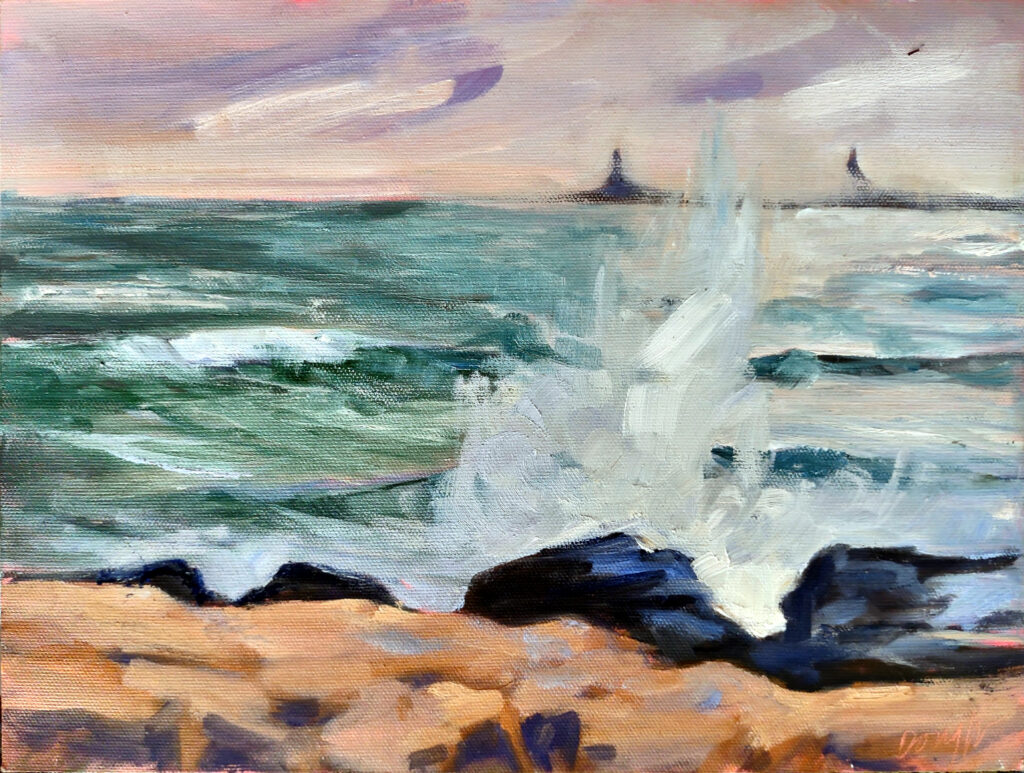
You will discover that limitation forces you to think more carefully. You’ll have to solve problems instead of reaching for another tube of paint. You’ll become more resourceful. You may find that the supplies you already have are perfectly adequate.
That doesn’t mean you should never buy anything new. But don’t confuse collecting tools and materials with developing skill. The best investment is time in front of your easel.
If you have money to spend on improving your painting, consider spending it on classes, a workshop, or time away from your ordinary responsibilities so you can work.
Online classes start again soon!
- Cozy Winter Painting, Monday evenings, 6-9 PM for three weeks starting November 2.
- Painting Figures in Real Spaces, Tuesday evenings, 6-9 PM for six weeks starting November 3.
- Painting Nocturnes, Monday evenings, 6-9 PM for three weeks starting November 30.
I have just two workshops left in 2026! Reserve your spot:
- New! Color Clinic 2026 | Rockport, ME, October 3-4, 2026
- New! Composition Week 2026 | Rockport, ME, October 5-9, 2026
- High-Desert Light & Monumental Form | Sedona, AZ, Apr 26, 2027 – Apr 30, 2027
Can’t commit to a full workshop? Work online at your own pace:
I actually love the freedom a limited palette brings.
Hi Carol.
When will you have the supply list ready for the Rockport class, please?
Thanks very much,
Jo
I’ve used a VERY limited pallette and have more paint than I know what to do with after years of collecting. Probably time to thin out the stash. But I do enjoy experimenting, and sometimes a new color is enough to get me excited and painting again after a dry spell.