There’s a difference between painting fast and phoning it in.
 |
|
Main Street, Owls Head, 16X20, oil on gessoboard, $1,623 unframed |
The hiker makes constant adjustments to his course, although he does most of them automatically. When sailing, the helmsman trims frequently to follow changes in the wind. On a zip line, a person makes one decision (to jump) and then hangs on for dear life. As our speed increases, our control decreases.
That’s as true for painting as anything else in modern life. It’s one reason why so much modern art has been about expression of a single idea or feeling, rather than craft. It’s a true representation, in tangible form, of the chaotic speed at which we hurtle through life.
 |
|
Apple Blossom Time, 9×12, oil on canvasboard, $696 unframed |
If that’s your schtick, there’s not much a traditional painting teacher can offer you. We’re no substitute for the creative genius that will motivate you to vomit pigment onto a canvas. What we teach is rather shopworn: a process by which you can transfer ideas onto canvas, using technique that’s more than a thousand years old. It’s not for the easily-bored, because it takes time to master. And even when it’s mastered, it takes time to execute properly.
That doesn’t mean that good paintings are necessarily slow paintings (or vice versa). “How can you finish a painting that fast?” is a question every plein air painter has heard many times. We’ve learned an efficient way of approaching the problem. If we deviate too far from it we get bogged down in the process of painting, at the expense of our personal vision.
 |
|
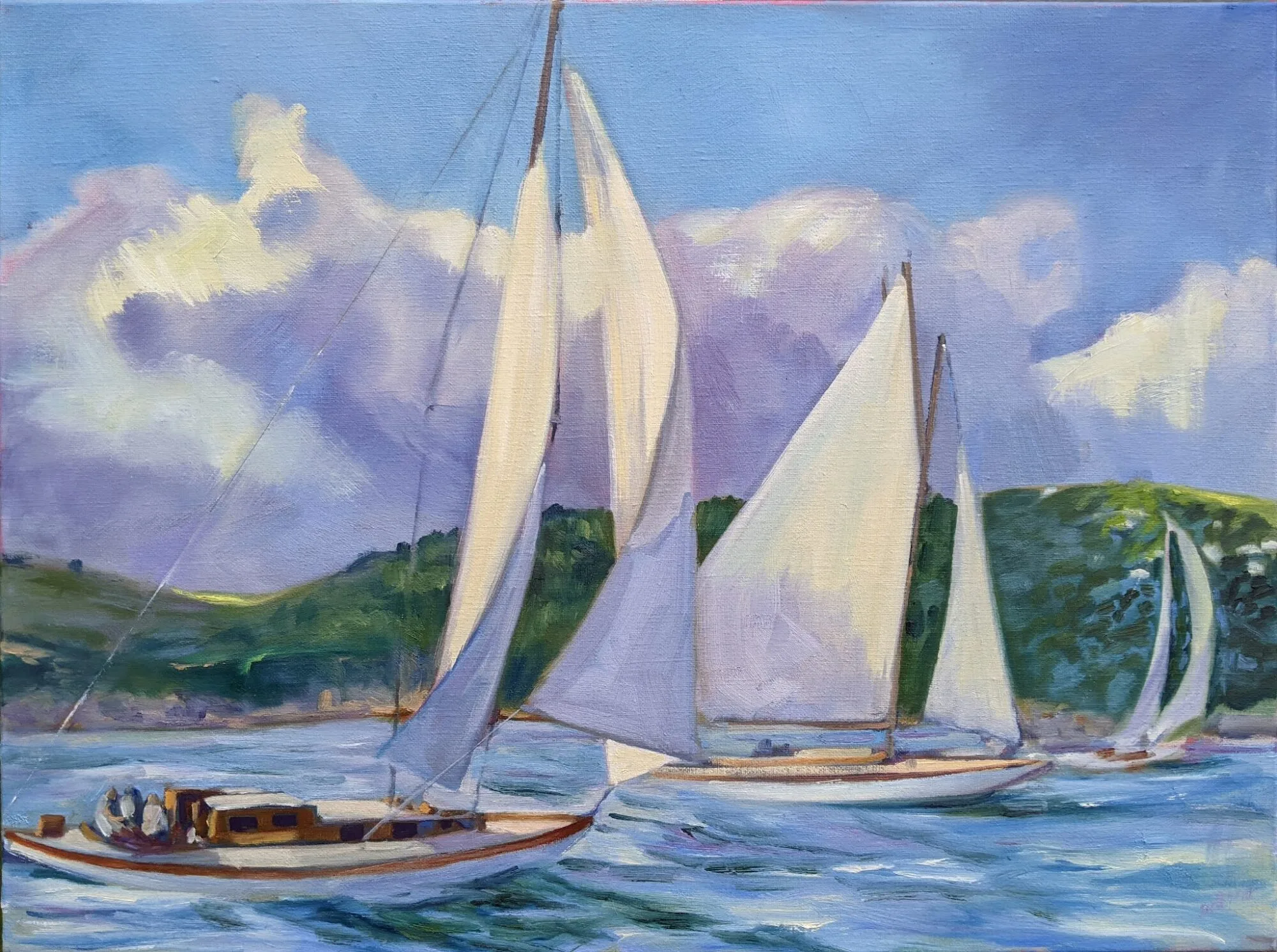
Autumn blues, 12X16, oil on canvasboard, $1449 framed |
When my advanced watercolor students have finished a long project, I’ll sometimes tell them, “Now, paint it again in ten minutes.” They’re often surprised that the second, fast painting is better than the one they spent so much time on. But that second painting didn’t take them ten minutes—it took them that plus all the time they spent on the first one. It’s just a second iteration of the same work.
There’s a difference between painting fast and phoning it in. It’s a difference of intention. I was dissing a well-known artist with an avid collector at a reception last week. “His new work has become…” He paused, unable to think of how to finish his sentence.
“A schtick?” I suggested.
His eyes widened. “I own one of his paintings from the ‘90s,” he protested, “and it’s really good.”
“That’s because he wasn’t copying himself yet,” I said.
 |
|
Fallow field, 12X16, oil on canvasboard, $1449 framed |
It happens to many excellent painters—they figure out a motif that sells, and produce a lot of it, and then suddenly, it’s ‘what they do.’ They’re no longer engaged on a deep level; they’re phoning it in, either out of laziness or fear of losing their audience.
Galleries don’t help, because they want painters to produce shows that are unified and coherent. There’s visual impact to twenty almost-identical paintings, especially if they lean heavily on graphic design. But that’s only true in the showroom; take one home and it loses that impact. Then it must stand or fall on its own merit.
That doesn’t mean that we artists don’t have one finger raised to the wind of painting fashion. Obviously we do, or we would still be painting like Mannerists. But within our time and place, we have great scope for personal creativity, exploration, and deep thinking. The artists with long-term staying power are those who never forget that.