Happy Easter!

Christ Appears to Mary Magdalene, 1511, from the Small Passion, Albrecht Dürer
Dürer, above, is illustrating the following passage from the Gospel of John:
But Mary stood weeping outside the tomb, and as she wept she stooped to look into the tomb. And she saw two angels in white, sitting where the body of Jesus had lain, one at the head and one at the feet. They said to her, “Woman, why are you weeping?”

She said to them, “They have taken away my Lord, and I do not know where they have laid him.” Having said this, she turned around and saw Jesus standing, but she did not know that it was Jesus. 

Jesus said to her, “Woman, why are you weeping? Whom are you seeking?” Supposing him to be the gardener, she said to him, “Sir, if you have carried him away, tell me where you have laid him, and I will take him away.”

Jesus said to her, “Mary.” 

She turned and said to him in Aramaic, “Rabboni!” (which means Teacher). 

Jesus said to her, “Do not cling to me, for I have not yet ascended to the Father; but go to my brothers and say to them, ‘I am ascending to my Father and your Father, to my God and your God.’” 

Mary Magdalene went and announced to the disciples, “I have seen the Lord”—and that he had said these things to her.
Happy Easter! We resume our regularly scheduled programming tomorrow.

Let me know if you’re interested in painting with me in Maine in 2014 or Rochester at any time. Click here for more information on my Maine workshops!

Dürer’s Small Passion

Small Passion: 23.Christ Being Nailed to the Cross, by Albrecht Dürer.
As noted yesterday, there are typically 14 Stations of the Cross in the modern church, and they have become formalized into a specific order (which tends to meander a bit from the Gospel texts). That was not always the case.
Albrecht Dürer produced three print cycles of the Passion. Two were in woodcut: the Large Passion containing twelve scenes, and the Small Passion containing 37 scenes. His engraved Passion contained 16 scenes.
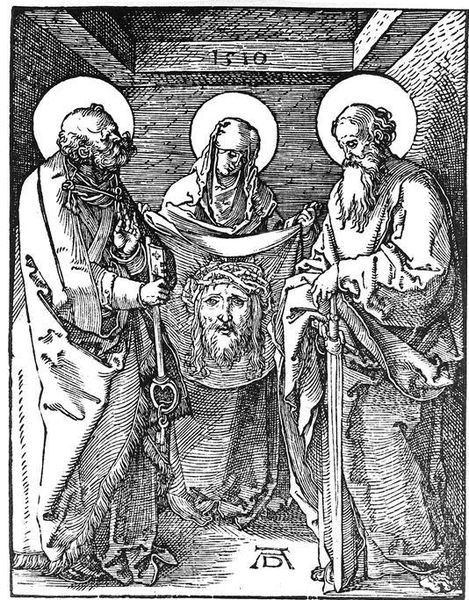
Small Passion: 22.The Sudarium of St Veronica, by Albrecht Dürer.
These were famous and popular works, distributed throughout Europe. Not only did they shape what the viewer expected in a Passion, they were widely copied by other artists, and by forgers as well.
The Small Passion starts with The Fall of Man and ends with The Last Judgment. The few plates that Dürer dated suggest that he started with Palm Sunday and moved forward in an historical way through Easter Week. As he was finishing, he added The Fall of ManThe Expulsion from EdenThe AnnunciationThe Nativity, and Saints Peter, Paul, and Veronica holding the Suderium.
These plates changed the focus from The Passion to a history of mankind culminating in salvation through Jesus Christ.
Small Passion: 29.The Resurrection, by Albrecht Dürer.
Dürer was a perfectionist, so it is no surprise that he cut his blocks himself until he could train professional woodcutters to work within his technique. The quality of his work can be seen in part in the fact that impressions were printed from his original woodblocks for more than a century.

You can see the Small Passion here.

Let me know if you’re interested in painting with me in Maine in 2014 or Rochester at any time. Click here for more information on my Maine workshops!