The Feast of the Bean King

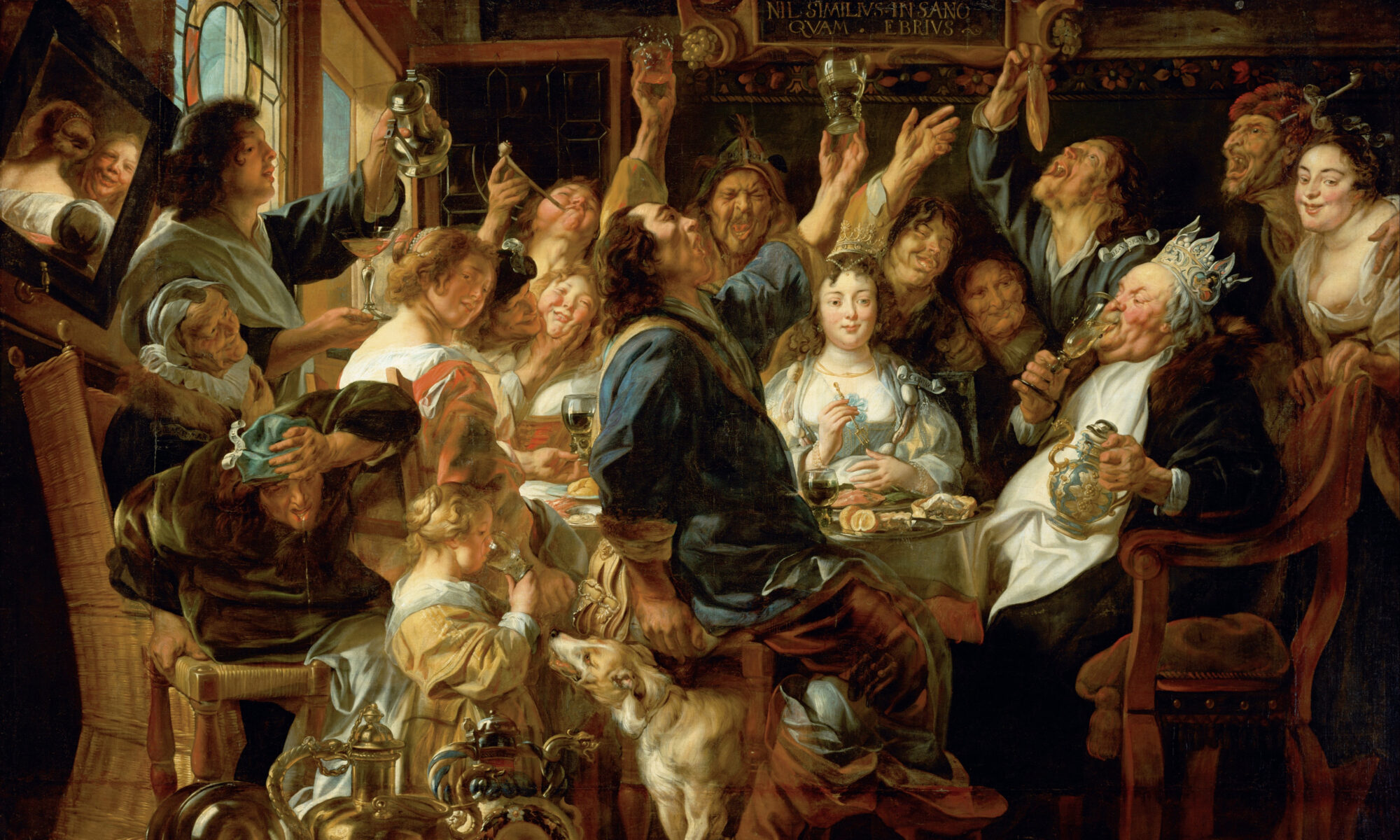
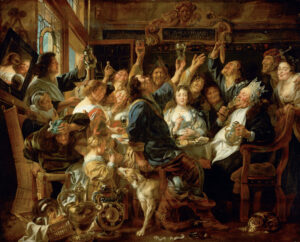
The Feast of the Bean King, Jacob Jordaens, c. 1640-45, courtesy Kunsthistorisches Museum

For Americans, today marks the end of the Christmas season, since we all go back to work tomorrow. In anticipation, we’re talking diets and exercise and generally mistaking January for Lent.

Historically, Christmastide ended on Epiphany, January 6. The Monday after Epiphany was called Plough Monday. It was the day poor English soaks went back to work. That shortened Christmas season is one indication of how modern life is not always better.

The night before Epiphany was Twelfth Night, which was the last big shindig of Christmas. About the only custom we retain from it is the King Cake, in which a fève (‘bean’) is hidden. Whoever finds it gets a prize.

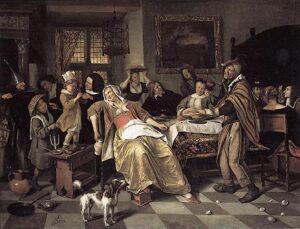
That’s an anemic celebration, compared to our ancestors. The bean in a King Cake has given us the English expression ‘beano’, which mean a blowout party. The person who found the bean was the Bean King, the Low Countries’ version of the English Lord of Misrule. He or she presided over the last remaining debauchery of Christmastide.

The Bean Feast, Jan Steen, 1668, courtesy Museumslandschaft Hessen Kassel

Who’s boozy now?

Blame it on the water, if you must, but our ancestors drank a lot more alcohol than we do. A 16th century German averaged three-quarters of a liter of beer a day, along with whatever wine he could afford. Nuns, those models of probity, got by on an allotment of eight glasses of ale a day.

A sailor’s ration of alcohol in the British navy was originally a gallon of beer daily. After the Napoleonic Wars, it changed to half a pint of spirits, since rum doesn’t go bad. The so called ‘rum ration’ was quartered by 1850 to the traditional amount, and lasted in that form until 1970.

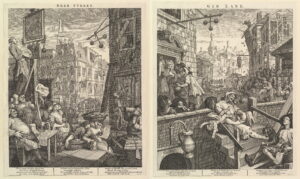
Beer Street and Gin Lane, William Hogarth, 1751, courtesy Wikimedia.

Cheap gin in the 18th century and cheap whiskey in the 19th century brought on periods of intense drinking. These were balanced by periods of sobriety, including the early years of the Industrial Revolution. There’s nothing like watching someone lose a hand in a mill to convince you of the virtues of abstinence, during the workday at least.

The 20th century was another period of lower alcohol consumption, although it’s on the rise again. But this is perhaps why the drunkenness recorded by artists like Jacob Jordaens and William Hogarth seem so marked to our modern eyes.

In Jordaens’ The Feast of the Bean King, everyone is drunk, from the grandfatherly ‘king’ to the child in the foreground. Behind her, a woman vomits; there is lust and a man so drunk he can’t lower a fish into his mouth. Some of the faces seem to swirl in and out of focus as if we, the viewers, are also drunk.

The inscription on the wall reads, “None is closer to the fool than the drunkard.” That’s our hint that this isn’t merely a disinterested look at local custom.

By the 17th century Puritans in northern Europe strongly condemned the celebration of Christmas, considering it a Papist abomination. In England, it became a point of conflict between the established church and the radical Roundheads. Christmas was banned in 1647, during the English Civil War.

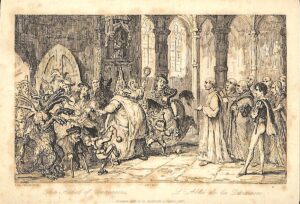
The Abbot of Unreasons, 1837, George Cruikshank, courtesy Collection MAS Estampes Anciennes. These monks look none too happy about the Lord of Misrule and his minions.

Charles I may have lost his head, but Christmastide did not go gently into that good night. Rioting broke out in several cities and clandestine celebrations continued. Christmas was reinstated with the restoration of the monarchy in 1660, but the Calvinists north of the border were slow to have it back. It wasn’t until 1871 that Christmas was designated a holiday in Scotland.

In America, the Puritans pointedly stuck their noses in the air and worked through the Christmas season, while their southern cousins followed the Cavalier tradition of feasting. It wasn’t until the middle of the 19th century that Christmas became fashionable in Boston.

The Feast of the Bean King was the last gasp of Christmastide celebrations, in an era when people partied more than we do now. As for us, well, we’ll be back at work on January 5.

Monday Morning Art School: Four masters show us how to use scale

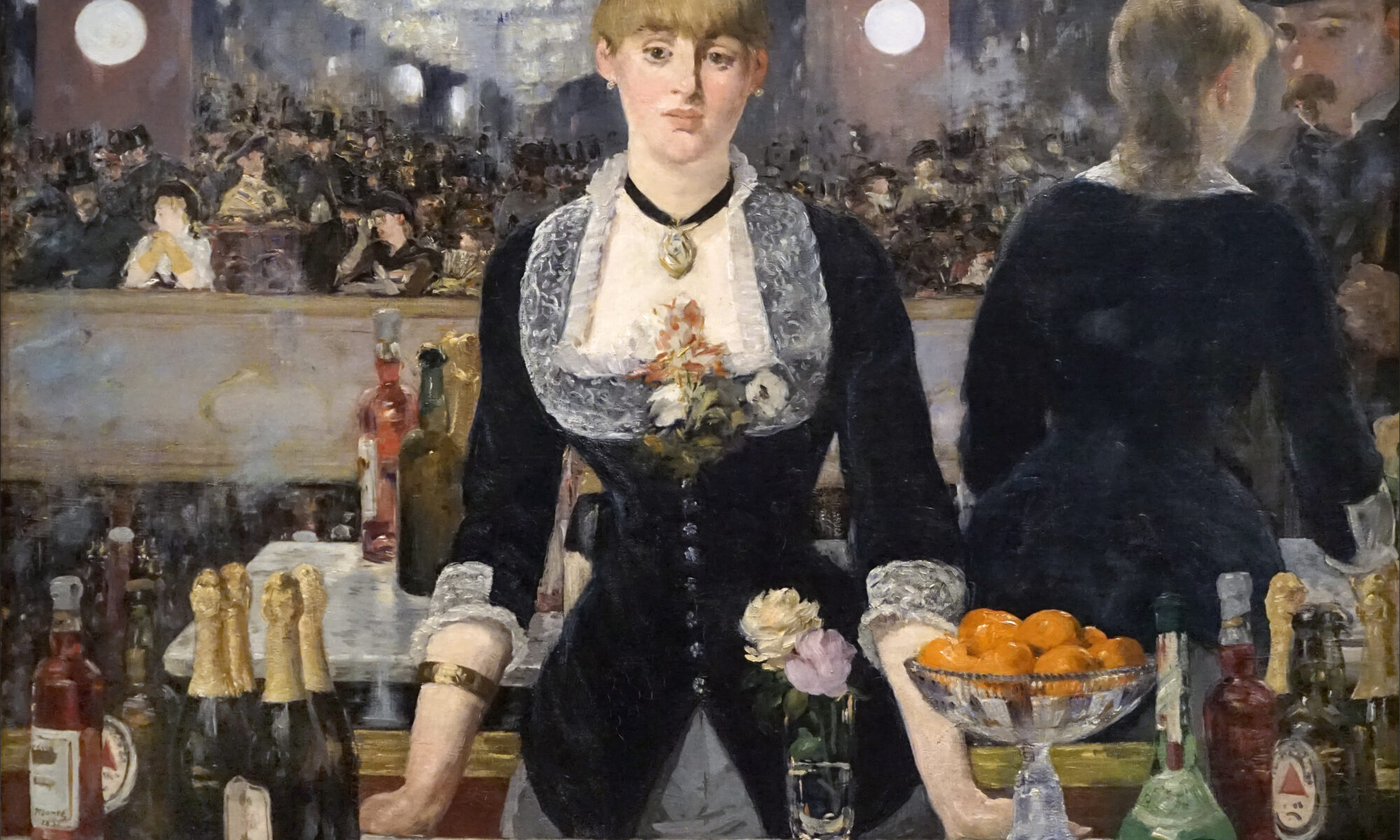
A Bar at the Folies-Bergère, Édouard Manet, 1882, courtesy the Courtauld

We don’t know why prehistoric man created the 360 ft.-long prehistoric Uffington White Horse in Britain, but every generation is both amazed and moved by it. Conversely, miniatures dazzle us with their meticulous craftsmanship. In very large or very small works, we’re immediately transported out of the ordinary. That is why The Heart of the Andes by Frederic Edwin Church must be seen in person-the scope is lost in photos.

The scale of the figures within a painting can make its message more powerful. Here, four masters show us how it’s done.

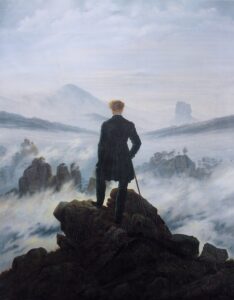
Wanderer above the Sea of Fog, Caspar David Friedrich, c. 1817, courtesy Hamburger Kunsthalle

Wanderer above the Sea of Fog is by the great German Romantic painter Caspar David Friedrich. He doesn’t spell out the identity of the model; in fact, the man is turned away from the viewer. He is an Everyman with whom we are meant to identify. He is centered in the canvas (saved from being static by the S-curve of his body) and is larger than the landscape itself. Friedrich wants us to focus on our human responses and not the landscape itself, as symbolic of uncertainty as it is.

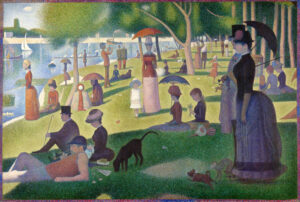
A Sunday Afternoon on the Island of La Grande Jatte, Georges Seurat, 1884-1886, courtesy Art Institute of Chicago

A Sunday Afternoon on the Island of La Grande Jatte by Georges Seurat is one of the most famous paintings in art history. It’s the seminal work of Neo-Impressionism. It was birthed with some difficulty, as Seurat labored over it for three years. Observe the scale of the figures. They range from the monumental couple on the right with their weird little monkey to the distant figures in the background. Using figures of various sizes, Seurat deftly created depth without atmospherics or modeling. Compare this painting to its companion piece, Bathers at Asnières, which takes a more conventional approach to creating depth.

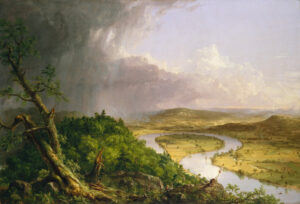
The Oxbow: View from Mount Holyoke, Northampton, Massachusetts, after a Thunderstorm, Thomas Cole, 1836, courtesy Metropolitan Museum of Art

Many Hudson River School paintings are sermons on canvas, and Thomas Cole‘s The Oxbow: View from Mount Holyoke, Northampton, Massachusetts, after a Thunderstorm is no exception. You are meant to see the American landscape as an Arcadia where man and nature live in harmony. There’s also nascent American myth here, celebrating our story of discovery, exploration and settlement just as they began to fade into history. Cole hammers this home with the Hebrew lettering in the logging clearcut. It spells either “Noah” or “Shaddai” (the Almighty) depending on whether you’re reading it right-side-up or from the God’s-eye-view.

Cole painted himself into The Oxbow. He’s so tiny it will take you a moment to find him. Look in the ravine to the left of his kit and umbrella. By making himself so small he drives home the point that we are mere specks in Creation.

Much has been written about the ‘impossibility’ of the reflections in Édouard Manet‘s A Bar at the Folies-Bergère (at top). The gentleman at the far right is enigmatic; he’s both transactional and nightmarish. Note the feet of the trapeze artist at the far left and the Bass Pale Ale bottle, which hasn’t changed in 140 years.

The barmaid’s face is life-size, and she is assessing us straight-on. Whether we’re looking at exhaustion, sadness, or resignation is hard to say. By making her life-size, Manet hammers home the power of her straightforward gaze. This painting isn’t just a mirror in a bar; it’s a mirror on our own souls.

Manet was dying of syphilis when he painted this, suffering severe pain and paralysis. Controversy has raged about the identity and character of the model, known only as Suzon. That hardly matters, because what we see in her eyes is a reflection of Manet’s, and by extension, our, thoughts.

If you’ve ever thought about taking one of my workshops aboard schooner American Eagle, here’s a lovely account from writer Georgette Diamandi, who joined us this past September.

Seven things you should know about the Group of Seven

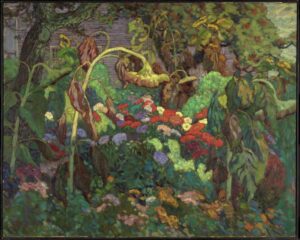
The Tangled Garden, 1916, JEH MacDonald, courtesy National Gallery of Canada

No, not the G7-that’s the forum of world’s biggest economies. They’re politically important, but nowhere near as important as the Canadian painters by that name.

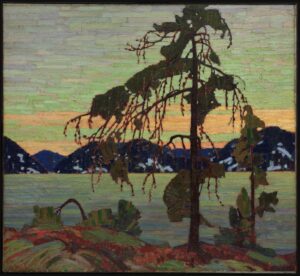
The Jack Pine, 1916-17, Tom Thomson, courtesy National Gallery of Canada
  1. The death of Tom Thomson is one of art’s enduring mysteries. Although the Group of Seven didn’t formalize until after his death, he was one of the painters who gathered at the design firm Grip, Ltd. He was arguably the most famous of them all.A dedicated woodsman and fisherman, he loved heading into the wilds of Algonquin Provincial Park to paint, as he did one July afternoon. He was found drowned eight days later, a four-inch bruise on his temple. Did he capsize, did he commit suicide, or was he murdered by a jealous husband? We’ll never know.
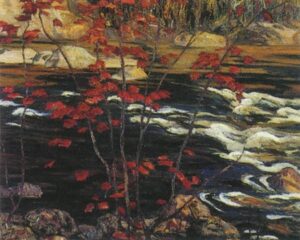
    Red Maple, 1914, by AY Jackson, courtesy National Gallery of Canada
  2. The Group of Seven were realists in the age of abstract art.They passionately clung to plein air in defiance of a world culture that was veering off toward abstraction. They felt the spirit of Canada was best understood by painting in direct contact with nature. Instead of huddling in Toronto studios massaging their angst, they rode the rails to some of Canada’s most desolate and difficult-to-reach spots.
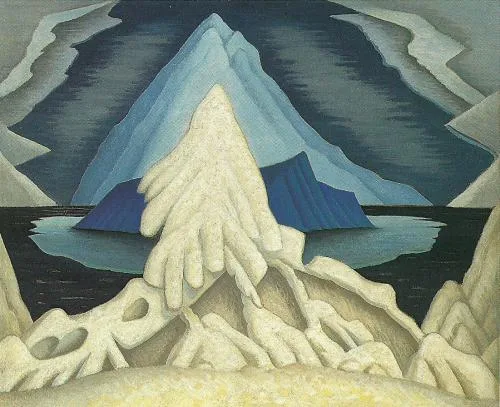
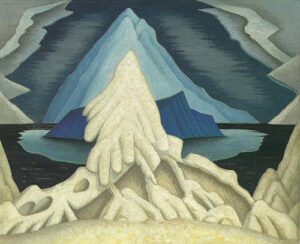
    Winter comes from the Arctic to the Temperate Zone, 1935, Lawren Harris
  3. They invented the idea of the Great White North.Lawren Harris believed the desolate north was the seat of Canada’s economic and spiritual power. His scenes of the cold, majestic, and empty northland defined Canada’s essential self-image. This was a land of black spruces, isolated peaks and dark water, lit by fantastic skies.This started out as nationalism, but transformed into a more universal paean to the power of nature. As much as he abstracted the landscape in later years, he always told this story.
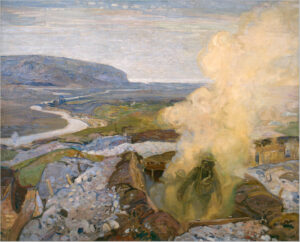
    Gas Chamber at Seaford, 1918, by Frederick Varley, courtesy Canadian War Museum
  4. The Great War temporarily derailed them.The First World War had a profound effect on Canada. Out of an expeditionary force of 620,000, 39% were casualties. AY Jackson, Arthur Lismer and Frederick Varley enlisted as official war artists. Jackson served in France and was seriously injured. Lawren Harris enlisted in 1916 and was discharged in May 1918 after a nervous breakdown. Tom Thomson’s death in 1917 was another blow to the group.
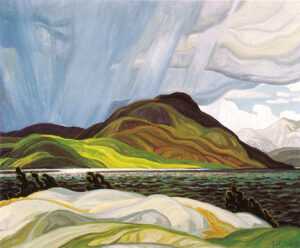
    Lake Wabagishik, 1928, Franklin Carmichael, courtesy McMichael Canadian Art Collection
  5. In the early years, the group was supported in part by tractor money.Lawren Harris was the son of Thomas Harris of A. Harris, Sons & Company Ltd., farm machinery merchents. This merged with the Massey company and later became known as Massey Ferguson. Harris’s share of his family fortune enabled him to partner with James MacCallum to build the Studio Building in Toronto, where his fellows could rent studio space cheaply. Together the two men bankrolled the Group of Seven during lean periods. Harris took them on boxcar trips to  Algomaregion north of Lake Superior and elsewhere.
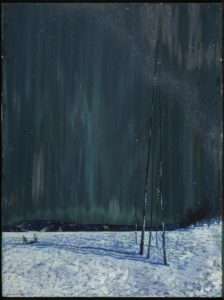
    A Northern Night, 1917, Franz Johnston, courtesy National Gallery of Canada
  6. They developed a distinctive Canadian style.Group of Seven paintings are instantly recognizable by the fusion of graphic design and Impressionism. However, they were always driven by what was actually there. The screen of trees and the view down into the deep woods are recurring motifs. This is not a grand, golden view in the style of the Hudson River School painters, but a deeply honest view of what the northeastern part of North America looks like. It requires embracing chaos in a totally new kind of composition.
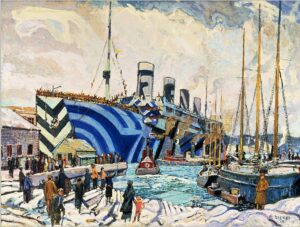
    RMS Olympic in dazzle at Pier 2 in Halifax, Nova Scotia, Arthur Lismer, courtesy Canadian War Museum
  7. The Group of Seven is not without controversy.They’ve been criticized for depicting northern Canada as a no-man’s-land, or terra nullius, when it’s been lived in for centuries by indigenous people. However, the goal of plein air has primarily been to capture the landscape, not human activity.Having painted across Canada myself, I can say that much of it seems empty a hundred years later. In any case, they’re among the best painters North America has produced, and that’s the real reason to study their work.