Here is a link to the workshop information. I’d love to see you there!

Watch Me Paint: World-Class Art, World-Class Instruction

Here is a link to the workshop information. I’d love to see you there!
Study for “Northern River” by Tom Thomson
Like every other kid who grew up in
What Albright-Knox didn’t collect is every bit as interesting, because it missed two seminal movements in modern art that were happening right by its own back door. It acquired only about a dozen or so works on paper by
The Group of Seven were, above all, acolytes in a nascent cult of
“We live on the fringe of the great North across the whole continent and its spiritual flow, its clarity, its replenishing power passes through us to the teeming people south of us.” (Lawren Harris)
The Group of Seven understood the artists’ role as prophets of this spiritual identification.
“Indeed no man can roam or inhabit the Canadian North without it affecting him, and the artist, because of his constant habit of awareness and his discipline in expression, is perhaps more understanding of its moods and spirit than others are. He is thus better equipped to interpret it to others, and then, when he has become one with the spirit, to create living works in their own right, by using forms, color, rhythms and moods, to make a harmonious home for the imaginative and spiritual meanings it has evoked in him. Thus the North will give him a different outlook from men in other lands. It gives him a difference in emphasis from the bodily effect of the very coolness and clarity of its air, the feel of soil and rocks, the rhythms of its hills and the roll of its valleys, from its clear skies, great waters, endless little lakes, streams and forests, from snows and horizons of swift silver…” (Lawren Harris)
Ultimately the Group of Seven’s agenda (the celebration of the unique power of
In fact, some of what they did—abandoning value, abandoning the ‘scene’, ignoring atmospherics—could never work if their color mixing and drawing were not so spot-on.
In fact, I think the reason Seymour Knox ignored them is that they challenged him in two key points that would really irk a mid-century American mogul: that modernism was inherently better than tradition, and that being American was inherently better than being Canadian. But at a fifty year remove, Knox seems almost pathetically provincial, blindly following
I can only speak as a New Yorker, but from my vantage point, there has been no clear sense of direction in painting for the last three decades. However, one thing seems clear: representation and technique have returned to importance, and Abstract-Expressionism (although it leaves its mark) has far less influence now than at any other point in my life.
The earliest core of the Group of Seven— Tom Thomson (who was never a formal member), AY Jackson, Arthur Lismer and Frederick Varley—were painting together in Algonquin Park by 1914, at which point their work was interrupted first by the onset of the Great War, and then by the untimely death of Thomson, who was found dead in Algonquin under mysterious circumstances. The group eventually included Lawren Harris, JEH MacDonald, Frank Johnston, Franklin Carmichael, AJ Casson, Edwin Holgate, and LL Fitzgerald. Emily Carr and Clarence Gagnon were closely affiliated with them in viewpoint and technique.

“Sopwith Camel Looping” by Frank Johnston. Several of the Group of Seven painters were conscripted into the war effort. When viewing Johnston’s aerial perspectives, one must remember how rare and new flight was and the difficulty of taking reference photos at the time.
This Sunday, I was doodling in church when a painting dropped full-blown into my head. That isn’t common, but is always exciting. And in this case, it was fortuitous since I just finished several weeks of flailing around on the previous piece.
Where does a fully-realized idea spring from? First, a thought: in this case, a dilemma that has bedeviled me for almost a year. Then, visual input that is usually jumbling around in one’s cranium solidifies into a concept. In this case:
When I’m painting observationally, I follow the traditional rules of alla prima painting: dark before light, big masses divided into small masses, fat over lean. When I’m painting from an interior vision, I paint indirectly, starting with a color map, and then modulating with opaque paints.
BTW, this is my current easel setup—electronic reference to the left, paper reference to the left.
Every year I seem to get one kid who draws wonderfully. Sometimes, this kid has managed to decode the rules of drawing on his own. More typically, he has studied outside of school. But however he does it, to the casual observer, he appears to have “spontaneously” learned to draw.
In turn, his teachers identify him as talented, and he is a star of his public school art program. Meanwhile, the majority of kids are vaguely encouraged toward self-expression but never challenged to learn the craft of making art. Nobody considers them particularly talented.
As an educational model, that’s bizarre. If we taught math like that, we’d have only one kid a year who mastered calculus. If we taught English like that, we’d be a nation of illiterates.
There is no more a “genius” for art than there is one for math, and it’s a terrible disservice to both students and society to not teach the craft of drawing to all young people.
When I was in school, art instruction was undergoing a sea change. There were some teachers who still taught the technical skill of drawing, but they were being replaced by a generation who emphasized emotional intensity and ideas rather than the nuts and bolts of observation and description. I was fortunate in having superlative draftsmen as teachers, but I’m among the last generation for whom that was a given.
Almost no kids come to my private studio with any experience in observational drawing. They don’t even know there’s a difference between observational drawing and copying photographs. They have never learned the systems of perspective, measurement, and proportion that were drilled into us in an earlier time.
The painting at the top of this page was done by a high school senior. She started studying with me in August, 2011, having had no prior instruction. She is not someone who could teach herself to draw, and hence she wasn’t identified as “talented.” However, she is extremely bright and hardworking. Moreover, she has a story she’s anxious to tell. In five months time, she has gone from not being able to draw at all to being able to paint at this level: not by concentrating on self-expression but by practicing the core disciplines of drawing and painting.
I’m not worried about her future, but she isn’t going to art school because she didn’t have time to develop the chops needed to put together a mature portfolio. But what if she had been taught to draw in elementary school, as I was? How might her life be different?
And what about all the people who never have the chance to learn the skill of drawing? How many potential Manets or Velázquezes have we squandered?
This is the second year I’ve bought into the Sketchbook Project and then felt my muse desert me as soon as the package arrived in the mail. It’s ironic, because I carry a sketchbook everywhere I go, a habit that started in elementary school.
My school notekeeping was a total fail from an academic standpoint—full of drawings, with notes occupying a very minor role. My current sketchbooks look exactly the same.
I now realize that drawing in school allowed me to cope with undiagnosed ADHD at a time when school was extremely regimented and bad behaviour still punishable with a ruler to the knuckles. And I received my share of thwacks for drawing in class, believe me. But as a parent and painting teacher, I encourage both my children and students to do the same thing. Unfortunately, most teachers are still opposed to it.
I know it works (as long as the information being presented is verbal and not visual). For some reason, it’s perfectly possible for the mind to listen, learn and retain a lecture while drawing something entirely unrelated.
For me, drawing takes the place of the anxious fidgeting that is part of ADHD. Educators have begun to recognize that allowing such kids to move paradoxically makes concentration easier. But they don’t generally recognize that drawing can achieve the same goal.
I bring my sketchbook to church, to appointments, on errands—in short, anywhere there’s a possibility I will cool my heels. I make no pretence to style, and don’t think about content or composition. (To do otherwise would interfere with my listening.) My goal is simply to record what I see. It’s totally process-based; I never think of the sketches as anything other than practice strokes or visual notes. Which may be why the Sketchbook Project never works for me: it can’t help but turn process into product.
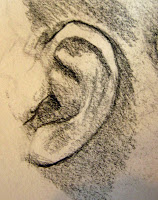
(L-R) Or, you can draw your non-dominant hand; people almost always have a few ears hanging around; patient at the neurologist’s office.
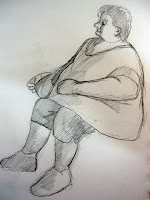
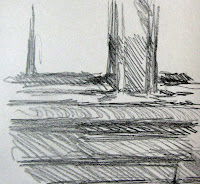
(L-R) Quick value study of a path (I could paint it from this); man in church; my son’s big foot, at the pediatrician’s office.
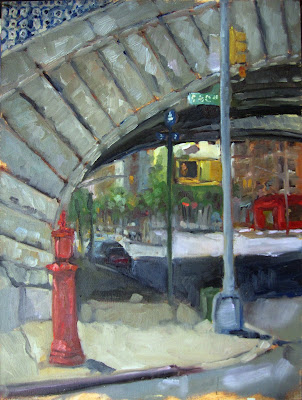
Usually, when we say “field sketch,” people think of pastorals, but the term can apply equally to urban landscapes. I went on a tear painting the Queensboro (or
Just as urban plein air painters complain about the “endless green” of the woods, pastoral painters are overwhelmed by the grey of the city. But just as there are many different greens, there are many different greys. The trick is to find them, and to find the accidental notes in either landscape.
How do you avoid dreary, dull greys? First, avoid using black as a base. I was taught that this was because of the large grains in carbon-based blacks, which may or may not be true. But for whatever reason, black has a way of making cool colors look muddy and warm colors look more opaque, and that’s a bad basis for greys.
Under the Queensboro Bridge, oil on canvasboard, 12X16
I normally paint foliage using a matrix of nine mixed greens plus one from a tube (chromium oxide). There are at least that many greys present in the urban landscape. I prefer to mix them not in matrices, but in threads, so that every permutation is easily available.
Some of my favorite grey threads, from left to right:
Cadmium orange and Prussian blue;
Raw sienna and Prussian blue;
Yellow ochre and quinacridone violet;
Burnt sienna and ultramarine blue.
Remember, every manufacturer’s paint handles somewhat differently, and unless you’re using RGH paint, you’re unlikely to duplicate my results exactly. But the principle is simple: just choose two colors from opposite sides of the color wheel and add white.
In addition, I think it’s very helpful to use a warm-toned canvas or canvas board.
It’s not often you get a model showing up with a black eye, and that’s irresistible to paint. (Before you get worried that she’s the victim of domestic abuse, she’s a dancer and occasionally her face gets in someone else’s way.)
During the interregnum between open painting and figure, I usually set up my palette in a flesh-tone matrix. This is how I’m able to do a credible figure painting in three hours. Today, a number of interruptions stopped me from doing that, and I ended up doing the first hour of painting using pigments scarfed from a student’s palette. On top of that, I’m working huge for a sketch—this canvas is 48X36. So most of this is a rough underpainting, and I’ll be finishing it next week.
Michelle’s shiner, in draft form
A note about this model: she’s a wonderful, adventurous nut, who allows me to wrap her up in Saran Wrap.

Michelle as a shrink wrapped vegetable, 18X24, oil on canvas
This commissioned work is a formal portrait of a mature woman who desired a nude painting reflecting her Central American heritage. The client wanted an impression of the beauty of a woman not matching the cliché of the commercialized American ideal of willowy, leggy and fair female imagery.
The composition features an S-curve created by the background and gold lace mantilla and subtly reinforced by the rim lighting bathing the model’s knees and leg.

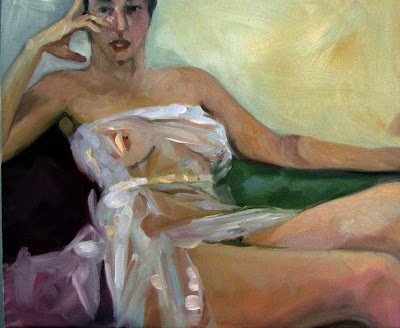
(Michelle reading, 24X36″ oil sketch on canvas.)
I have been doing fewer 3 hour figure studies, because my pal Marilyn has blown down to Florida. This is from Saturday’s session. I love the pose.
Three hours for the figure, about another half hour for the background.
Excuse the reflections; at this time of year, paint dries really slowly.
Mark your calendars for a meet the artist reception on 7/29 from 6pm to 8 pm and a roundtable discussion on “Why Art Matters” on 7/31 at 1:00pm (click to sign up).
Carol Douglas is a well-known

She studied figure, anatomy for artists and painting at the Art Students League in
She is a former state chairperson of New York Plein Air Painters and a signature member of that group. She is a member of Oil Painters of American and Landscape Artists International.
She teaches studio and figure painting in her Brighton studio and plein air in the

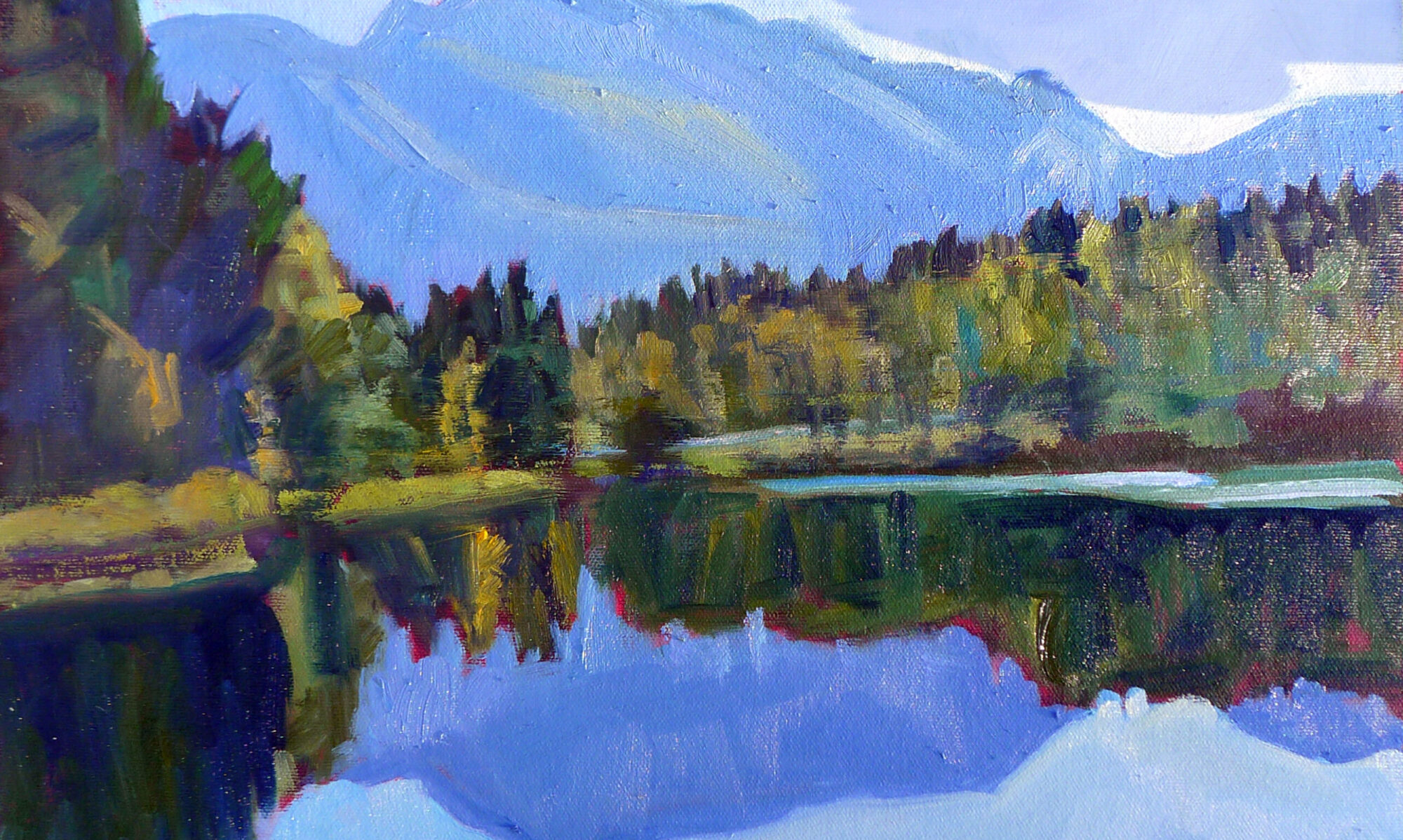
Crossing Big Bay on Route 10 14X18 Oil
|
|