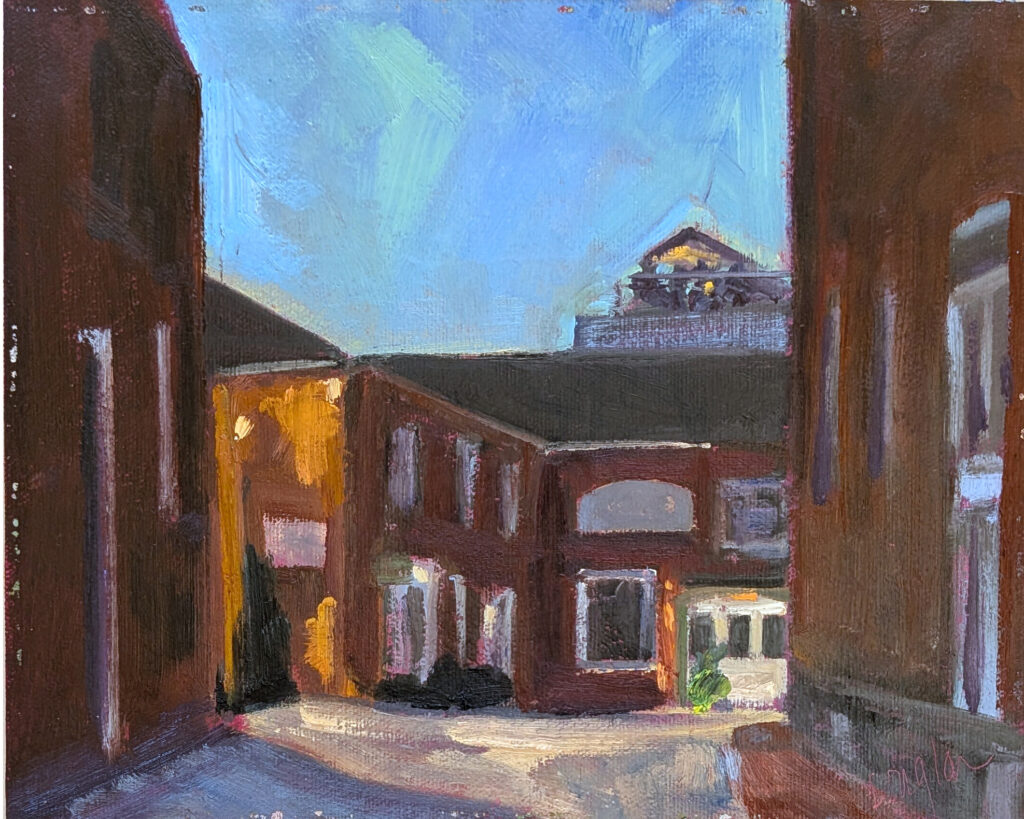
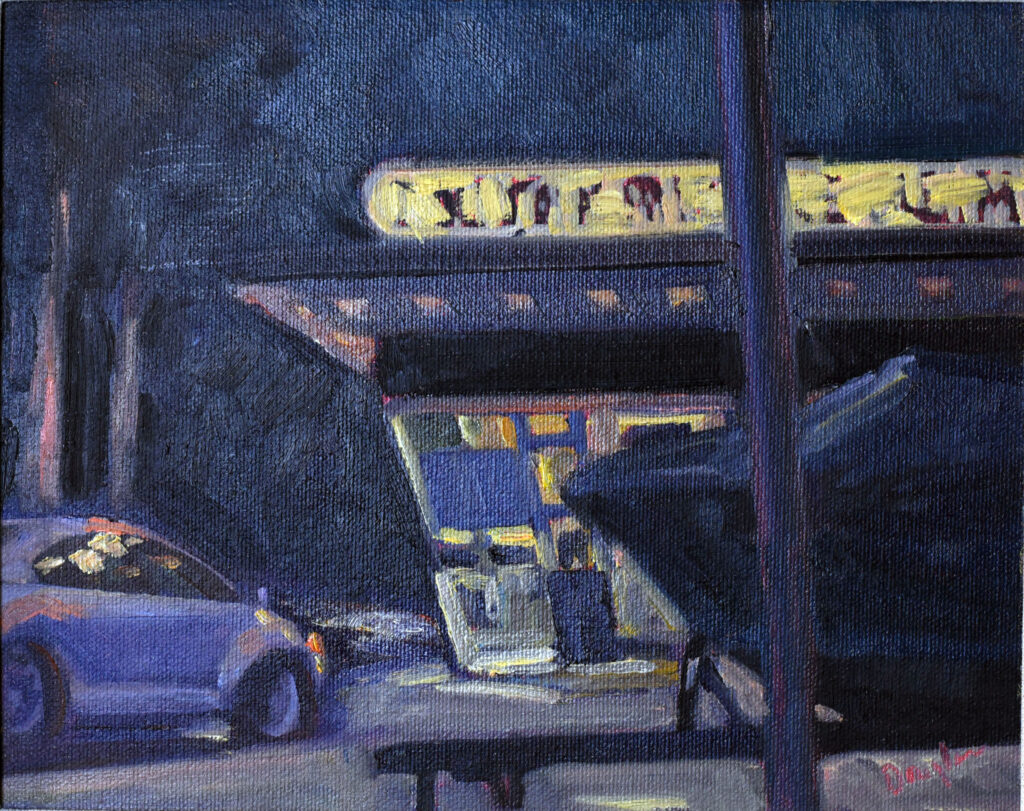
As I was cleaning up after a day painting at Plein Air Litchfield, I received a text from Stephen Florimbi. Thinking my retort would be much funnier in person, I drove over to where he’d set up to paint a nocturne.
I was slightly surprised to find myself unpacking my kit and setting up to paint with him.
There’s a rooftop bar on the building behind Cobble Court. Our pals from the event were there to party. Meanwhile, Stephen and I were having a hoot down on the street, watching them in the fading light.
I’m a morning person. When events require nocturnes, I usually get up before dawn to paint them. But I’ve been on a nocturne painting jag for a while now, and I’m finding that staying up late to paint isn’t killing me.
Painting nocturnes for Sedona
I leave for the 22nd annual Sedona Plein Air Festival a week from today, driving cross-country and camping along the way with my friend Laura Martinez-Bianco. We’re doing this as a convoy because we each have too much equipment to share a vehicle.
Sedona Arts Center asks us to hang two paintings before the event begins. I have lots of beautiful paintings of Sedona since I paint and teach there every year.
But this time I decided to create work especially for the festival.
My criteria were simple:
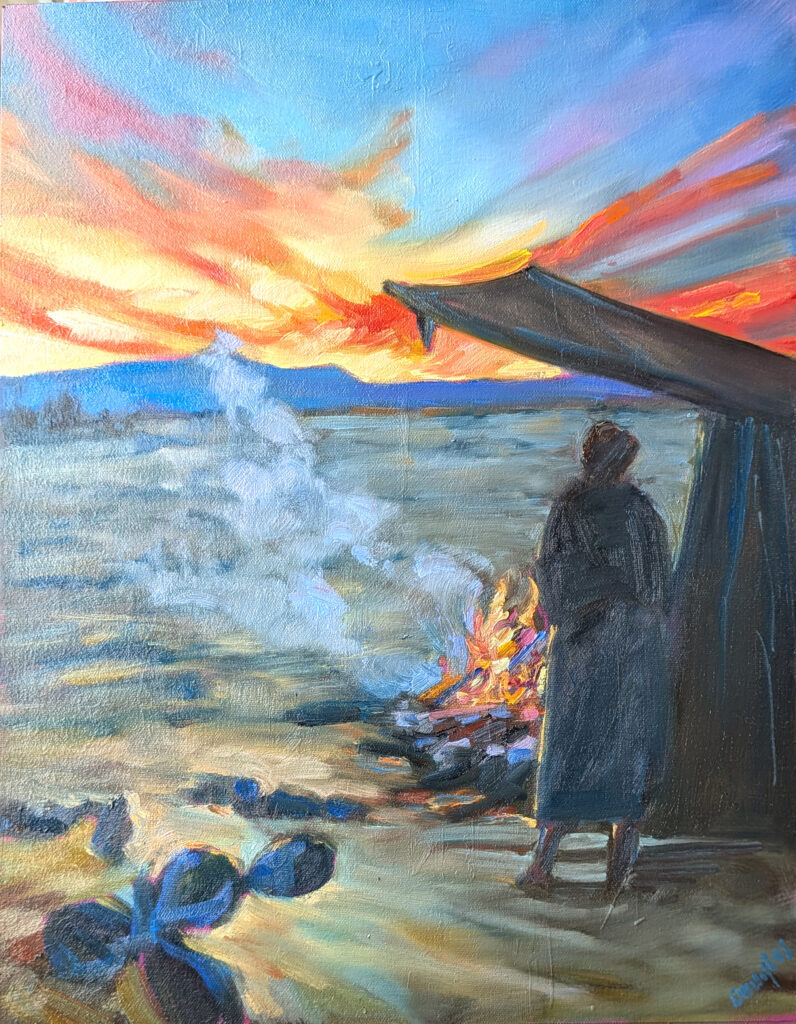
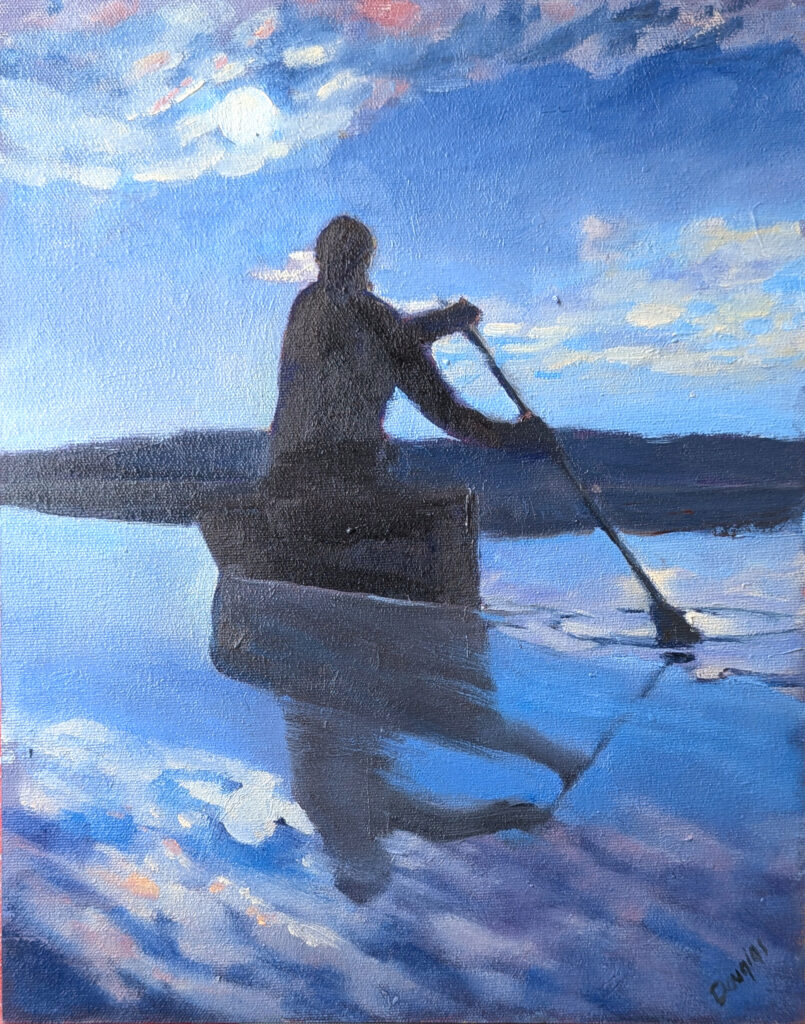
- Each painting should include a figure.
- They should be narrative.
- They should be nocturnes.
Frederic Remington’s nocturnes
My approach arose from a deep dive into Frederic Remington’s experiments in nocturnes.
Remington is best known for his paintings and sculptures of the American West: cowboys, cavalrymen, Native American scouts, horses and Western landscapes. But late in his career, he became fascinated with painting at night.
For Remington, the night wasn’t merely a setting. It was part of the subject.
His earlier Western paintings were relatively straightforward narrative paintings. In his nocturnes, he increasingly withheld information.
You see a rider, but not necessarily where he’s going. You see figures looking toward something you can’t see. You see a wolf reacting, but to what?
That uncertainty is what makes Remington’s nocturnes so compelling. The darkness creates the possibility of unseen danger. The viewer knows that something is happening, but doesn’t necessarily know what.
What makes a nocturne different?
The subject of a nocturne doesn’t have to be the person, animal or event depicted in the painting.
It can be the state they’re in: waiting, listening, watching, approaching, searching, hiding, isolation, danger or anticipation.
This is one of the things I find most interesting about nocturne painting. The darkness gives the painter permission to leave things unresolved. A rider can disappear into the night. A distant light can raise a question. A figure can be watching something beyond the edge of the painting. A landscape can become less about describing a place and more about creating an experience.
That’s why Remington’s nocturnes feel surprisingly cinematic. He uses what the viewer cannot see as part of the composition.
Painting the dark sky
Remington was also painting at a fascinating moment in history. Just as cowboy culture was fading into history, electric lighting was coming into its own. It changed people’s experience of darkness, making it more a thing to be feared and avoided. Remington’s nocturnes engage not only with the beauty of nighttime but with the changing meaning of darkness itself.
I like wilderness camping. My husband thinks I’m nuts, but is along for the ride.
I’m coming full circle from where Remington was. For Remington, electric light was changing the experience of night. For me, the dark sky is an escape from the electrified world.
I don’t know where this nocturne painting experiment is going. Maybe that’s part of the attraction.
I’m enjoying staying up late, looking into the darkness, and figuring it out one painting at a time.
Online classes start again soon!
- Cozy Winter Painting, Monday evenings, 6-9 PM for three weeks starting November 2.
- Painting Figures in Real Spaces, Tuesday evenings, 6-9 PM for six weeks starting November 3.
- Painting Nocturnes, Monday evenings, 6-9 PM for three weeks starting November 30.
I have just two workshops left in 2026! Reserve your spot:
- New! Color Clinic 2026 | Rockport, ME, October 3-4, 2026
- New! Composition Week 2026 | Rockport, ME, October 5-9, 2026
- High-Desert Light & Monumental Form | Sedona, AZ, Apr 26, 2027 – Apr 30, 2027
Can’t commit to a full workshop? Work online at your own pace: