Monday Morning Art School: desert lessons

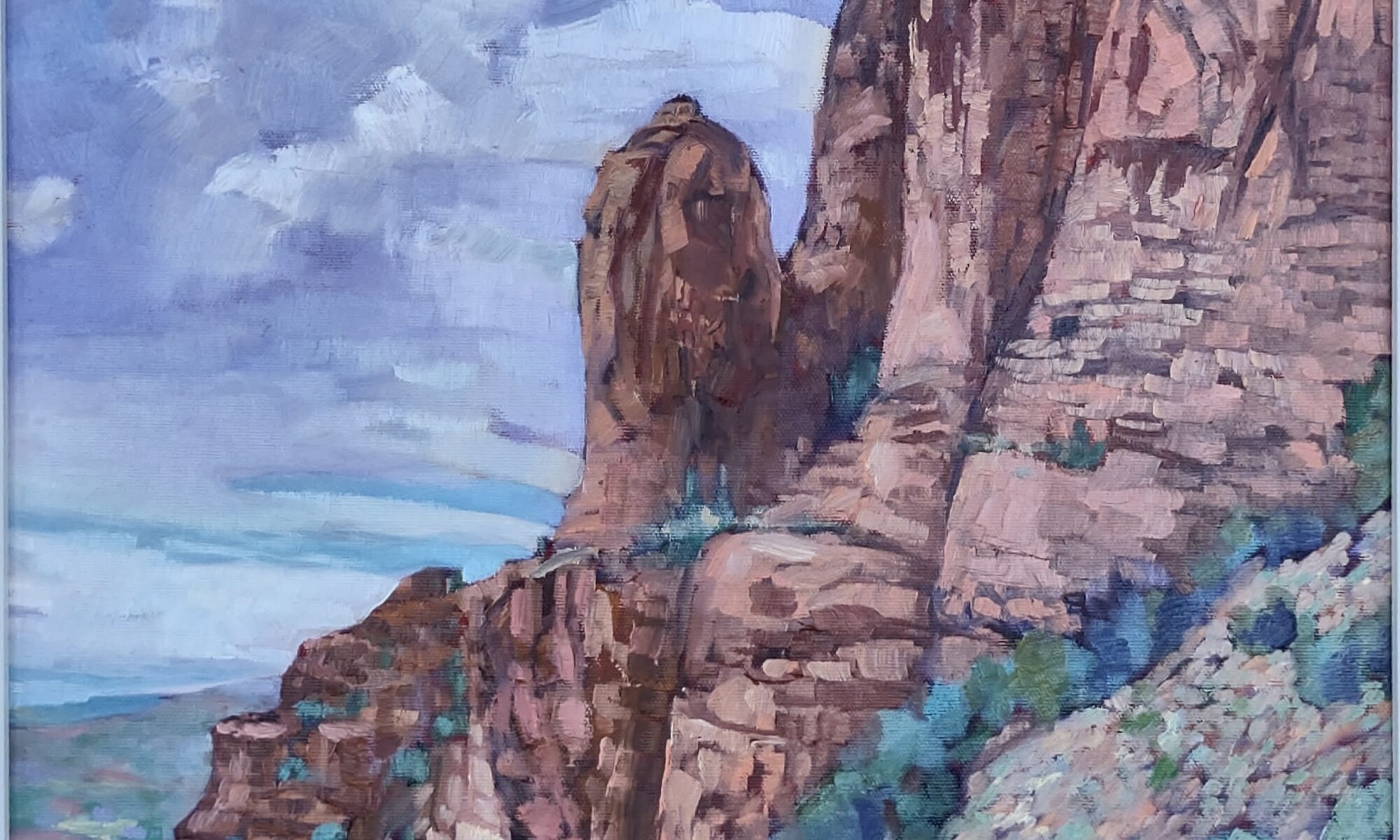
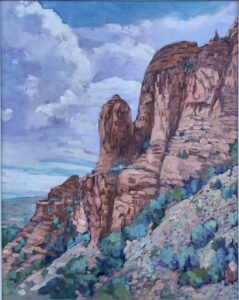
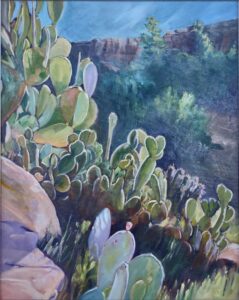
Cliffs, 12X12, oil on birch, private collection.

Arizona (especially Sedona’s red-rock country) looks simple from a distance. Big shapes. Big color. Big sky. That apparent simplicity is exactly what makes it hard to paint well.

Every landscape has its own rules, and the desert is particularly unforgiving to painters who arrive armed with assumptions instead of observation. I know this because a long time ago I did exactly that. What did the Arizona desert teach me about painting light and color? More things than I can list, but below are the main points.

View across the Verde Valley, 11X14, oil on birch panel. Available through Sedona Arts Center.

Capturing desert light 

Capturing desert light starts with understanding that Arizona’s atmosphere is clean, dry, and thin. There’s very little haze to soften transitions. As a result, value contrasts are stronger than you may be used to, and color temperature shifts are abrupt. Sunlit planes are warmer than expected, except at midday. The shadows snap cool, sometimes dramatically so. That’s from a distance. Up close, there’s a tremendous amount of color bouncing around the shadows. They are often higher in chroma than the sun-bleached parts of the picture.

If your painting feels flat, it’s often because you aren’t respecting color temperature enough.

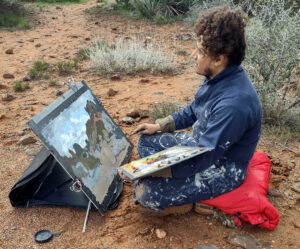
Carol L. Douglas painting at Acadia National Park
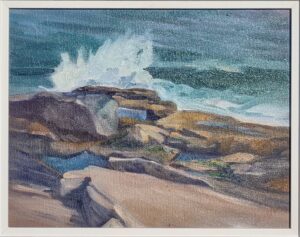
Sunlight and shadows, oil on birch, 14X18, private collection.

Painting rock formations 

Painting rocks is less about detail and more about structure. From individual rocks to gigantic massifs, rock formations are built from planes. Start by identifying the major directional faces of the rock and assign them clear value families. Vertical planes can read darker than sloped ones, and ledges catch light differently still. At the vast scale of the desert, texture and detail are almost an afterthought. If you paint every crack and striation, you’ll destroy your painting—and your mind.

Lone pines, 14X18, oil on birch, available through Sedona Arts Center.

Working fast in changing light 

Working fast is not optional in the desert. The light moves quickly, and shadows can crawl across a canyon wall in minutes. This is where the preparatory sketch earns its keep. Adapt it for desert conditions by simplifying even more than usual. Four different value steps are sufficient. If you can’t organize the scene in ten minutes, you won’t fix it in two hours. And you’ll be mighty glad to have that sketch when the light shifts.

Color mixing for arid landscapes 

Color mixing for arid landscapes is where many painters go off the rails. Yes, rocks are orange and bluffs are ochre. But Sedona and the wider Southwest are full of violets, cool reds, muted greens and dusty neutrals. Shadows are often infused with unexpected color. Adjust temperature rather than dialing up saturation. If everything is intense, nothing is.

The desert doesn’t reward fussing. It rewards decisiveness, clear value structure, and honest color. Arizona’s landscape will teach you quickly where your habits help you—and where they don’t. That’s why painters keep coming back. The desert is a tough teacher, but it never wastes your time.

Want to learn more?

This March, I’m leading a 5-day plein air workshop in Arizona, and I’d love for you to join me.

Canyon Color for the Painter: A Plein Air Workshop will be held through the Sedona Arts Center, March 9–13, 2026. This immersive week-long workshop is designed for painters in oil, acrylic, pastel, watercolor, gouache, and all experience levels.

You can register directly on Sedona Arts Center’s website, here. Or, contact me if you have questions. I’m happy to answer anything about the workshop, skill requirements, materials or what to expect painting in the desert.

Registration is now open for workshops in 2026! Reserve your spot:

Can’t commit to a full workshop? Work online at your own pace:
Seven Protocols for Successful Oil Painters

The most important rule of painting

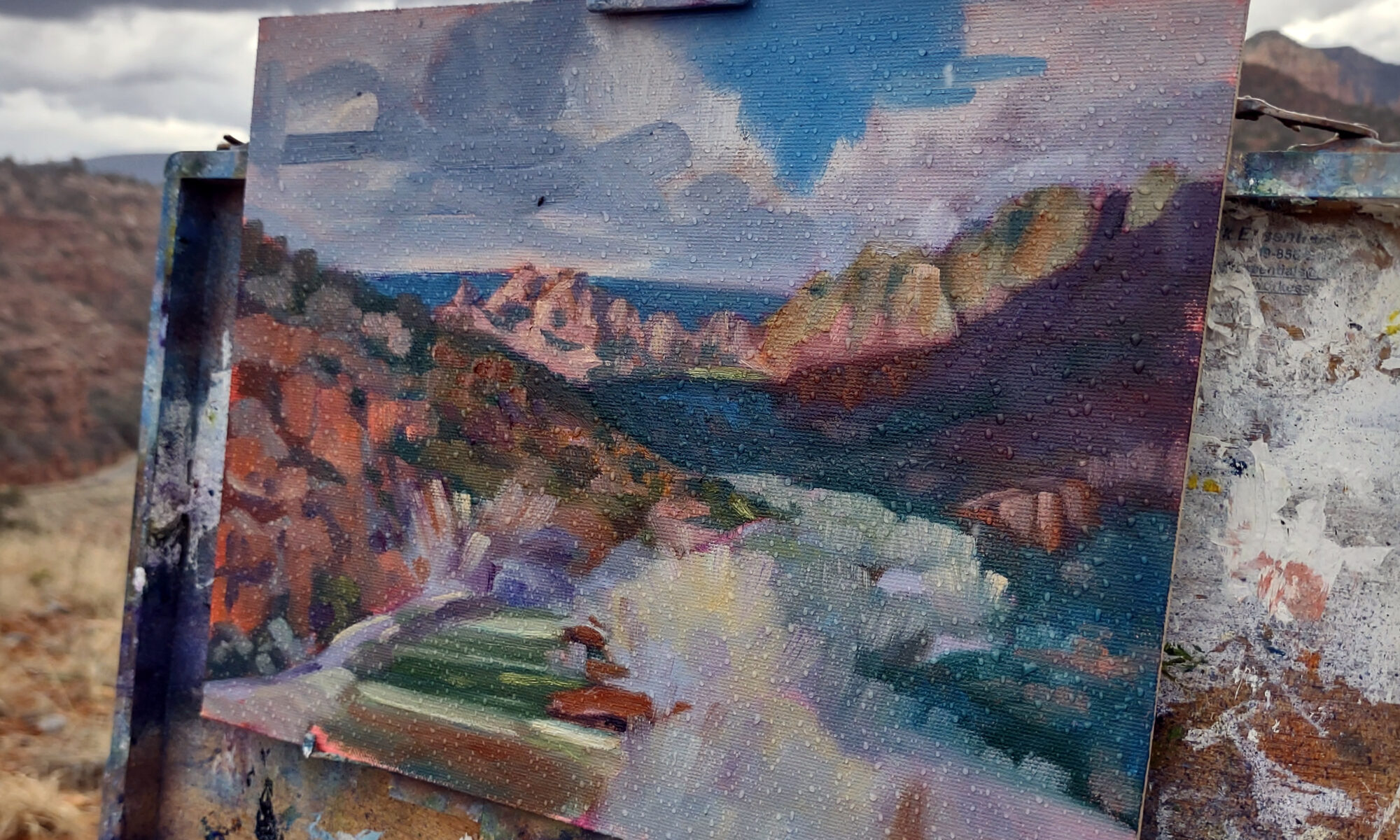
It’s a start. Maybe I can even finish it before I leave!

Last March when I taught in Sedona, it was t-shirt weather. Our biggest dilemma was which day we should visit the winery. This year the weather has been terrible. Even I, an incurable optimist, can’t deny that.

The historic snows and rains that have pounded California have not left Sedona unscathed. Flood-prone areas were on high alert yesterday. State Route 89A closed in both directions between Sedona and Flagstaff due to rock slides.

Arizona has close ties to California, and people here have shown me pictures of their favorite ski resorts in the Sierra Nevada, where some places have seen close to 100 inches of new snow in the month of March alone. I’m from Buffalo and that number astounds me.

We’re not getting that, but we have had mixed precipitation and cold weather all week. It’s maddening when we’ve invited people to paint en plein air and they’re stuck inside, as beautiful as the teaching studio is at Sedona Arts Center. I want my students to be happy, and circumstances beyond human control are making that difficult.

“It’s the beginning of a new Ice Age,” I grumbled, and my student Maggie laughed and agreed.

Snow is welcome in December; at the end of March it’s just annoying.

This weather isn’t helping my slump

Maggie and her pal Beth wisely decided to paint indoors yesterday. The rest joined me at Secret Slickrock trailhead. Rain eddied and blew through the massifs, and Oak Creek roared in its rain-swollen channel below us. It would have been magical if the weather hadn’t been so stubbornly uncooperative. One by one, my students retreated to the warmth of their cars until it was just Matthew, Laura and me left.

I’ve been in a painting slump recently. There are all kinds of reasons for slumps, including health problems, pressure at work, grief and much more. Being able to identify the cause doesn’t necessarily solve the problem, but it does help me to feel better. And I know why I’m here. I’m spending most of my creative energy developing an online painting course. I’m alright with that trade-off, but it’s frustrating when I can steal a moment to paint and dreck comes off my brush.

Matthew is wearing three layers under that boilersuit. It’s a wonder he can stand up and waddle to his car.

But here I was on the top of a bluff and most of my students had left. I laid in a quick painting, breaking rules I drill into my students. I made no preparatory value sketch because I’d loaned my sketchbook out and hadn’t retrieved it. I did major design surgery in the middle of the painting. The painting is unfinished, because the rain and snow started sheeting down on us again. (Oil paint turns into stodge when it absorbs enough water.) And of course I don’t have a reference photo; I never remember to take them.

Yet I’m happier with this start than with anything else I’ve done since January.

Sometimes we go through dry periods. Sometimes we break rules we know are important. But the most important rule of all is to show up. Yes, you’re very likely to make a bad painting when you’re in a slump, but you stand a zero chance of making a good one if you don’t paint at all.

Registration is now open for workshops in 2026! Reserve your spot:

Can’t commit to a full workshop? Work online at your own pace:
Seven Protocols for Successful Oil Painters

I’m rich!

The Rocks Remain, 16X20, $2029, available through Sedona Arts Center.

Flying west from a tiny town in northern New England lacks charm. You get up at an unearthly hour, drive to a bus depot, and head to Logan. It complicates the already-dismal nature of air travel to have to start at 2 AM.

I live in one of America’s beauty spots. Why I’d spend 21 hours to get to another beauty spot is a mystery of wanderlust and economics, but apparently it works. I do it with frequency.

Rim Light, 16X20, $2029, available through Sedona Arts Center.

The trips themselves can make me grumpy. Yesterday, I was in Phoenix, consoling myself in my friends’ kitchen with chocolate when my phone rang. It was Eric Jacobsen, calling to wish me well at the 18th Annual Sedona Plein Air. That’s what’s brought me to Arizona.

Eric’s a great listener. I’d made an error in my car reservation and it ended up costing me a thousand bucks. My frames were dinged in transit. That sets the break-even hurdle at this event higher than I’m comfortable with.

He reminded me that blessings are not always linear, but they are guaranteed. That was an indirect way of pointing out my true wealth: I’m surrounded by people of great intellect and compassion.

Falling Tide, 11X14, $1087, available through Cape Ann Plein Air.

My old pal Ed Buonvecchio, formerly of Manchester, Maine, has been watching for my paints. They’re traveling here by UPS. As of this morning, they still haven’t arrived, but I have a small reserve in my kit. Ed was my monitor at my 2022 workshop in Sedona and I’m hoping he’ll do next year’s, too. (It’s called Towards Amazing Color, and it sold out last year.)

As I mentioned Monday, frames make me nuts. Ed’s a dab hand at woodworking, and he’s offered to help me mend my damaged frames. That’s a generous offer, since he is also painting in this event. But that’s Ed; he has a heart a mile wide.

Dawn Wind, Twin Lights, 9X12, $869, available through Cape Ann Plein Air.

It seems like I always land in Phoenix at rush hour. That puts me on Interstate 10 just in time to sit in traffic. “I fail to see any beauty in this landscape,” I grumbled. I felt better when I arrived at my friends’ house. I’ve known Jim and Ellen since our salad days. That’s a uniquely comfortable relationship that involves knowing each other’s secrets but electing to not disclose them. I felt even better when we went out for dinner and Jim picked up the check.

After a too-short visit, I was northbound to Sedona on US 17. There’s a point around Black Canyon City where you cross a ridge, the saguaro cactuses giving way to the conifers of higher elevations. “This is the most beautiful place in the world!” I exclaimed.

And thereafter, every ridge I crossed was tinged with loveliness-not simple grandeur, but the ineffable beauty of Creation. My pulse quickened. I’m uniquely blessed, because wherever I am is at that moment the most beautiful place in the world.

True wealth is in being surrounded with good people. It’s also in not coveting anything but simply experiencing it in the moment. I’m happy to be here, as I have been happy to be in all the places it’s been my good fortune to visit. When I get home, I’ll be equally happy to be in my little farmhouse on Richards Hill.

By the way, paintings from Cape Ann Plein Air are up and for sale. There is work available from some of the best plein air artists in America. Buy early; buy often!