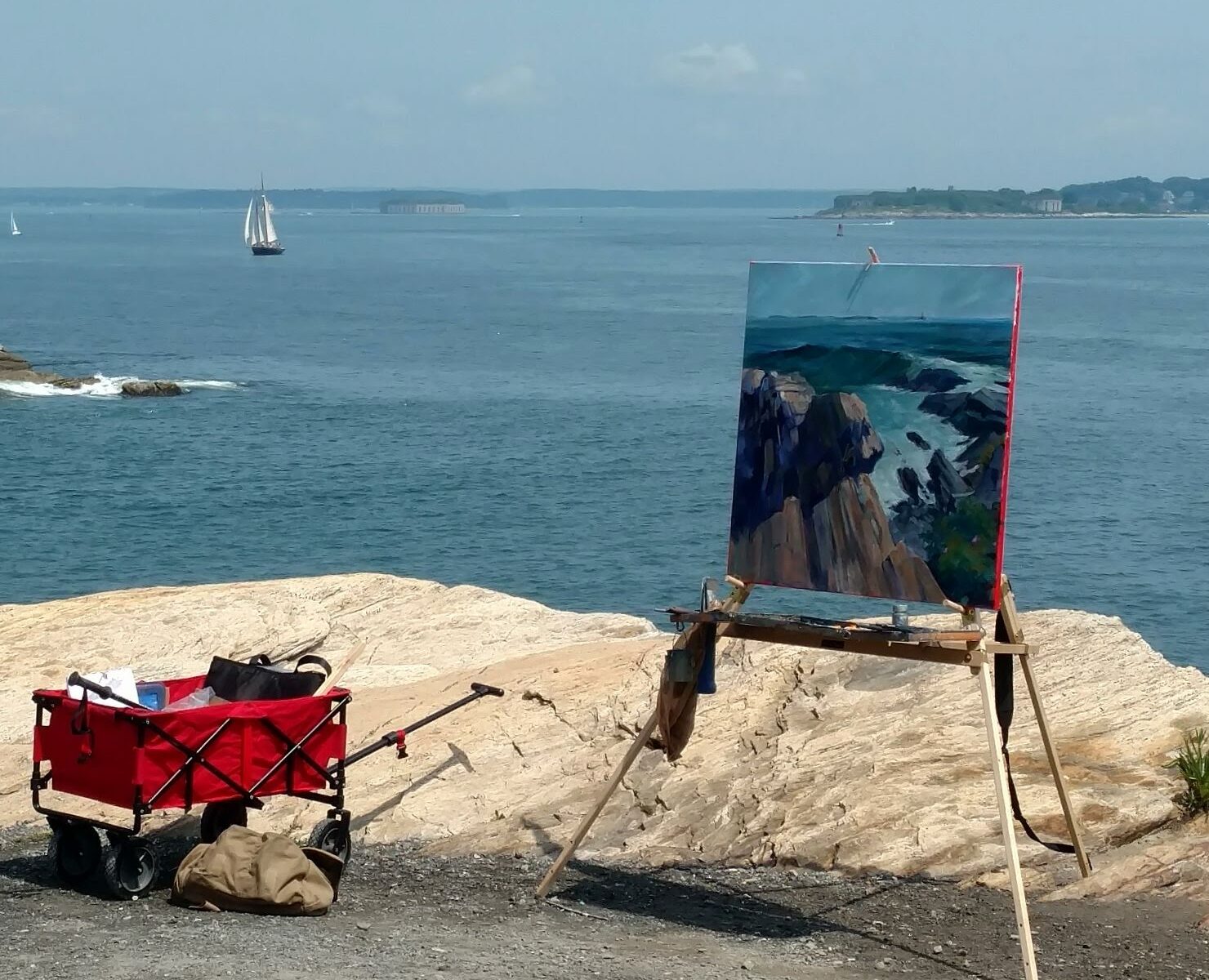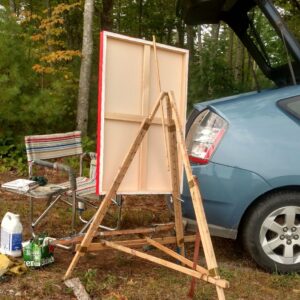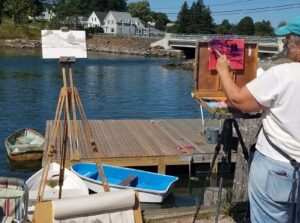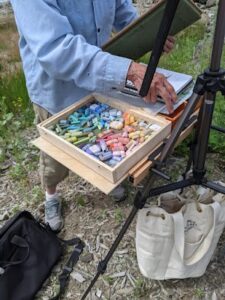

I finished last week’s workshop with a plein air easel show-and-tell at my gallery, because a recurring question is, “what kind of easel is best for me?”
There’s no one-size-fits-all answer, so before you start looking, ask yourself these questions:
- What size paintings do you typically do outdoors? There are maximum sizes for each plein air easel, and they don’t perform well once you exceed that.
- What medium do you use—oil, acrylic, watercolor, gouache or pastel?
- Do you prefer fast setup and light weight, or something more stable in high winds?
- How do you usually travel to paint?
- Park-n-paint, where you paint near or out of your car.
Backpacking or hiking to painting sites.
Flying to workshops.
- Park-n-paint, where you paint near or out of your car.
- How frequently will you paint outdoors? A daily painter needs a more stable plein air easel than a once-a-month painter.
- How handy are you? Paint boxes are simple; a good craftsman can build or modify most designs. However, if you don’t know which end of the screwdriver means business, you’re better off buying one off the shelf.
Remember, all plein air easels and pochade boxes are compromises, which is why I’ve ended up with so darn many of them.

Watercolors vs. oil painting
Watercolor painters who work small may need no plein air easel at all; they can do just fine with a folding chair and their work on their lap. If you plan to work larger, a pivot head is important. There are a number of options for this, including the Mabef M-27 field easel (here at Dick Blick, here at Amazon). It can hold a full sheet of watercolor paper on a Gatorboard support and the angle adjusts very quickly. It’s also usable for other mediums, but there are easier plein air easels for oils and acrylics. Also, balancing a palette on its arms is sometimes an exercise in frustration.
Pivot heads are not just for watercolor
There are several other pivot-head systems on the market, and I generally like them because they divorce the support from the often-heavy paint box. The Leder easel at $159 (not including the tripod) is reasonably priced for a solid, stable, painting system. It can hold a canvas up to 24″ tall, which is large enough for most plein air work. You must buy your own tripod and paint box, but that has some advantages. You’re not hauling around a heavy wooden box, because you can pair it with a Masterson Sta-Wet palette box, which is far lighter. It’s also a great system for pastels, because it allows you to use your existing pastel box. In fact, you can flip between media quickly. (Ed says that if you use the code Carol10, you’ll get a 10% discount.)

Guerrilla Painter boxes are rock solid but too heavy for me (I just gave my last one to a friend). They do make a fabulous support, the No. 17 Flex Easel. It still requires a tripod with a pivot head and some kind of box, but En Plein Air Pro makes an excellent shelf that will hold your stuff.
Another option in this family is the Coulter Art Box, which has a pivot head and a box with a wraparound support that grabs the legs of your tripod.
This is where being handy is helpful; many artists have modified or built flat paint boxes at a fraction of the cost of an off-the-shelf version. I built mine.
Pochade boxes
There’s so much variety in pochade boxes that I can’t possibly mention every choice. For most fieldwork I use an Easy L box, which I have in three sizes, including an 8X10 that’s light enough to backpack. I bring an Easy L box when I’m flying.
The New Wave u.go pochade is a simple, elegant design, but even the largest is really only suitable for smaller work. Its mixing area is very shallow; that’s a problem if you use lots of paint. However, the palette does lift out so you can freeze it, and it’s lightweight.
Strada makes the only aluminum pochade boxes that I know of. That’s a pity, because aluminum is less prone to moisture damage than wood. It doesn’t result in much weight savings, however.
About your tripod
A good carbon-fiber tripod and a ball head with a quick-release plate may set you back more than your pochade box. The good news is that they’re lightweight, stable, and almost indestructible. I have only one; I swap it out every time I change pochade boxes.

Gloucester-style easel
For years, I used a cheap knock-off of the Gloucester easel. Mine finally snapped in a high wind. The replacement was so warped that I returned it. If you want this style easel, you need the Take-It Easel.
The Gloucester-style easel is invaluable for large work or windy days, but it’s too heavy for me to carry very far. Weight is the big reason so many artists use the park-n-paint approach to plein air. It’s easy, but it’s limiting.
What not to buy
I’ve written about how Google drove me toward inexpensive and fatally-flawed Meeden pochade boxes. It’s always frustrating to watch students struggling with terrible equipment..
Many people have been given a French box easel by loving friends or relatives. If you have one, by all means use it, but don’t voluntarily inflict one on yourself. They’re heavy and difficult to set up. Pochade boxes are lighter and nimbler.
Registration is now open for workshops in 2026! Reserve your spot:
- Find your Authentic Voice in Plein Air | Berkshires, MA, August 10-14, 2026
- New! Color Clinic 2026 | Rockport, ME, October 3-4, 2026
- New! Composition Week 2026 | Rockport, ME, October 5-9, 2026
Can’t commit to a full workshop? Work online at your own pace: