Who painted it better?

The Hay Wain, 1821, John Constable, courtesy National Gallery (London). This picture was one of three Constables selected for the Salon of 1824.

A recent op-ed piece by Waldemar Janusczak says that J.M.W. Turner would defeat John Constable in three rounds, based on his early talent, his breadth of travel and style and his influence on future painters. Stuff and nonsense, I say.

Modern plein air painting

Artists have been sketching outdoors for as long as there has been art, but Constable was the seminal figure in making it a movement. He made outdoor painting central, systematic, and intellectually serious. Since plein air painting has been the most important movement in figurative art since his time, that makes his influence at least as important as Turner’s influence on abstraction.

Before Constable, outdoor work was preliminary. Field sketches were to be improved, idealized, romanticized and rearranged in the studio to suit classical taste. The natural world was a reference, not the final authority.

Venice: The Dogana and San Giorgio Maggiore, c. 1834, JMW Turner, National Gallery of Art (Washington, DC)

Constable believed that nature itself was the subject. He painted it as investigation, not as rough notes. His famous cloud studies were often dated, timed, and annotated with weather conditions. His approach was revolutionary.

In the early 19th century, working outdoors at scale was unheard of. So was taking the landscape of your home seriously. Instead, aspiring artists (like Turner) made the obligatory grand tour of Europe, focusing on Italy. The real issue is how far they traveled artistically, and the answer for both is: very far indeed.

French painters at the 1824 Salon were stunned by the freshness of Constable’s palette, his broken brushwork and the rawness of his field studies. These could only come from the real observation of nature. This directly inspired the Barbizon School painters, who in turn passed these ideas along to Impressionism. Constable may seldom have left England, but his work sent ripples across Europe. Without his insistence on painting outdoors, modern landscape painting would look very different today.

Seascape Study with Rain Cloud, c.1824, John Constable, courtesy Royal Academy of Arts (London)

Today, plein air has a vast global influence, being both participatory and accessible. What it isn’t is avant garde. Perhaps that makes it less important to art critics. 

False framing

Turner was born in April, 1775 and Constable in June, 1776, making these their 250th birthdays. It’s tempting to see them as rivals, but any kind of competitive comparison is a false framing. It misrepresents what art and artists are all about.

Turner and Constable were very different painters, not opponents in a zero-sum game. Yes, there’s a famous story from the Royal Academy Exhibition of 1832 where Turner saw Constable’s warm canvas set against his own cool canvas. The legend goes that Turner slapped a blob of red onto his canvas at the last moment and Constable quipped, “He has been here, and fired a gun.” But that says more about gossip culture than it does about the two men.

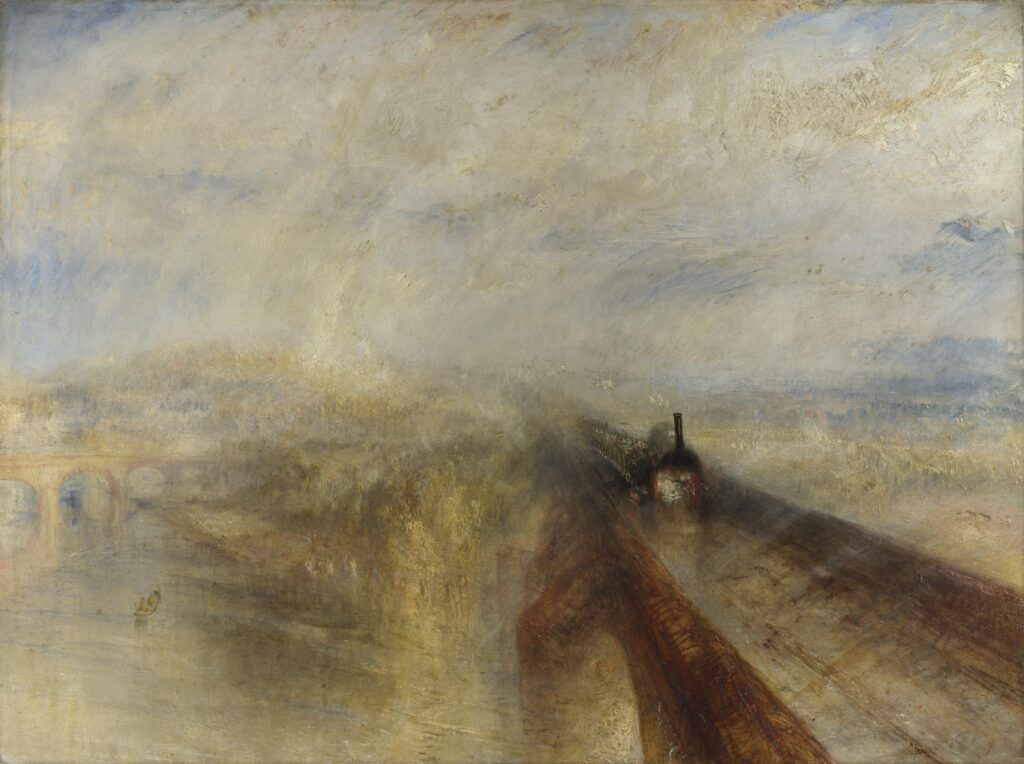
Rain, Steam and Speed – The Great Western Railway, 1844, JMW Turner, courtesy National Gallery (London)

Why do winner-loser narratives persist in the world of art criticism? They’re easy clickbait. They fit tidy tropes but they distort a deeper truth. There is no hierarchy of greatness when it comes to painters. They all have audiences to whom they speak and lessons they impart.

Framing art in terms of competition is pernicious, whether that competition is a local art show or a master-painter designation by an organization. It makes painters take fewer risks, work towards the mainstream, and constantly look over their shoulders.

Registration is now open for workshops in 2026! Reserve your spot:

Can’t commit to a full workshop? Work online at your own pace:
Seven Protocols for Successful Oil Painters

Monday Morning Art School: what we can learn from JMW Turner

The Fighting Temeraire tugged to her last berth to be broken up, 1838, J. M. W. Turner, courtesy National Gallery

We’ve just marked the 250th birthday of Britain’s great Romantic artist, Joseph Mallord William Turner. As with so many great painters, Turner really didn’t become Turner (the prefigurer of modern painting) until he was closing in on old age. While there are many lessons to be learned from his work, here are two that stand out to me:

The Fighting Temeraire

The Fighting Temeraire was once voted Britain’s favorite painting. It’s featured on the £20 banknote, which also includes the Turner quote, “Light is therefore colour.”

The painting shows the 98-gun HMS Temeraire being towed up the Thames by a paddle-wheel steam tug, to be broken up for scrap. The Temeraire was one of the last second-rate ships of the line left from the Battle of Trafalgar in 1805. Her role had been pivotal in the deadly sea battle between the British Royal Navy and the fleets of Spain and France. Vice-Admiral Horatio Nelson was killed when his flagship, HMS Victory, was battered by the French ship Redoutable. In response, Temeraire surged forward, raking Redoutable with grapeshot, causing her to strike her colors. The victory confirmed British naval supremacy and prevented Napoleon from ever again considering invading England.

The Fighting Temeraire is generally taken as an elegy for faded national glory. But modern interpretations focus on Turner’s admiration for newness, as epitomized in Rain, Steam and Speed—the Great Western Railway. In that view, Turner was actually painting the steamship and arguing for leaving the past behind.

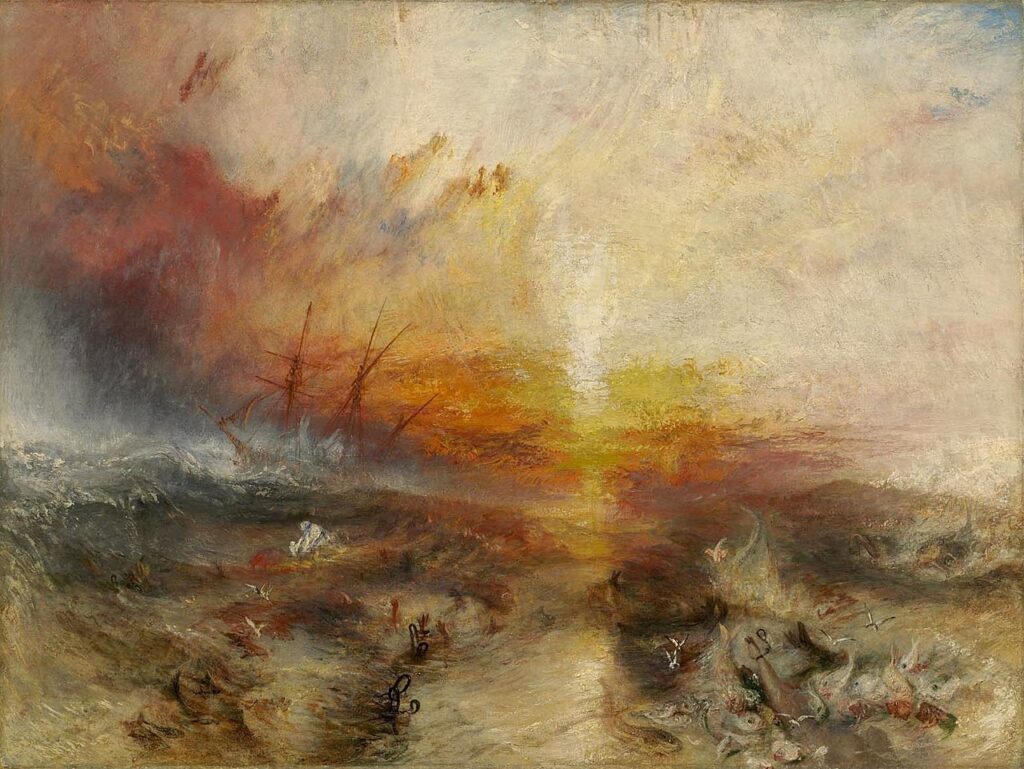
The Slave Ship, 1840, J. M. W. Turner, courtesy Museum of Fine Arts, Boston

The focal point is not always the subject

Yes, the main focal point of The Fighting Temeraire is inarguably the steamship; it’s the passage with the greatest contrast. (It, and the amorphous shape in the foreground right and the sun on the horizon are the three focal points, forming a strong triangular composition.) But that doesn’t make it the subject of the painting. Turner explicitly tells us otherwise with his title and the careful prep work he did for the painting. The moonlight, the wrecker’s flag (not the Union Jack) and the detail on the Temeraire tell us we’re to read this all of a piece, together. Long before anyone talked about focal points and subject, he was playing them against each other to make a complex statement.

Rain, Steam and Speed – The Great Western Railway, 1844, J. M. W. Turner, courtesy National Gallery

Making the jump from linear to painterly

Painterly vs. linear is not a quality distinction, but rather a stylistic distinction.

A painting is linear when it uses skillful drawing, shading and contour to create the illusion of dimensionality. Painterly means there are visible brushstrokes, less control, and more impulsive color. While there have always been artists on the painterly side of the divide, the real historic divide is with the Impressionists, who slewed off into painterliness in the latter half of the 19th century. We have, for the most part, stayed on that side ever since.

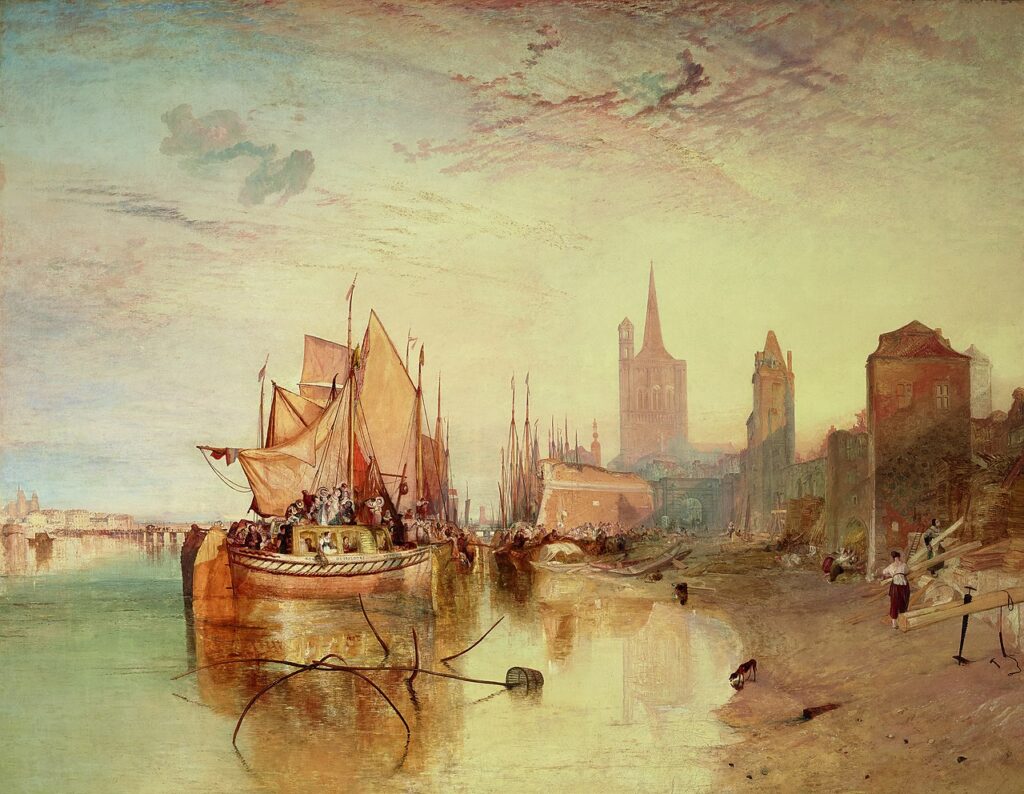
Like his peers, Turner was a linear painter until sometime in the mid-1830s, when suddenly he wasn’t anymore. The mature Turner stopped painting line and became a painter of mass, tone and light. He treated land, air, and water, as if they were all one. “Indistinctness is my forte”, he said. This being the onset of Victorian England, with its rising tide of realism and of sentimental Landseers and Pre-Raphaelites, it’s hard to imagine how he struck out in such a unique direction.

Turner when he was linear: Cologne, the Arrival of a Packet Boat in the Evening, c 1826, J. M. W. Turner, courtesy The Frick Collection

Did Turner wake up one morning and decide to make soft miasmas of color? No; you can see hints of this in earlier paintings. Somehow, by poking at it, day in and day out, he came up with something new to himself and everyone else. We can learn a lot about painterliness from studying his paintings, but ultimately we have to do the studio time, too.

Registration is now open for workshops in 2026! Reserve your spot:

Can’t commit to a full workshop? Work online at your own pace:
Seven Protocols for Successful Oil Painters