Painting the living language of canyons and buttes

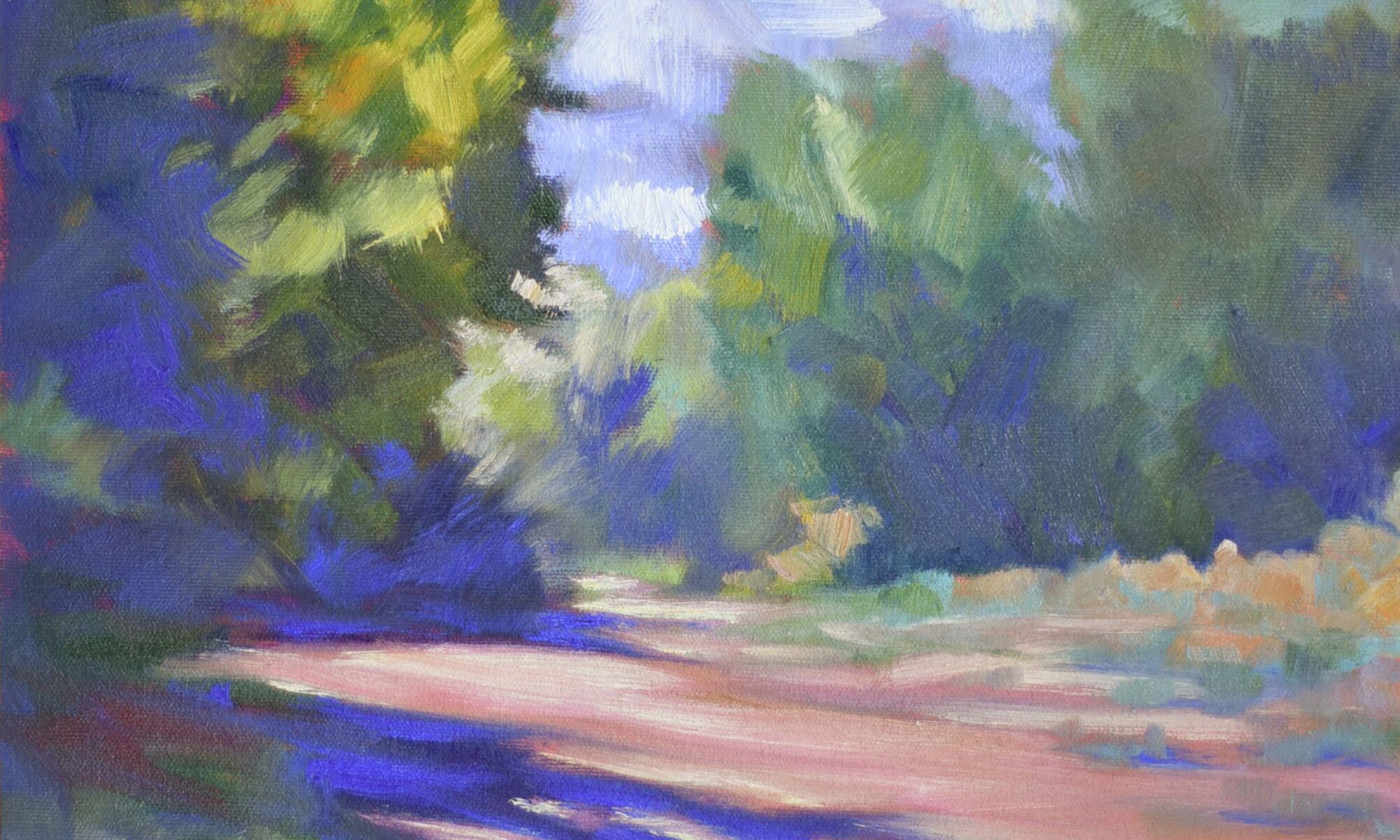
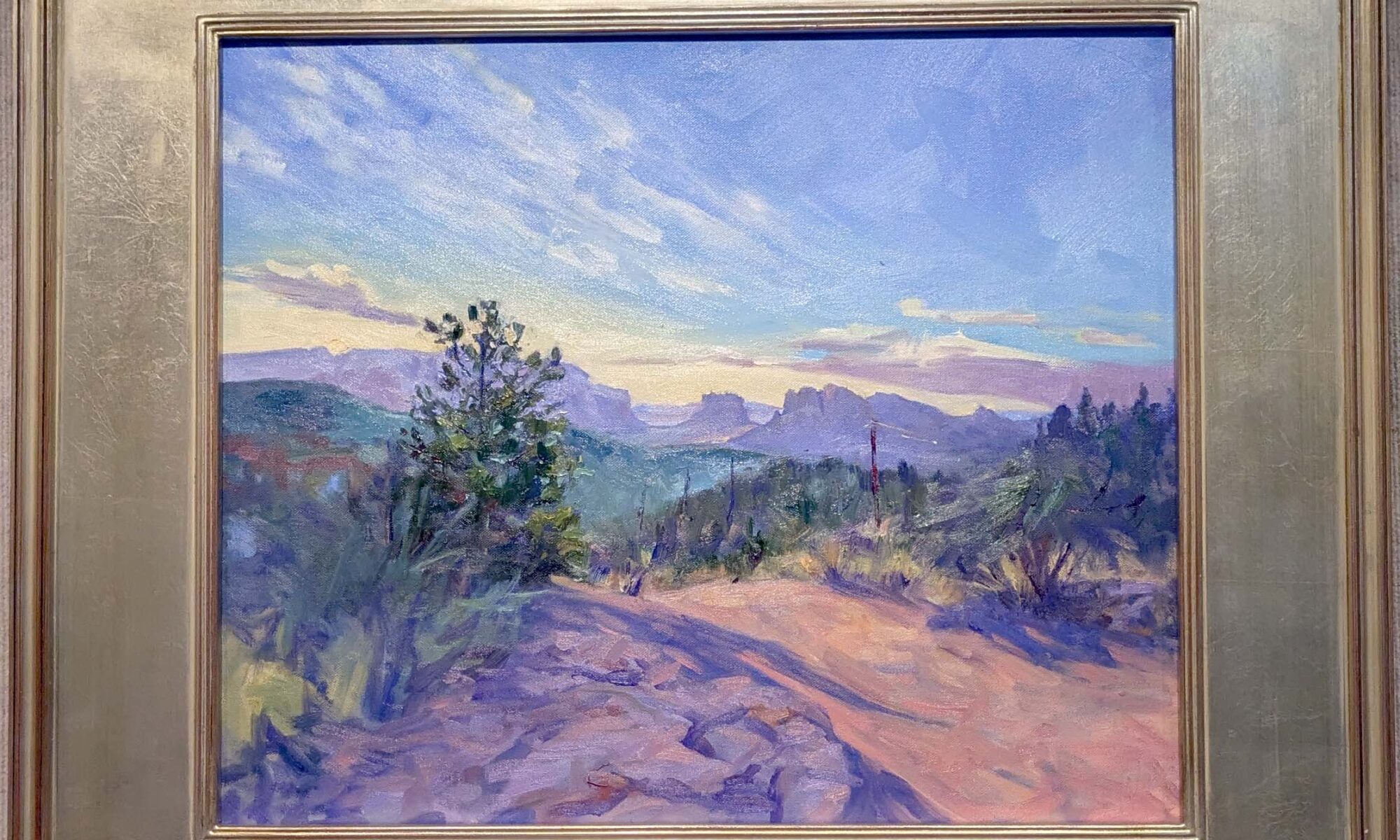
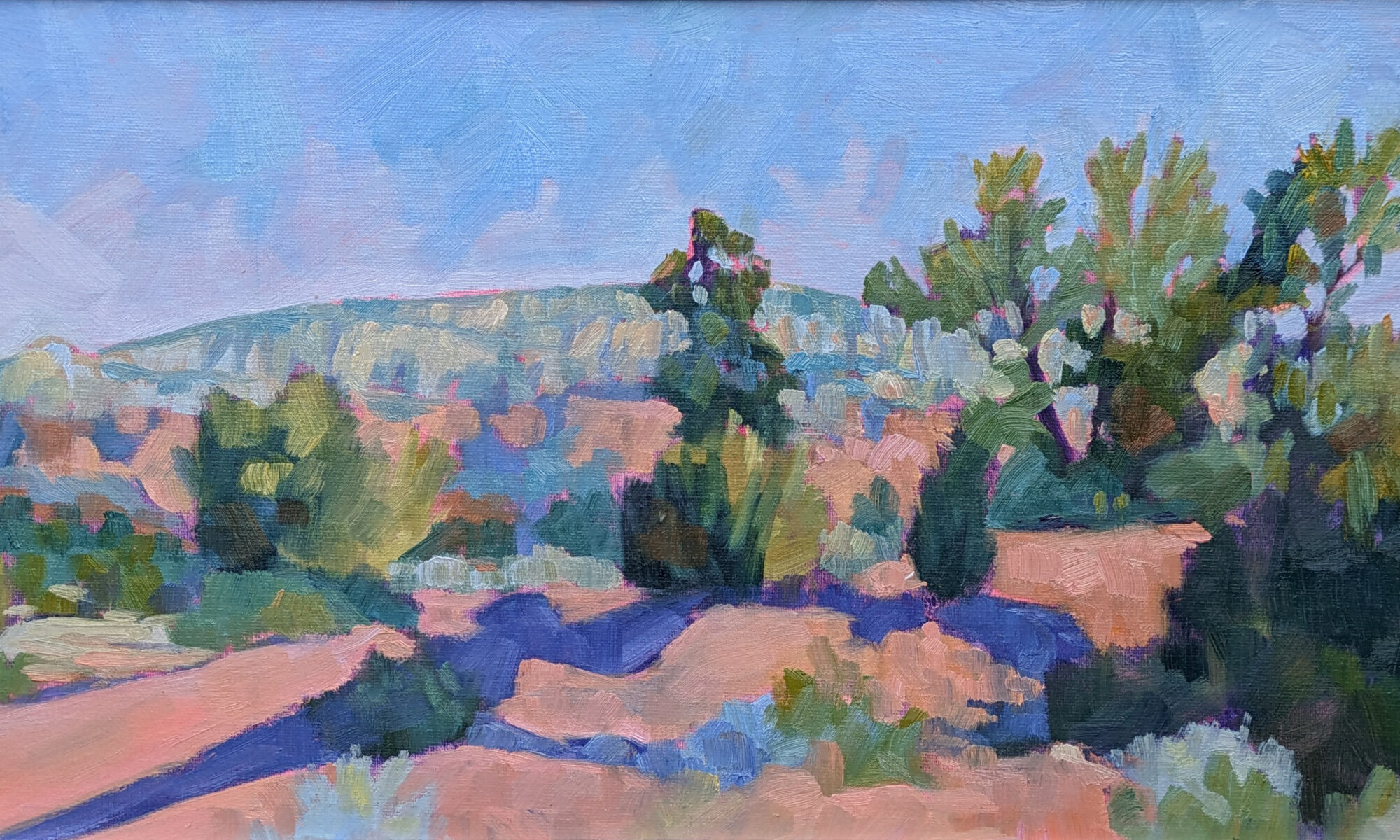
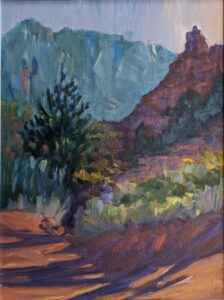
Along Boynton Canyon Road, 9X12, oil on birch, available through Sedona Arts Center.

Geologic time is humbling. It took more than 300 million years to make the layer cake of sandstone, siltstone, and limestone that eventually became the Schnebly Hill formation in Sedona. The tectonic uplift and erosion that carved it into what we see today took 80 million years. Compared to that, our own span of existence is impossibly short.

The shapes and colors of the red rocks of the Colorado Plateau are astonishing. This is iron-rich sandstone. It catches the light and shifts from cool violets to blazing oranges and reds. There are hoodoos and spires, canyons and buttes. Although they change at a sub-glacial pace, there is movement and rhythm written all over them.

Every time I’m in Arizona to paint, I understand their form a little better. Oak Creek Canyon isn’t just a cavernous hole, and the massifs are not simply towering shapes. They are dynamic, the very language of color, light and geological poetry.

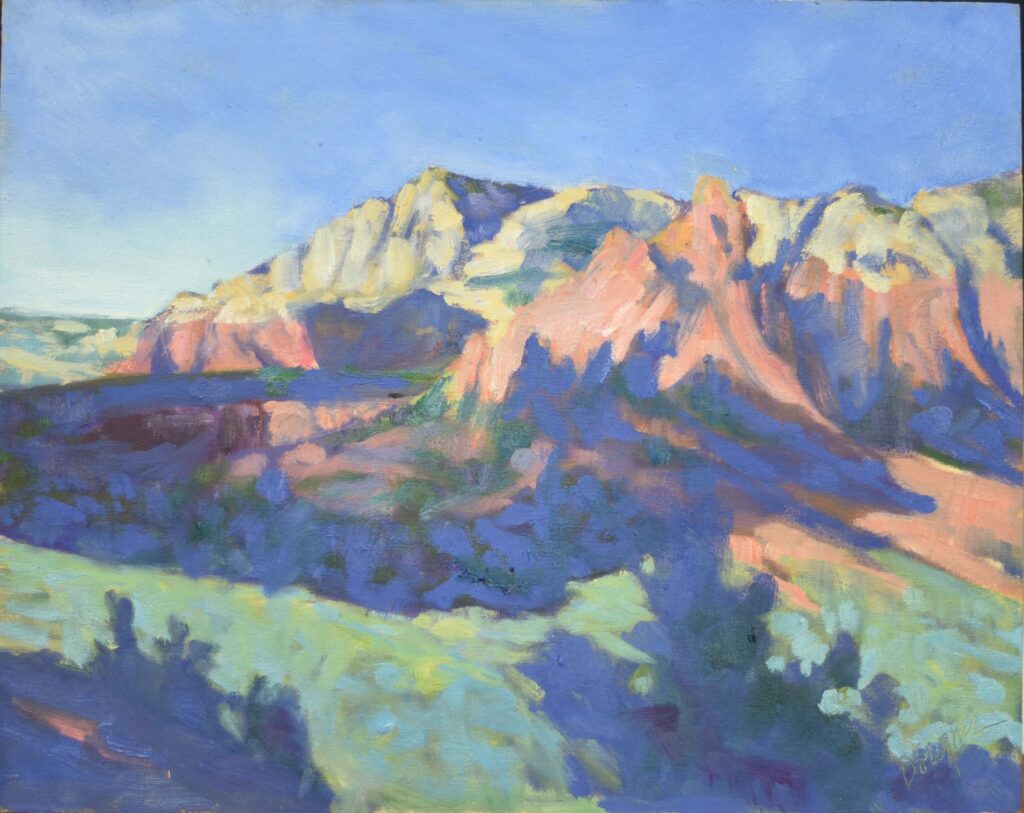
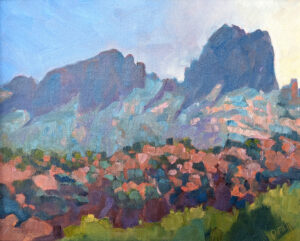
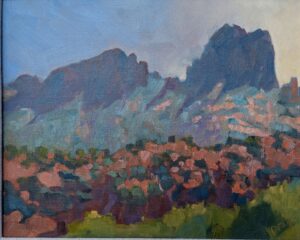
Cliffs, 12X12, oil on birch, private collection.

The dialogue between earth and time

Many Native Americans viewed rocks as animated, rather than inanimate. The Ojibwe considered rock formations and cliffs to be alive with unseen spirits. Algonquin-speaking peoples used terms like manitou to describe the spiritual power that rests everywhere, including within ‘spirit stones.’ I don’t think of rocks as alive in that sense, but I can read their geology well enough to picture how they’re constantly in motion.

The dialogue between earth and time is difficult to paint. Since reference photos don’t adequately describe the scale or light, painting the high desert requires actually being there. The dust-dry air of Sedona filters light in ways you can’t fully grasp until you’ve seen it firsthand. Shadows have a cool clarity, and highlights sing with warmth and saturation.

Then there’s the swift movement of the light, in the warm glow of dawn against a cliff face or the shifting shadows that move across layered rock strata. It helps to visualize these gigantic rock formations as vast theaters of shifting color and contrast.

Carol L. Douglas painting at Acadia National Park
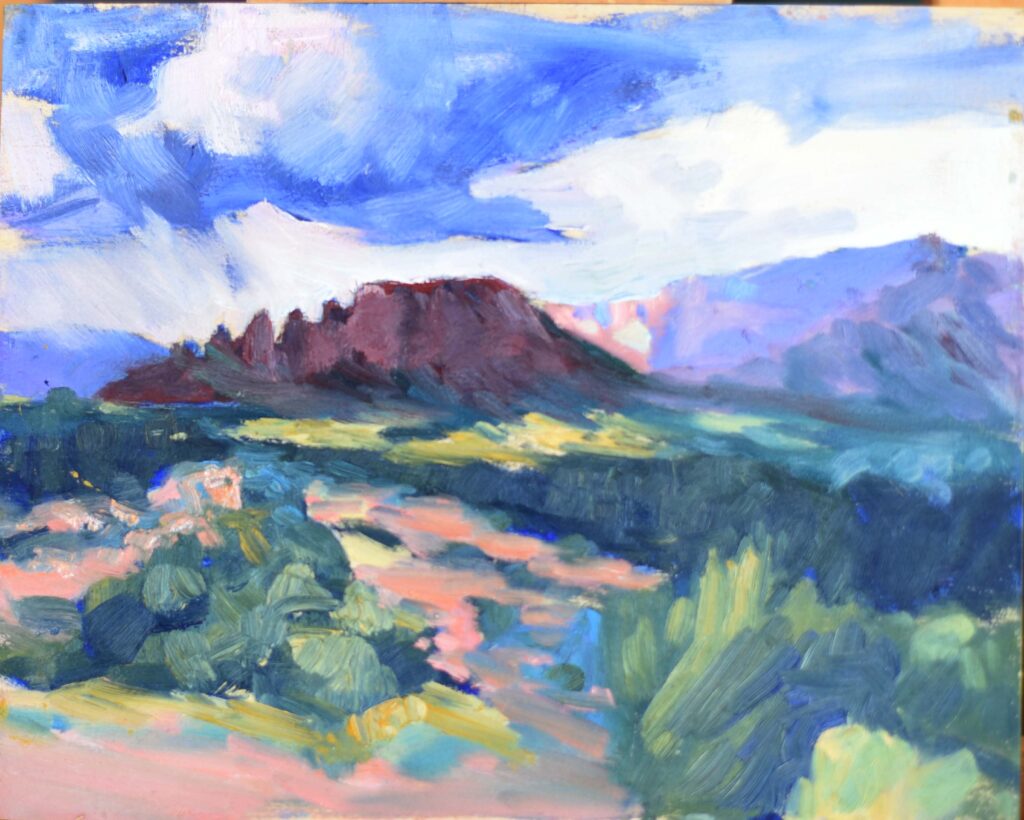
Sunlight and shadows, oil on birch, 14X18, private collection.

They are complex compositions of value, edge and form. Shifting, reflected light, atmospheric perspective and above all the rhythm of shapes tell their story. I find the long views to be the most difficult subject (which is why I return to them over and over). Done right, the towering forms are a scaffold, the story moving from foreground to midground to distant horizon, each plane with its own emotional tone. That’s why I think paintings capture the high desert better than photos do.

In plein air painting, every form is a challenge—to simplify the complexity, balance the hard edges of rock against the fleeting softness of cloud shadows, or make deep crevices feel alive on a modest 9×12 panel. Canyons and buttes become conductors of color relationships, inviting you to push beyond the literal.

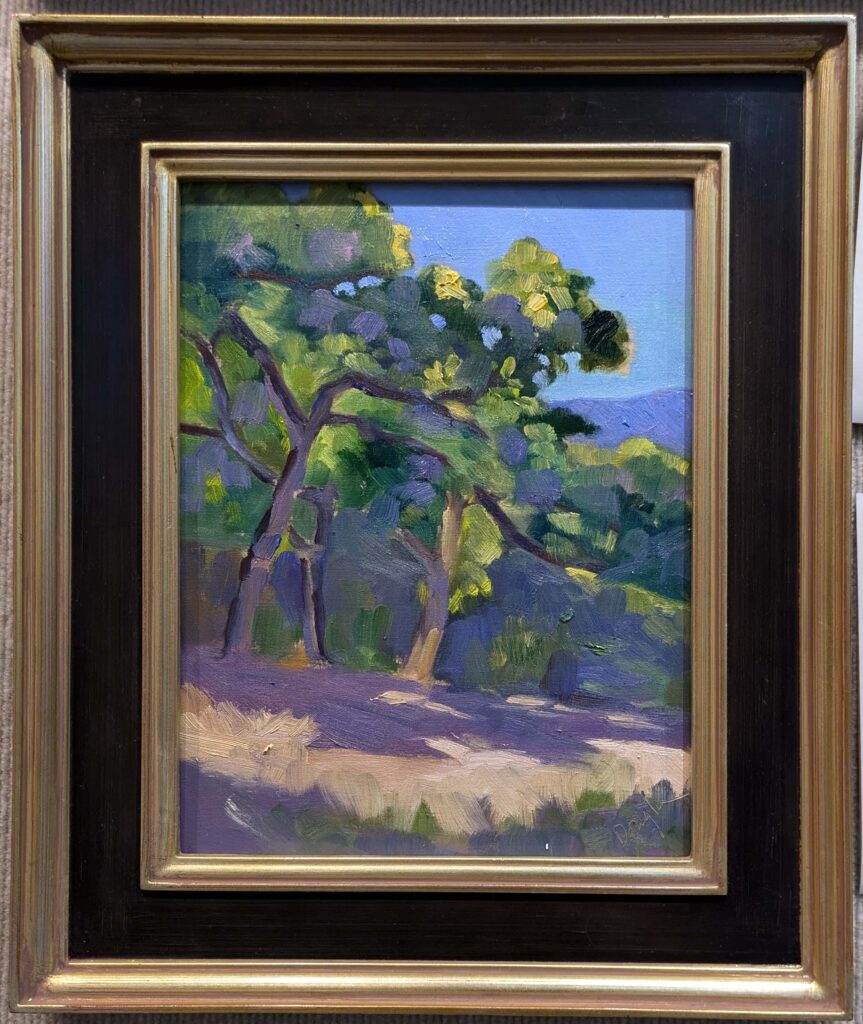
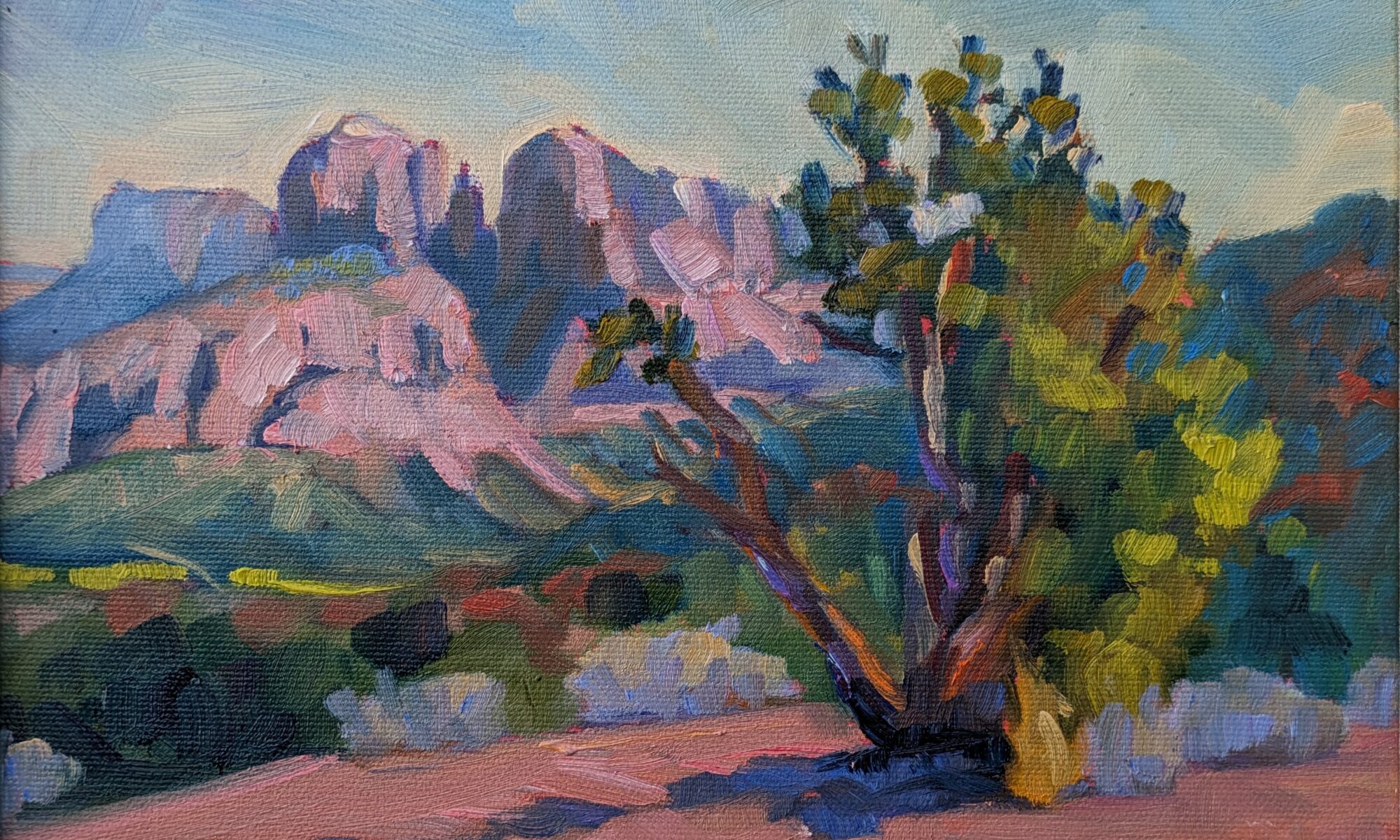
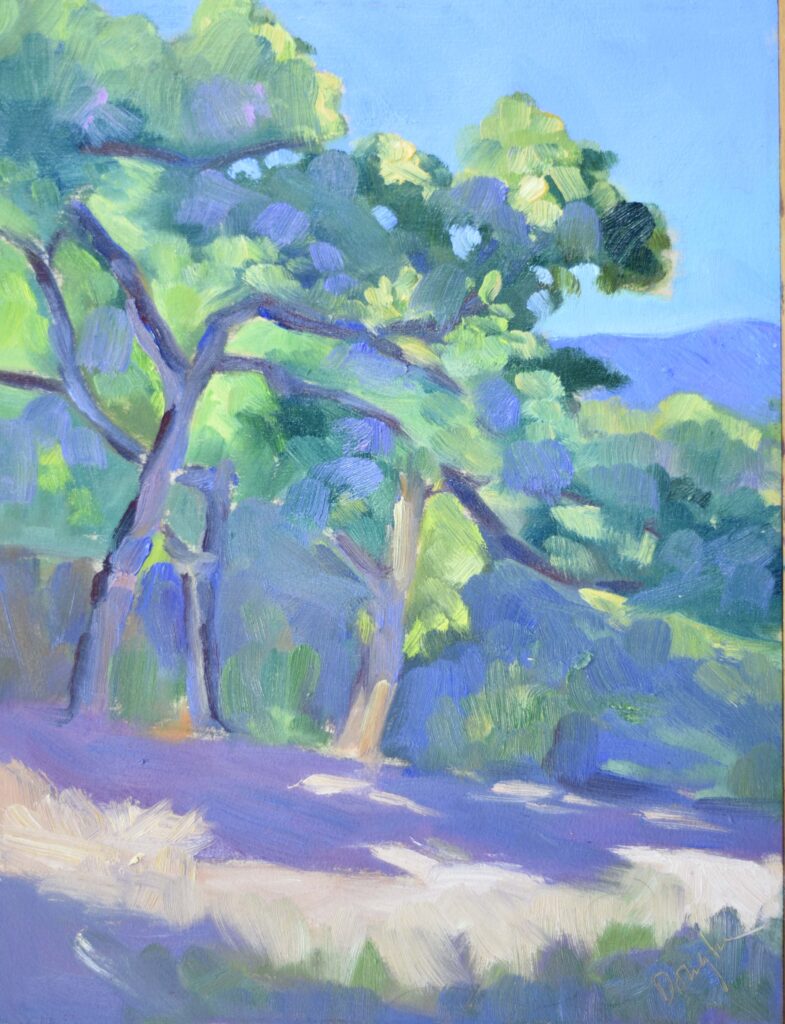
Lone pines, 14X18, oil on birch, available through Sedona Arts Center.

If you’ve ever felt the tug of a landscape, if you’ve ever wanted to paint buttes, spires and hoodoos, or if you’re just plain cold after this long winter, I invite you to join me for Canyon Color for the Painter: a Plein Air Workshop at the Sedona Arts Center, March 9–13, 2026. You’ll learn to lead with color, build compelling compositions, and translate the hidden symphonies of light and land into your own plein air paintings. Register now and let the canyon teach you to paint with deeper insight and confidence.

Registration is now open for workshops in 2026! Reserve your spot:

Can’t commit to a full workshop? Work online at your own pace:
Seven Protocols for Successful Oil Painters

Seeing, brushwork and color are the painter’s trifecta

The Fleeting Hand of Time, 9X12, oil on archival canvasboard, $696 includes shipping and handling in continental US.

Most painters stall because they’re trying to solve too many problems at once. Students make real leaps forward when they start building skills in a sensible order. That’s what this trio of learning opportunities is designed to do.

Color, brushwork and composition are a three-legged stool. You must learn to see, orchestrate color and express your ideas with confidence.

Mather Point at dawn (Grand Canyon), oil on canvasboard, 9X12, , $696 includes shipping and handling in continental United States.

How to See Like a Painter (Zoom class)

Everything starts with perception. If you can’t see clearly, no amount of technique will save you. How to See Like a Painter is an interactive online painting class focused on visual analysis. That’s a skill most artists ignore, yet need the most.

We will dig into value relationships, shape and focal hierarchy, edges and—most importantly—the difference between what you think you know and what you’re actually seeing. Once you understand how to simplify complexity, your decisions will get stronger and faster.

The class meets Monday evenings, 6-9 PM EST on Feb 23-March 2 and March 16-April 6.

Here is more information and online registration.

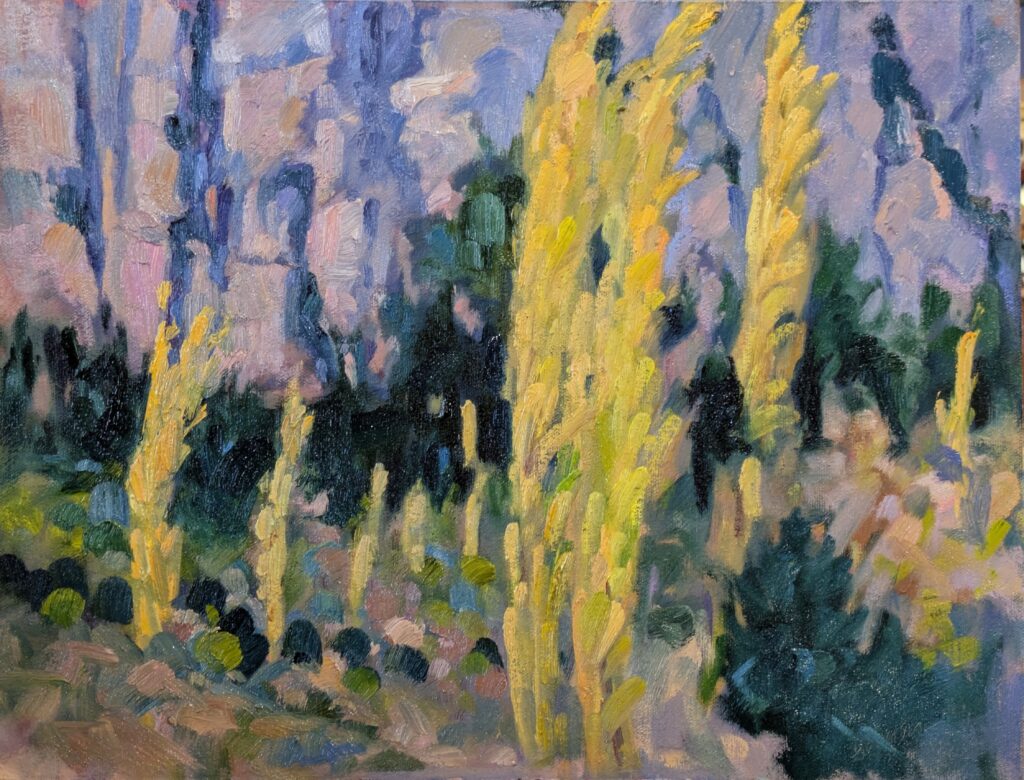
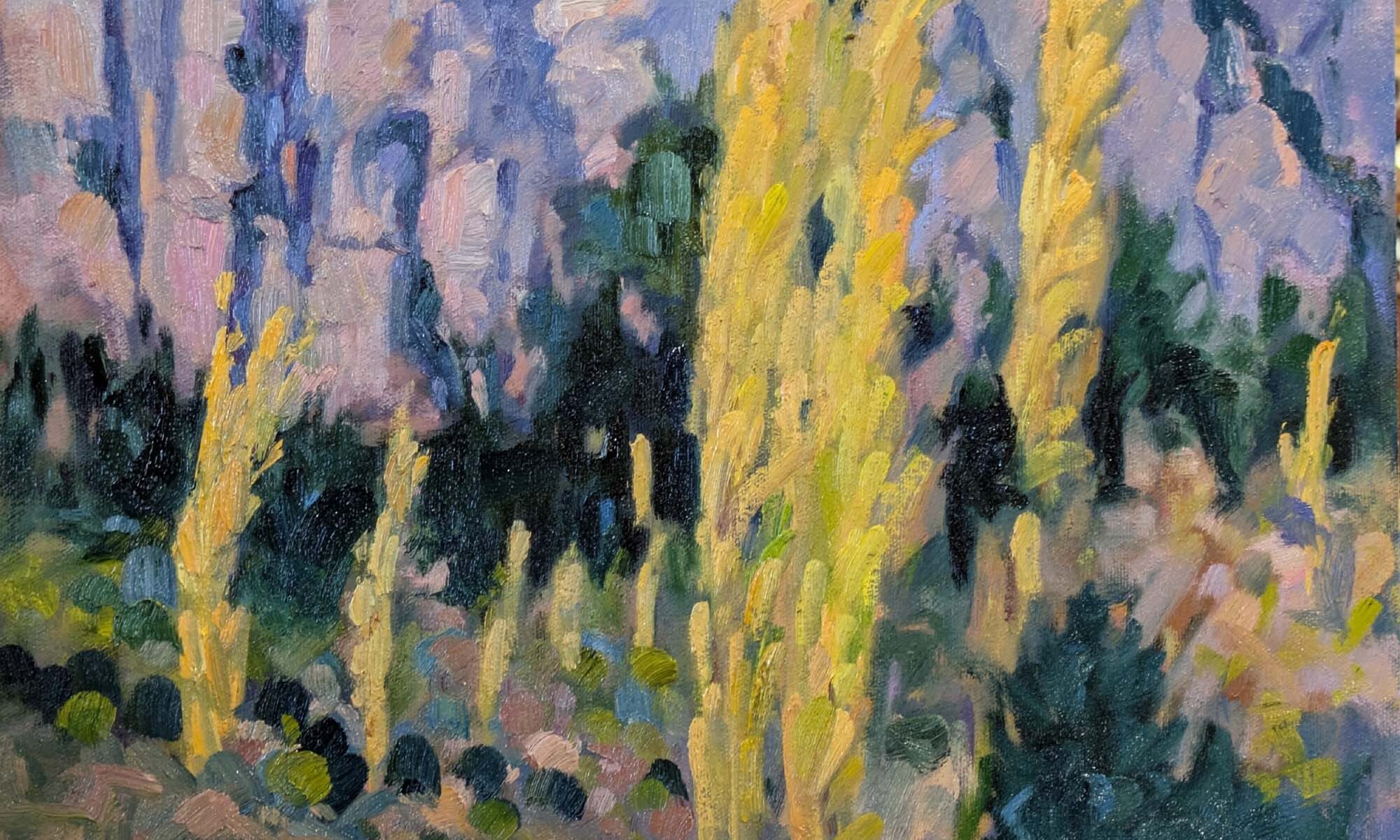
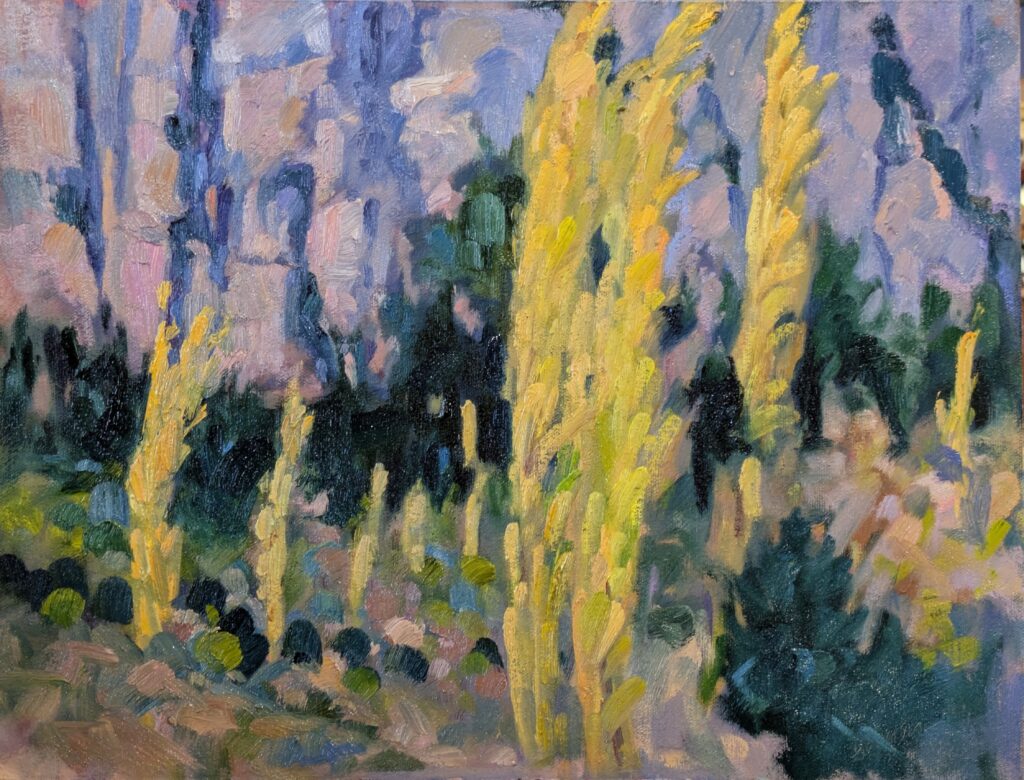
Poplars, 12X16, oils on archival canvasboard, $1159 includes shipping and handling in continental US.

Painterliness, looseness and bravura brushwork (Zoom class)

Painterliness, looseness and bravura brushwork is an interactive online class devoted to expressive paint handling. We talk about economy, confidence, and when to set it and forget it. Looseness isn’t sloppiness; it’s clarity delivered with energy.

This class helps you escape overworking and replace it with confident, readable brushwork. You’ll learn how to load the brush, commit to a stroke and let your surface do some heavy lifting. If your paintings feel tight, stiff or hesitant, this class is for you.

The class meets Tuesday evenings, 6-9 EST on Feb 24-March 3 and March 17-April 7.

Here is more information and online registration.

For either Zoom class, we have had students from across the US and Canada and Great Britain. If you can tune in at those times and are fluent enough in English to talk about art, we’d love to have you join us.

Canyon Color for the Painter: A Sedona Plein Air Workshop

Why is there a one-week break in middle of these Zoom classes? I’m heading to Sedona, AZ to teach Canyon Color for the Painter: A Sedona Plein Air Workshop, March 9-13.

Sedona is one of the most demanding and rewarding outdoor classrooms on earth, which is why I love it. The desert doesn’t forgive lazy color thinking. Light is strong, shadows are crisp, and color temperature shifts happen fast.

In this workshop, we focus on color strategy: how to simplify without dulling, how to exaggerate without lying, and how to organize color so your painting reads brilliantly from across the room. You’ll apply new skills directly to the landscape, with real-time feedback and lessons. I keep my workshop numbers low enough to give every person individual attention. Sign up quickly, as this workshop is filling fast.

Cottonwoods along the Rio Verde River, $696 unframed, oil on Baltic birch.

Which one should I take?

In a perfect world, you’d have the time and energy to take all three. Together, they address the core problems all painters face: unclear seeing, timid execution and confused color. But I know that’s not practical.

Ask yourself which of these core problems you need the most work on: brushwork, composition or color. And then register for the class which will help you the most. If I can help you with your choice, email me.

(Frankly, looking at this weekend’s brutal temperatures in the northern US, I’d also factor in the desert warmth. Southwest has a fare sale until Friday. 😉)

Registration is now open for workshops in 2026! Reserve your spot:

Can’t commit to a full workshop? Work online at your own pace:

Seven Protocols for Successful Oil Painters

Monday Morning Art School: desert lessons

Cliffs, 12X12, oil on birch, private collection.

Arizona (especially Sedona’s red-rock country) looks simple from a distance. Big shapes. Big color. Big sky. That apparent simplicity is exactly what makes it hard to paint well.

Every landscape has its own rules, and the desert is particularly unforgiving to painters who arrive armed with assumptions instead of observation. I know this because a long time ago I did exactly that. What did the Arizona desert teach me about painting light and color? More things than I can list, but below are the main points.

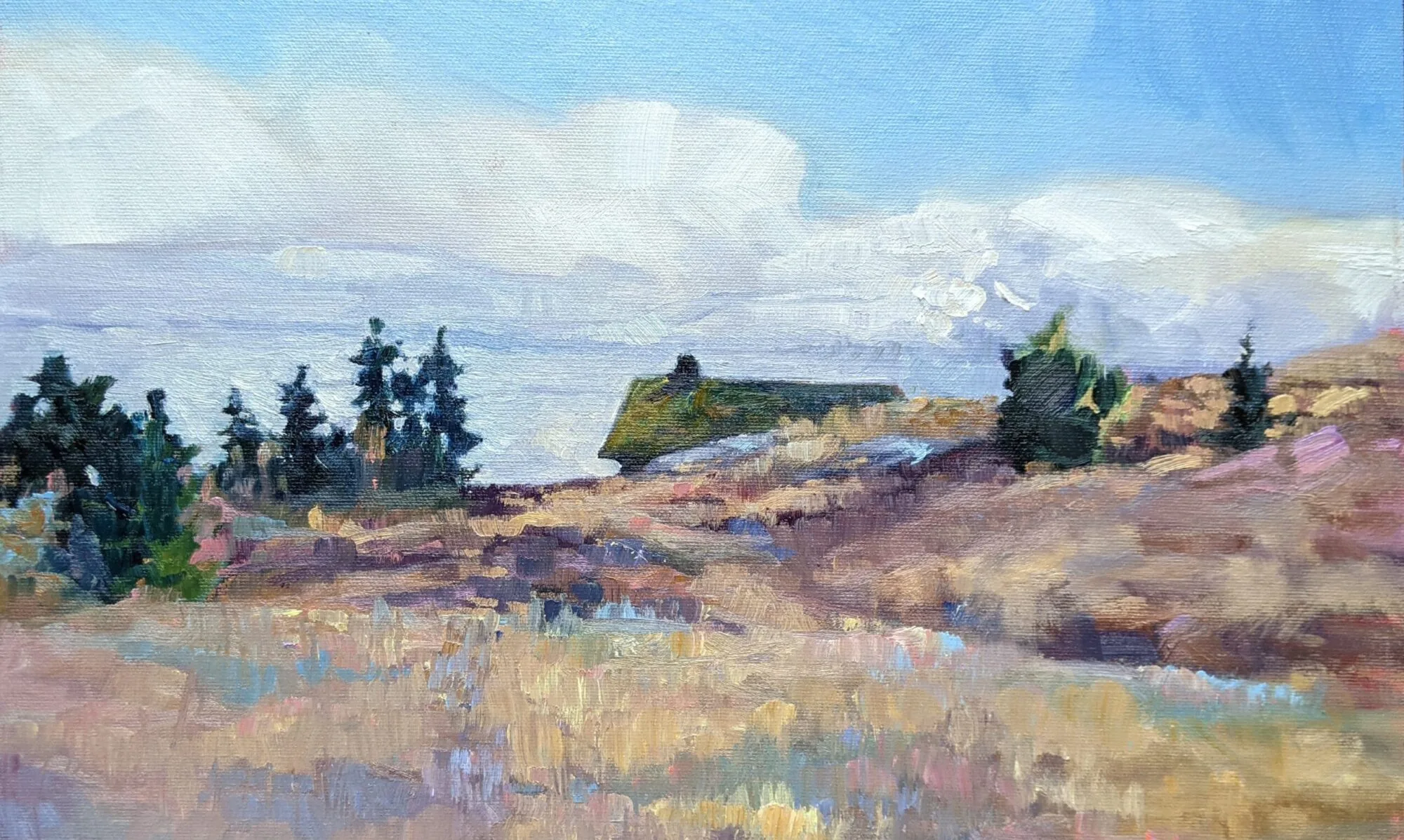
View across the Verde Valley, 11X14, oil on birch panel. Available through Sedona Arts Center.

Capturing desert light 

Capturing desert light starts with understanding that Arizona’s atmosphere is clean, dry, and thin. There’s very little haze to soften transitions. As a result, value contrasts are stronger than you may be used to, and color temperature shifts are abrupt. Sunlit planes are warmer than expected, except at midday. The shadows snap cool, sometimes dramatically so. That’s from a distance. Up close, there’s a tremendous amount of color bouncing around the shadows. They are often higher in chroma than the sun-bleached parts of the picture.

If your painting feels flat, it’s often because you aren’t respecting color temperature enough.

Carol L. Douglas painting at Acadia National Park
Sunlight and shadows, oil on birch, 14X18, private collection.

Painting rock formations 

Painting rocks is less about detail and more about structure. From individual rocks to gigantic massifs, rock formations are built from planes. Start by identifying the major directional faces of the rock and assign them clear value families. Vertical planes can read darker than sloped ones, and ledges catch light differently still. At the vast scale of the desert, texture and detail are almost an afterthought. If you paint every crack and striation, you’ll destroy your painting—and your mind.

Lone pines, 14X18, oil on birch, available through Sedona Arts Center.

Working fast in changing light 

Working fast is not optional in the desert. The light moves quickly, and shadows can crawl across a canyon wall in minutes. This is where the preparatory sketch earns its keep. Adapt it for desert conditions by simplifying even more than usual. Four different value steps are sufficient. If you can’t organize the scene in ten minutes, you won’t fix it in two hours. And you’ll be mighty glad to have that sketch when the light shifts.

Color mixing for arid landscapes 

Color mixing for arid landscapes is where many painters go off the rails. Yes, rocks are orange and bluffs are ochre. But Sedona and the wider Southwest are full of violets, cool reds, muted greens and dusty neutrals. Shadows are often infused with unexpected color. Adjust temperature rather than dialing up saturation. If everything is intense, nothing is.

The desert doesn’t reward fussing. It rewards decisiveness, clear value structure, and honest color. Arizona’s landscape will teach you quickly where your habits help you—and where they don’t. That’s why painters keep coming back. The desert is a tough teacher, but it never wastes your time.

Want to learn more?

This March, I’m leading a 5-day plein air workshop in Arizona, and I’d love for you to join me.

Canyon Color for the Painter: A Plein Air Workshop will be held through the Sedona Arts Center, March 9–13, 2026. This immersive week-long workshop is designed for painters in oil, acrylic, pastel, watercolor, gouache, and all experience levels.

You can register directly on Sedona Arts Center’s website, here. Or, contact me if you have questions. I’m happy to answer anything about the workshop, skill requirements, materials or what to expect painting in the desert.

Registration is now open for workshops in 2026! Reserve your spot:

Can’t commit to a full workshop? Work online at your own pace:

Seven Protocols for Successful Oil Painters

Arizona’s light changes everything

Crepuscular rays from Forest Road 525, 8X16, oil on linenboard. Available through Sedona Arts Center.

Painters think about light the way sailors talk about wind. We don’t perceive either of them directly, but they influence everything we do.

I’ve been painting and teaching in Sedona, AZ for several years now (and am very blessed to do so). There’s something about high desert painting that transforms the way we see color. The warm light and the color of the shadows falling across canyon walls are different from anywhere else. I don’t think that’s just because the light is brighter, although it is. It behaves differently from the filtered light of the northeast.

Sedona’s colors are over the top. There are red rock buttes, sheer ochre cliffs and cool green pines and junipers, all under a brilliant blue sky. That can fool painters into always using the most saturated colors possible. That’s a trap. The real story isn’t the color of the rocks, it’s what the light does to them.

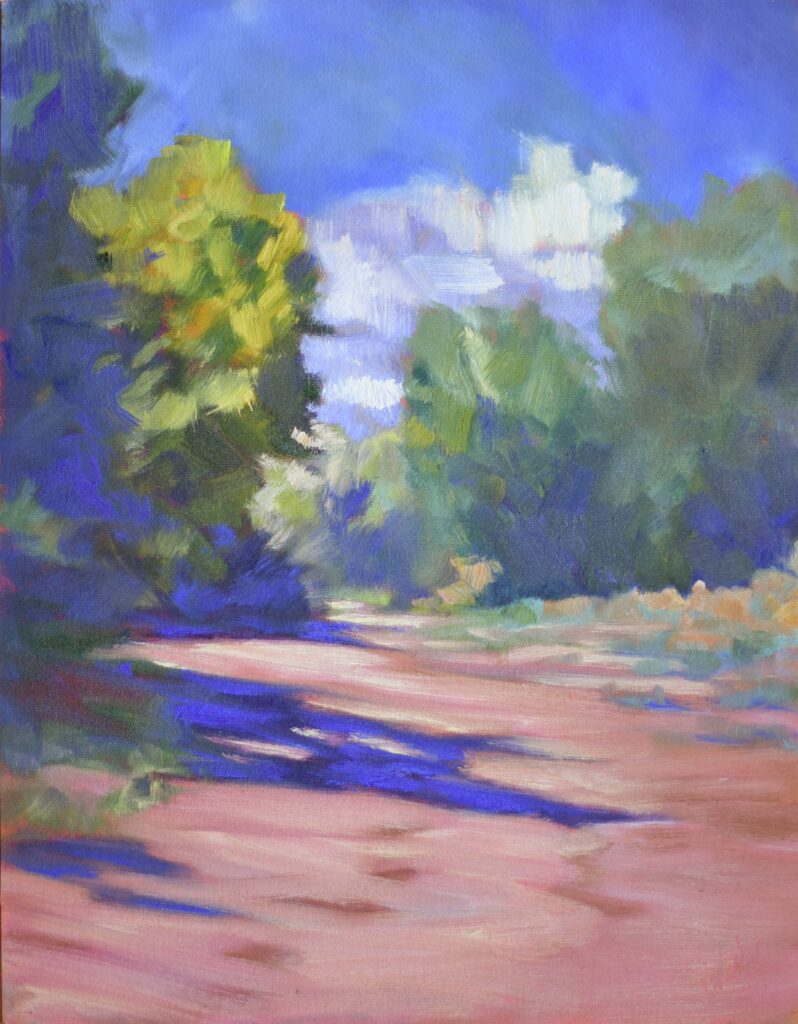
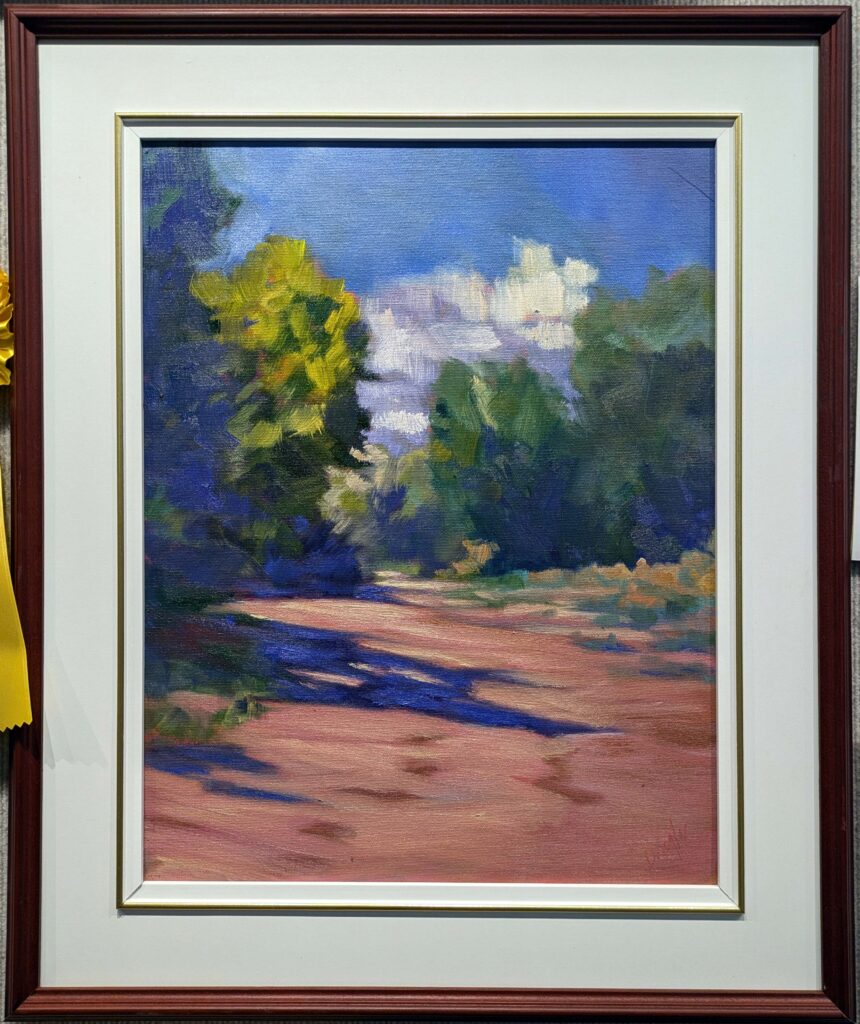
Country path, 14X18, oil on archival canvasboard, $1,275 includes shipping and handling in continental US.

Sedona sits high, dry, and clear. There’s seldom atmospheric haze to soften edges or dissolve forms. As a result, values snap into focus. Shadows aren’t murky or vague; they’re cool, transparent and very colorful. You can’t get away with ho-hum darks.

The intense warmth of the red rocks complicates what we understand about color temperature. They bounce warm light into shadow areas, creating a running dialogue between warm and cool. Shadows contain more color than sun-bleached planes. That’s counter to what we think should happen.

Hammerhead cumulonimbus cloud over Posse Grounds Park, 9X12, oil on canvasboard, available through Sedona Arts Center.

Wanna try it?

This March, I’m leading a 5-day plein air workshop in Arizona, and I’d love for you to join me.

Canyon Color for the Painter: A Plein Air Workshop will be held through the Sedona Arts Center, March 9–13, 2026. This immersive week-long workshop is designed for painters in oil, acrylic, pastel, watercolor, gouache, and at all experience levels.

You’ll master advanced color strategies that elevate your plein air and studio work. Through practical lessons, focused exercises, and daily on-site painting sessions, you’ll gain time-saving techniques, build stronger compositions, and harness color and line to direct the viewer’s eye with authority.

You’ll refine your unique artistic voice while strengthening foundational skills in drawing, observation, and brushwork. Whether you paint boldly or seek more control and clarity, this workshop offers deep insights, supportive instruction and meaningful feedback. And did I mention it’s lots of fun?

Sycamore Shadows, 14X18, oil on archival canvasboard, available through Sedona Arts Center.

Reserve your spot now for an unforgettable artistic journey.

This workshop includes:

  • Demonstration and instruction
  • Supervised plein air painting sessions
  • Targeted exercises
  • Critique and discussion
  • Individual feedback

This is a great opportunity to break out of comfortable patterns and push your skills, all while enjoying the great cultural and natural resources of Sedona.

Questions

You can register directly on Sedona Arts Center’s website, here. Or, contact me if you have questions. I’m happy to answer anything about the workshop, skill requirements, materials or what to expect painting in the desert.

Registration is now open for workshops in 2026! Reserve your spot:

Can’t commit to a full workshop? Work online at your own pace:
Seven Protocols for Successful Oil Painters

Sedona at dawn

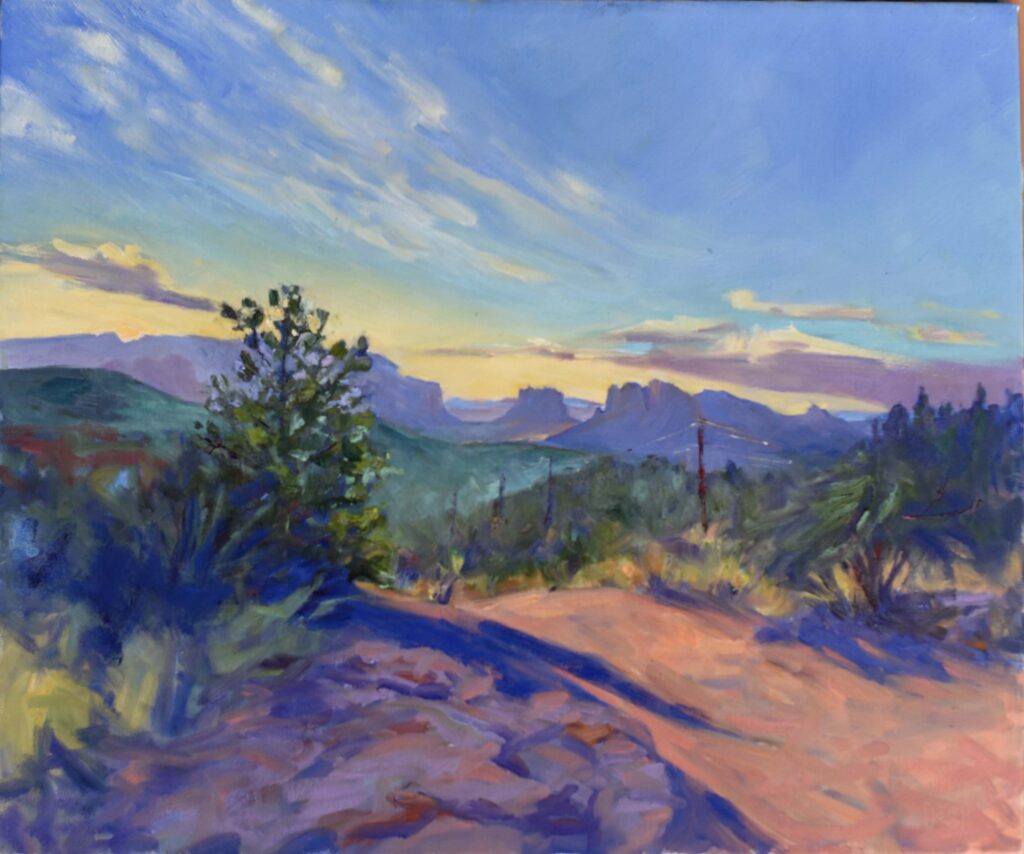
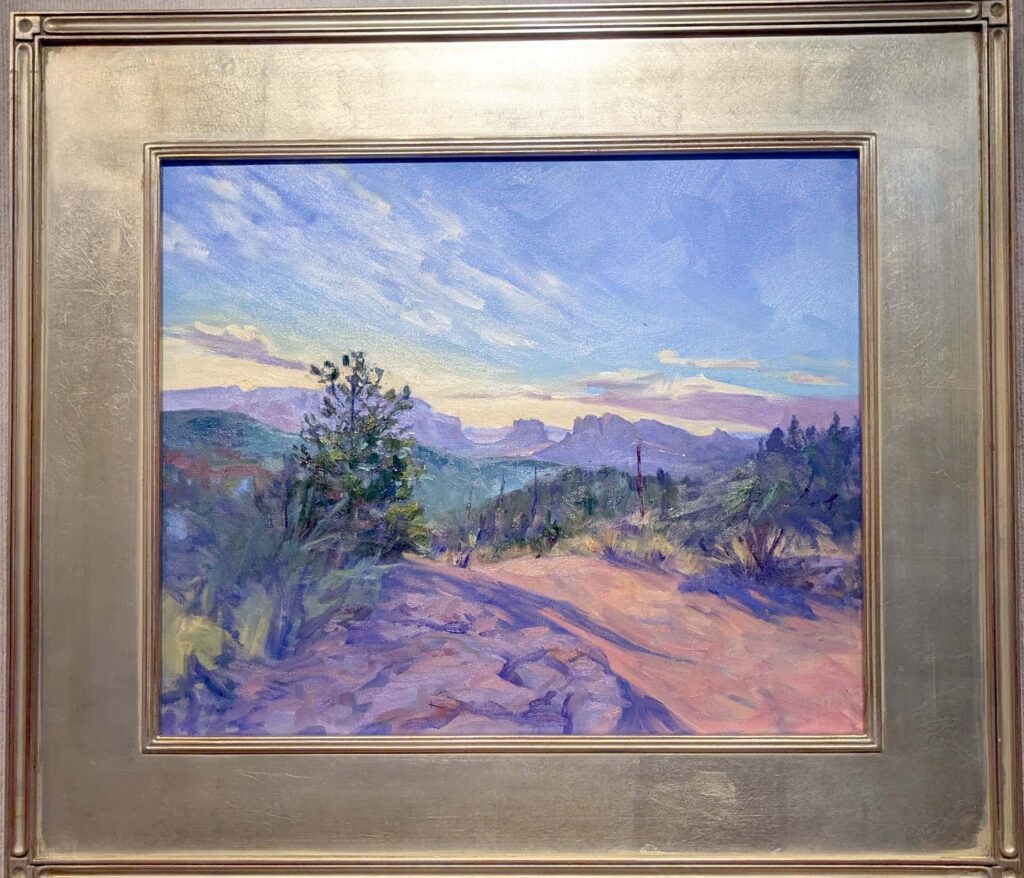
Dawn along Upper Red Rock Loop Road, Sedona, 20X24 oil on canvas, $2318 unframed includes shipping and handling in continental US.

I have a strong preference for painting at dawn instead of sunset. At dawn, twilight seems to last longer and the light changes more slowly and smoothly. Early morning air tends to be clearer with less dust and pollution. That makes morning haze softer than evening glare. There’s seldom anyone around except me and my trusty dog. And you can make last-minute adjustments without fiddling with your head-lamp.

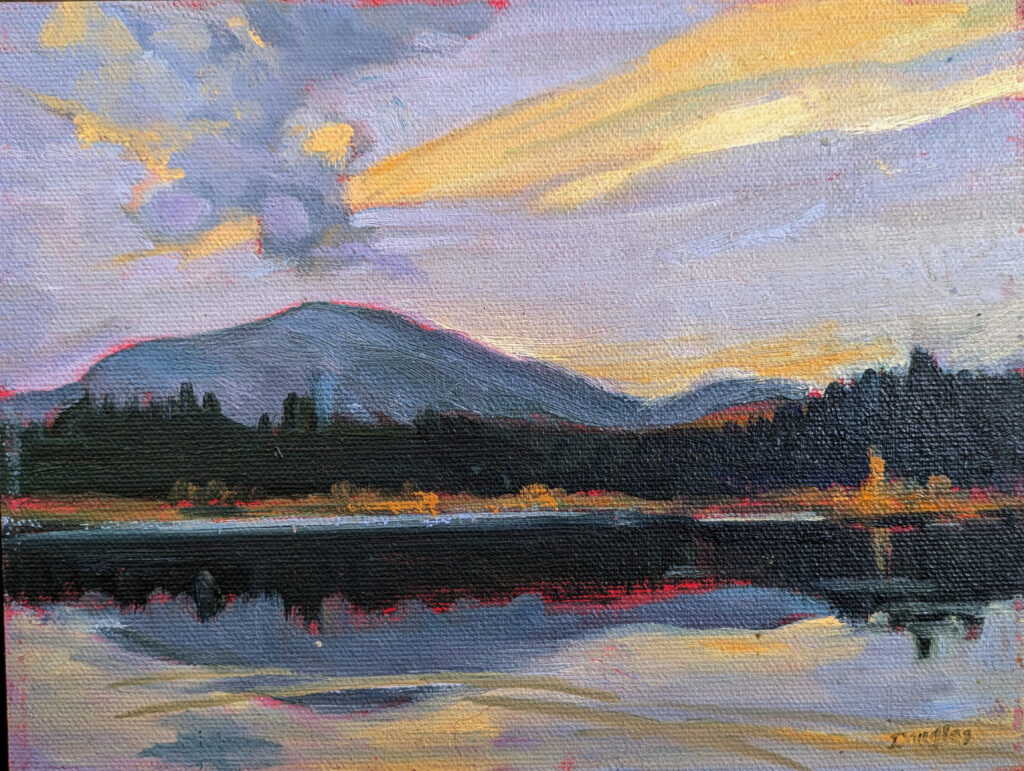
Early Morning at Moon Lake, 6X8, oil on archival canvasboard, $348 includes shipping and handling in continental US.

But mostly it’s because I’m an early riser (a trait that’s exaggerated when I travel west). While the predawn hours can be chilly, that rapidly resolves when the sun rises. I’ve spent so much time outdoors watching the dawn that the changes are predictable to me. There’s the first birdsong in the gloaming, followed by color on the eastern horizon and finally the morning breeze as the air starts to warm up.

Are you a collector looking for an original fine art piece that captures the true spirit of the Southwest? I think Dawn along Upper Red Rock Loop Road has the potential to bring the quiet beauty of Sedona directly into your home.

Dawn Wind, Twin Lights, 9X12, oil on archival canvasboard, $869 includes shipping and handling in the continental US.

I returned to the same spot before dawn over multiple mornings to paint Dawn along Upper Red Rock Loop Road. My dog and I got there in darkness, set up and then painted until the dimness resolved into daylight and the lizards and hikers came out. These are the authentic colors and atmosphere of the desert at first light, caught in real time.

There’s an immediacy in painting from life that’s different from studio paintings, even when the plein air paintings are as carefully measured and executed as this one.

Why did I include the power poles and wires? I’m perfectly happy to edit things out, but I thought their linearity balanced the soft dawn colors and iconic red-rock forms. That blend of the natural landscape with everyday human presence is fundamental to Sedona and gives the work depth and narrative.

But if you really love sunsets, here’s Sunset over Cadillac Mountain, oil on archival canvasboard, $869 includes shipping and handling.

I hope this plein air Southwest landscape also radiates the peaceful, calm energy I feel whenever I paint in Sedona. If it resonates with you, the painting is available here. Or, you can join me in Sedona in March, 2026 for my weeklong workshop, Canyon Color for the Painter.

Registration is now open for workshops in 2026! Reserve your spot:

Can’t commit to a full workshop? Work online at your own pace:
Seven Protocols for Successful Oil Painters

Business for artists and painting in Sedona

Shadow Fingers, 11X14, oil on Baltic birch, $869 includes shipping and handling in continental United States.

First, the business

My friend Dennis used to tell me, “I’m an accountant with the soul of an artist.” That’s all very well, I’d counter, but every successful artist also needs the mind of an accountant. (Luckily, I never believed in that now-discredited left-brain, right-brain malarkey.)

On March 8-9, I’ll be presenting at the first Sedona Entrepreneurial Artist Development Program. This is open to Arizona residents aged 18 and over. The two-day intensive covers a range of topics from financial management and marketing to crafting an artist statement, developing work samples and selling artwork online. My part will be accounting for artists, and I plan to make it exciting.

Even if you hire someone to do your taxes, you still need to understand what expenses to record and what don’t matter. You need to be able to track your inventory, and, if you teach or run a gallery, how to protect yourself against liability.

Country path, 14X18, oil on archival canvasboard, $1,275 includes shipping and handling in continental US.

Painting in Sedona

Immediately following the Entrepreneurial program, I’m offering Canyon Color for the Painter from March 10-14. There are still a few seats left.

I’ve taught and painted in Sedona for several years and know great places for morning light, evening light, and all the light in between. We’ll meet on location at 9 AM, work steadily until 4, and then you’ll have the evening to hike, take one of the famous Pink Jeep tours, or try one of Sedona’s many fine restaurants. If the weather is poor—and it almost never is—we can meet in a classroom at the Sedona Arts Center (SAC).

Dawn on the Upper Red Rock Loop Road, 20X24, oil on canvas, $2,318 includes shipping and handling in continental United States.

The top five things I love about painting in Sedona

  1. The weather—there is a scene in PG Wodehouse’s Quick Service where the old prizefighter Steptoe is trying to convince his wife to give up on Merry Olde England. “What you want wasting your time in this darned place beats me. Nobody but stiffs for miles around. And look what happens today. You give this lawn party, and what do you get? Cloudbursts and thunderstorms. Where’s the sense in sticking around in a climate like this?”

    He was urging her back to California, but in Sedona it’s also almost always fine. After this winter, we deserve fine.

  2. The scenery—Sedona combines some very brilliant colors: the reds of Bell and Cathedral Rock, the lush greens of Oak Creek Canyon, the sere yellows of the chaparral, and the deep blue of the sky. Because it’s seldom overcast, shadows jump and the light shimmers. It’s just magical.

  3. The people—I’ve known Julie Richard, the executive director of SAC, for a decade. It’s the same with Ed Buonvecchio, my workshop monitor. The rest of the support staff, including Bernadette Carroll and JD Jensen (with whom you’ll have the most contact), are kind and terrifically helpful.

  4. The hiking—There are 400 miles of hiking trails in the Red Rock Ranger District on the Coconino National Forest. Then there are state and city parks. Sedona is a hiker’s paradise, and I swear Julie Richard can tell you about every single trail.

  5. The funny things that always seem to happen to me there—Painting in Sedona has led to extremely funny interactions between the punters and me. I don’t think that’s from ley lines and vortexes, but because in the grand scheme of things, plein air painters are just one more dot on the overwhelming landscape. Come prepared to smile.
Hail on the Cockscomb Formation, oil on Baltic Birch, $522 includes shipping and handling in continental United States.

Registration is now open for workshops in 2026! Reserve your spot:

Can’t commit to a full workshop? Work online at your own pace:

Seven Protocols for Successful Oil Painters

What am I looking for in an artist portfolio?

Dawn on Upper Red Rock Loop Road, 20X24, oil on canvas, available through Sedona Arts Center. Please excuse the awful photography. I haven’t remembered to photograph any of these before they were framed and hung.

Years ago, I took a master class from a nationally-known painter, through a nationally-known art institute. After a day, he asked his monitor, “who let these people in?” It was rude, but I saw his point. No effort had been made to ascertain whether students were competent to take a master class.

It was a waste of time and money for all involved. Neither the beginners nor the advanced painters benefitted, and the instructor was frustrated. (Not that I’m certain he had a lesson plan, but that’s another issue.)

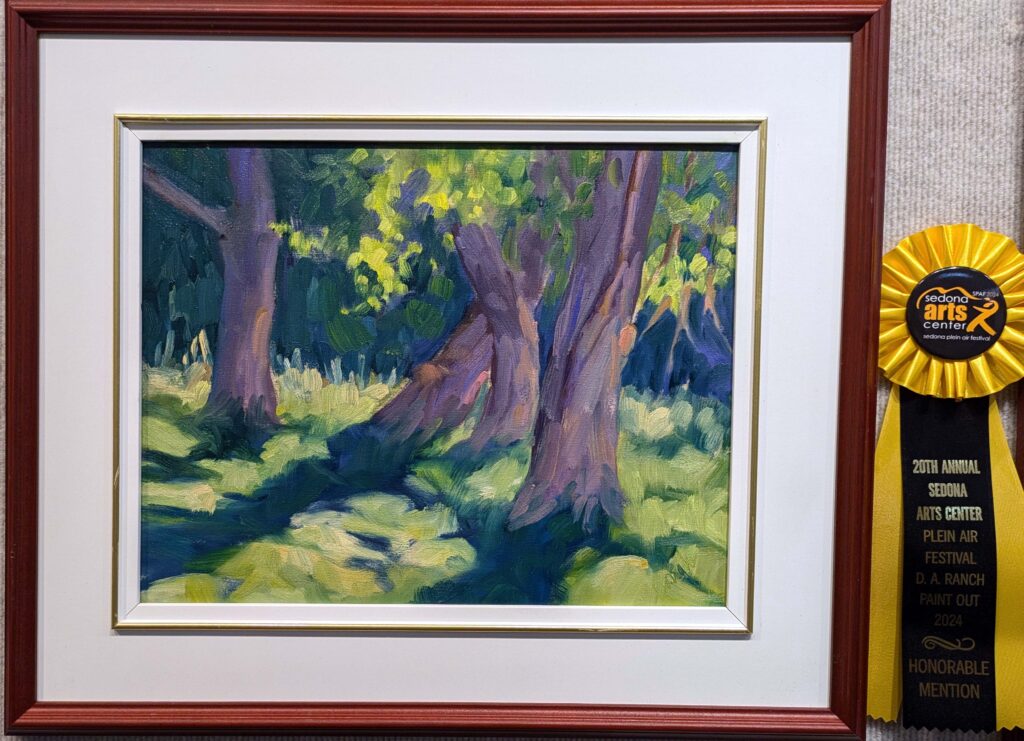
I honestly can’t remember the title, but they were three cottonwood trees casting magnificent shadows. Available through Sedona Arts Center. And, yeah, I won an award.

I’m teaching an advanced painting workshop next June, and I don’t want to repeat that mistake. I’m reviewing portfolios now. I hate hurting people’s feelings, and I know that some people will find the portfolio review process painful. However, I owe it to everyone to be straightforward. All my workshops benefit students at more advanced levels. Many professionals (by which I mean people who are regularly selling paintings) have taken them and benefitted. However, this particular workshop is directed toward people with a specific foundation in process and design.

If you need more fundamentals and you’re an oil painter, you can take my online Seven Protocols for Successful Oil Painters.

This was a very enjoyable painting to do. They’re cottonwoods along the Verde River. Am I in a tree mode? I think so. Available through Sedona Arts Center.

What am I looking for in an artist portfolio?

  • Are the fundamental orders of operations of painting (which differ for different media) understood and respected?
  • Does the artist understand color theory?
  • Does the artist understand the fundamental rules of composition?
  • Is there mastery of technique?
  • Is there a coherent value structure?
  • Is there developed brushwork?
  • Is there consistency?

Don’t let that intimidate you

I’ll be absolutely honest with you about whether you should take this workshop or another one, but don’t let fear dissuade you. Many of you are finer painters than you realize.

I had an epiphany courtesy of Laura Bianco this week. She has been telling me for several years that she doesn’t care about the judging, or the competition. I found that difficult to understand until today. I suddenly realized that all that matters is that I’m here. Considering how long it’s taken me to arrive at that home truth, I can’t expect you to suddenly buy into it, but I promise I’ll write more about it later.

Country Road, 14X18, available through Sedona Arts Center. This is my favorite painting so far.

However, cut me some slack, timewise

I’m in the middle of a very long event, the 20th annual Sedona Plein Air Festival. I’m trying to get to emails and texts, but it’s an uphill slog. I spent 14 hours (you heard that right) on Dawn on Upper Red Rock Loop Road this week, and I’m beat.

Registration is now open for workshops in 2026! Reserve your spot:

Can’t commit to a full workshop? Work online at your own pace:

Seven Protocols for Successful Oil Painters

Two paintings heading west

Poplars, 12X16, oil on archival canvasboard, available through Sedona Arts Center.

Going to Sedona Arts Center

I did about 95% of this painting while whooping it up with Ed Buonvecchio and Laura Martinez-Bianco in the Oak Creek Valley north of Slide Rock State Park. It was the last day of Sedona Arts Center’s 19th Annual Sedona Plein Air Festival. Ed wisely focused on the rocks rather than the trees. Laura and I waded into the foliage, looking for the abstraction that would define the place.

The scene has a flat meadow of dry grasses that cut straight across the base of the trees. Although the color was exquisite, I could find no way to include the grass without making a compositional blunder. Furthermore, black poplars are leggy and ungainly trees, although they were a magnificent golden color on that autumn day.

Claude Monet repeatedly visited poplars in a series of now-famous paintings. Nominally, these are about the trees, but their real subject is the interplay of light and pattern.

What I found so compelling (and difficult) about the scene was the repetition of the strong vertical motif in the trees and the rock spires behind them. I emphasized this by making the far-left tree bleed into the vertical chasm above it.

Sometimes we take risky decisions. Inevitably someone will come along and tell us how to correct our ‘mistakes’. I could have avoided the confluence of tree and rock, but it wouldn’t have been nearly as interesting to paint. Monsieur Monet never took the safe path; why should I?

Poplars is going with me to the 20th Annual Sedona Plein Air Festival later this month. I’m always happy to go to the Sedona Arts Center; not only do I get to see lots of my friends, but it’s a great organization.

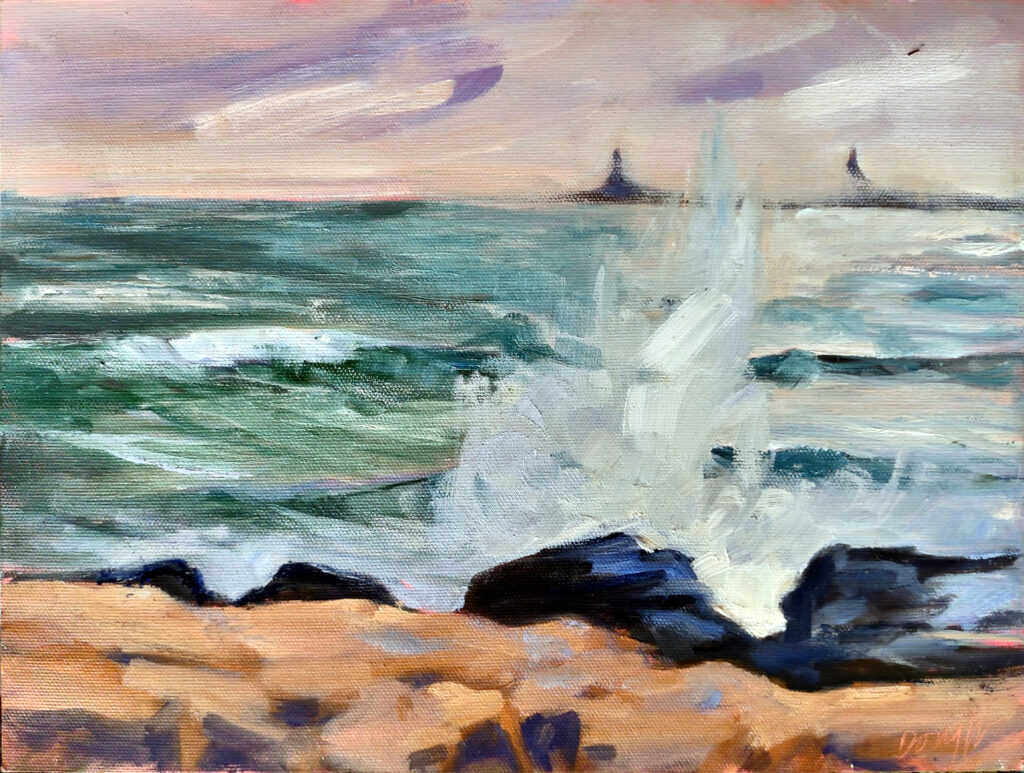
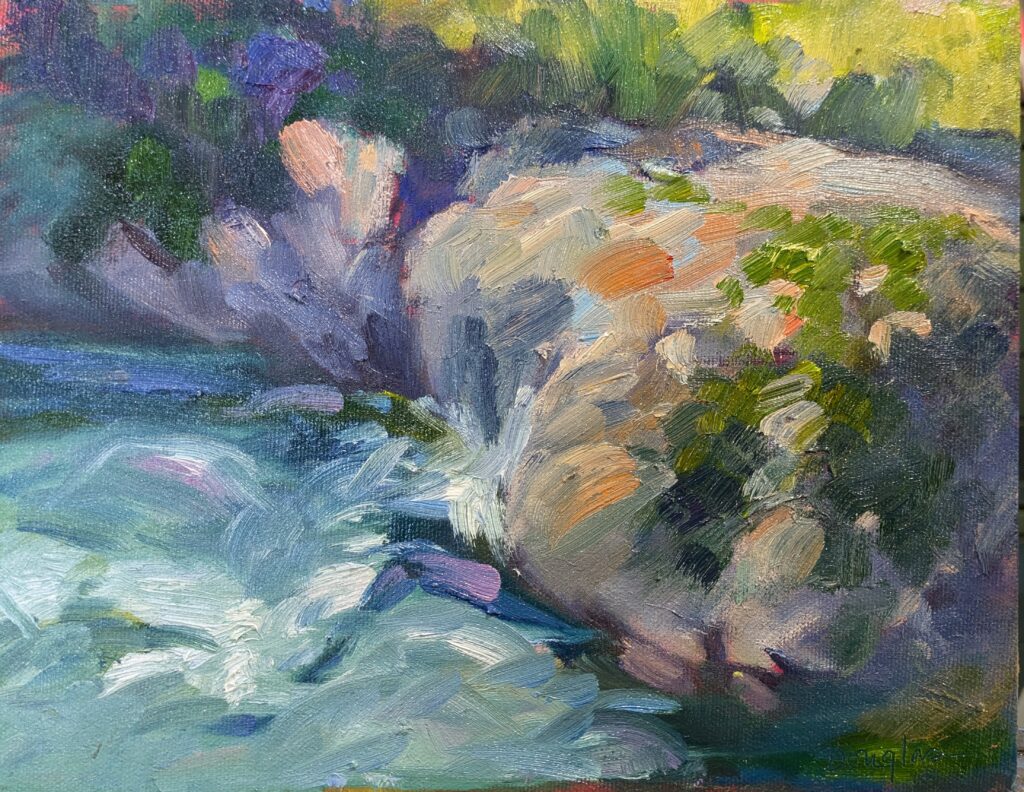
Floof, 8X10, private collection.

Floof!

This is going to a private collection out west. Its owner wanted a coastal Maine painting (who doesn’t?) so she’s getting this tiny confection of surf and rock, with a bit of pine in the top left corner. That’s pretty much what this state is all about, after all.

I am not sure why I called it Floof, except I kept saying that to myself as I churned the water up. As for the rocks themselves, they’re along the Bagaduce River in the town of Penobscot, ME.

A reminder

Student show
Richards Hill Gallery
394 Commercial Street
Rockport, ME 04856
4-6 PM
Friday, October 11, 2024

Monday Morning Art School: why is a workshop important?

Sand and Shadows, 8X16, oil on archival linenboard, private collection

I had a long chat with Olena Babak last week, where we mostly discussed how much we value our artist friends. The plein air world, in which we’re both deeply planted, fosters a sense of community. Many of my friends are artists whom I met teaching or at events. There is something unique in the experience of pitting ourselves against our own unreachable goals that binds artists together.

At the same time, I texted with someone considering my Towards Amazing Color workshop at the Sedona Arts Center.  “What is the most important thing I will take away from this workshop?” she asked. I’ve been mulling that over ever since.

All painting starts with observation and perception, and Sedona is in a natural setting so preposterous that painters can’t fall back on what they think they know. The landscape is vast and the air is so clear that none of the usual tricks of aerial perspective apply. This creates distinctive lighting conditions, especially at sunrise and sunset, which in turn bounces what we think we know about color on its head.

Peace, 8X16, $903 framed includes shipping and handling in continental US.

That’s a great thing, since none of us should be painting stereotypes anyway.

In most of our world, the dominant color scheme is green, brown and blue, with flashes of warm colors. There is nothing wrong with that, of course; I paint it and love it deeply. But Sedona flips all that on its head. Its giant rock massifs are red and cream, set off by a ferocious azure sky and accented with dull greens.

Meanwhile, the intense warm light forms equally intense cool shadows. A week of painting that light will bleed back into our paintings of the more-delicate lighting elsewhere, helping us capture the nuances of light and shadow. Painting what we don’t know is invaluable for developing a keen sense of observation for when we get back to what we do know.

Early Light is 11X14, oil on archival canvasboard, $869 includes shipping and handling in the continental US.

That raises the question of how accurately we mix our colors. Just as I discourage eastern painters from using premixed greens, I discourage Sedona painters from using premixed reds. Yes, the rocks may be close to burnt sienna, but slathering that on will just make for a flat painting. We need to learn to mix colors to match the subtle variations in the landscape. That’s a skill you can take anywhere.

My personal painting challenge right now is in representing what I’ll call, for lack of a better term, deep space. It’s easy enough to paint an eastern mountain that’s a few miles away, especially when I have aerial perspective to fall back on. The giant rearing rock formations of Sedona, set like massive eroding jewels, are eroded like hoodoos but bigger than skyscrapers. They create their own special drafting problems. They teach me how to convey distance, perspective, and dimensionality. Once you’ve seen that kind of depth in a painting, you can’t go back to using mere layering to create the illusion of distance.

Pensive, 8X10, oil on archival canvasboard, $522 includes shipping and handling in continental US.

I am both a committed plein air painter and outdoorswoman (although I can’t tell you which came first). Painting outdoors fosters my connection with the natural world. It’s not just the landscape and atmosphere; it’s also the weather, the creatures and the plants. (That relationship transcends words, which is why I loathe writing artist’s statements.) Sedona has all those things in spades. If you haven’t ever been there, it’s worth the journey.

I hope this answers my correspondent’s question, and by extension, yours too.

Registration is now open for workshops in 2026! Reserve your spot:

Can’t commit to a full workshop? Work online at your own pace:
Seven Protocols for Successful Oil Painters

What I’ve accomplished so far this week

I wish I could remember the title of this piece.

We’re down to the final stretch at the 19th annual Sedona Plein Air Festival. At this point, I haven’t the energy to wax philosophical, so I’ll just tell you a little story about each of these paintings, in the order in which I completed them.

I can’t remember the title of the painting above. It was the first one I painted, and the first one I’ve sold. This is the painting where Casey Cheuvront and I were entertained by a series of spirit guides, which I wrote about here. I remain stubbornly unenlightened.

Early Light, 11X14, oil on archival canvasboard.

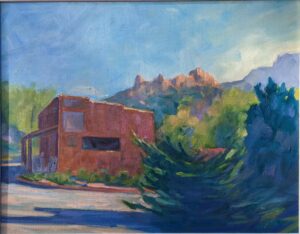
Early Light is of the building next to the Sedona Arts Center. To my eyes, it’s the most authentic building in downtown Sedona. The Jordan Family built it of red rock in 1938 to house their retail operations; their former fruit-processing barn is now part of the Sedona Arts Center. I doubt they could envision that it would one day offer Intuitive Psychic Readings or Reiki, Energy and Chakra Balancing, among other things. It’s 11X14, oil on archival canvasboard, available through Sedona Arts Center.

Dusk at the Merry-Go-Round, 11X14, oil on archival canvasboard.

Since my rental car was upgraded to a Jeep, Ed Buonvecchio, Casey and I decided to drive up Schnebly Hill Road. This track used to be the road to Flagstaff; today it’s barely fit for a high-clearance Jeep. It took us an hour to get to our destination, and we barely had teeth left. Heading down in the failing light, I realized I only had my sunglasses with me. Casey watched for obstacles while I steered. “Did you see that person on the side of the road?” she asked me. Ahem.

“It’s actually a little smoother if you take the washboards a little faster,” Casey told me. So, I did. “I didn’t mean the rocks!” she cried. Dusk at the Merry-Go-Round is 11X14, oil on archival canvasboard, available through Sedona Arts Center.

Pensive, 8X10, oil on archival canvasboard.

Pensive is an 8X10 which I did as a demo on Sunday, in concert with Hadley Rampton. “How did you feel when you were painting it?” a member of the audience asked.

“Larky,” I answered.

“That’s not larky; it’s pensive,” he replied. I didn’t realize I was pensive; I thought I was having a great time, but sometimes your subconscious has a mind of its own. Available through Sedona Arts Center.

Peace, 8X16, oil on archival canvasboard.

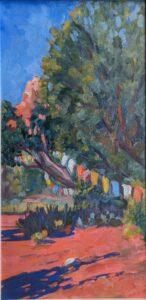
I’ve been praying for peace for Israel and Ukraine. My friend told me that there were prayer flags along the trail near the Amitabha Stupa and Peace Park. Frankly, I was attracted to the bright colors fluttering among the piñons and junipers, but why not pray for peace while you’re painting in a peace park? Peace is 8X16, and available through Sedona Arts Center.

The Beauty of the Rocks, 11X14, oil on archival canvasboard.

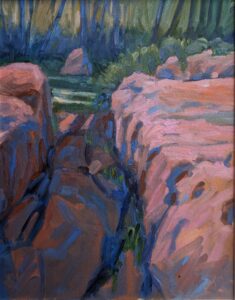
The Beauty of the Rocks is 11X14, and was painted along Oak Creek behind L’Auberge de Sedona, which is a very swank resort. There’s one classic view, looking upstream, but I painted that last year. Why not drop down into a fissure and paint the diagonal gap in the rocks instead? Of course, I couldn’t back up to look at my work without killing myself, so I periodically called to Laura Martinez-Bianco to ask her if passages needed changing. This committee approach to painting apparently works; I’m pleased with both the color and composition.

I have to select three pieces for judging. Although I’ve still got two more days to paint, I’m interested in your opinion. What do you like best, and why?

Registration is now open for workshops in 2026! Reserve your spot:

Can’t commit to a full workshop? Work online at your own pace:

Seven Protocols for Successful Oil Painters