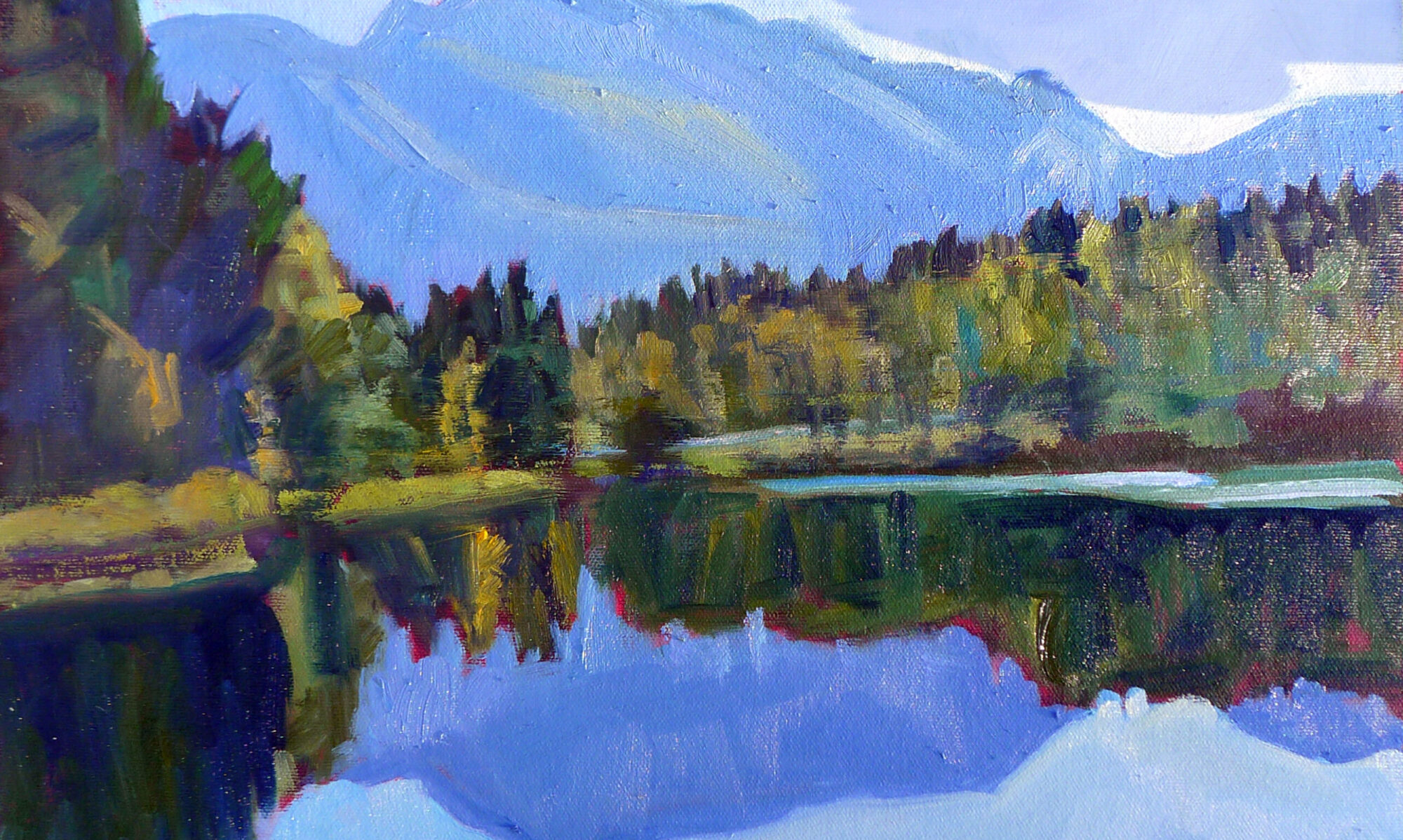


I occasionally get so interested in driving around looking at things that I forget to paint. That’s kind of silly, since I live in a scenic wonderland. Still, we’ve all done it. Sometimes it seems like the hardest part of painting outdoors is picking the spot.
A good painting isn’t about the perfect view, it’s about what you do with the shapes, values, and colors in front of you. Some locations make that job a lot easier.

Look for strong shapes, not postcard views
This can be a real challenge in places with sweeping vistas and no foreground interest. Long views are beautiful and look great in person, but when they’re all middle values and no structure, they don’t translate well to canvas. The basis of a good painting is a strong pattern of lights and darks. Take off your glasses or squint. If there’s no ‘there’ there, there’s no painting, either.
Mind the light
Photographers talk about ‘golden light,’ those early morning and late afternoon periods when long shadows play against warm highlights. That’s a goal, but it doesn’t always happen. Starting with a good value sketch makes light changes more manageable. And you can always seek out strong architectural shapes, like trees and rooflines, to create composition on an overcast day.

Consider your comfort
I don’t paint well when I’m too hot, too cold, or bedeviled by flies. Nor can I concentrate when I’m concerned about traffic. A miserable painter makes a miserable painting.
This is high on my list of reasons to paint in a workshop. Those ergonomic issues are mostly worked out for you.

Start simple
It’s so tempting to throw everything in the view into a single canvas. You’ll get clearer compositions and structure if you concentrate on a single tree against a field, a barn with strong shadows or a boat against lapping waves. There’s a place for complex compositions, but work up to them.
Why I love to take students up Beech Hill in October
Beech Hill is the perfect mix of big skies, sweeping views, and constantly-changing light, all in a 360° panorama. Penobscot Bay stretches out like a sheet of hammered silver, dotted with islands. To the west, the Camden Hills blaze in reds, golds, and deep greens. The summit is a blueberry barren, and right at the very top is Beech Nut, an iconic stone hut with a sod roof.
Beech Hill is all about big shapes and strong value patterns, with both foreground interest and far vistas. It’s a natural classroom for learning how to simplify complex scenes, which is the heart of great plein air work.
And then there’s the light. On a clear day, you’ll see the kind of color shifts and shadows that make painting outdoors addictive. Even when it’s overcast, the muted harmonies are spectacular.

During my October Immersive Plein Air Workshop, we’ll paint on Beech Hill and other hand-picked locations that challenge and inspire. You’ll learn how to:
- Break down vast vistas into simple, paintable shapes;
- Use atmospheric perspective to create depth;
- Handle fast-changing coastal light without panic;
- Keep your values organized so your painting reads at a glance.
Want to learn this in real time? Join me for my October Immersive Plein Air Workshop, where we’ll spend a full week in some stunning autumn landscapes—learning not just where to set up, but how to build strong, confident paintings on site. Spaces are limited.
Click here to reserve your spot.
I’m looking forward to October’s workshop & hopefully painting up on Beech Hill (this time – weather permitting)!
See you then!
I can’t wait!