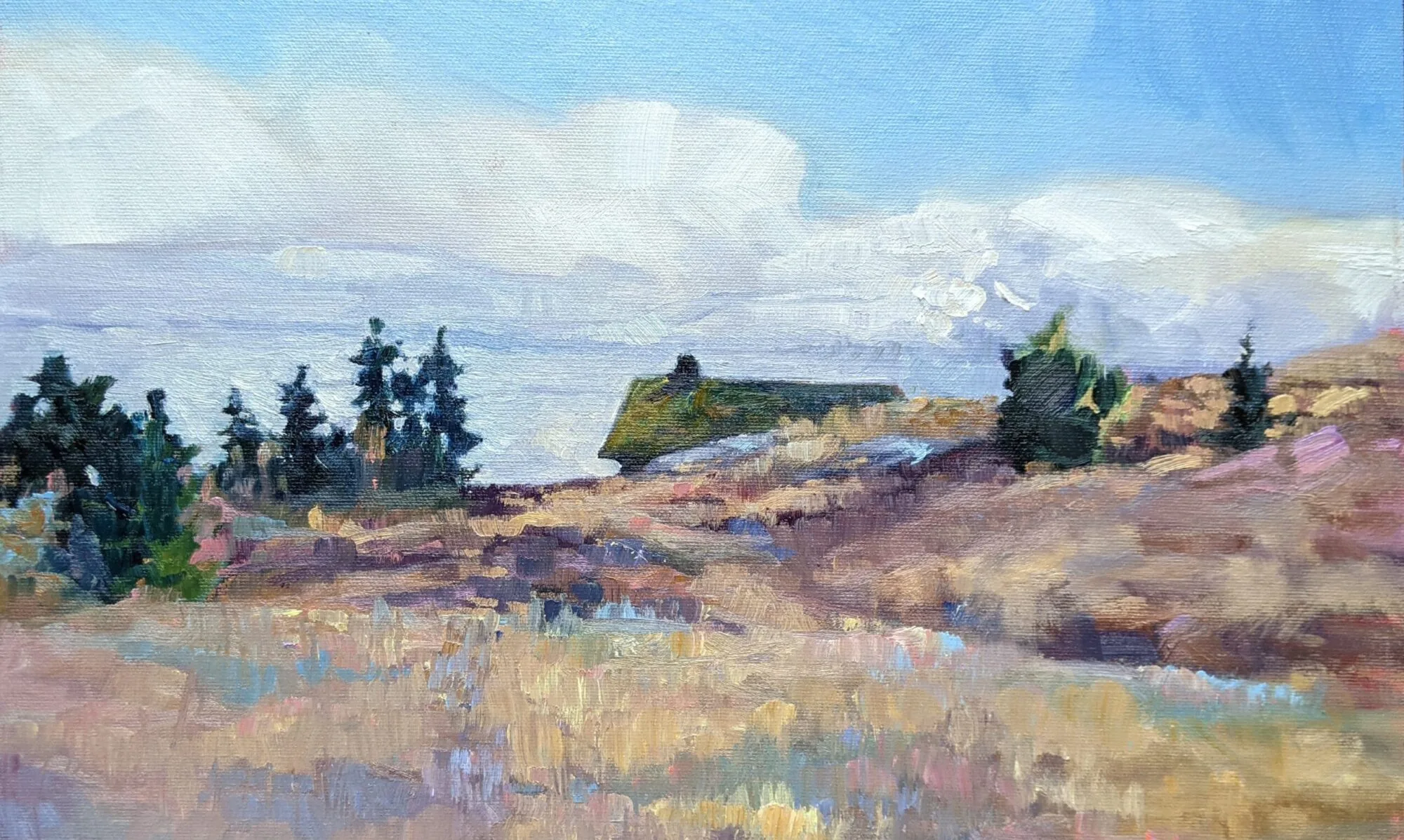
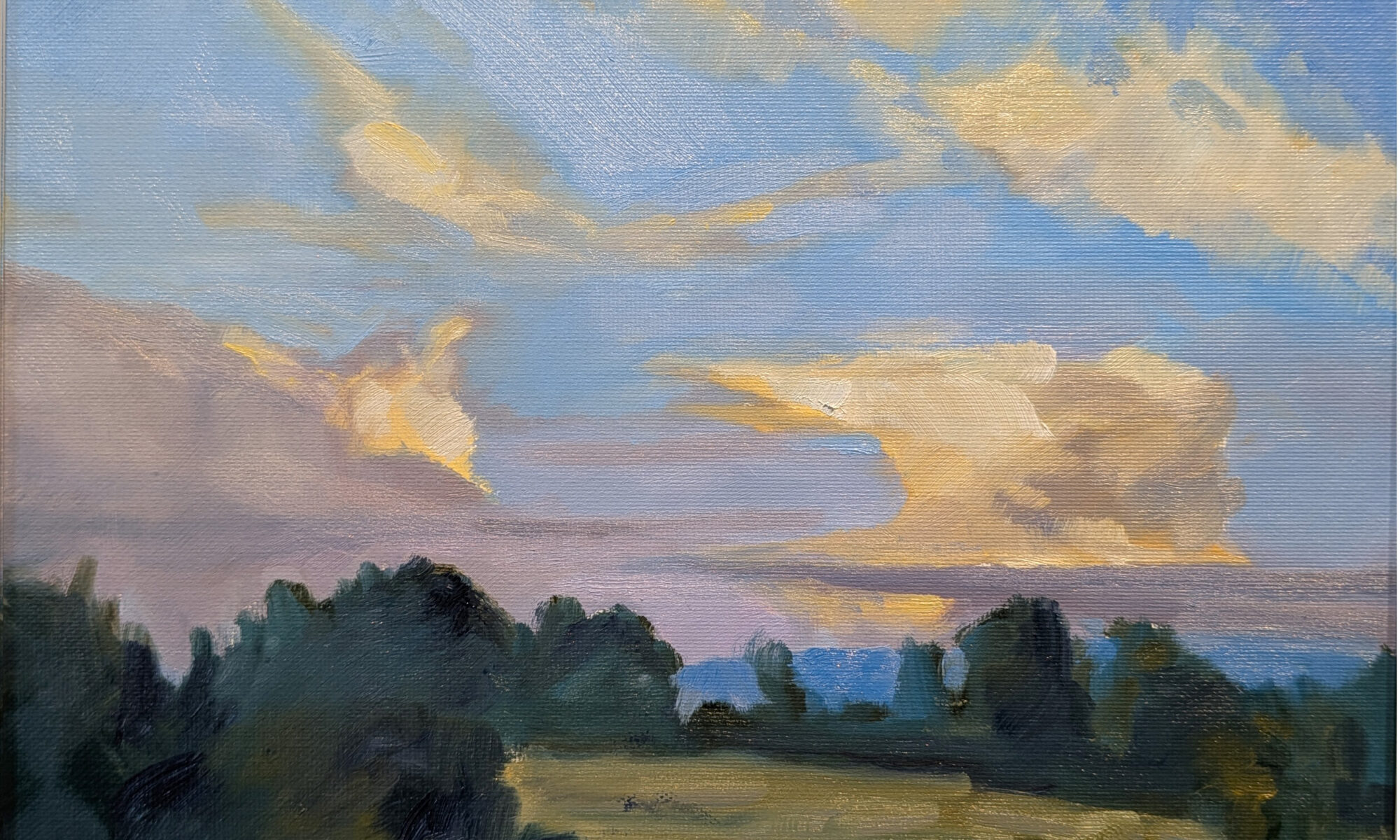
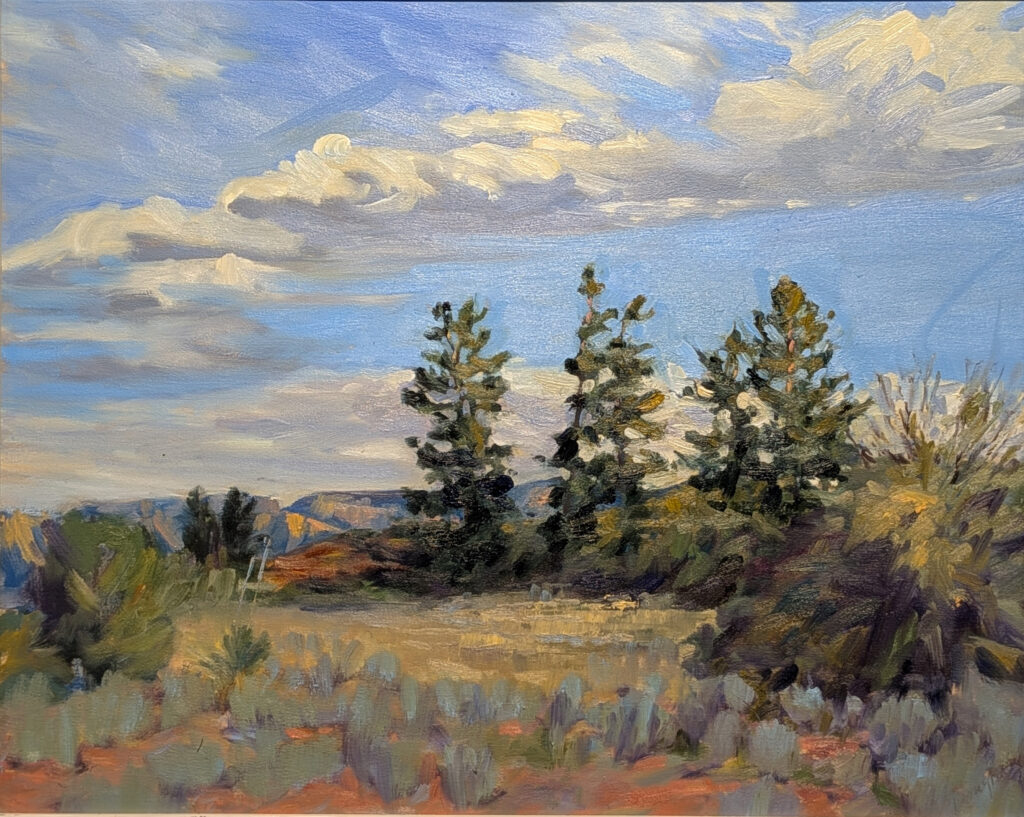
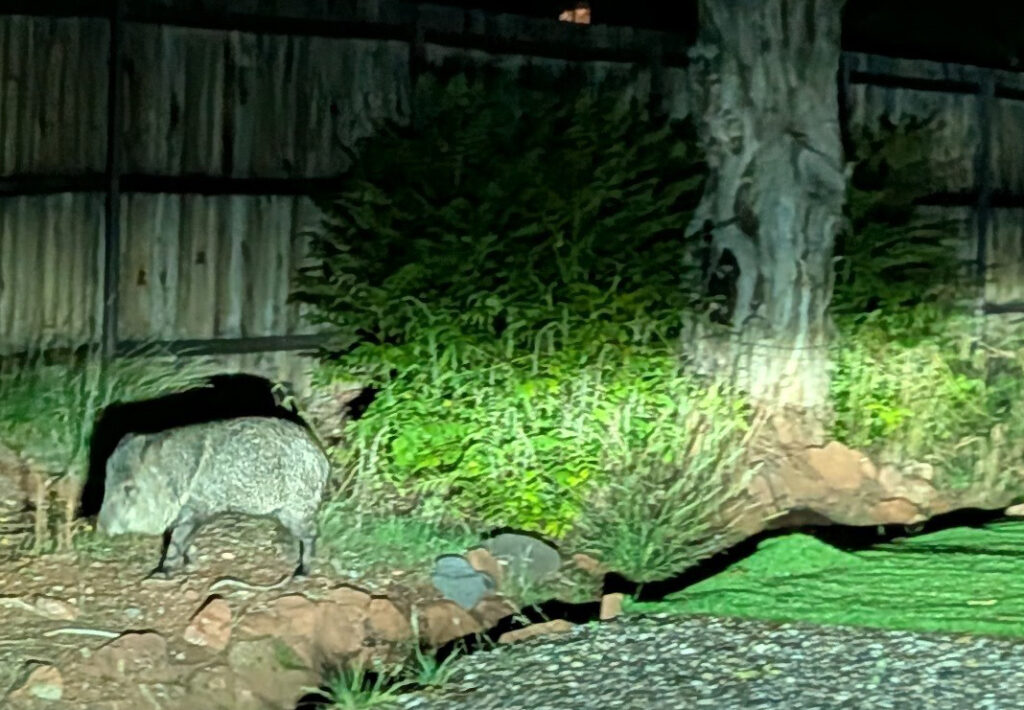
Yesterday I was painting alongside Dry Creek Road in Sedona with Krystal Brown and Laura Martinez-Bianco. We’re here for the 21st Annual Sedona Plein Air Festival. Unfortunately, I forgot to photograph my painting during daylight, and I’m afraid of the javelinas who hang out outside at night, so you’ll have to wait for that.
A woman stopped by to see what we were doing. “Paintings tell a story that photos can’t,” she said. “A painting is a memory of a place, but you first have to experience the place.” That’s not always true; if it were, Frederic Church’s The Heart of the Andes would never have been a blockbuster hit. But there is a tangible difference between a snapshot and a painting in terms of capturing the essence of place.
I think of that a lot while painting here, at home in Maine, or indeed anywhere tourists visit. I’ve spent several mornings this week at a scenic overlook at Posse Grounds Park. Cars sometimes stop only long enough for the passenger to jump out and snap a picture. But whether the visitors are on foot or in a vehicle, they all seem to lead with their phones.
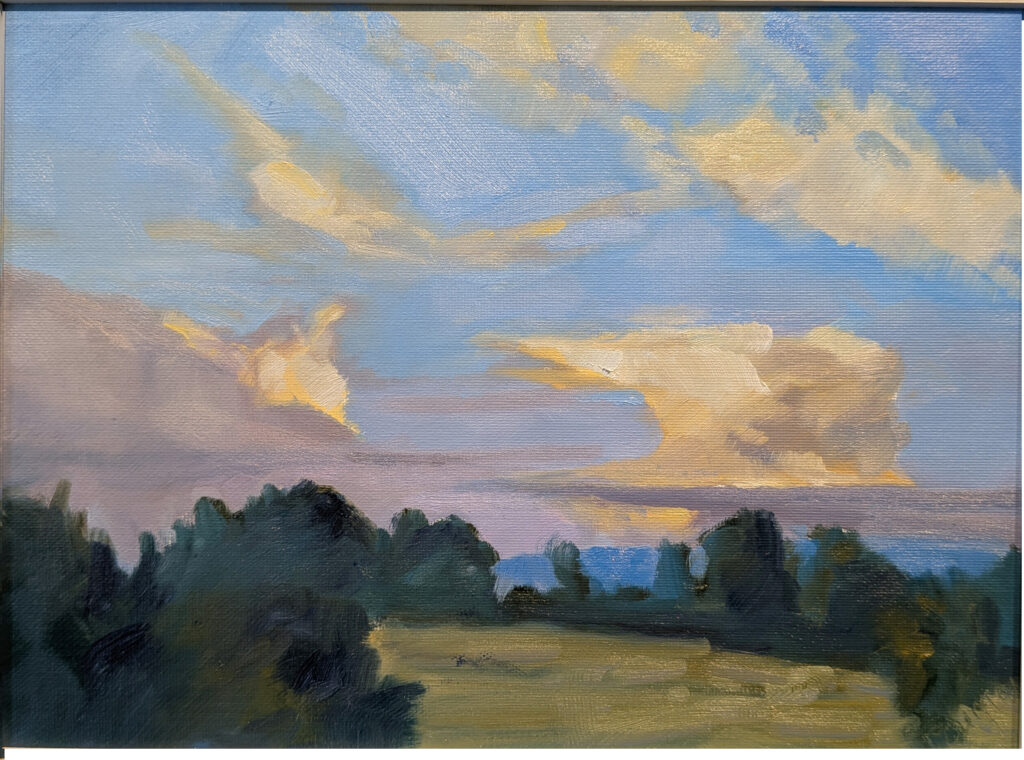
That was an impossibility a generation ago, when we were constrained by 24- or 36-shot rolls of film. Then, we spent a lot more time looking before clicking. Now, we seem to fire off hundreds of shots, constrained by nothing. To me, the irony is that I never even look at the thousands of pictures I’ve taken along the road. Even when I’m lucky and get an excellent picture, it’s still stuck inside my little digital box. It has about the same half-life as an Instagram short (which is measured in hours, not weeks).
Conversely, good paintings engage intensively for a long time. That’s because they capture not only light and color, but a pared-down, essential distillation of experience.
Similarly, they’re a distillation of time. Paintings take hours, versus the fraction of a second that snapping a photo takes. The artist works through changes in weather and light. While we don’t ‘chase the light,’ the passage of time is part of the painting. Our paintings record not just a scene but the state of being that came with it.
Painters are translators, not copyists. I see that in every person I teach. While I can help them develop technique, I can’t alter their essential worldview (nor do I want to). I look at paintings by others differently than my own work. In the front hall of my house, I have (among others) paintings by Poppy Balser of Advocate Harbor, NS; by Jane Chapin of Lower Colonias, NM; by Tom Conner of Cornville, AZ. These are all places I love, by painters I admire.
Even if you have a great printable photo on your cell phone, it will never command the same attention as a painting, which is a tactile, hand-wrought object from one human being to another. In today’s world, that’s a rare commodity.
I’ll be demoing at the Sedona Arts Center this afternoon at 1 PM, along with Laura Martinez-Bianco and Casey Cheuvront. That’s at 15 Art Barn Rd, Sedona. On Saturday, we’ll hang out final pieces for sale and judging, and they’ll be available through 2 PM on Sunday. There’s more information here.
I sometimes think about how painters worked until quite recently. Most of the work we all love was painted without photo reference. So, yes, it had to capture the place and the sense of that time/place versus the exact outline of the treetops. I have thought about going back to that with a series.
Nothing beats plein air painting. I know of an artist (Michael Chamberlain) who said even when he does a still life – he’ll take it outside rather than sit in his studio. Don’t know that I would go that far – but I sure understand the sentiment.