Monday Morning Art School: you asked ChatGPT what?

My students love to send me things they know will interest me, but sometimes they send me things to make my hair stand on end. As a courtesy, I’ve obliterated the OP’s name and photograph, but you really asked ChatGPT to tell you what paints to buy? And you put 32 paints on your palette? And now you want to know about color theory?

Assuming OP bought regular-size tubes of paints, they set her back $15-20 each. For 32 paints, that’s between $480 and $640. All those paints won’t make her a better painter. They’ll make her a worse painter, because she’ll never learn about color theory and color mixing.

A few years ago, I mailed a small sample of paints to a student in South Carolina. She was frustrated with her paints and I was equally frustrated watching her try and fail to hit color notes. What I sent her was a simple, primary-color limited palette: QoR brand Ultramarine BlueNickel Azo Yellow, and Quinacridone Magenta. This is what she did with them:

A color chart done with just three pigments: ultramarine blue, nickel-azo yellow, and quinacridone magenta.

Learn to love limited palette

A limited palette sounds like a restriction, but it’s a shortcut to clarity and cohesiveness. Instead of dabbing in all those paint pots, you learn to mix and marry color.

Learning to mix color teaches you more about color theory than any color wheel. You discover how complements neutralize each other, how color temperature works to create form, and how value does the heavy lifting in painting.

Color harmony and consistency

When all your colors are mixed from the same small family, they are innately related—that’s a shortcut to color harmony. There are no out-of-tune notes screaming for attention. For beginners, who often struggle with garish or muddy color, limited palette creates a more consistent color voice.

Painters need to learn the working characteristics of their paints, including hue, value, chroma, transparency, granulation (in watercolor) and dry time (in oils). That’s hard enough to master for just a few paints.
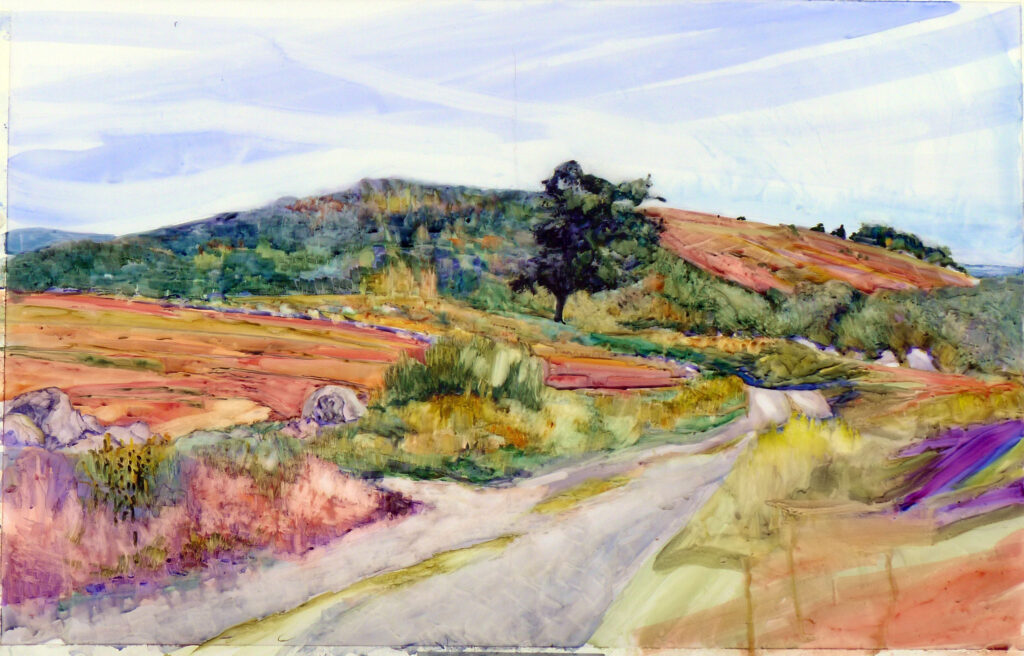
Clary Hill Blueberry Barrens, watercolor on Yupo, ~24X36, $3985 framed includes shipping and handling in continental US.

Decisiveness

With fewer choices, you spend less time dithering and more time painting. That’s invaluable in alla prima and plein air, but it matters any time you pick up a brush. You’re not hunting for the perfect color on your oversized palette; you’re learning to make what you need. This builds confidence and speed.

We can play fast and loose with hue if value is right, which is why pink or yellow skies can make perfect sense in paintings. When pigment options are reduced, we’re forced to shift our attention to value, which is more important than hue.

By stripping color back to basics, we also see form, edges and composition more clearly.
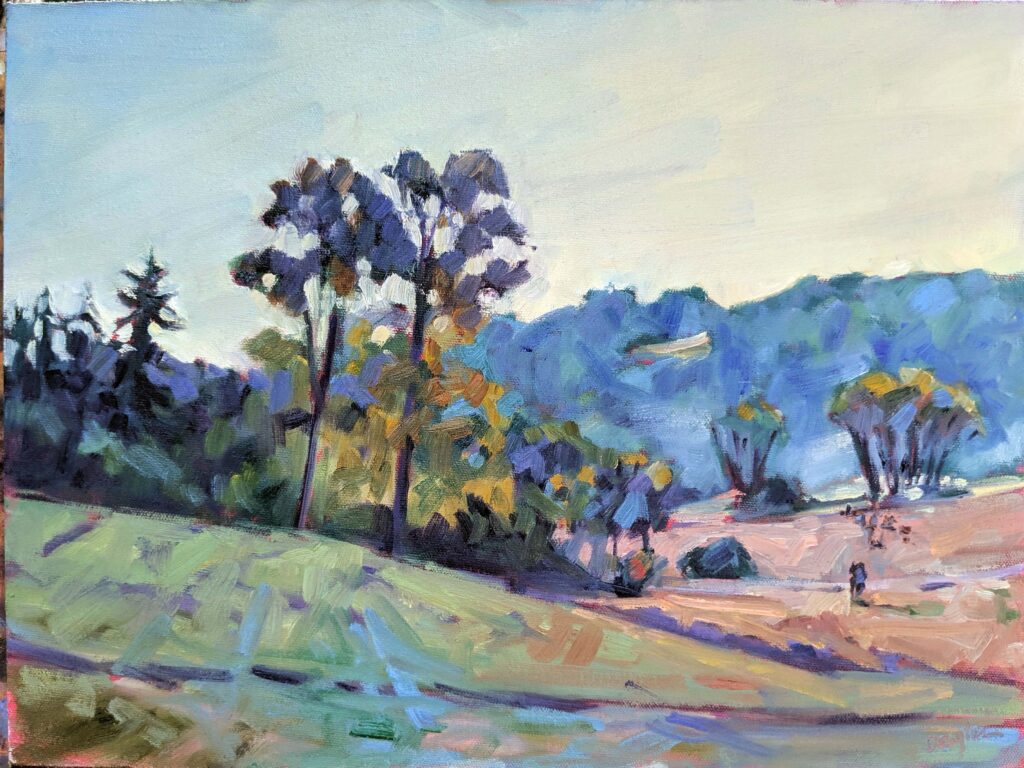
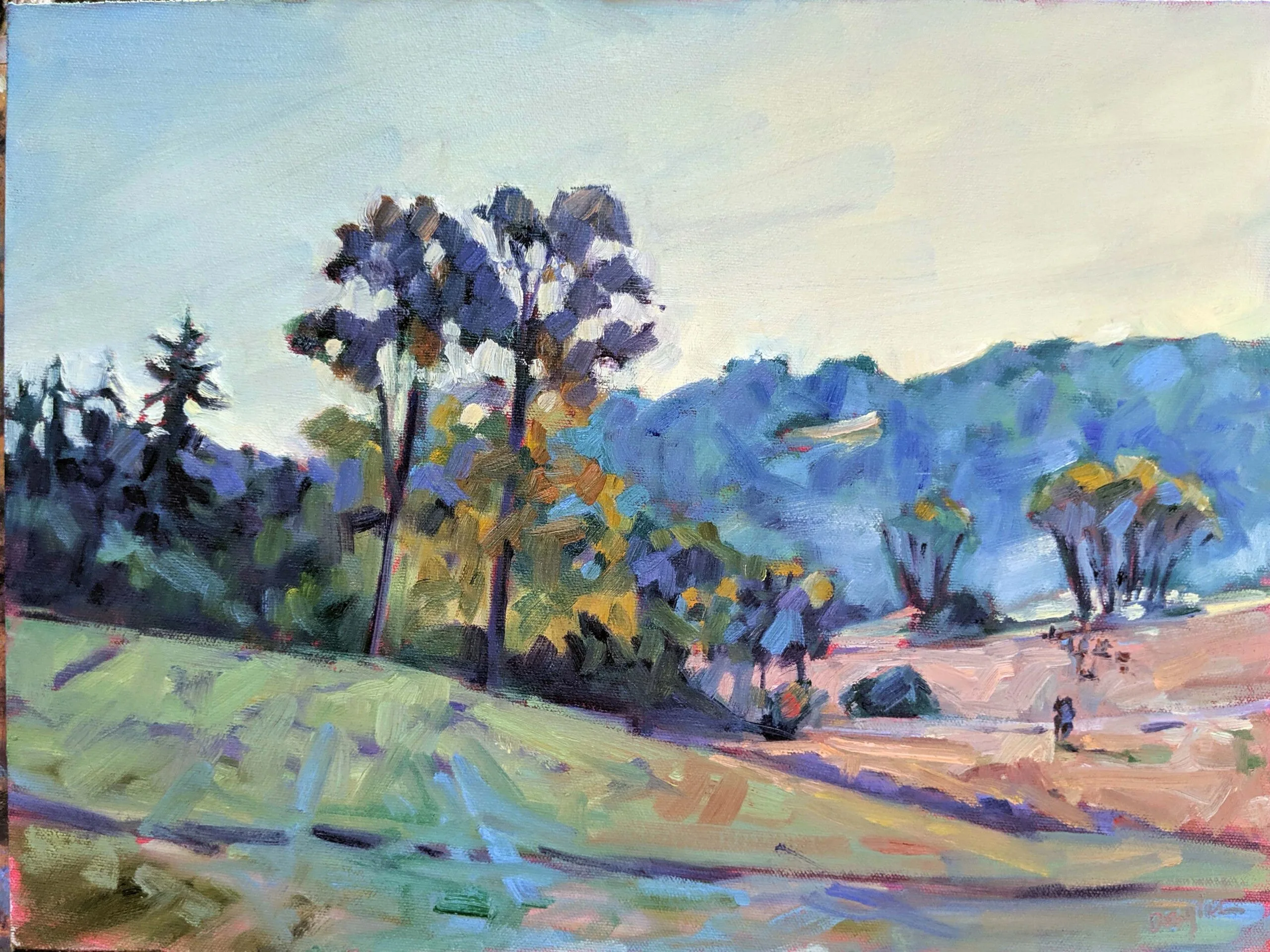
Autumn Farm, Evening Blues, oil on canvasboard, $1449 framed includes shipping and handling in continental US.

A limited palette is a tool, not a moral position

Once you understand what each pigment on your palette does, you can expand with intention. But I’ll note that I’m using the same number of paints I was thirty years ago, with very few modifications. They’re simply not necessary.

In the end, a limited palette isn’t about limitation at all. It’s about focus. By reducing choices, you sharpen your eye, strengthen your technique, and let painting be about seeing rather than collecting colors. That’s a lesson worth revisiting at every stage of an artist’s journey.

And, by the way, I’d have freely shared my palette recommendations with this artist. She’d have had hundred of bucks to spend more intelligently… and most of her paint wells would have remained empty.

Registration is now open for workshops in 2026! Reserve your spot:

Can’t commit to a full workshop? Work online at your own pace:
Seven Protocols for Successful Oil Painters

AI-generated art vs. the human soul

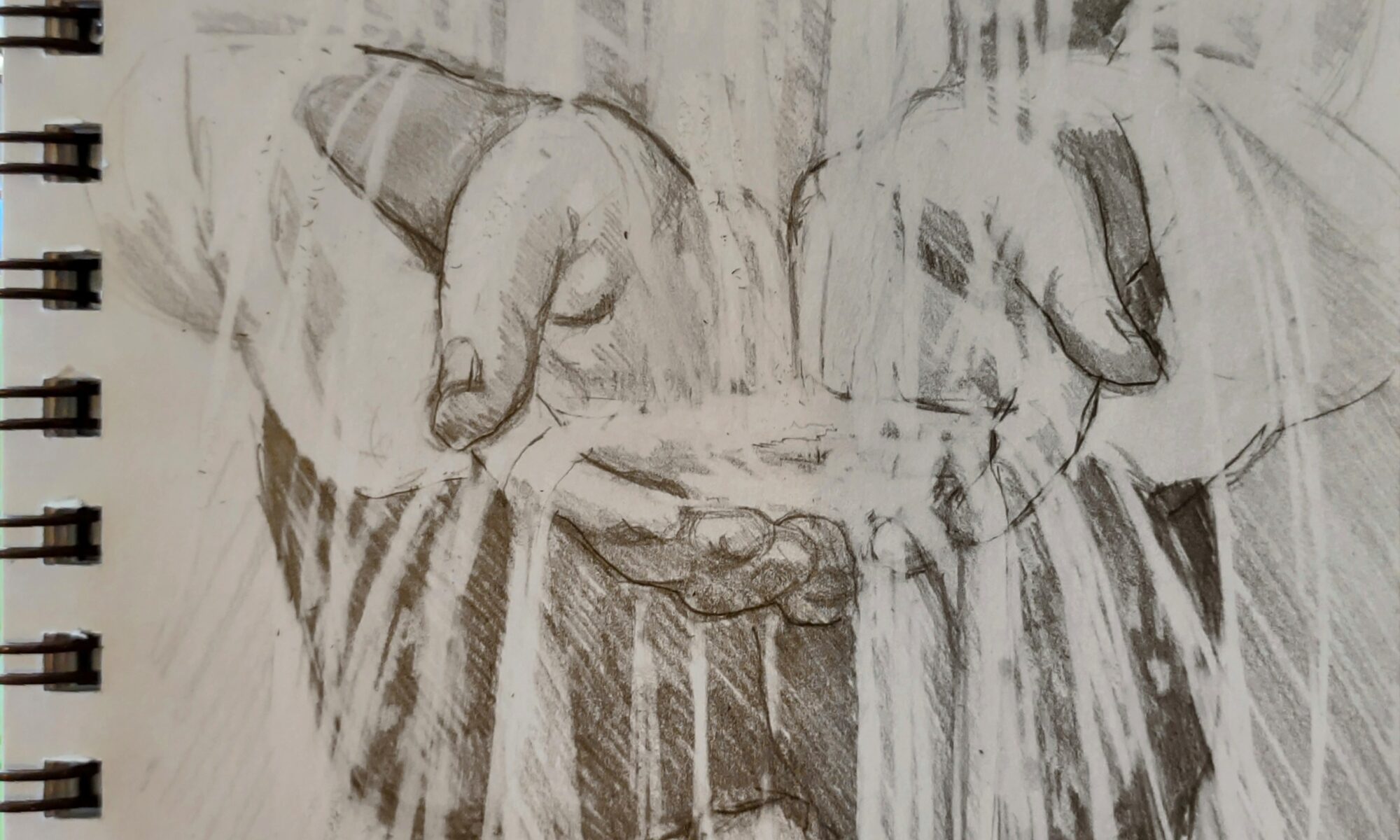
Drawing in church by Carol L. Douglas

A few weeks ago, I wrote on the highly-forgettable nature of AI-generated art. That got a response from painter Carey Corea. He’s involved in the Art & Spirit Forum. Would I be interested in speaking to their group online? “Of course!” I said. That’s this Thursday, February 9, from 6:30-8 PM. Admission is free but you must register through Eventbrite.

Acts 18:3 tells us that Paul was a tent maker by trade (in an era when they were massive structures, not little nylon things). I’m a painter by trade, and my landscape paintings are no more ‘religious’ than Paul’s tents were.

Drawing in church by Carol L. Douglas

Our beliefs inform our work

Still, our beliefs and behaviors can’t help but inform our work. This is why I have a difficult time with Pablo Picasso’s paintings; the same misogyny that characterized his relationships with women bleeds through his canvases. How different that is from the slightly-older Henri Matisse, who was equally obsessed with the female form, but in a positive way.

Volumes have been written Picasso’s and Matisse’s relationships. That covers the ‘who’ and ‘what’ but it only scratches the surface on the ‘why.’ Why does one artist end up victimizing women and another, like Sir Stanley Spencer, end up the victim? Our personal histories are too complex to write off as the result of family, background, genes, or experience, although all those things are factors.

Drawing in church by Carol L. Douglas

AI doesn’t have beliefs

We’ve all seen examples of AI-generated text that reads like polished, human-written copy. Kept within narrow parameters, AI can do a passable job of assembling data into pleasing paragraphs. But that’s where it ends.

Last night, I asked ChatGPT some questions that another human being would have no trouble with, things like, “Do you love me?” “What is love?” and my favorite, “How do you know I’m a sentient human being?”

Elizabeth Barrett Browning has nothing to worry about.

If we’ve met in person, you know I’m a sentient human being because… well, you just know. (It’s also true if you’ve only seen me on a screen or read this blog, albeit to a lesser extent.) That’s the soul talking, and it’s the part AI-generated art doesn’t get. You may not believe in God, but it’s hard to deny that human beings have souls. Otherwise, our flesh bags would not respond as they do to our contacts with others. We experience this indefinable reaction both through intense connections, such as with a lover or child, and in transitory experiences like paying the cashier at McDonalds.

Drawing in church by Carol L. Douglas

If anything, AI validates traditional religion. Christian doctrine teaches that we are triune beings, composed of body, soul, and spirit. The body is our physical self; the soul is our humanity; the spirit is that part of us that’s in contact with God. On the surface it appears that we differ from AI because we have a body, but it’s our soul and spirit that differentiate us from machines.

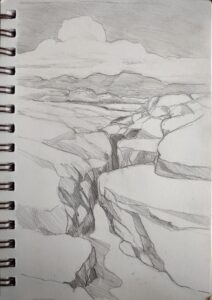
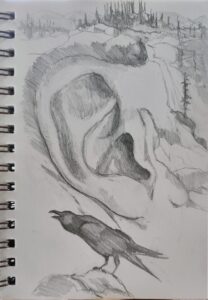
I’m going to talk about AI-generated art, including examples made by photographer Ron Andrews, which are frankly more interesting than mine were. I’m also going to talk about some of my own work, the things that I don’t generally show. That starts with my sketchbooks. I hope you join us!

Drawing in church by Carol L. Douglas

Art & Spirit Forum
Thursday, February 9
6:30-8 PM.
Admission is free but you must register through Eventbrite.

Registration is now open for workshops in 2026! Reserve your spot:

Can’t commit to a full workshop? Work online at your own pace:
Seven Protocols for Successful Oil Painters