
I’m not anti-Artificial Intelligence (AI). It has lots of good uses, like asking it what people are thinking about so I don’t have to. I even pay for one service (proof that I’m already in too deep). I don’t use it for generative AI art, though. After all, it’s basically the internet mashed into one polite parrot. Still, I caught myself saying “thank you” to ChatGPT last week. That was a low point. I try not to treat it like a person, but apparently my manners run on autopilot.
My daughter asked, “What kind of answers would AI give your students?” Well, it’s gotten better since the early days. But better doesn’t mean useful. Mostly, it just plagiarizes blogs like mine—with less wit, hopefully fewer typos, and no wine spilled into the keyboard.
My job is safe. AI is not ready to replace me.
I started by asking Microsoft Copilot: “What is the Golden Triangle in composition?” Its description was adequate, but its application was cock-eyed. Below is a Golden Triangle armature overlaying Edgar Degas’ The Dance Foyer at the Opera on the rue Le Peletier. Degas clearly demonstrates how those 90° angles can help with diagonal flow and focal point placement.


Then I asked it to make an AI-generated illustration of the Golden Triangle. The result is so baffling I don’t even know what to call it. A Golden Trainwreck? Bad geometry homework?

What is the most important rule of composition?
My students know the answer to this question is, “don’t be boring.” Copilot, being a robot, epitomizes boring. It chose the rule of thirds, which is basically the oatmeal of art composition. It’s bland, predictable, and too easily parsed to be interesting. See the example below made by Copilot. And why must it look like a bad Barbizon School painting with awful, yellowed varnish?

Oh, ho ho!
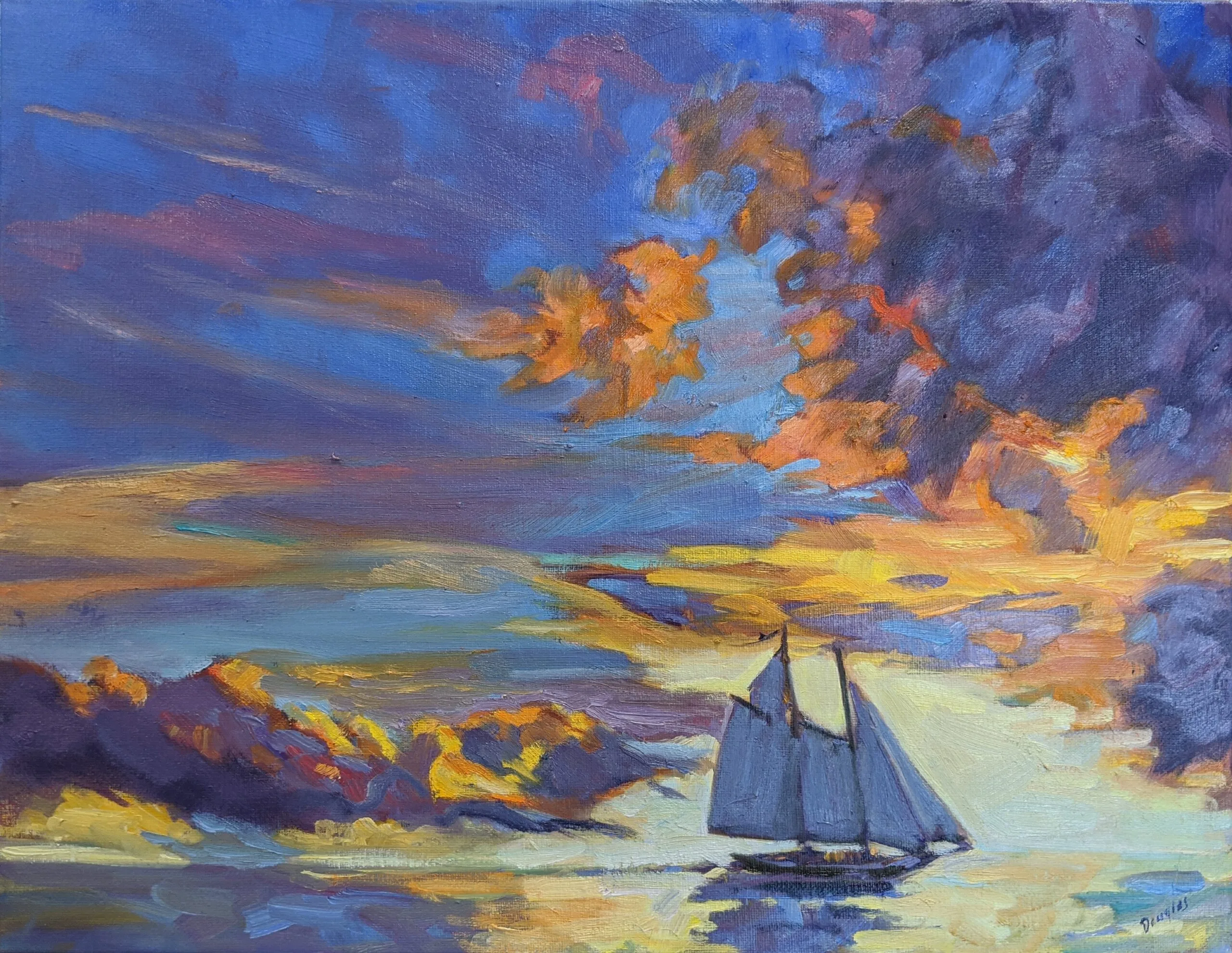
Next, I asked Copilot to blind-critique my own painting, Sunset Sail, at the top of this page. The result? A 369-word love letter. Gems included: “a masterclass in mood and minimalism” and “a stunning example of how light, color, and silhouette can be orchestrated to evoke emotion and atmosphere.” Reader, I swooned. If I ever need an ego boost, I’ll just ask for another AI art critique. It won’t make me a better painter, but who doesn’t enjoy a little shameless flattery? No wonder lonely people start dating their AI.
Can AI identify compositional armatures?
Copilot was able to vaguely describe steelyard and radiating line designs, but its art history examples were laughably wrong. (If you want to know what they’re supposed to look like, check out Caravaggio’s Beheading of St. John the Baptist and Vincent van Gogh’s Stairway at Auvres, respectively.) Copilot’s versions? I’ll spare you the inevitable Jesus picture, but radiating line compositions are so much more than just a halo.
.jpg)
.jpg)


Color theory
Color theory is a discipline to make us more sophisticated and compelling users of color. “Make me a split complementary color scheme,” I typed. What I got looked like a nuclear meltdown at a Skittles factory. My eyeballs may never recover.

The bottom line
By the way, to wrap up my experiment, I asked ChatGPT, “what are the problems with asking AI technical questions about art?” It couldn’t, or wouldn’t, answer. Figures.
Do you have questions that might be fun to compare AI with my human art-teacher answers? I’ll ask AI and videotape the answers.
I have just two workshops left in 2026! Reserve your spot:
- New! Color Clinic 2026 | Rockport, ME, October 3-4, 2026
- New! Composition Week 2026 | Rockport, ME, October 5-9, 2026
- High-Desert Light & Monumental Form | Sedona, AZ, Apr 26, 2027 – Apr 30, 2027
Can’t commit to a full workshop? Work online at your own pace: