My holiday gift guide for 2025

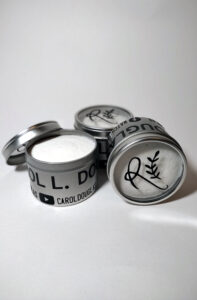
Rowan Branch Brush Soap, $12 plus shipping and handling.

Brushes are where quality matters, but they’re pricey, so they’re where most artists flinch. Start by encouraging your artist to take care of the ones he or she has. Oil and acrylic painters need Rowan Branch Brush Soap. My daughter Mary makes it for me, and I’ve used it for several years with great results. (Watercolor brushes don’t need or want brush soap.)

Watercolor brushes

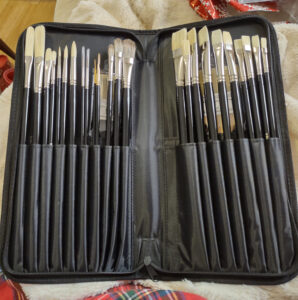
My current watercolor brush love is the 3/8” Silver Brush Limited 3/8” Black Velvet Dagger Striper Paintbrush. Its full belly means it carries a lot of paint, while its fine point means you can slip from fat to fine in the same brushstrokes. I have a collection of very expensive watercolor brushes but the ones I continually grab are Princeton Neptunes. This nifty travel kit would make any watercolor painter happy.

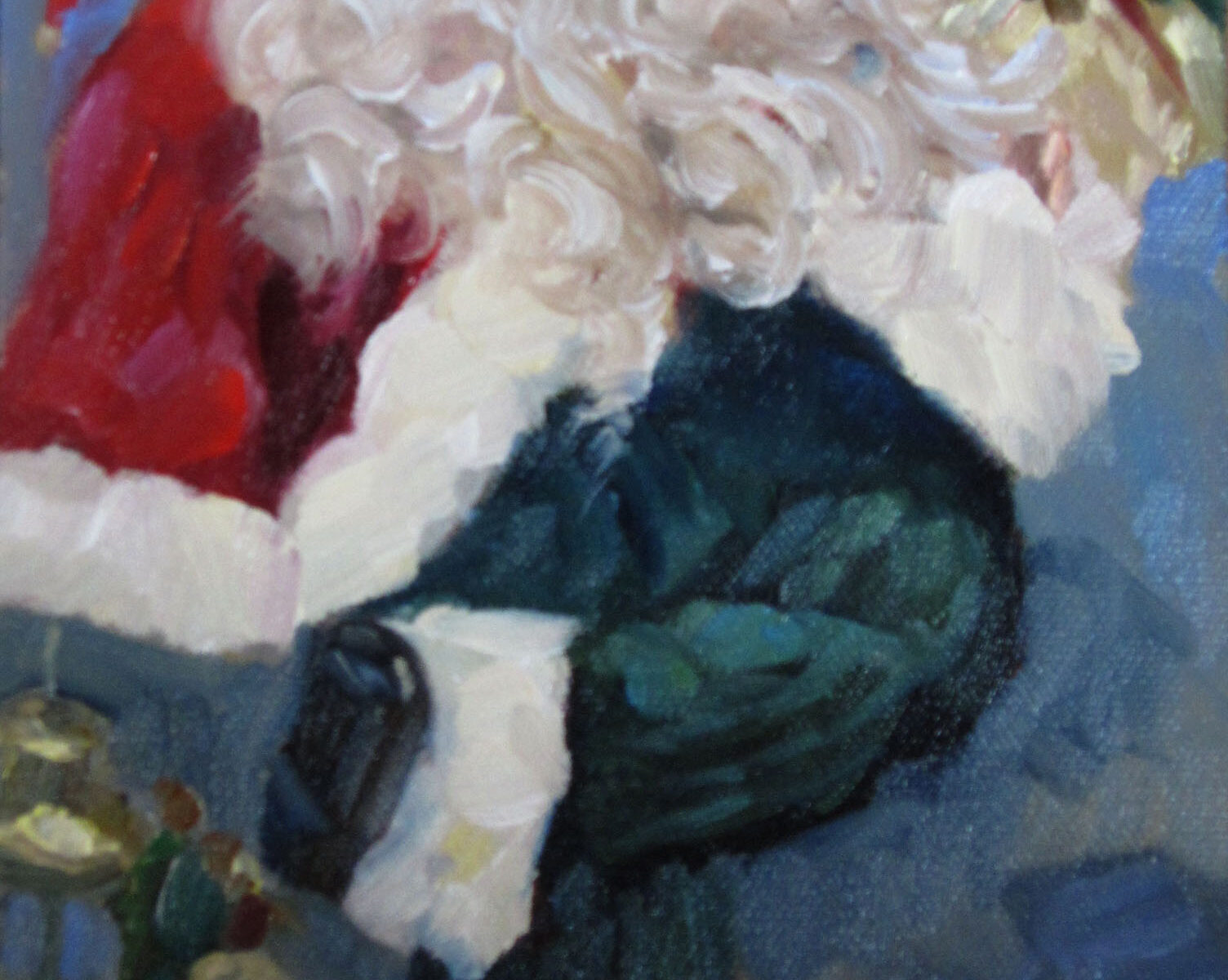
Santa Claus, 6X8, oil on archival canvasboard, $435 framed includes shipping and handling in continental US.

Oil and acrylic brushes

I’m a fan of hog bristle brushes for oils and acrylics but I borrowed a Rosemary & Co. Evergreen from Olena Babak. It was enough to make me get a few for when control is more important than heft.

But for most alla prima painting I like muscular hog-bristle brushes. Isabey is a French company that makes very nice interlocking bristle brushes that stand up to hard use without splaying. Here’s a #8 bright, #6 flat, #8 filbert and #8 round that will give more mileage than three times the number of lesser brushes.

It’s easy to wipe out tiny brushes, so I have a few of these Princeton 9650 size 2 around for when I need to sign my name or paint a squiggle.

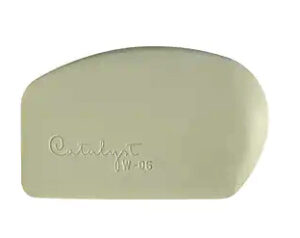
Eric Jacobsen, that incomparable mark-maker, got me a Princeton Catalyst W-06 wedge, and it’s become an indispensable part of my kit. Last month I noticed Krystal Brown using the same wedge for mark-making. You can’t be precise, so it’s a great tool for loosening up your brushwork. In fact, the whole series of these wedges are fun. They’re meant for any heavy-body paints, and they’d be especially appreciated by any encaustic painter on your list.

Gouache is so on-trend right now.

Gouache and other colorful things

Many painters are interested in experimenting with gouache, and for good reason—its results are completely on-trend. Schmincke Horadam is a fabulous, high-pigment brand. M. Graham has a primary-color starter set that’s about half the price and nearly as luscious.

A great combo for mixed media experimentation is oil paint and oil pastels. Sennelier’s 24 color starter kit is a great introduction. 

Similarly, you can add chalk pastels to watercolor or acrylic paintings. My preferred soft pastel is Unison. I love NuPastel hard pastels for both underdrawing and blending instead of with a stump. For just plain fun, try these Caran d’Ache Classic Neocolor II Aquarelle watercolor crayons.

Easels: the good, the bad, and the ugly

If your painter struggles with a knock-off Gloucester-style easel, you can make him or her ecstatic by buying the Take-It Easel, which costs twice as much and is worth every penny. After breaking one of the cheap ones and then buying a second one that arrived warped, I shelled out for the real thing. I’m glad I did.

As a teacher, I see a lot of pochade boxes and easels, and can steer you away from the bad ones as well as recommend good ones. I’ve had a version of the Mabef Field Painting Easel for decades and recommend it highly as a good starter tool for plein air. It has a swing head so can be used for oils and watercolor. The Leder Easel is simple, effective and light-weight, and the more I use it, the more I like it for all media. Tell Ed I sent you and he’ll give you 10% off (and, no, I don’t get a spiff for that).

Terrie Perrine working in pastels on her Leder easel.

I use an EasyL Pro on a carbon-fiber Manfrotto tripod with a ball head. It is very lightweight and has survived incredible abuse (including saltwater), but it’s not a cheap combination.

For studio work, I swear by the Stanrite #700 Professional Studio Easel. I use its little brother, the Testrite #500, for students. The difference between the two models is in the maximum size canvas they’ll accept. They’re aluminum so they don’t warp or crack. I’ve had them for decades. The only maintenance I’ve ever done was replace parts that wandered off.

Miscellany

The danger of “park and paint” plein air is other drivers. One of the nicest gifts I ever received was a pair of safety cones. This set of collapsible ones is more practical: they’re reflective, come with LED lights, and will fit easily in a car trunk.

I have an Artwork Essentials umbrella, but I also like the Shade Buddy, which won’t pull your pochade box over in heavy wind.

I have more than one taboret cabinet but my current favorite is this simple six drawer rolling cart. Mine sits under my teaching desk and holds all the art supplies I might need while teaching. Watch for discounts; I got mine on a Woot daily deal.

If your artist is starting to frame and sell work, the Fletcher FrameMaster point driver will save him or her a world of aggravation. Mine is decades old and still works fine.

Registration is now open for workshops in 2026! Reserve your spot:

Can’t commit to a full workshop? Work online at your own pace:

Seven Protocols for Successful Oil Painters

This page contains affiliate links for some but not all products. If you choose to make a purchase after clicking a link, I may receive a commission at no additional cost to you. Thank you for your support!

Gifts for the artist you love

Santa Claus, 6X8, oil on archival canvasboard, $435 framed.

Today I’m thankful for the people who support artists, so here’s a shopping guide that will make their holiday gift-buying easier.

Let’s talk about brushes:

Several years ago, my students bought me a set of Rosemary & Co. brushes. My biggest regret about my lost painting kit is that those brushes were a gift from people I love, but Bobbi Heath and Karen Ames have both sent me spare brushes. That adds another level of gratitude to my brush roll.

Brushes are where quality matters, but they’re pricey, so they’re where most artists flinch. Why not buy a Rosemary & Co. gift card? That means they’ll have to pull the trigger on a brush, as Rosemary doesn’t carry much else. Gift cards come in odd increments because it’s a British firm, but plan to spend at least $130 for it to be useful. They make oil, acrylic and watercolor brushes, so only pastelists need miss out.

One of the nicest gifts I’ve ever received was this set of Rosemary & Co. oil brushes.

Isabey is a French company that makes very nice bristle brushes that stand up to hard use. If your artists have no big brushes, buy a bright, flat or round anywhere between a size 10 and 14. Those big boys are the ones artists never get around to buying.

It’s easy to wipe out tiny brushes. This small bright and even tinier round are perfect for detail. Princeton has rebranded these brushes as Snap! But they’re the same excellent quality that the series 9700 has always provided.

I have a collection of very expensive watercolor brushes but the ones I continually grab are Princeton Neptunes. This nifty travel kit would make any watercolor painter happy.

This Catalyst wedge is lots of fun with any heavy-body paint.

Eric Jacobsen, that incomparable mark-maker, got me a Princeton Catalyst W-06 wedge. You can’t be precise, so it’s a great tool for loosening up your brushwork. In fact, the whole series of these wedges are fun. They’re meant for any heavy-body paints, including oil, acrylic and encaustic.

If I could carry only one watercolor travel brush, it would be an Escoda Reserva Kolinsky-Tajmyr Pocket Brush. It’s compact, comes in a protective tube, and makes an outstanding range of marks. A close second at a lower price point are the Da Vinci Cosmotop Spin Travel Brushes. A hat tip to Heather Evans Davis for introducing me to them.

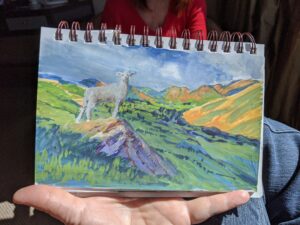
Gouache is a versatile and portable medium that’s appealing to artists in any medium. I did this when I ran out of painting boards while stranded in Argentina.

Gouache and other colorful things

Many painters are interested in experimenting with gouache, and for good reason-its results are completely on-trend. Schmincke Horadam is a fabulous, high-pigment brand, but a starter set runs a hundred bucks. Instead, you could make up a primary-color kit of Titanium White, Lemon Yellow, Scarlet (Pyrrole Red), Helio Blue (Phthalo), and Ivory Black. That’s everything necessary for limited-palette painting. M. Graham has a primary-color starter set that’s significantly less expensive and nearly as luscious.

A great combo for mixed medium experimentation is oil paint and oil pastels. Sennelier is the clear quality winner in oil pastels. A landscape or iridescent starter kit will give your artist enough information to know if he likes the combination.

Similarly, you can add chalk pastels to watercolor or acrylic paintings. My preferred soft pastel is Unison; a starter color kit is enough to experiment with. I love NuPastel for hard pastels; a set of 24 will provide a full range of color options. Of course, watercolor pencils are fun for everyone. I like Staedtler Karat Aquarell and Faber-Castell Albrecht Dürer Magnus, which are fatter than usual.

Cheap pochade boxes are a false economy. This field kit was pricey, but it’s put up with an incredible amount of abuse, including saltwater, sand, deserts, heat and freezing temperatures.

Easels: the good, the bad, and the ugly

If your painter struggles with a knock-off Gloucester-style easel, you can make him or her ecstatic by buying the Take-It Easel, which costs twice as much and is worth every penny. After breaking one of the cheap ones and then buying a second one that arrived warped, I shelled out for the real thing. I’m glad I did.

As a teacher, I see a lot of pochade boxes and easels, and can steer you away from the bad ones as well as recommend good ones. I’ve had a version of the Mabef Field Painting Easel for decades and recommend it highly as a good starter tool for plein air. It has a swing head so can be used for oils and watercolor. The Leder Easel is simple, effective and light-weight. Tell Ed I sent you and he’ll give you 10% off (and, no, I don’t get a spiff for that).

I use an EasyL Pro on a carbon-fiber Manfrotto tripod with a ball head. It is very lightweight and has survived incredible abuse (including saltwater), but it’s not a cheap combination (and thank goodness it wasn’t in my painting kit when that went missing.) I’m getting an EasyL Lite soon, which will replace my home-built aluminum pochade box for backpacking.

For studio work, I swear by the Testrite #700 Professional Studio Easel. I use its little brother, the Testrite #500, for students. The difference between the two models is in the maximum size canvas they’ll accept. They’re aluminum so they don’t warp or crack. I’ve had them for decades. The only maintenance I’ve ever done was replace parts that wandered off.

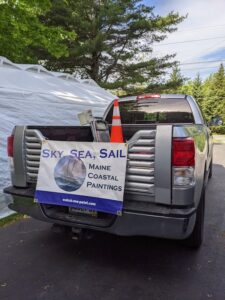
My traffic cones ride in the back of my truck, but if you drive a smaller vehicle, you’ll want the collapsible kind.

Miscellany

The danger of “park and paint” plein air is other drivers. One of the nicest gifts I ever received was a pair of safety cones. This set of collapsible ones are reflective, come with LED lights, and will fit easily in a car trunk.

I have an Artwork Essentials umbrella, but I’m equally impressed with the Shade Buddy. However, for many situations, I find a beach umbrella works just as well.

I have more than one taboret cabinet but my current favorite is this simple six drawer rolling cart. Mine sits under my teaching desk and holds all the art supplies I might need while teaching. Watch for discounts; I got mine on a Woot daily deal.

If your artist is starting to frame and sell work, the Fletcher FrameMaster point driver will save him or her a world of aggravation. Mine is decades old and still works fine.

I’d be remiss in not mentioning Rowan Branch Brush Soap. My daughter Mary makes it for me, and I’ve shared it with enough other artists to know that it really works.

This page contains affiliate links for some but not all products. If you choose to make a purchase after clicking a link, I may receive a commission at no additional cost to you. Thank you for your support!

Registration is now open for workshops in 2026! Reserve your spot:

Can’t commit to a full workshop? Work online at your own pace:

Seven Protocols for Successful Oil Painters