

A young reader recently asked me, “How does fast fashion influence art for my generation?”
My mother, starting in the 1940s, bought silver flatware one piece per paycheck. This went into her hope chest, which (for my young reader’s benefit) was a trunk used by a young woman to store household items she collected for marriage. Mom’s assumptions today seem almost like a foreign country, but it’s the idea that she expected to use and love one style of silverware for the rest of her life that I want to talk about.
My parents modernized their old farmhouse kitchen when they bought it in 1965; it never changed before Mom died in 2014. Today, a house with a circa 2000 kitchen is outdated. That can easily be a $30,000–$50,000 project, done for purely aesthetic considerations.
So, I see my student’s point.

Fast fashion has changed our relationship with objects. And that inevitably influences art.
My mother bought something because she expected to live with it for her lifetime. We increasingly buy things because they are trendy. Fashion changes. Colors change. Styles change. Quality takes a back seat to speed and price.
Yet art has traditionally been the opposite of fast fashion. A painting appreciates. It is intended to be something you live with for life and pass along to your kids. A good painting should hang so long that, yes, it gathers dust.
My kids live in a consumer culture of extraordinary speed: Instagram, TikTok, Pinterest and online shopping constantly bombard us with new things to want.

Tension, tension, I’ve got tension
On one hand, contemporary artists are inevitably influenced by the culture around them. We see different colors, compositions, patterns and subjects because of the world we live in. Our art should respond to that.
On the other hand, there are immutable truths in art: good composition, good value structure, solid color relationships, good brushwork. I might easily be painting a view that has been there for a millennium. And the tide comes in and out the same way it always has.

Not everything needs to be replaced
One of the most interesting conversations I have with young people has to do with the price of art. Their benchmark is inevitably Wayfair or TJ Maxx/HomeGoods. I get that, since there was a time when the only original art in my home was that which I had made myself.
As I’ve gotten older, I’ve learned the cost of cheap things. Now I buy good shoes, good cars and good clothes, and I wear them out. Of course, none of the cheap art I once had remains anywhere in my house. And none of the good original art that I’ve carefully collected has ever needed to be replaced. That may be one of the best things art can offer to Gen Z: the idea that not everything needs to be constantly replaced.
The challenge for artists is not to pretend fast fashion doesn’t exist. It is to understand the visual culture it has created without becoming captive to its demand for novelty. We can make paintings that are contemporary without making paintings that are disposable.
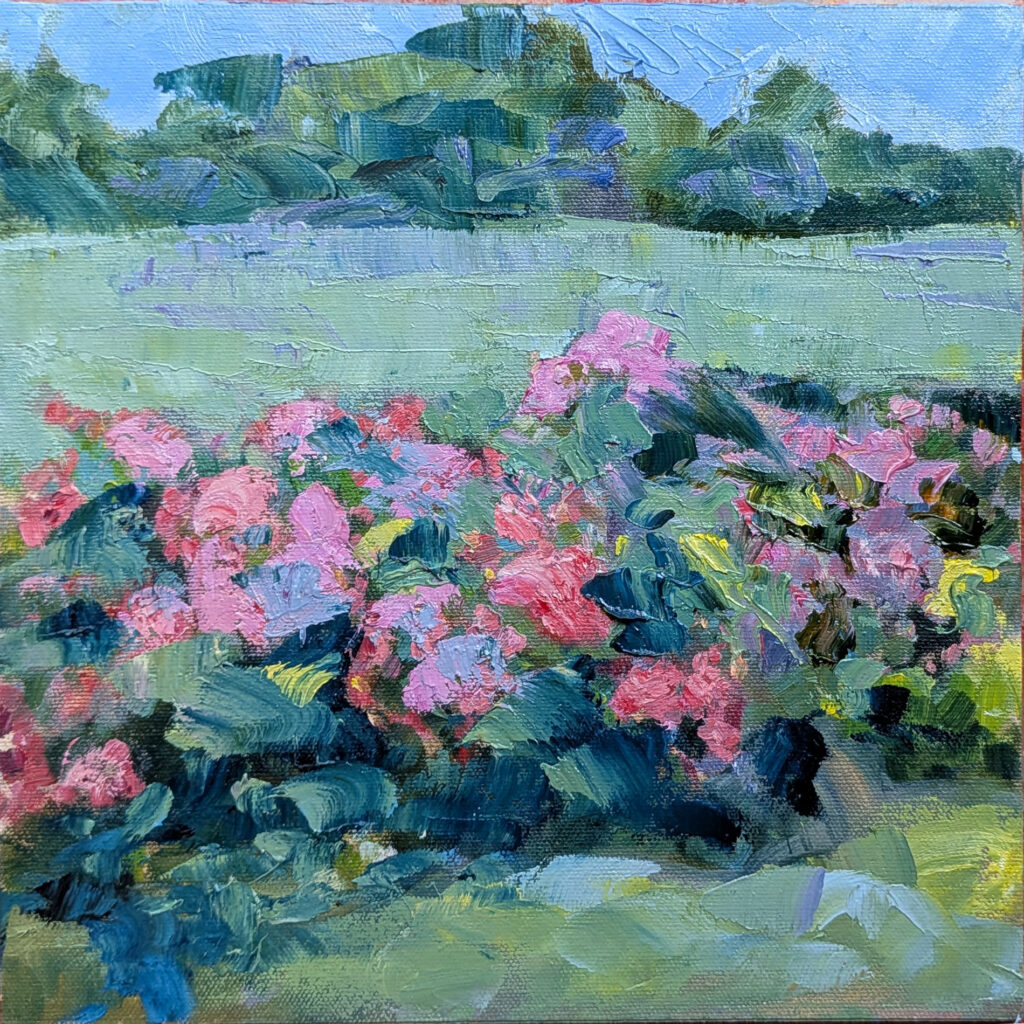
And perhaps that is where generations can meet. My mother saved her silverware one piece at a time. I paint one brushstroke at a time. Both are ways of saying: this is worth keeping.
I have just two workshops left in 2026! Reserve your spot:
- New! Color Clinic 2026 | Rockport, ME, October 3-4, 2026
- New! Composition Week 2026 | Rockport, ME, October 5-9, 2026
- High-Desert Light & Monumental Form | Sedona, AZ, Apr 26, 2027 – Apr 30, 2027
Can’t commit to a full workshop? Work online at your own pace:
The commission I’m working on is of Ireland’s Cliffs of Moher. It will replace a commercially produced generic print (so generic I can’t recall what the picture is of) hanging over the fireplace in the home of friends. When they were younger, my friends just went for something fast and inexpensive to match their living room decor. Now they want something original of value that holds some meaning for them and that they can pass along to the next generation. As an artist, that, more than anything else, makes me happy.
I don’t disapprove of buying a painting that looks good over the sofa, but I can’t see buying a BAD painting for that reason.
Thanks for echoing my sentiment that paintings are worth keeping. My mother in law too bought her silverware one piece at a time and saved for each piece. It was a lovely pattern and appreciated. It did last the 70 odd years of their marriage…..and many family dinners. Grandchildren have it now and the same goes for paintings. Quality endures. Let’s paint good, quality paintings! Thank the good Lord who gives us inspiration to create one painting, one sketch at a time! And the freedom to do so!
I have my mom’s now, although I admit I seldom set a formal table.
Carol— It is a shame the silverware is not used more often….helps keep it from tarnishing for sure. My sister in law had a old silver coffee or tea set out on a tray on display on the hutch in the eating area with Mom’s silver spoons in the empty creamer as a reminder of the value of a good cup of tea with friends and family. I admired her ingenuity and attention to such things. We live in a busy world!
I admire that too! I confess, I’ve gotten rid of my old silver tea set. I couldn’t care for it properly in the time I have.