The mysterious shortage of hog bristle brushes

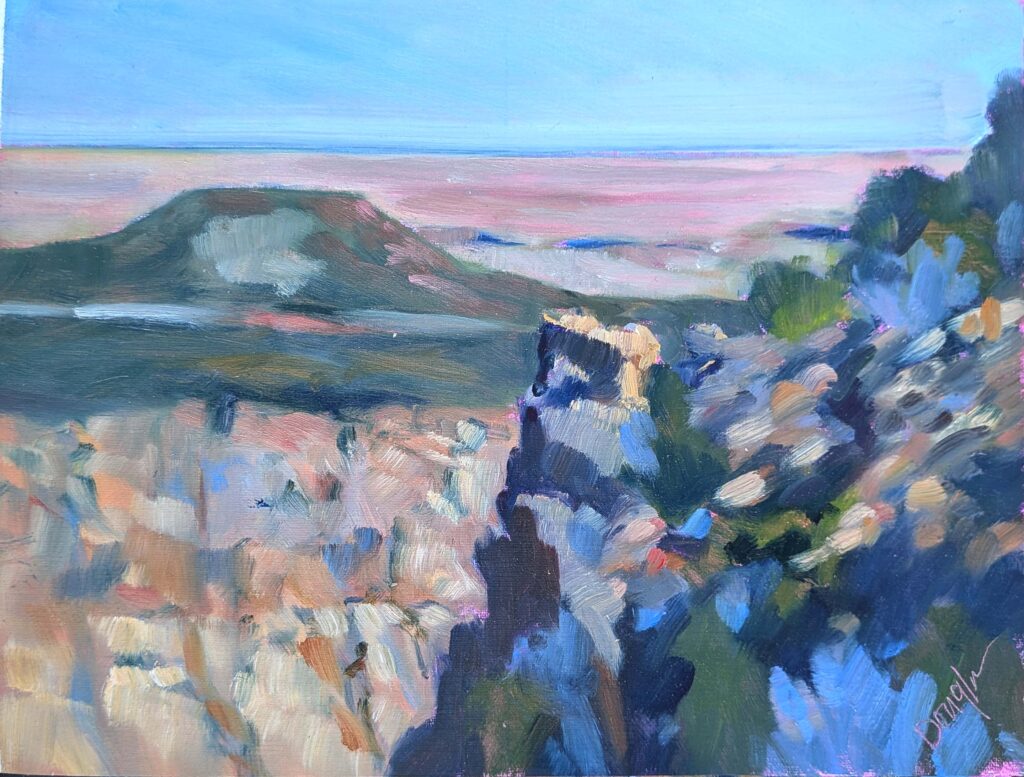
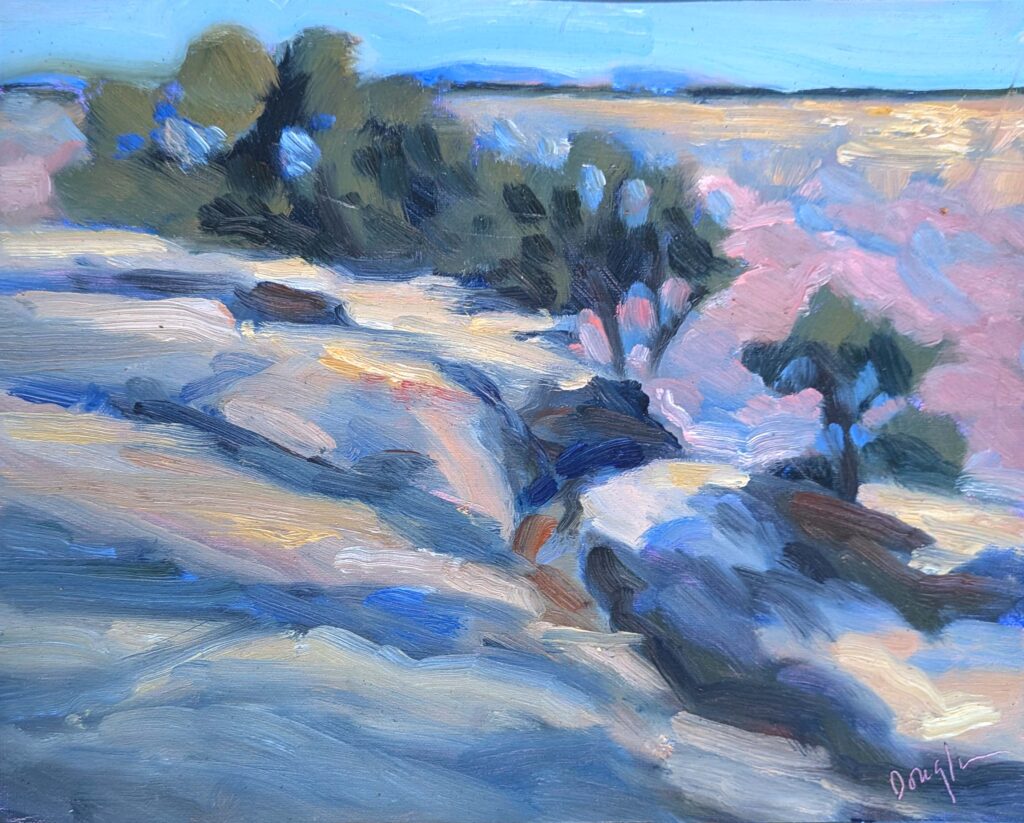
Desert View, 9X12, oil sketch on linen. This is one of four oil sketches I did at the Grand Canyon last weekend.

I recommend hog bristle brushes for oil painters, but recently my friend and student Jeanne-Marie told me she couldn’t get them at her local art store. “There’s a worldwide shortage of hog bristle brushes,” she told me. It turns out she’s absolutely right.

Hog bristle brushes really are getting harder to find. To understand why, you have to look far beyond the art supply aisle.

Where hog bristle actually comes from

The stiff, springy hairs that make a good oil painting brush usually come from hogs raised in northern China, where cold climates produce the strong, resilient bristles prized by artists. These hairs—often called Chungking bristle—are sorted, cleaned, and bundled before being shipped to brush makers around the world.

China produces the vast majority of the world’s natural hog bristle; estimates run as high as 80% of global supply. That concentration means any disruption ripples through the entire brush market.
Mojave Point #2, 9X12, oil sketch on linen. This is one of four oil sketches I did at the Grand Canyon last weekend.

Disease, farming shifts, and shrinking supply

African swine fever devastated pig populations in China, reducing the country’s hog herd dramatically and cutting the supply of usable bristle. Some estimates suggest the herd fell by about 40% during the epidemic, which pushed bristle prices sharply upward.

Even after herds recovered, the market never quite returned to normal. Pig farming changed, supply chains tightened, and the amount of high-quality brush hair remained limited. In recent years, exports have dropped by more than 12%, tightening the market for manufacturers who depend on those bristles. If you’re a brush maker, that meant an unpleasant choice: raise prices or compromise on materials. Or both.

When demand rises but quality falls

The shortage isn’t just felt by painters. Hog hair is also used in cosmetic brushes and industrial products, which increases competition for the same raw material. The demand for cosmetic brushes has increased significantly (thanks, Mary). This growth is driven by rising interest in professional-grade, high-quality brushes, social media-driven makeup trends and growing consumer awareness of beauty hygiene.

When demand rises and supply shrinks, manufacturers sometimes resort to blending in lower-grade bristle or shortening the hair bundles. That can produce brushes that feel scratchier, lose their shape sooner and splaying more quickly.

Some artists report that modern bristle brushes simply aren’t as durable or consistent as older ones they’ve kept for years.

If you have a fine hog bristle brush, care for it carefully. Above all, keep it clean.
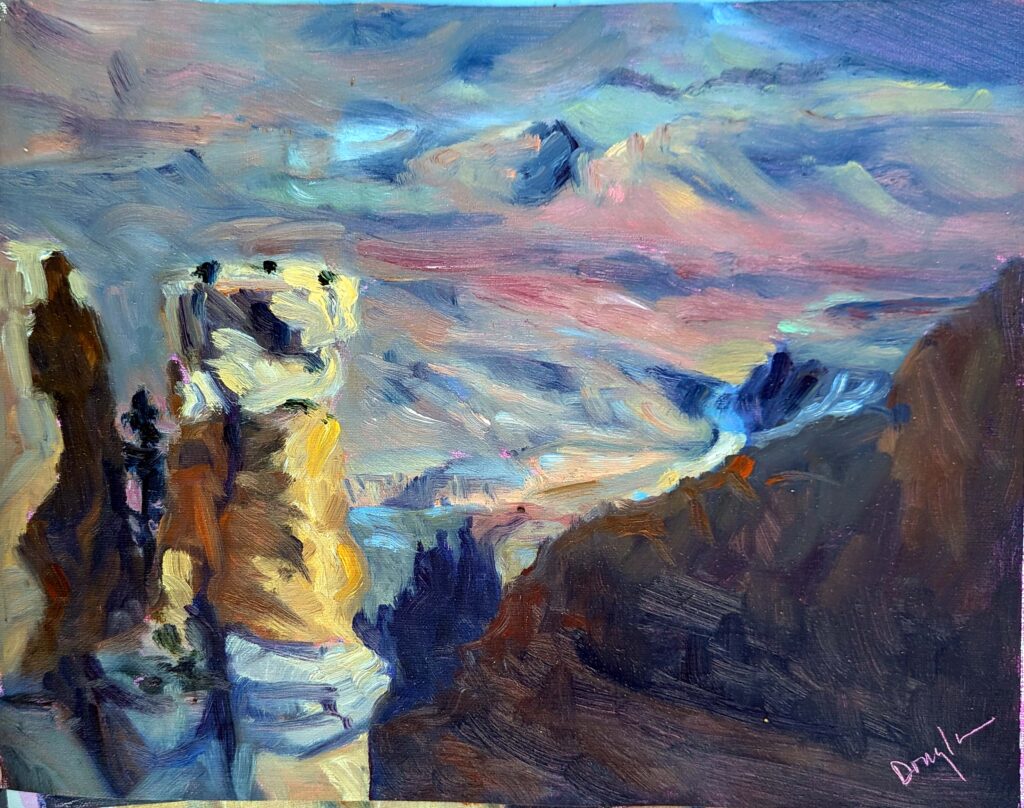
Colorado River from Moran Point, 9X12, oil sketch on linen. This is one of four oil sketches I did at the Grand Canyon last weekend.

The rise of synthetic alternatives

Some modern synthetics claim to mimic the stiffness and paint-holding capacity of hog bristle, though I’ve yet to meet one that replaces the spring and stiffness of Chungking bristle brushes. For painters who love muscular brushwork, especially in alla prima oil painting, hog bristle remains the gold standard.

What painters should do

In practical terms, the shortage means a few things for working artists:

  • Buy good brushes when you find them.
  • Take better care of the ones you have.
  • Be open to trying synthetics for certain tasks.

Mostly, this shortage is a reminder that painting materials are part of a much larger world of agriculture, manufacturing, and global trade. The pigments, canvas, linen and brushes you use are all products that start in the natural world. Your humble brush has traveled a long way to reach your studio.
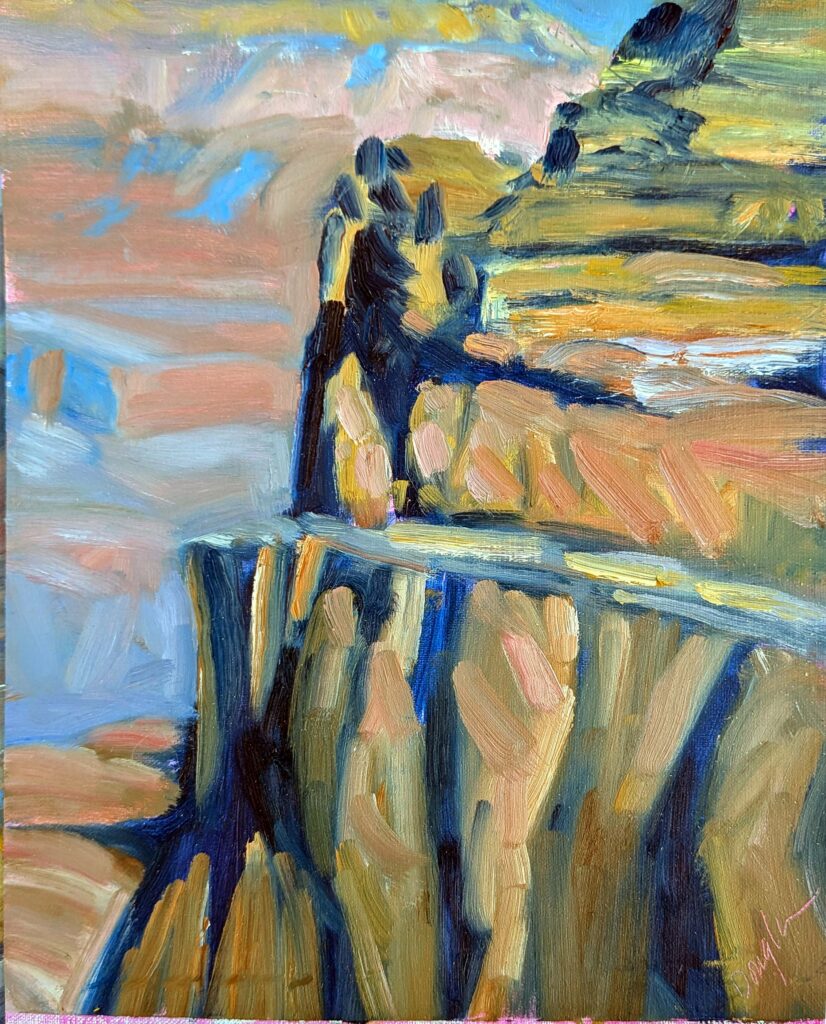
Mojave Point #2, 9X12, oil sketch on linen. This is one of four oil sketches I did at the Grand Canyon last weekend.

Registration is now open for workshops in 2026! Reserve your spot:

Can’t commit to a full workshop? Work online at your own pace:

Seven Protocols for Successful Oil Painters

I’ve Been Everywhere: plein air painting in the Grand Canyon

(With apologies to Hank Snow—and everyone else who sang that song)

Mather Point at dawn, oil on canvasboard, 9X12.

I’ve been painting and traveling. I faithfully blogged every stop until Thursday, when I got home too late to photograph my latest Grand Canyon paintings. That’s why you’re getting this post a day late. (They’re still lousy pictures, but the weather wasn’t cooperating; see below.)

In the past few weeks, my travels have taken me from Albany, NY, to Phoenix, Sedona, the Grand Canyon, and Sun City, AZ. Then back to Albany and on to Rochester to meet my newest grandbaby. From there, it was one more stop in Albany before heading home to Maine.

Grand Canyon at sunset, oil on canvasboard, 9X12.

Plein air painting at the Grand Canyon

This was my third time painting at the Grand Canyon after leaving Sedona. The first time, I went with my Sedona workshop student, Kamillah Ramos. Ed Buonvecchio loaned me a cold-weather sleeping bag and I slept under the stars. That shimmering night sky was transcendentally beautiful.

Since then, I’ve repeated the experience with my friend Laura Martinez-Bianco. This year, Ed joined us, and Hadley Rampton stopped on her way home to Utah. Each trip brings breathtaking sunrise views and the utter chill of high-altitude October nights. Next time, I may bring gloves and long underwear, but I’ll keep going back as long as I can.

The first time one paints the Grand Canyon en plein air, it seems absurdly difficult. The scene is so vast that it can’t be easily sorted. But it grows on you; every year I find myself more capable of slicing and dicing it into manageable bits.

Grand Canyon, late morning, 8X16, oil on archival linenboard.

My Grand Canyon paintings survived the trip surprisingly well, despite a makeshift packing job using only cardboard corners and stretch film. (I hadn’t planned on transporting wet canvases.) In fact, the only thing I lost on this trip was my electric toothbrush, and I’m pretty sure I know where that ended up.

Next week I’ll be in Boston at Brigham and Women’s Hospital with my husband—not quite as fun as painting in Sedona, but important. Thankfully, my friend Bobbi Heath is watching my pup and hosting me, so I’ll get to catch up with her between hospital visits.

(If wealth was measured in friends, I’d be a billionaire.)

Ed Buonvecchio being summoned by the Mother Ship. We were only a few hundred miles from Area 51, after all.

From Arizona sun to Maine rain

I had a lovely time in Sedona, but checked the weather forecast every day to see if our drought had broken. The National Weather Service was reporting it as ‘severe’ or ‘extreme’ across Maine and New Hampshire. By the time I flew home, it had still not rained.

People don’t associate Maine with forest fire, but it happens. The Great Fires of 1947 destroyed 200,000 acres of forest across Maine and killed 16 people.

Very welcome rain, welcoming me home.

So, I was pleased to see drizzle as I set off on my last leg across Massachusetts. It wasn’t doing much by the time I went to bed on Thursday night, but I awoke to the steady thrumming of rain on the roof. By morning, both small creeks along my Beech Hill hike had water in them. They’ve been dry for many, many weeks. Plein air painters may not like rain, but we homeowners are relieved.

Monday Morning Art School: put down that selfie stick

Laura Martinez-Bianco at our campsite at Mathers Point in the Grand Canyon. Yeah, she’s tired.

Laura Martinez-Bianco, my husband and I left Sedona Arts Center at 2:05 PM Saturday, heading toward Mathers Campground at the Grand Canyon. The last time I did this was with painting student Kamillah Ramos two years ago. I had a pretty good idea that we’d arrive just as the sun threw the last light onto the rim of the canyon, and so it proved.

For the past quarter century, the world’s beauty spots have been infested by digital photographers. I first saw this in 2008 at Phillip Island in Australia, where the evening march of the fairy penguins to their nests was obscured by tourists jostling to grab the perfect shot. “It happens every time,” my Aussie cousin told me.

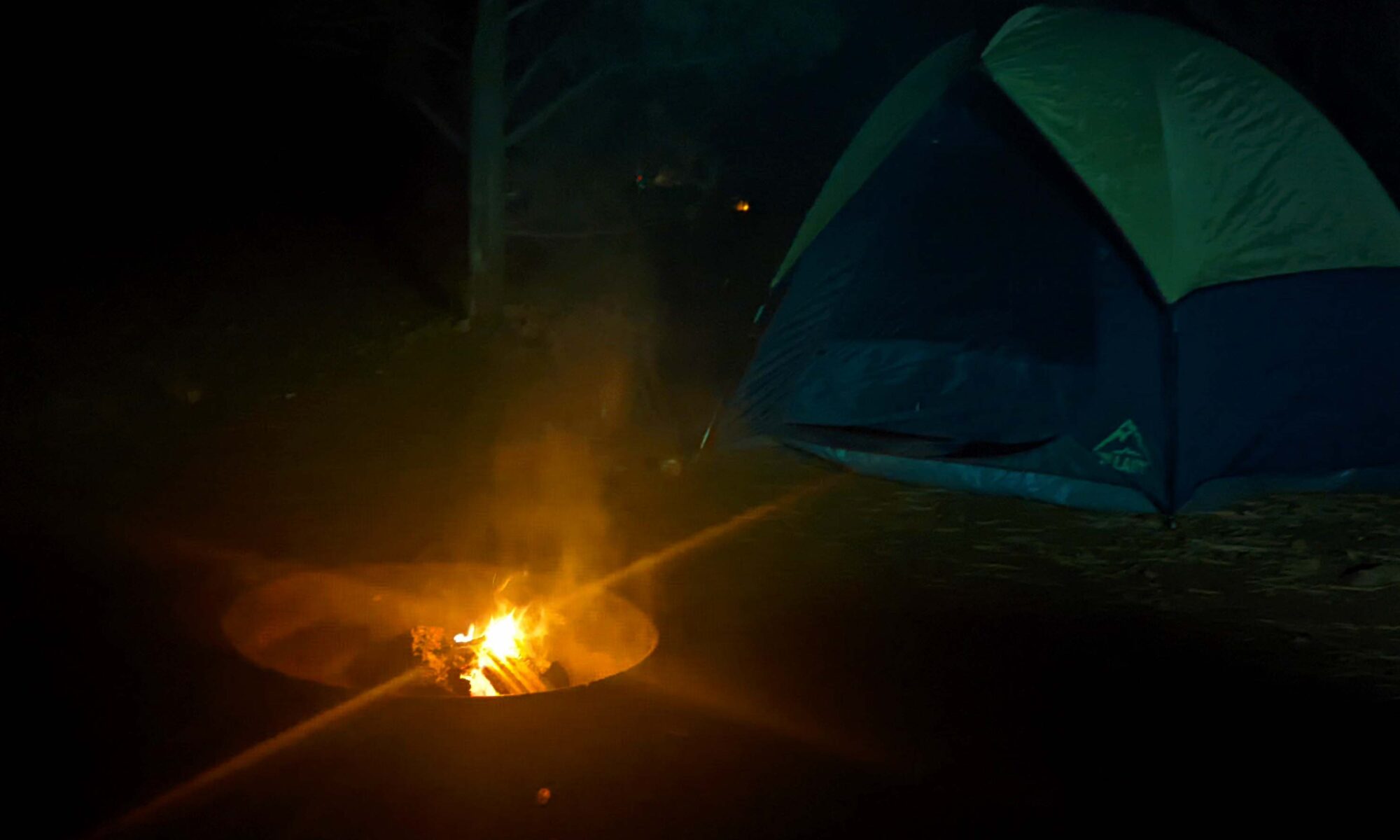
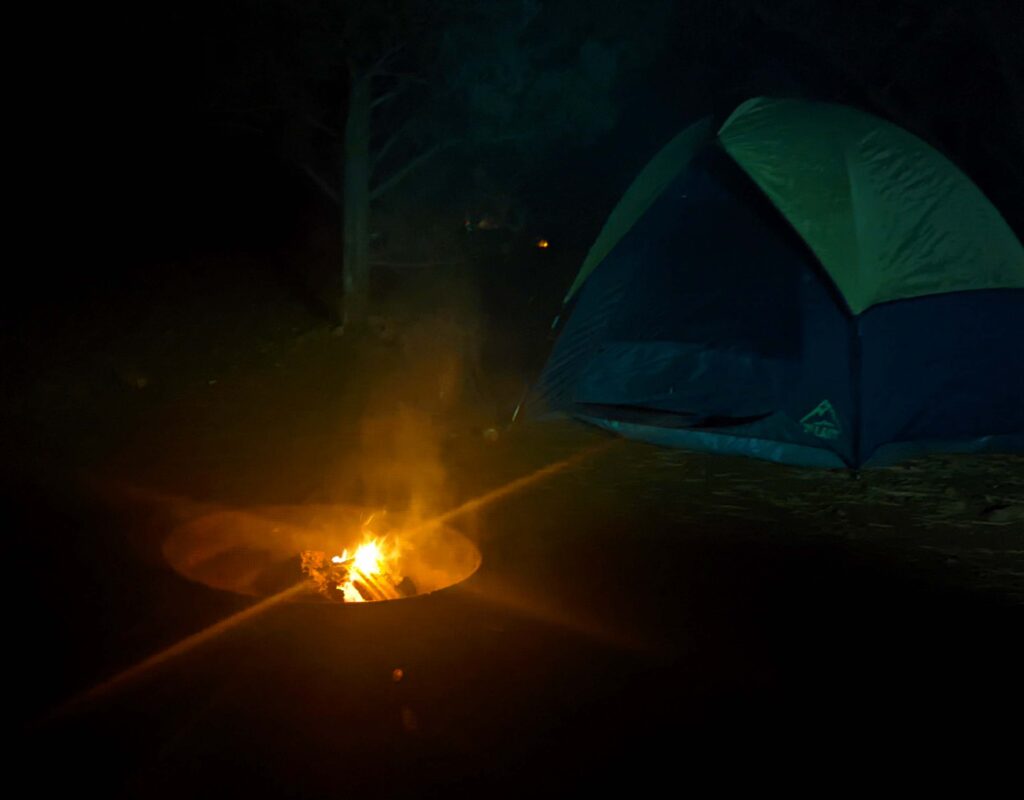
Our campfire and tent. Thank goodness for places with little light pollution.

The selfie stick and influencer-wannabes have made this worse. At Mathers Point, we could have tried to thread through the selfie photographers, but instead we just stood at the rim. “Pity the poor people at home who have to look at those vacation photos,” my husband commented about one particularly obnoxious man. “Hundreds of views of the same guy’s face.”

There’s more to life than your smart phone and selfie stick

Prior to 2000, people shot photos on film, which was expensive. When I visited the Grand Canyon, Bryce Canyon and Zion National Park in 1992, we shot three rolls of 36 exposures, or 108 images. Much more time was spent seeing than shooting.

Photography is so easy that pictures have become more about sharing on the internet than as a record for posterity. You can’t really see natural beauty through the screen of your phone, and nobody else is that interested in your vacation pictures. Yes, digital pictures are ‘free,’ but if you’re always looking at the screen of your phone, they steal the experience.

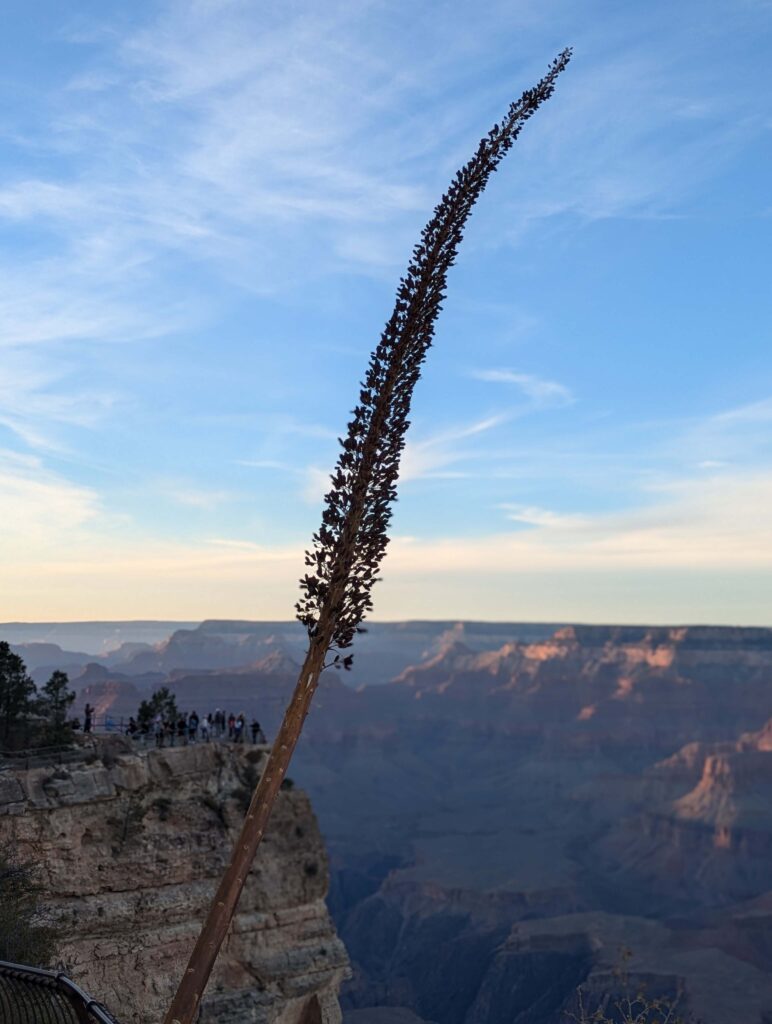
Cell phones sometimes annoy me, but they are great at identifying plants. This is an agave, or so sayeth the internet.

Your camera is making a sucker out of you

Last month, when the aurora borealis was peaking in North America, several people told me, “I saw them, but they weren’t as bright as I thought.” That’s because our expectation has been shaped by cell-phone photography. (I grew up in the Great Lakes region, and I’ve seen them many times.)

People will say, “I took that without a filter!” Unless you’re savvy enough to override the controls on your cell phone, it is, essentially, a filter. The aurora borealis looked brilliant on the internet because cell-phone (and digital) cameras automatically adjusted the exposure.

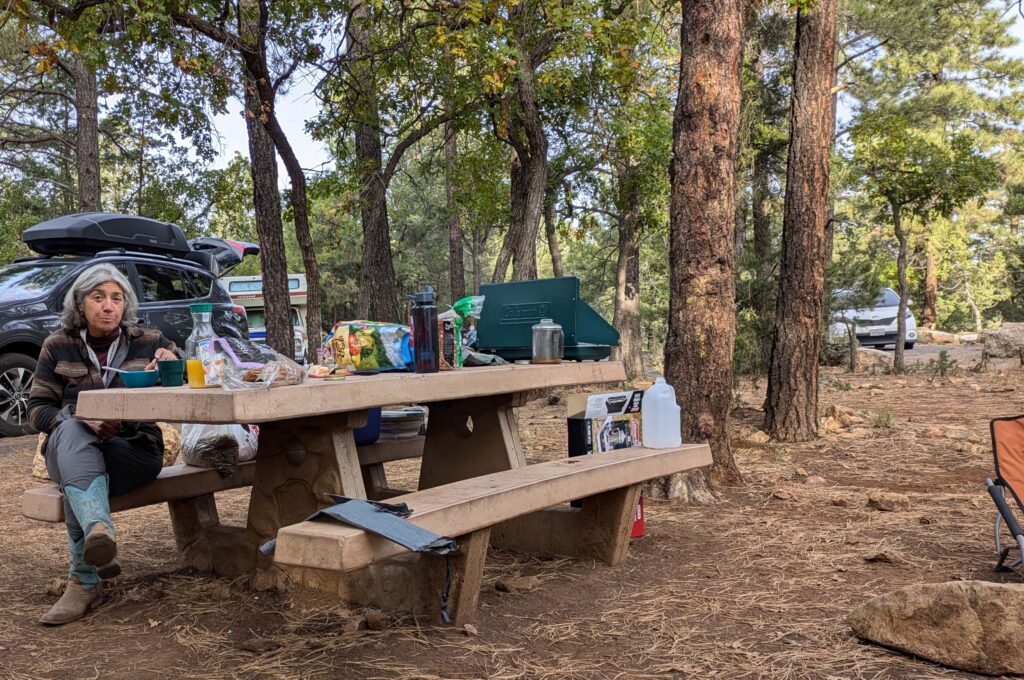
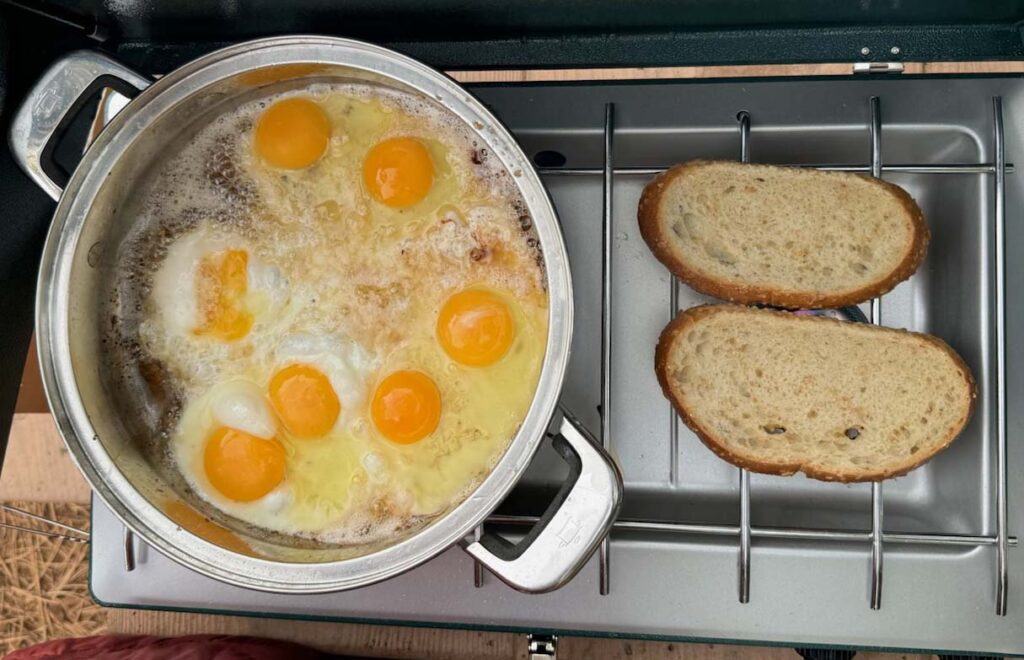
Who says I can’t cook? Oh, right, I do. (Photo by Laura Martinez-Bianco)

How modern photography has changed painting

It’s easy to oversaturate digital photography, and high chroma looks great on a video screen. That is in turn pushing modern painting into higher saturation. I like it, but it’s no more natural than my eyebrows.

Put down the camera… and the brush

“Do you want to go out at dawn to paint?” Laura asked me on Sunday morning. I had a long drive ahead of me, and, alas, we had to tear down our camp before hitting the road.

“Besides,” I told her, “My eyes and brain are tired.” Including all the events, Sedona Plein Air is nine days long, after all. Just like photography, the act of painting changes how you look at the world around you. I needed a reset.

I then drove hundreds of miles across the Kaibab Plateau and then north on US 89 between Bryce Canyon and Zion National Park, before finally hooking up with the interstate system. Since I was behind the wheel, I didn’t take a single photograph, but I saw dusty blue vistas that stretched forever, snow on high peaks, magnificent yellow cottonwoods, and hoodoos and hillsides scoured by the wind. It’s one of the most fantastic drives in this country, and it’s printed in my memory in a way that cell phone photos just can’t touch.

Sometimes, you have to put the phone—and the paintbrush—down and take time to just look.

Registration is now open for workshops in 2026! Reserve your spot:

Can’t commit to a full workshop? Work online at your own pace:

Seven Protocols for Successful Oil Painters