What’s the difference between plein air and studio painting?

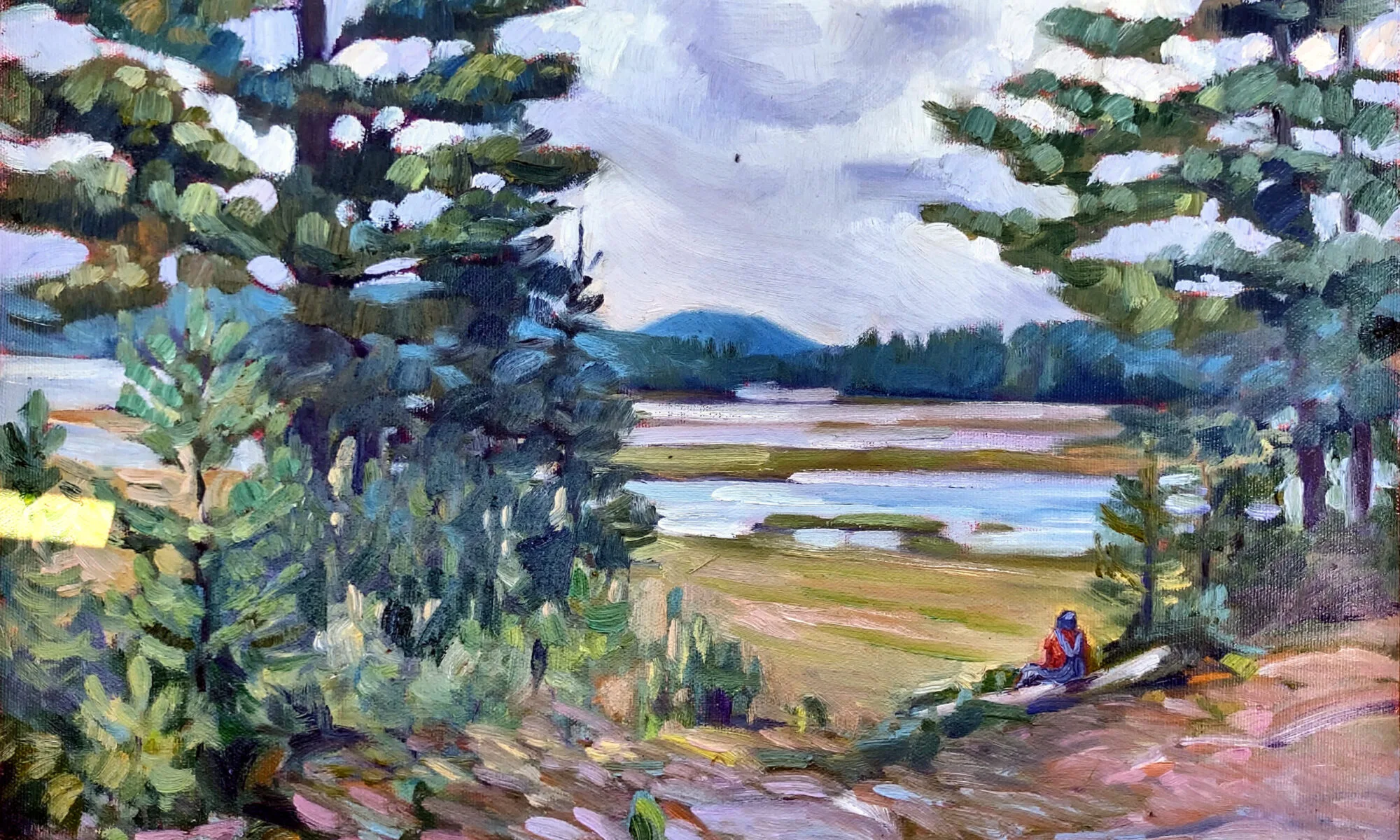
The Vineyard, oil on linen, 30X40, for more details, click on image.

I can beat a plein air painting to death as well as the next artist, so it helps to occasionally remind myself of the difference between plein air and studio paintings.

A quick note before we get into it

It’s time to claim your spot in Advanced Plein Air Painting, July 13-17 in Rockport, ME. If you have any questions about whether you fit into an advanced class, just ask!

In the field

Outdoors, I’m working against time. The light shifts, the shadows slide, the clouds roll by. I’m trying to capture something fleeting, and that forces me into clarity and economy of effort. I simplify, make snap decisions, commit. If I’m indecisive, it’s all over.

A good field sketch isn’t about detail; it’s all structure. It locks down the value pattern, major shapes and intent. It answers the essential question: what is this painting about? If you solve that outdoors, you’ve already done the hardest part.

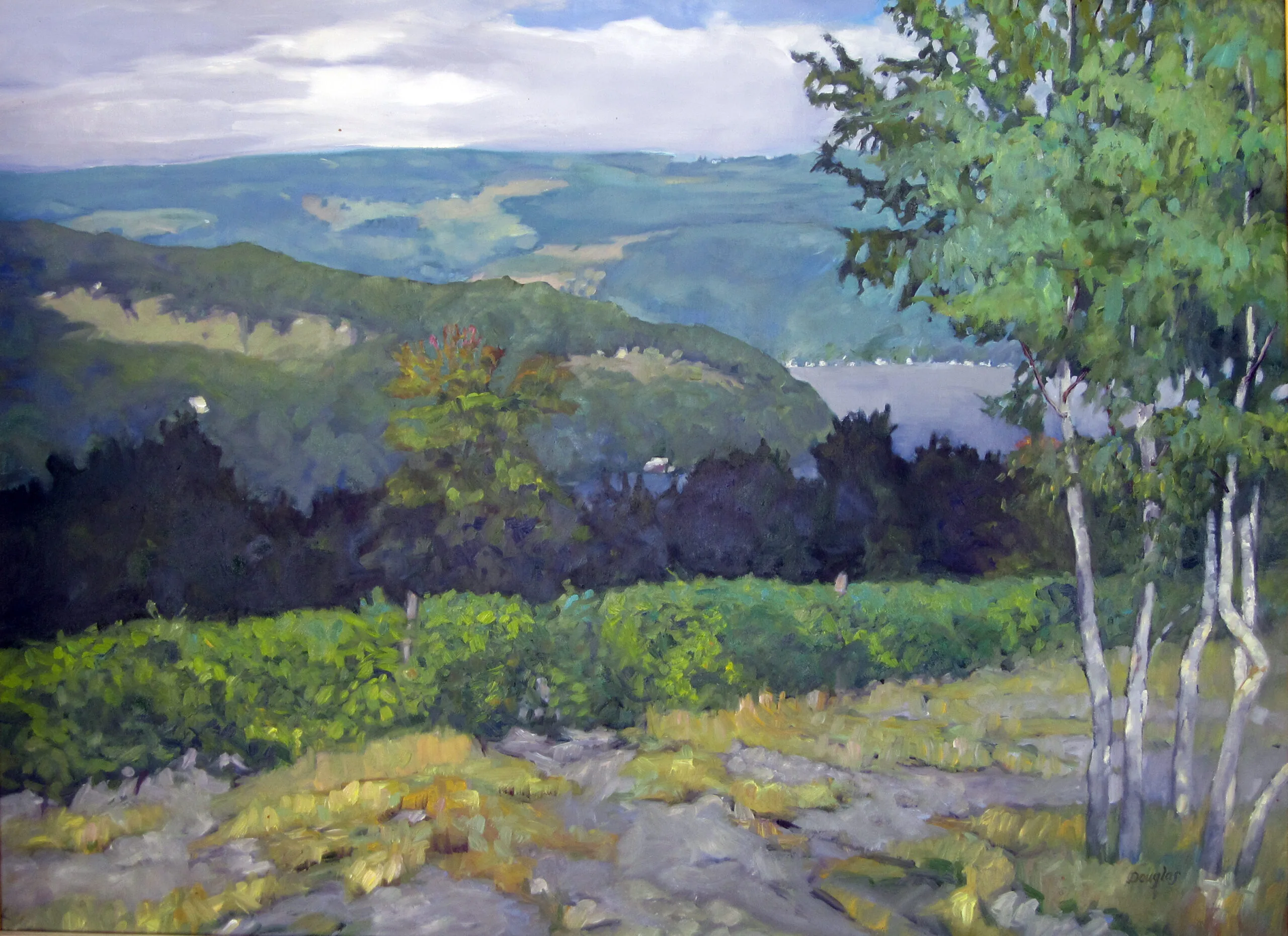
Keuka Lake vineyard, oil on archival canvasboard, private collection. This was the nucleus of my idea for the studio painting above.

In the studio

I almost never revise my plein air paintings back in the studio, because I can improve them right into dust.

In the studio, everything changes. Time expands. I fuss and second-guess. It’s easy to lose the freshness of the original idea because the germ of the painting is no longer in front of me. It’s very difficult to avoid reinventing my idea.

I’d rather use plein air sketches to inform and define separate studio paintings. That allows plein air to be fresh and studio work to be refined.

Photos lie

There was a reason for the decisions you made in the field. Your value structure, focal points and big shapes all happened because something in the real world caught your imagination. You can’t duplicate that from a photo; your snapshots are an aide to memory, nothing more.

Photos encourage us to bore (in both senses of the word) into too much detail. That’s especially true when you have the leisure to overwork, to describe every branch and leaf.

This is another painting I did while working out the same idea. Private collection.

Vitality or polish?

If your field sketch was strong enough, edges can ultimately be clarified, color deepened, drawing corrected. You can push temperature relationships, unify passages and make sure the eye moves cleanly through the composition. But the raw, living thing you caught outdoors should never be overwritten. That sacrifices vitality for polish.

Frederic E. Church traveled throughout New England, New York, Virginia and Kentucky painting. He made two trips to South America and went to Mexico, Newfoundland, Labrador, the Middle East and elsewhere. He took his field sketches back to his studio and created monumental paintings that made him one of the most successful artists in American history.

Many painters get lost trying to compromise between plein air and studio painting techniques. The field demands boldness; the studio demands sophistication. To carry vitality into the studio, you cannot destroy the thing you loved. It’s the map that will give your studio paintings direction and life.

That’s exactly what I focus on in my From Field Sketch to Final Studio Work Zoom class (Tuesday evenings, June 2, 9, 16, 23, 30, July 7). We break down the process step by step so you stop fighting your own paintings and start building on them.
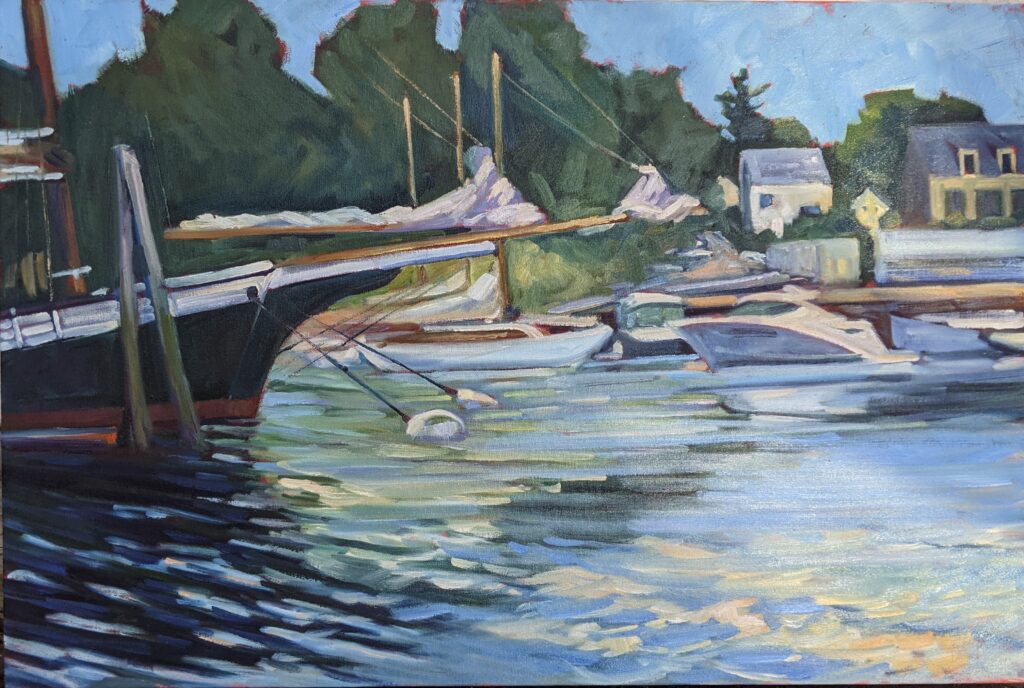
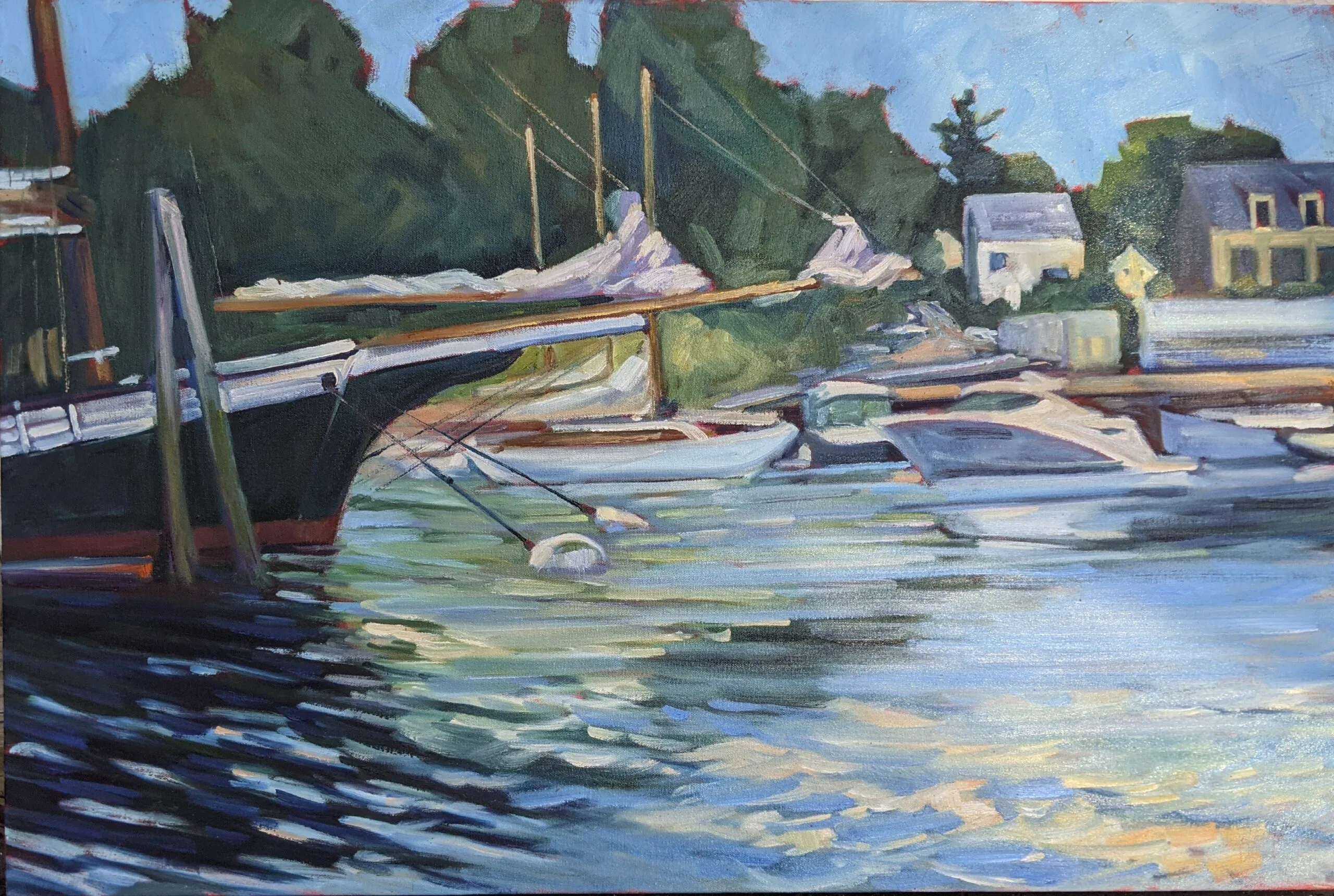
Camden Harbor, Midsummer, oil on canvas, 24X36. Although large, it was done entirely en plein air. For more information, click on the image.

Painting clouds

Of course, structure is only part of the story. If you can’t handle moving elements like water or shifting forms like clouds, your field work will always feel incomplete. That’s why I’m teaching a focused session on Painting Clouds (Monday evenings, June 22, 29 and July 6). The subject forces you to simplify, prioritize, and paint with authority. Both classes are really about the same thing: learning to make decisions that hold up from first sketch to final brushstroke.

I have just two workshops left in 2026! Reserve your spot:

Can’t commit to a full workshop? Work online at your own pace:
Seven Protocols for Successful Oil Painters

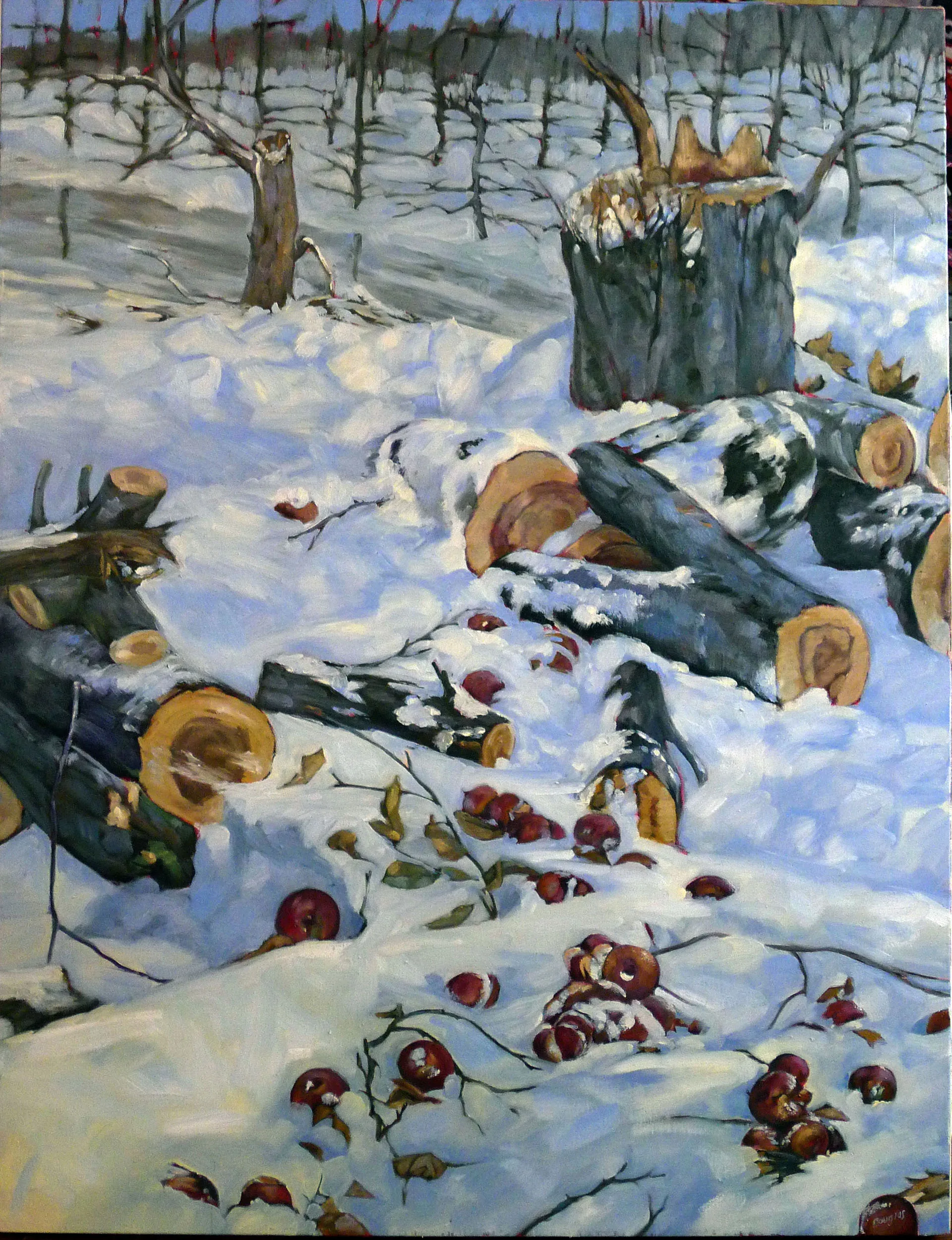
All Flesh is as Grass

All Flesh is as Grass, oil on linen, 30X40, $5072 framed, includes shipping and handling in continental US.

Of all the paintings I have hanging in my home, the one that gets the most comments is All Flesh is as Grass, above. It was part of a solo show called God + Man: Paintings by Carol L. Douglas at the Davison Gallery at Roberts Wesleyan College, and reprised at Aviva Gallery in Rochester, NY.

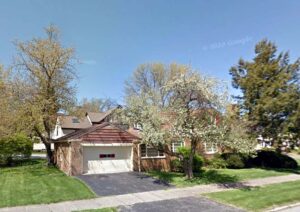
Harry Rogachefsky was an elderly man who lived across the street from us. He had a lovely apple tree curling over his driveway. He told us we were welcome to all the apples we wanted. They were not sprayed and thus organic, and they made great pies.

Mr. Rogachefsky’s house in happier times (2007) with his apple tree in flower.

The house was built in 1948, and the tree was planted around the same time. I thought of painting it many times, as I’m fascinated by the twisting branches of old apple trees. Alas, I never did it.

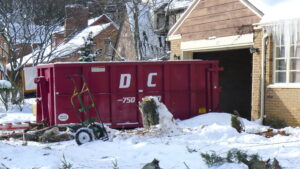
Mr. Rogachefsky eventually died at the venerable age of 95. His house sat vacant until Christmas, 2014, when a flurry of contractors descended. It had been purchased by house flippers. They yanked the mature foundation plantings and cut down that beautiful old tree.

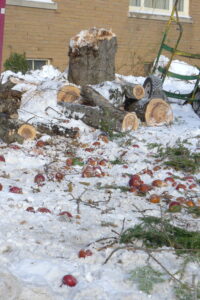
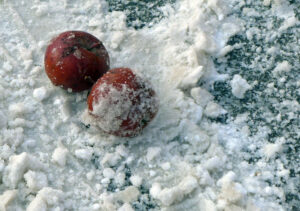
I found its remains while walking with my dear friend Mary. Its trunk was shattered and its branches sawn into logs. Its fruit was crushed and frozen.

What Mary and I saw as we rounded the corner.

There must be a standard landscaping plan for house flippers. When they were done with Mr. Rogachefsky’s house, five little popsicle shrubs marched along the sidewalk. Luckily, I didn’t live there much longer. Although I’m now hundreds of miles away, when pie season starts, I think fondly of Mr. Rogachefsky and his apple tree.

All flesh is like grass and all its glory like the flower of grass.
The grass withers, and the flower falls, but the word of the Lord remains forever.
(1 Peter 1:24-25)

We know that intellectually, but it’s still a shock when the chainsaw comes out.

No more pies, ever, from this tree.

A little while before the new owners moved in, I saw a boy knocking down icicles from the porch.

My next-door neighbor Aviva (may her memory be a blessing) had been seriously injured by a falling icicle a few years earlier. Icicles can weigh up to a thousand pounds and have a perilous pointy end. They’re especially lethal when they drop from any great height.

“Hey, kid, stop that!” I yelled from my stoop. “It’s dangerous!”

“Don’t worry!” he called back, and pulled off his hood to show me he was wearing a helmet underneath. It was Mary’s son Xoan, who was always prepared for any eventuality.

One knows it’s inevitable, but it’s still painful to see.

In the painting, I changed the setting to be an orchard of young trees; a chainsaw is in their unthinkably-distant future. The light is filtered and indirect; that’s the usual state of affairs along Lake Ontario in winter. There are warm lights and cool shadows, but they’re not as brilliant as in Maine. All Flesh is as Grass is a big painting, 36X48, but its delicate color structure means it’s not overwhelming. It’s in my own diminutive living room (about 14X12 feet) and looks lovely.

I recently pointed out to Naomi Aho that most painters’ paintings drop in price/square inch as they get larger. That makes a large painting like this a great deal, since it has the presence to compel as much or more than several smaller ones. Until the first of the year, you can use the discount code THANKYOUPAINTING10 to get 10% off it or any other painting on my website. And shipping and handling are always included within the continental US.

I have just two workshops left in 2026! Reserve your spot:

Can’t commit to a full workshop? Work online at your own pace:
Seven Protocols for Successful Oil Painters