I’m an artist; I don’t have a math brain

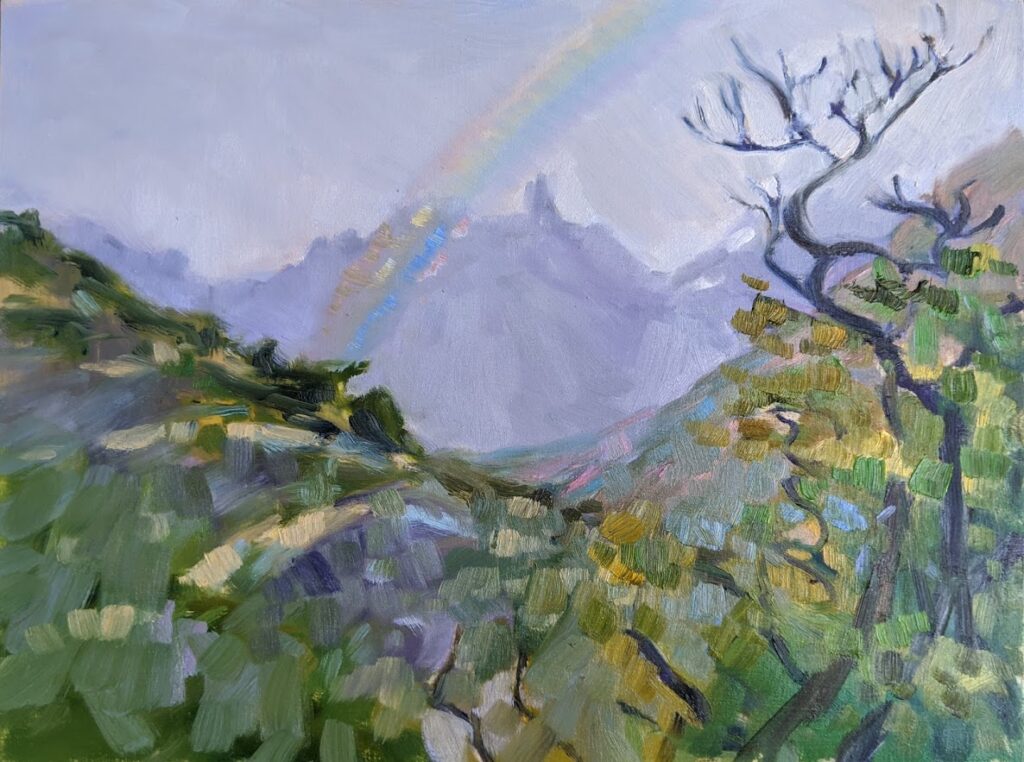
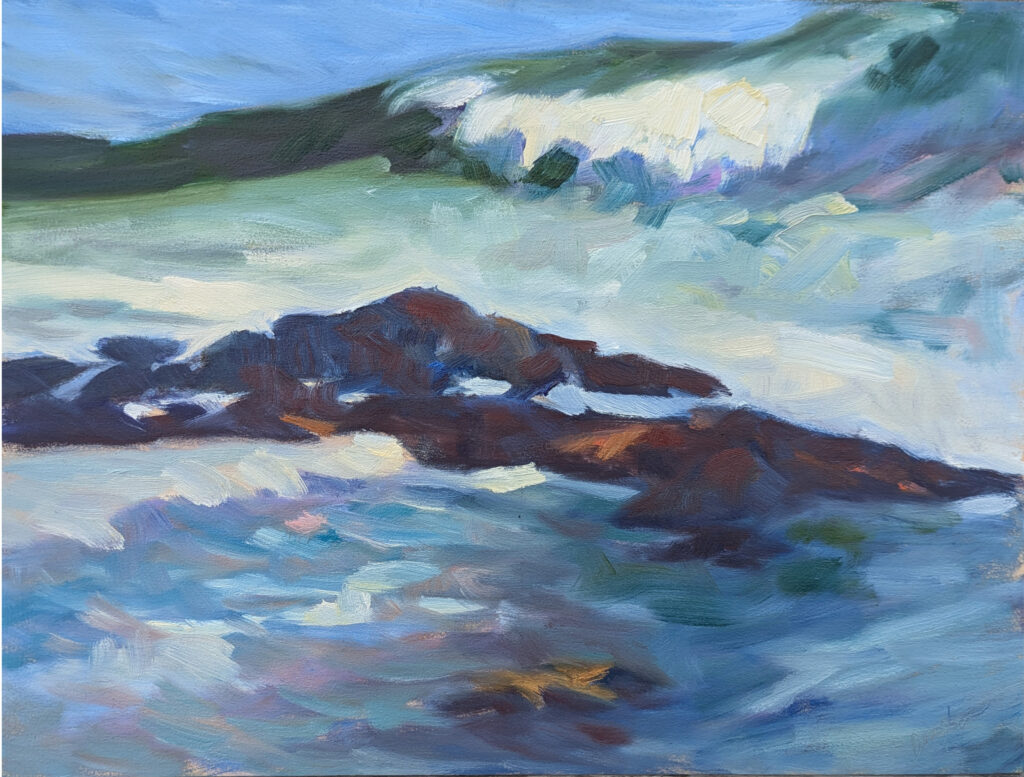
Surf’s Up is 12X16, on a prepared birch surface. $1159 includes shipping and handling in the Continental US.

When I was growing up, there was a popular idea that you were either good at math and science or at art and writing. I was definitely good at art and writing, so I couldn’t be good at math. It didn’t help that I skipped the second grade and never learned my times tables.

It never dawned on me that the ability to make my own sewing patterns or sculpt in clay were, in fact, signs of a math brain.

It wasn’t until college that I realized that I could see mathematical relationships. After that, I decided that proofs were just a memorization game, and math became easy-peasy. I took math up to 3D calculus.

Recently, I had the opportunity to speak to a group of artists. “How many of you like to sew? Do carpentry? Cook?” I asked. Many hands went up. “How many of you hate math?” About the same number said yes. But of course, sewing, carpentry and cooking all require the math brain. It’s too bad that for so many of us, math wasn’t mathin’ when we were in school.
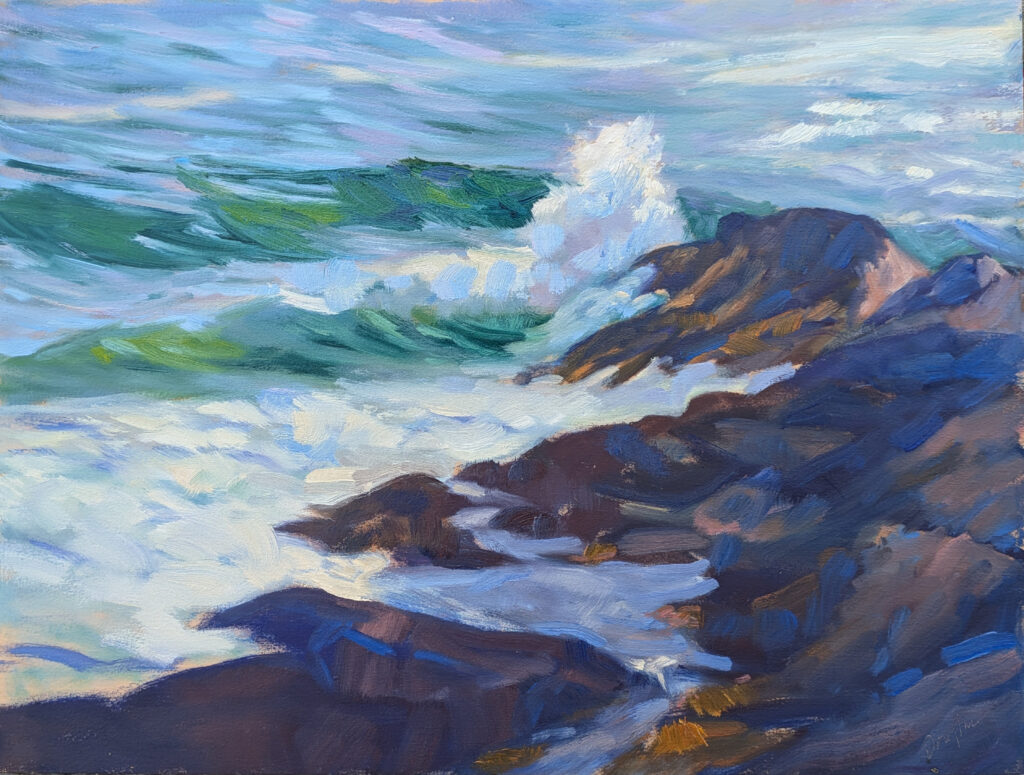
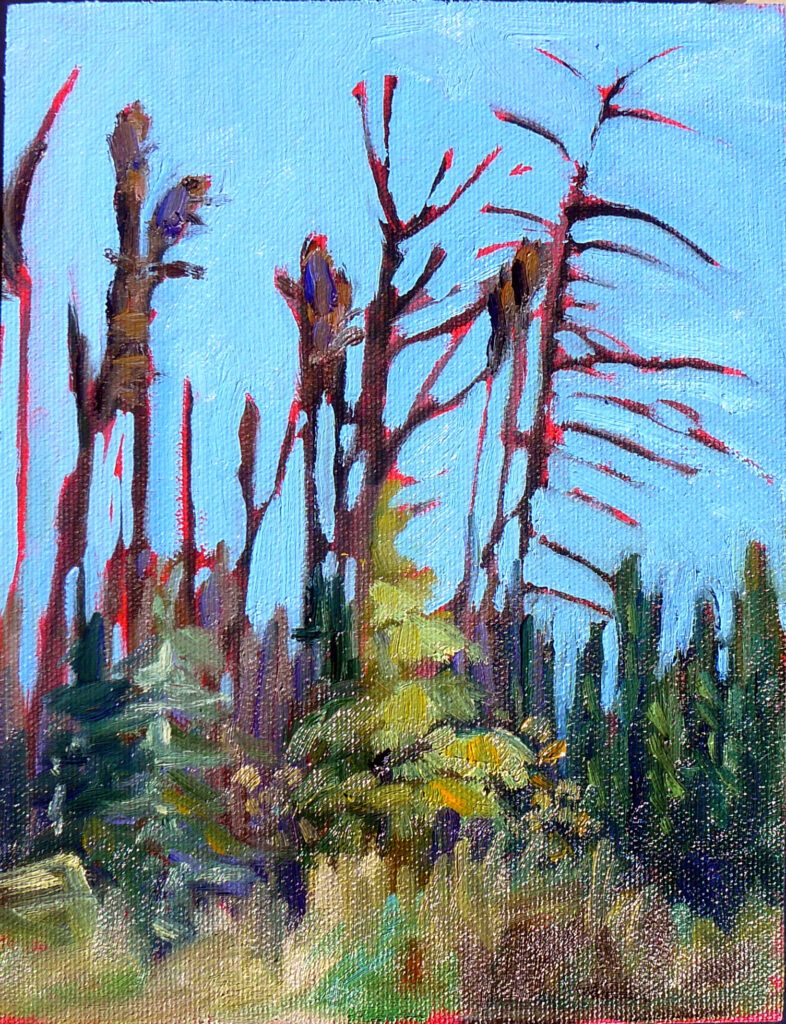
High Surf, 12X16, oil on prepared birch painting surface, $1159 includes shipping and handling in continental US.

What is your math brain?

Like creativity, math isn’t isolated into a single brain region, but rather is done in a network of interconnected brain areas. Here’s the funny thing: math and language share common brain areas (and as I mentioned on Wednesday, the brain is awfully good at compensating when parts don’t work right). However, there are some areas where there is specialization, particularly for speech.

As with creativity, math abilities are not fixed; they can be developed and improved through practice and learning. What blocks most of us from using our math skills is math anxiety. The only way around that is to challenge it head-on, by working with numbers. (When you get old, someone is going to ask you to count backwards by sevens to see if you’re gaga. You may as well practice now.)
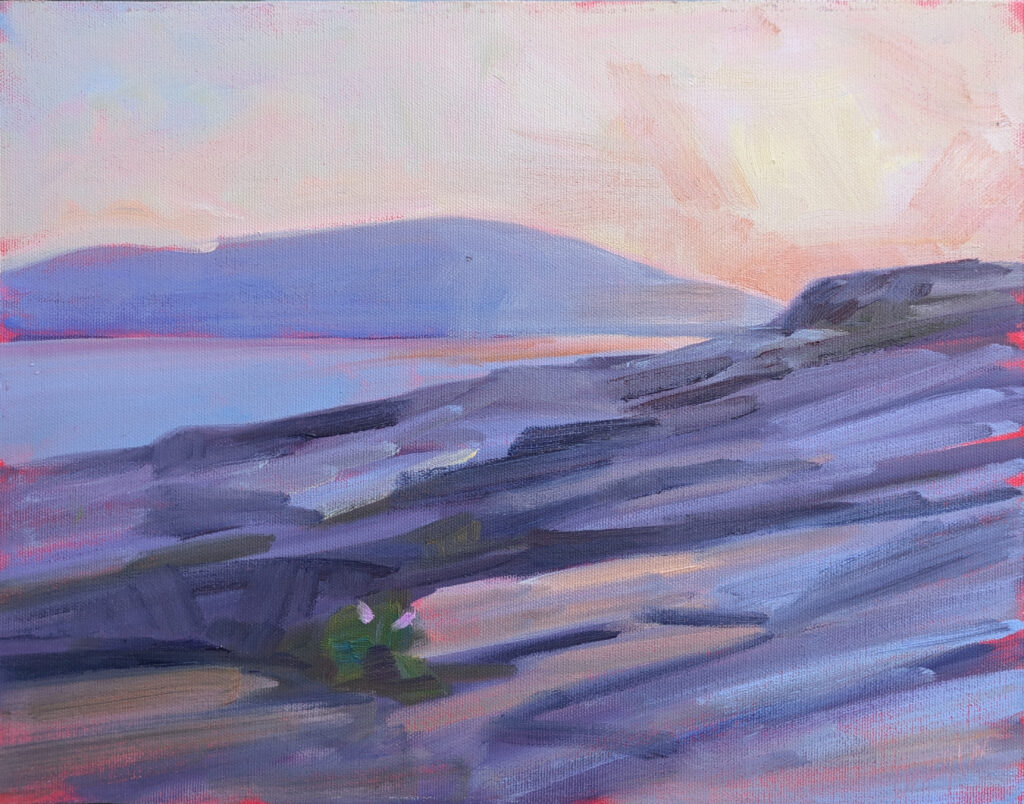
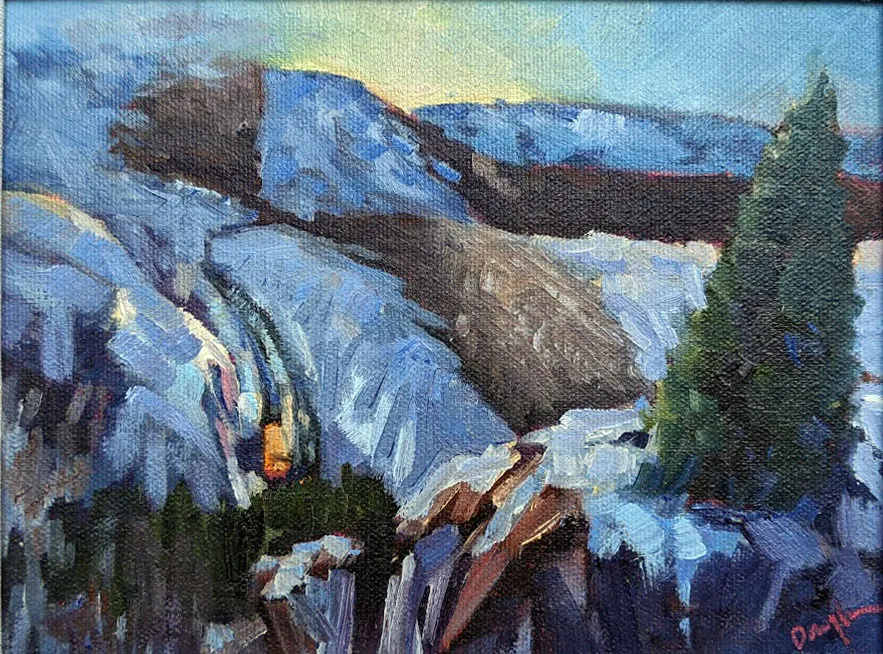
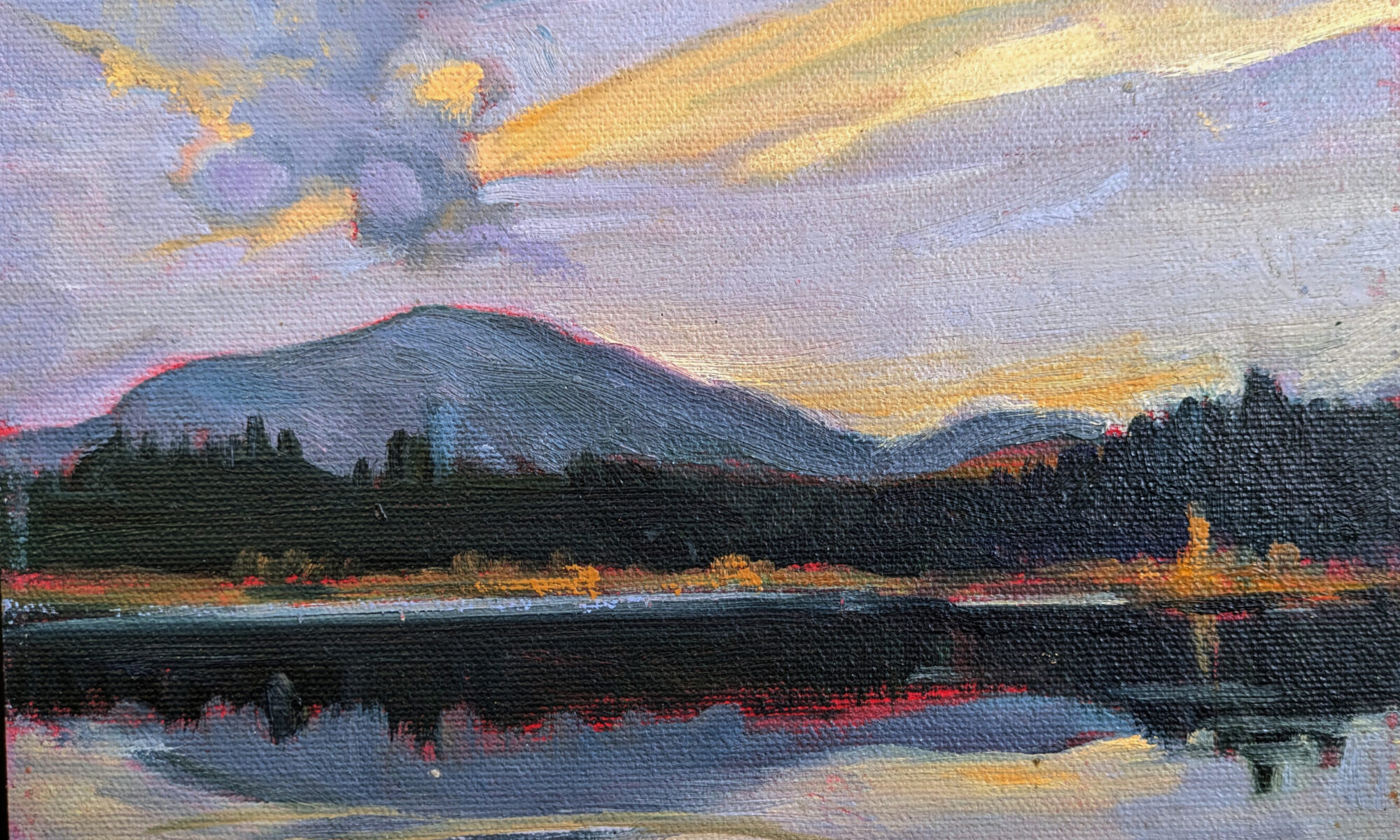
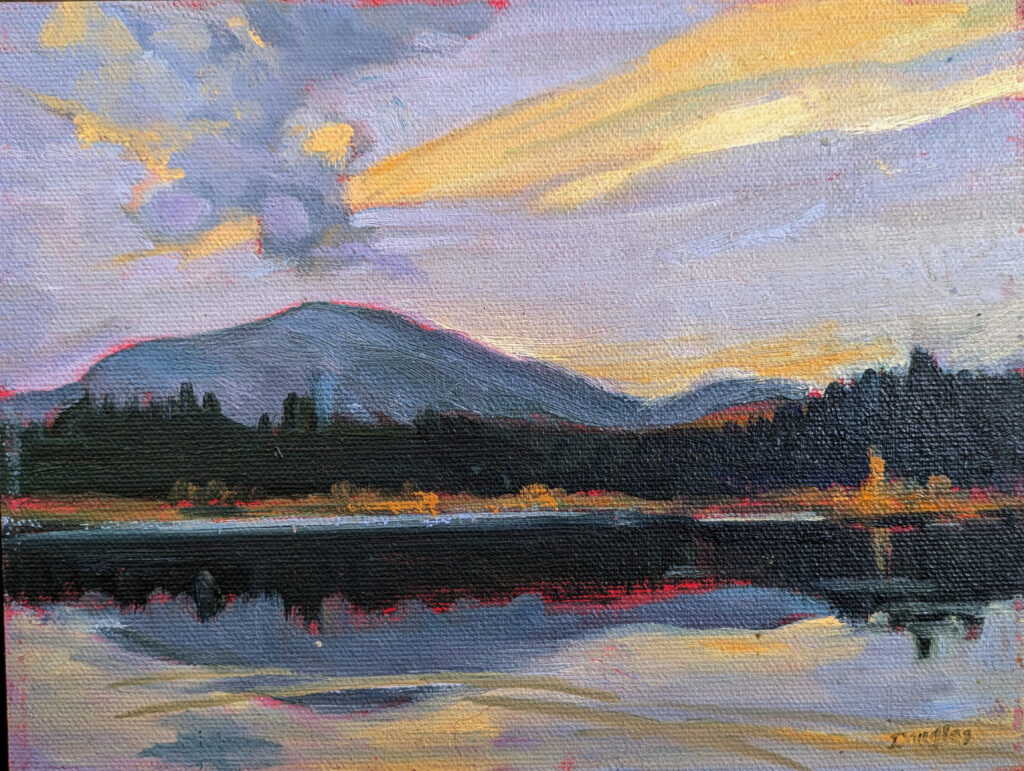
Sunset over Cadillac Mountain, oil on archival canvasboard, $869 includes shipping and handling.

Why should an artist care about math?

Whether they know it or not, artists use math all the time. We work in spatial relationships; that’s math. We painters work additively; sculptors work subtractively. People working in more technically-specific forms like intaglio, glassblowing or encaustic make constant adjustments that are based on either formal or off-the-cuff calculations.

Artists routinely simplify and abstract forms; that is a basic form of mathematics. It’s helpful to understand some geometry before you attempt two-point perspective. Symmetry in its different forms (reflection, translation, rotation) is a math concept. And the classical compositional armature, the Golden Ratio, is based on math. Our ancestors, after all, didn’t see a disconnect between the math brain and the art brain.

Just as anyone can exercise his or her creativity and get better at it, anyone can exercise his or her math brain. Math is the language that describes every function in our bodies, our planet and our universe. There’s no reason for an artist to be afraid of it.
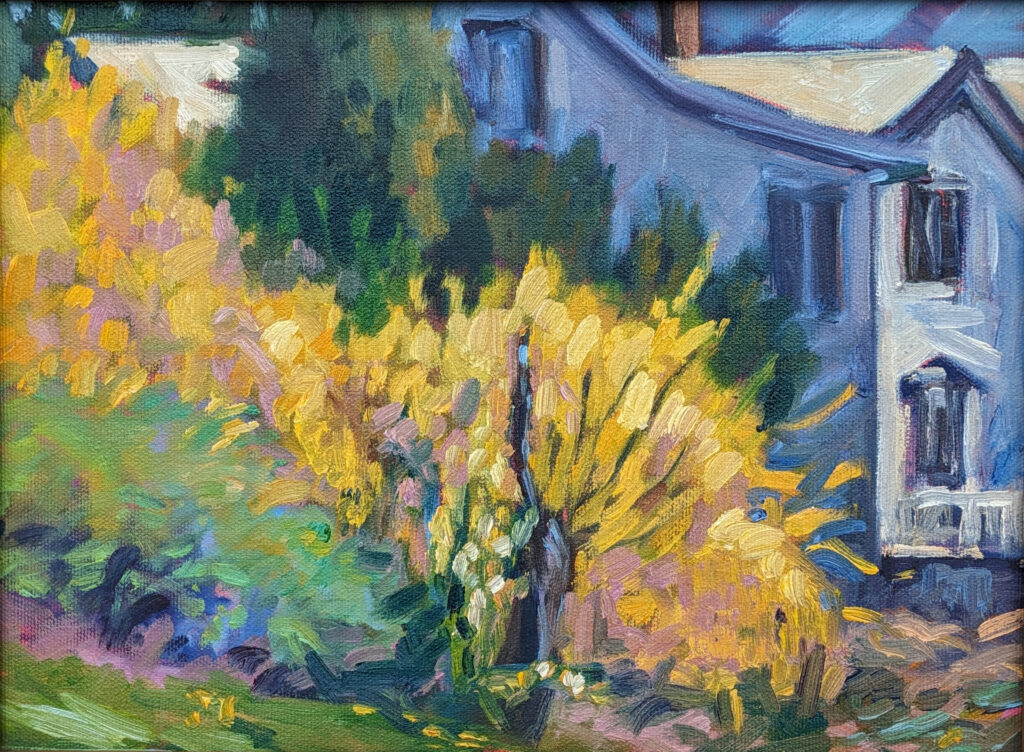
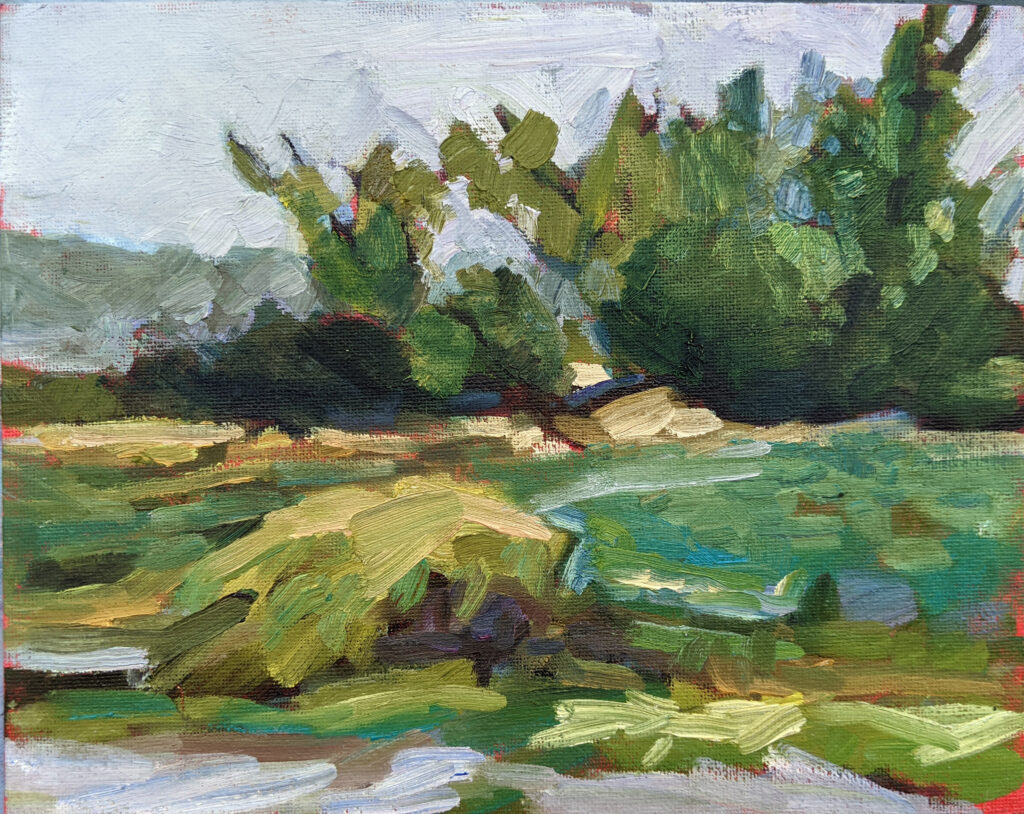
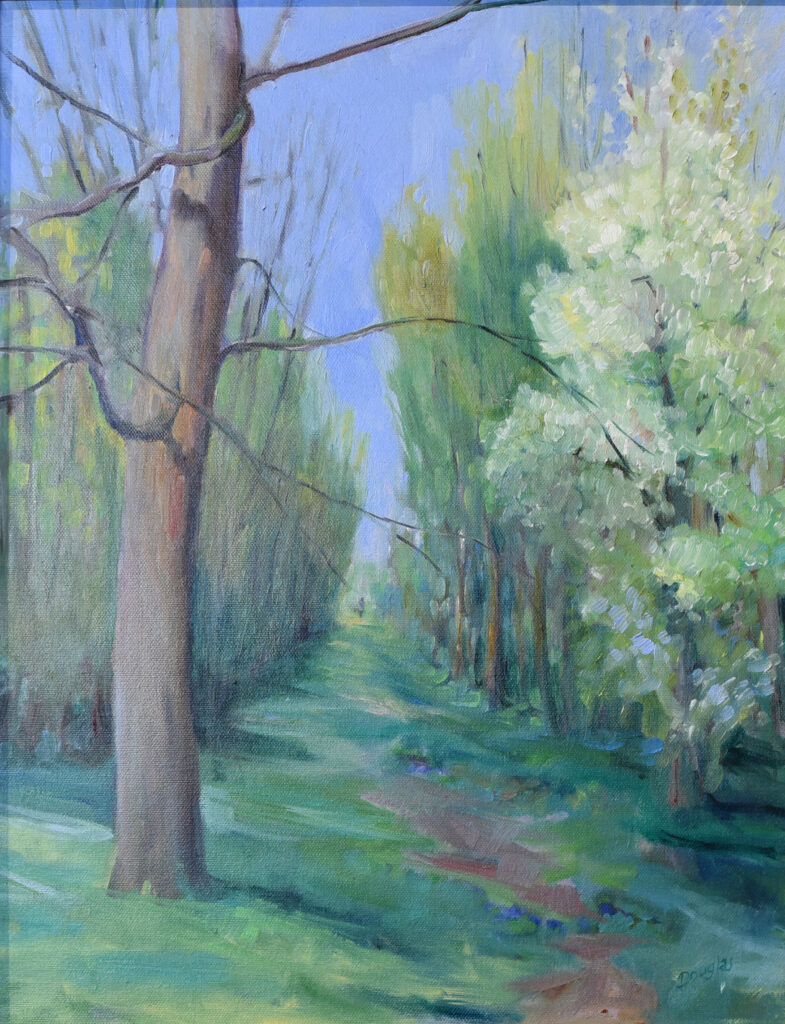
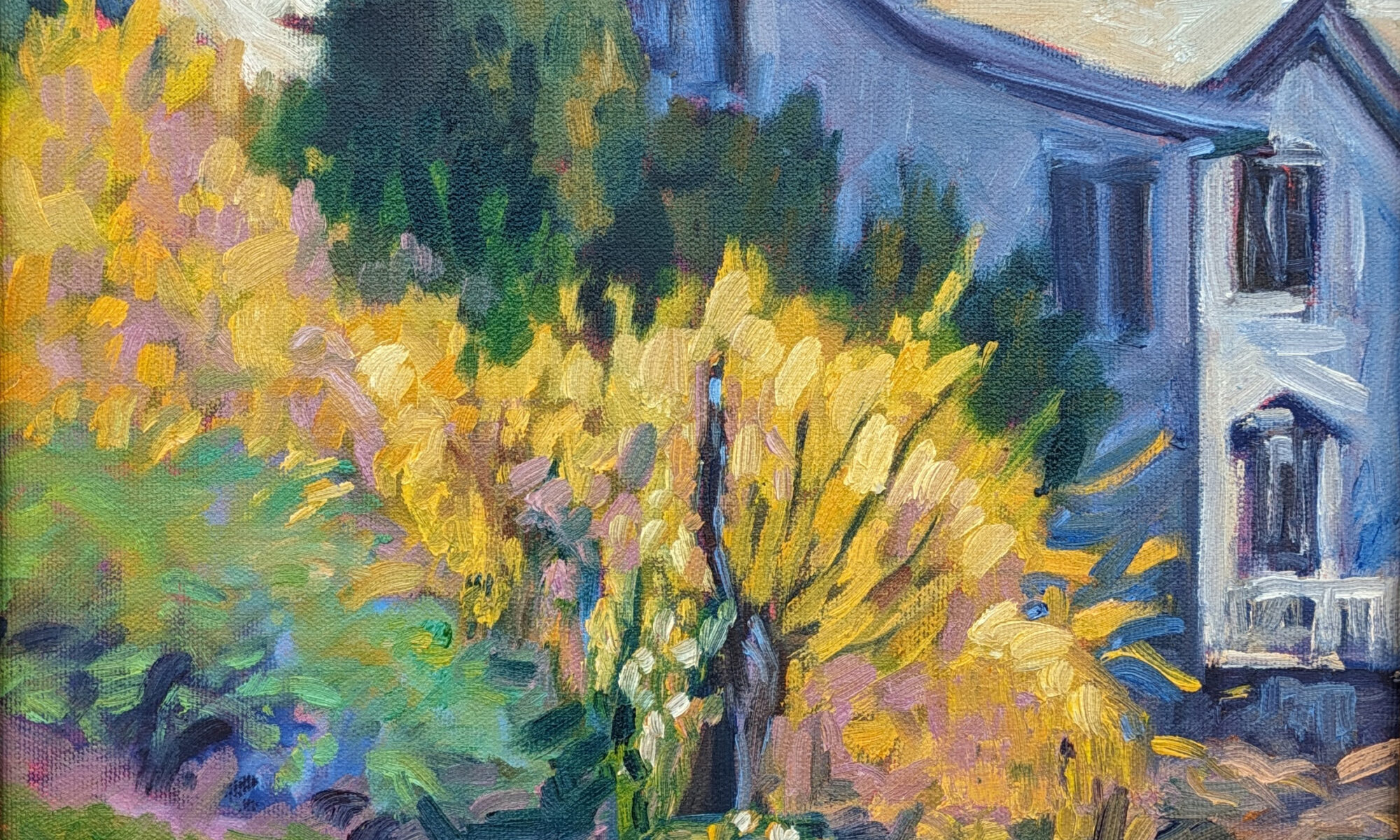
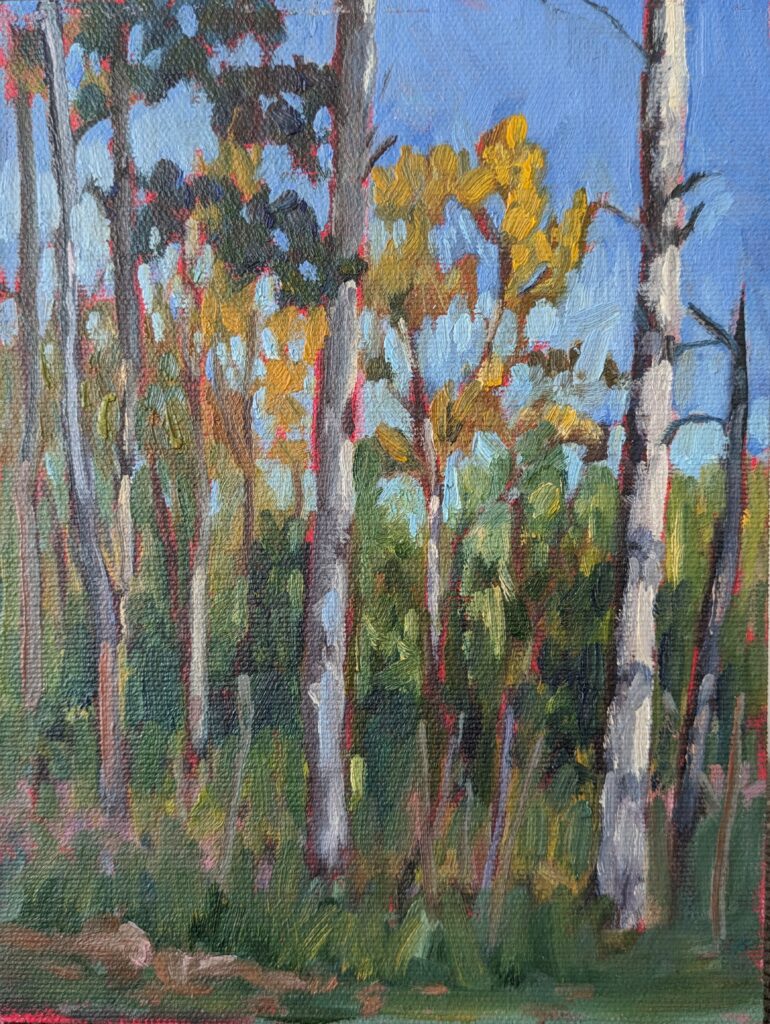
Forsythia at Three Chimneys, oil on archival canvasboard, $869 framed includes shipping and handling in continental United States.

I have just two workshops left in 2026! Reserve your spot:

Can’t commit to a full workshop? Work online at your own pace:
Seven Protocols for Successful Oil Painters

Left handedness and creativity

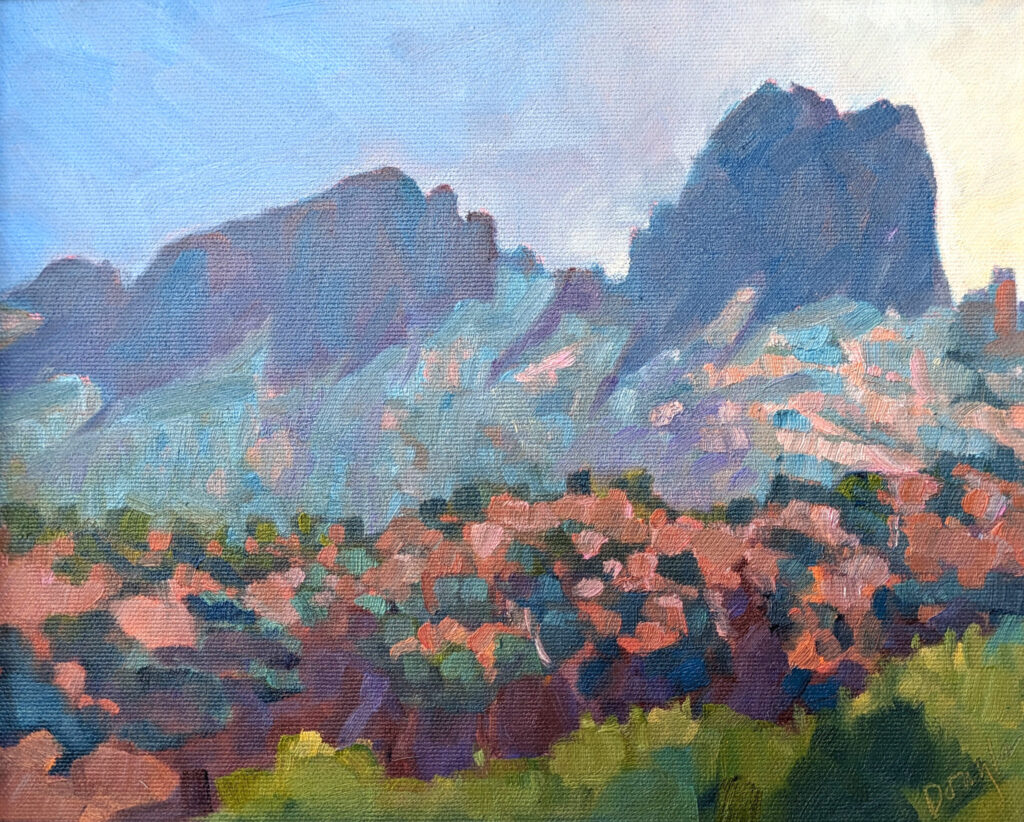
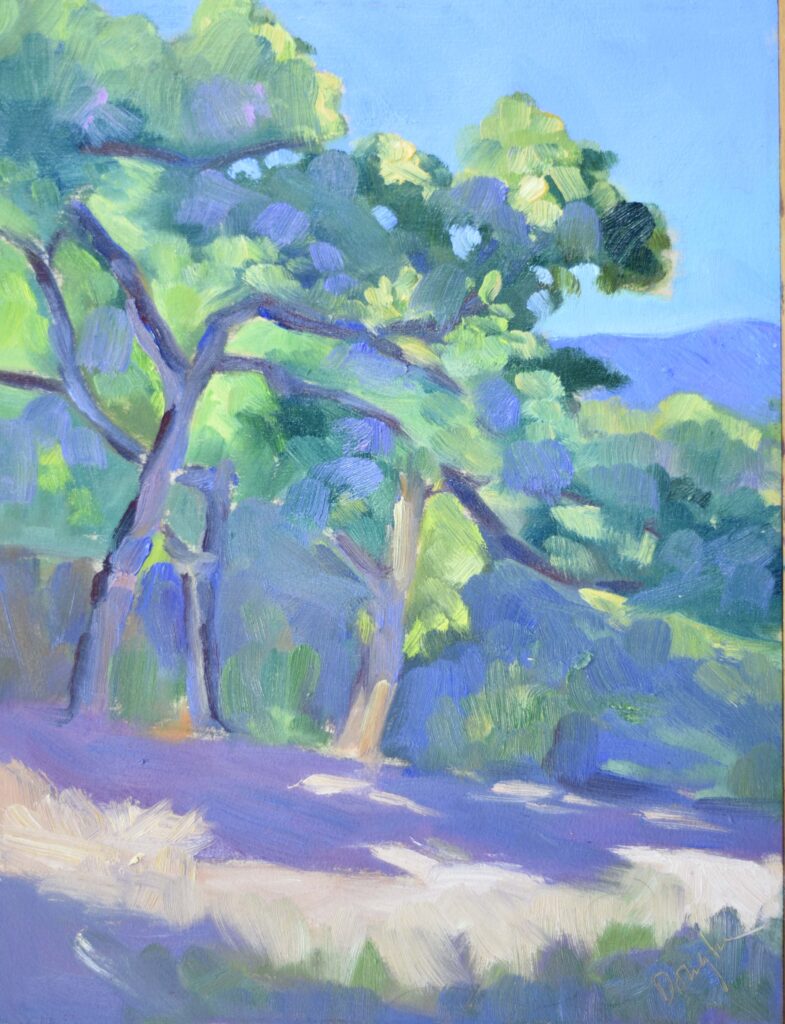
Cottonwoods along the Rio Verde River, $696 unframed, oil on Baltic birch.

About ten percent of the global population is left-handed, but I see a higher percentage of lefties among my students.

We still don’t know what causes left-handedness, but lefties are more likely to be ambidextrous than righties. I’ve known lefties who can do mirror-writing (including myself). This makes me think that the lefty brain is processing things slightly differently than do right-handed people.

As a lefty, I’ve always been interested in left handedness and creativity. Is there a correlation or is that a myth? Research on that question has yielded mixed results.

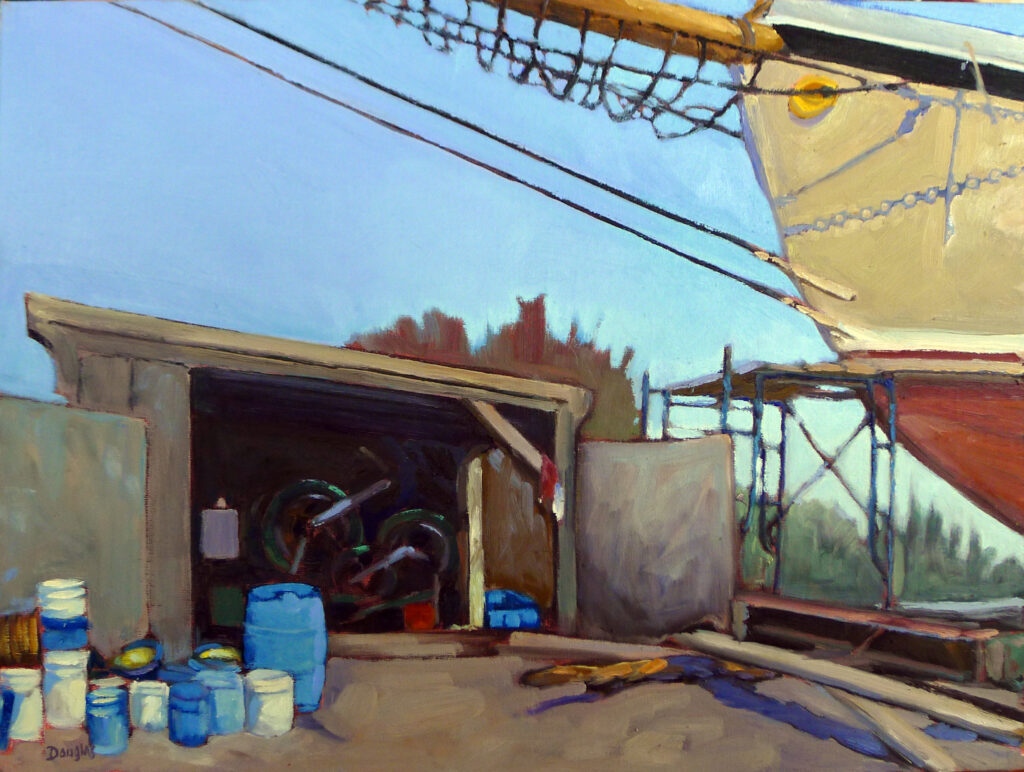
American Eagle in Drydock, 12X16, $1159 unframed includes shipping and handling in continental US.

Brain lateralization

Brain lateralization refers to the specialization of the brain’s two hemispheres (left and right) for different functions. The left hemisphere typically dominates for language and logic, and the right for spatial and creative tasks. However, every person’s brain develops differently, and there’s a lot of overlap between the two sides of the brain. Our brain is an amazing, miraculous instrument in which the other side can take over if one side is damaged by stroke or injury.

Lefties develop less brain lateralization than righties. That means we rely less on the left hemisphere for certain tasks like language. However, that doesn’t necessarily translate to increased creativity. The problem for scientists is that creativity is a cluster of skills and propensities. That isn’t so easy to measure.

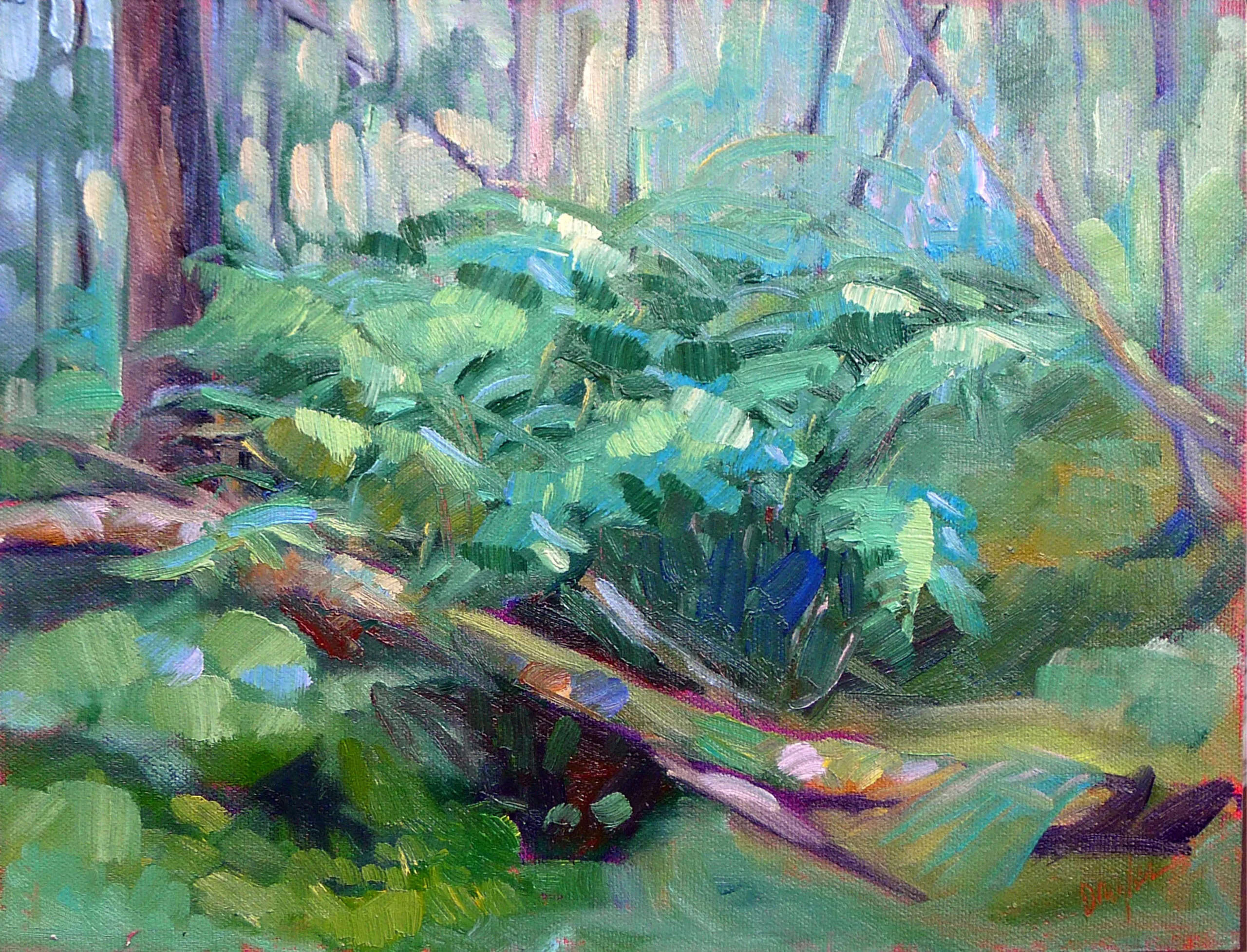
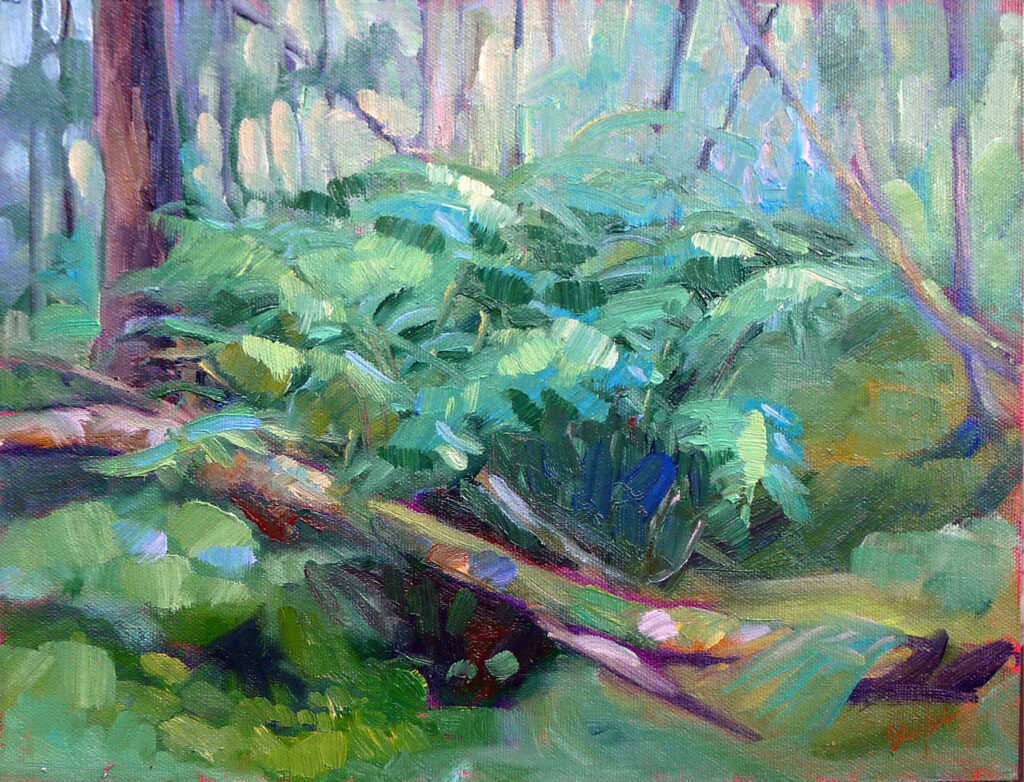
Cinnamon Fern, 9X12, oil on archival canvasboard, $869 framed includes shipping and handling in continental US.

Left-handedness is, however, linked to higher incidences of serious mental illness. The prevalence of left-handedness is roughly average for mood disorders like depression and bipolar disorder, but it rises for serious forms of psychosis like schizophrenia or schizoaffective disorder.

If creativity is the capacity to see things differently than the ‘typical’ human brain, then perhaps left-handed creativity is linked to those debilitatingly different viewpoints.

Left handedness is also linked to higher rates of autism spectrum. That may be due to the weaker brain lateralization in left-handed people.

What do we do with our left-handed kids?

I was born with a pencil in my hand (which must have been very painful for my mother). It is possible that, as a culture, we expect our lefties to be artistic, so we train them to be artistic. To see whether this was the case, a team of researchers analyzed woodcarvers in a pre-industrial society in New Guinea. The results? There was no link between left handedness and creativity. This suggests that our western link between lefties and creativity is created by the stereotype that left-handers are more artistic.

Eastern Manitoba River, 6X8, oil on archival canvasboard, $348 includes shipping and handling in continental US.

Suppression of left-handedness

I enjoy telling people that I’m the world’s oldest living artist; someday it will actually be true. However, I learned to write and draw in the early 1960s. By that time nobody was suppressing left handedness; in fact, as a kid I didn’t know any older people who’d had their handedness suppressed. When I read that suppressing left handedness was practiced up to the late 20th century in the United States, I just laugh. Be careful what you read on the internet, kids.

The more you create, the more creative you’ll be

The human mind is too intrepid and too varied to be put in any kind of box, and that includes the box of handedness. The more you create, the more creative you’ll be. Whether you’re left- or right-handed doesn’t matter.

I have just two workshops left in 2026! Reserve your spot:

Can’t commit to a full workshop? Work online at your own pace:
Seven Protocols for Successful Oil Painters

Monday Morning Art School: transferring your drawing to canvas

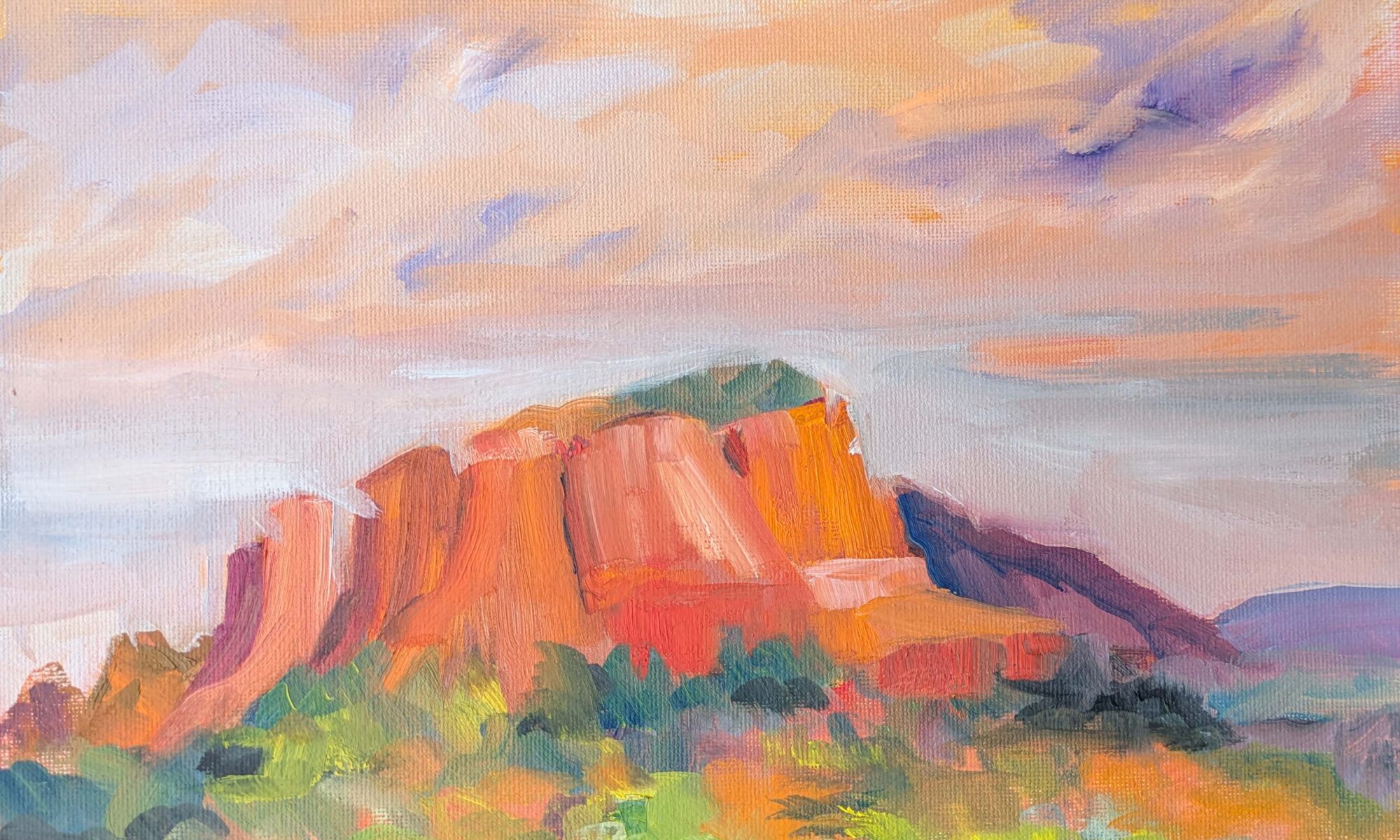
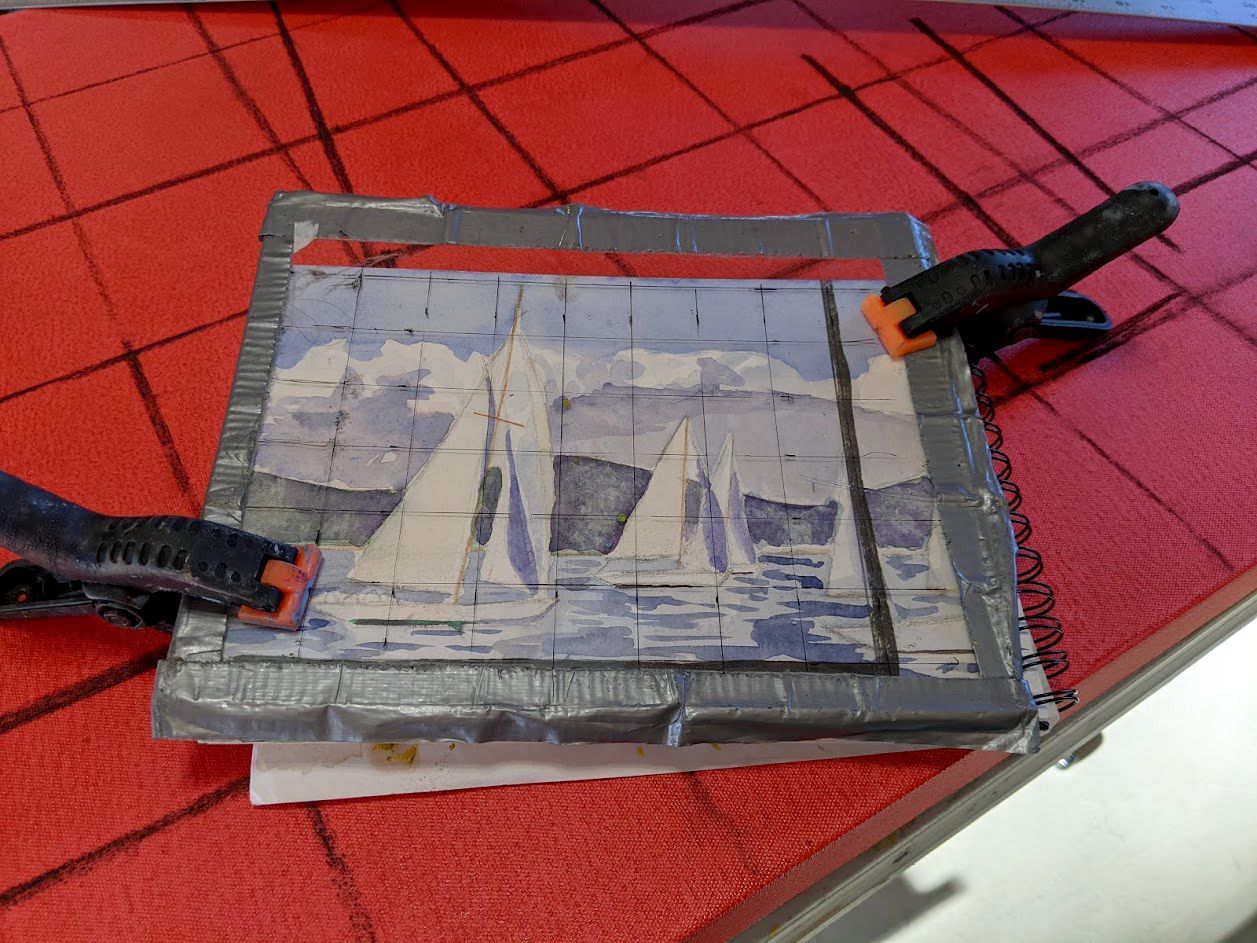
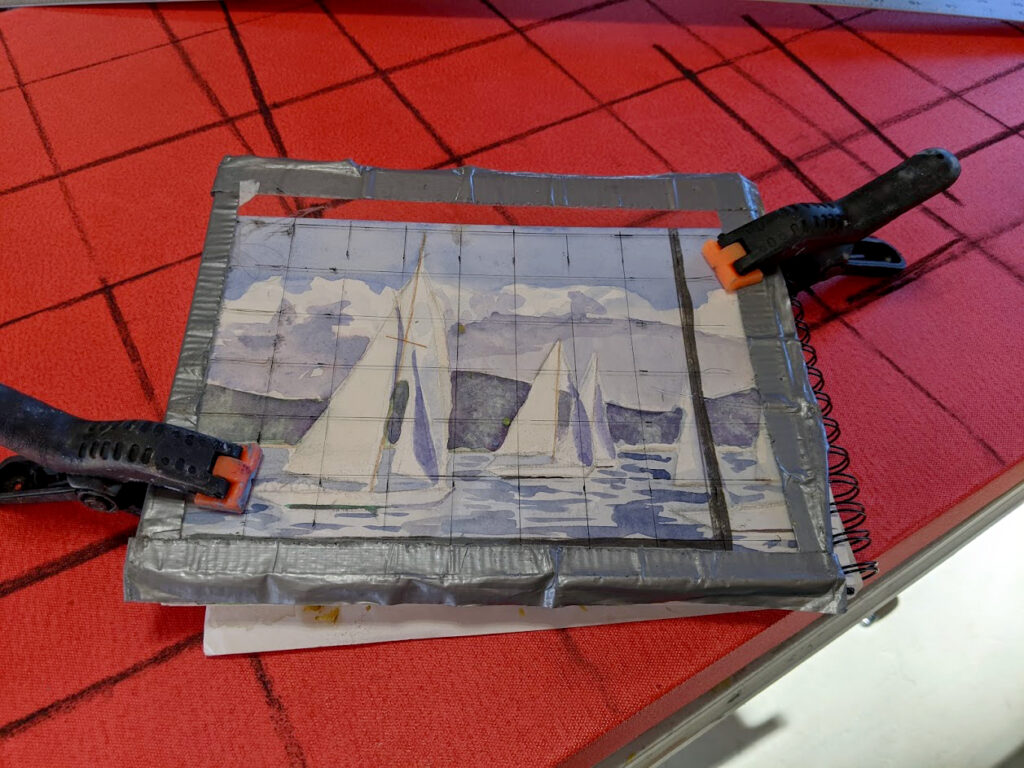
A painting that started as a watercolor, which I gridded on plexiglass.

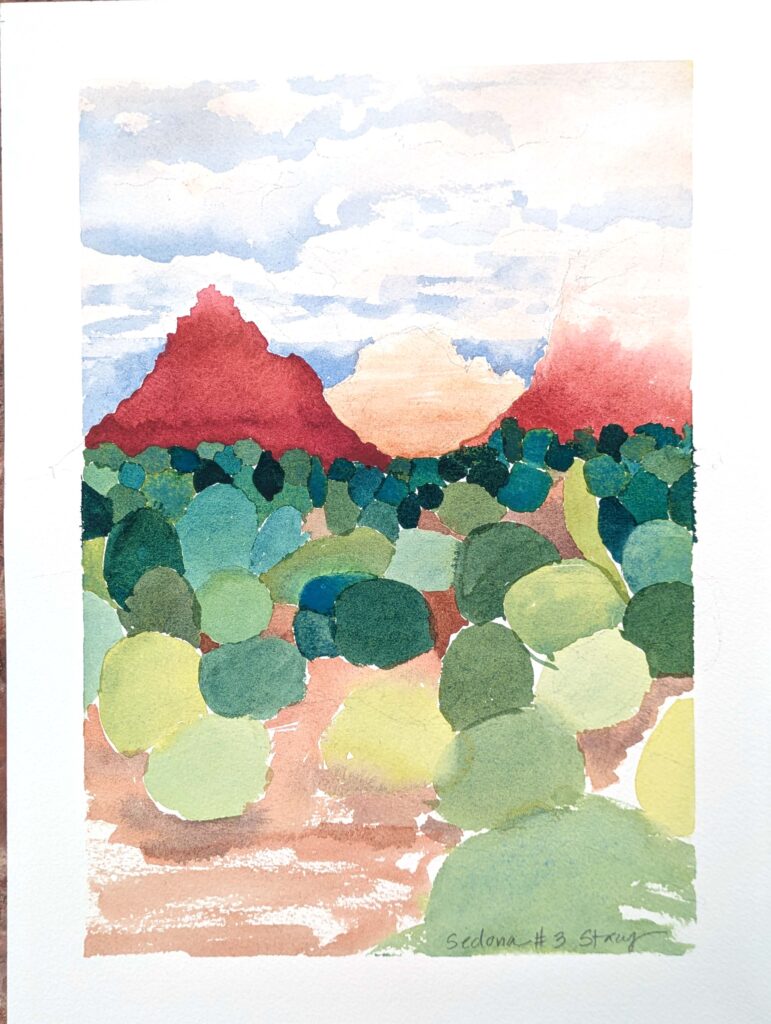
Last week I taught a plein air workshop in Sedona, AZ. One of my students did a superlative sketch but somehow managed to flatten out the diagonals when transferring to her watercolor paper. Gridding is harder in watercolor than it is in oils and acrylics, but it is a skill that needs to be mastered when learning to paint. In watercolor, just use very light pencil lines and erase, or use tiny cross marks at each intersection. Or, if you’re transferring a drawing of the same size, use Saral transfer paper.

Why grid instead of freehand?

We use preliminary value sketches to work out questions of composition. They allow us to take risks that we can’t when going straight to canvas. Why reinvent the wheel, or worse, regularize our risky decisions in the final painting? Gridding is a fast and easy way to set our best drawings in paint.

On Friday, I wrote about free apps like Grid MakerGridMyPic, etc. that allow us to paste grids directly over photographs in our phones. I’m looking forward to using them for gridding over my drawings, although for reasons of artistic control, I’d never grid across a photo. I have many notebooks full of gridded drawings that I wish I could make whole again.

First, consider aspect ratio

To start transferring your drawing to your canvas, work out whether the aspect ratio of your sketch is the same as the canvas. This is the proportional relationship between height and width. Sometimes this is very obvious. For example, a 9X12 sketch is the same aspect ratio as an 18X24 canvas. But sometimes, you’re starting with a peculiar little sketch drawn on the back of an envelope.

By the way, I never sketch into a box; I always sketch and then draw the box around my drawing. This allows me the freedom to explore what’s important in the scene without worrying about squeezing it into a preformed box. After, I can draw a box around it in the proper aspect ratio.

Everything starts with ratios

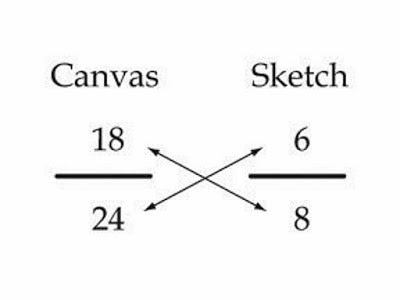
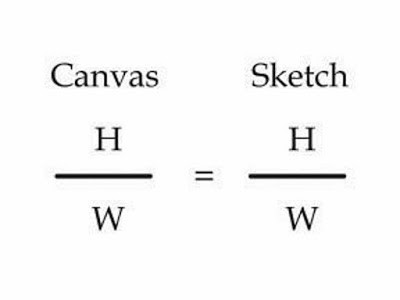
Remember learning that 1/2 was the same as 2/4? We want to force our sketch into a similar equivalent ratio with our canvas.

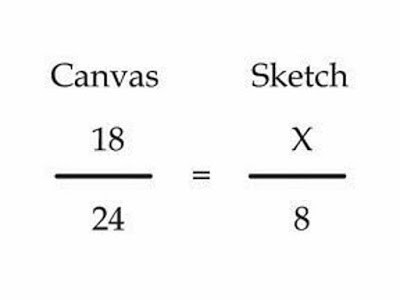
Let’s assume that you’ve cropped your sketch to be 8” across. You want to know how tall your crop should be to match your canvas.

Write out the ratios of height to width as above.

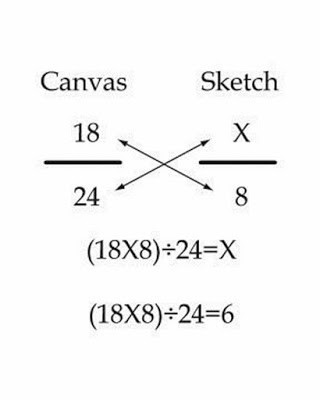
To make them equivalent, you cross-multiply the two fixed numbers, and divide by the other fixed number, as below:

Use your common sense here. If it doesn’t look like they should be equal, you probably made a mistake. And you can work from a known height as easily as from a known width; it doesn’t matter if the variable is on the top or the bottom, the principle is the same.

The next step is to grid both the canvas and sketch equally. In my painting above, my grid was an inch square on the sketch and 4″ square on the canvas, but as long as you end up with the same number of squares on both, the actual measurements don’t matter. You can just keep dividing the squares until you get a grid that’s small enough to be useful. For a small painting, that could be as simple as quartering the sketch and the canvas. I use a T-square and charcoal, and I’m not crazy about the lines being perfect; I adjust constantly as I go. The last step is to transfer the little drawing, rectangle by rectangle, to the larger canvas. I look for points of intersection on the grid, and from there it’s easy to transfer my drawing. It may seem time-consuming, but it saves a lot of work in the long run and will give you a painting that more closely matches the dynamic energy of your original sketch.

I have just two workshops left in 2026! Reserve your spot:

Can’t commit to a full workshop? Work online at your own pace:
Seven Protocols for Successful Oil Painters

Snowing in Sedona

Watercolor by Stacy White.

“It’s supposed to snow in Sedona at 8 PM,” my husband told me as I was driving west on 89A yesterday evening.

“That’s funny, because it’s squalling right now,” I answered. Before I made it back to my digs in Cornville, I had two weather alerts on my phone. Since I’m driving a very tiny Mitsubishi Mirage, I was concerned about being blown off the road or, worse, floating away.

I’m a worrywart. Of course, nothing happened.

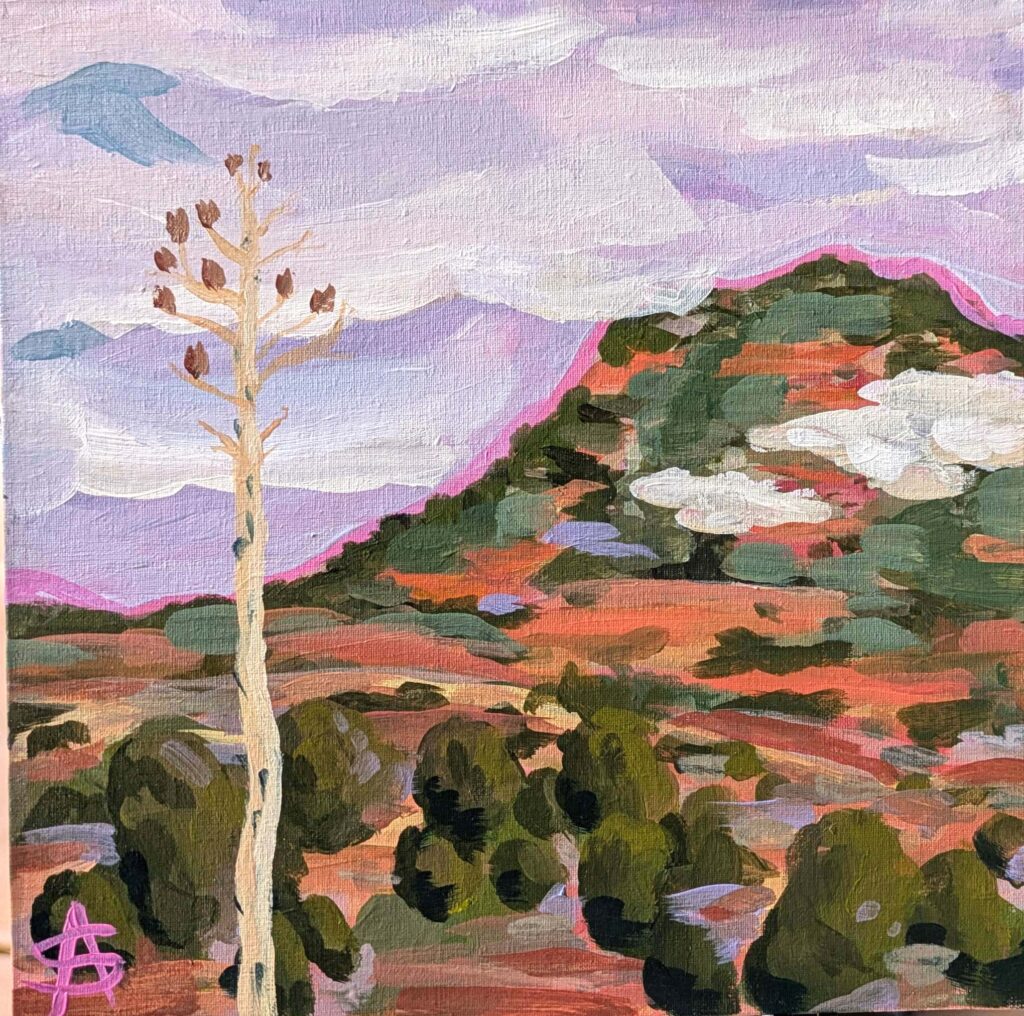
Acrylic by Amelia Scanlan.

There’s something wrong about snow in palm trees or cactuses, but Sedona and environs have been in a moisture deficit all winter. I feel badly for my students, who wanted to paint outdoors all week, but we had three good days in lovely weather. I’m also happy that we were able to break Sedona’s drought for them.

Plein air painting means expecting the unexpected, and that’s as true of workshops as it is of events. And, of course, we’re all learning, including me.

Watercolor by Bonnie Daley.

Snowing in Sedona

I have never taught a painting workshop where I haven’t learned something from my students. This week, it was about using apps like Grid Maker, GridMyPic, etc. that allow you to paste grids directly over photographs in my phone. That means I never have to ruin another value sketch by gridding across it in my sketchbook. Who knew?

I teach several painting workshops a year, and I hope that I send my students away with a variety of technical skills, including painting techniques, drawing and compositional fundamentals, and a healthy dollop of color theory. Then there are the practical skills, including material mastery, like brushes, surfaces and mediums. There are strategies for faster setup, better decision-making, and getting the best results in the fastest time. And everyone faces the same painting challenges, like dealing with slow drying in bad weather or accelerated drying in hot weather—both of which we’ve faced this week.

Oil by Rachel Houlihan.

But what a painting workshop really offers is a change in mindset. If I’ve done my job right, I’ve sparked new ideas and helped build connections between people who’ve never met before. I’m very tired, but it’s a good tired, because I’ve had a great group of students this week.

I have just two workshops left in 2026! Reserve your spot:

Can’t commit to a full workshop? Work online at your own pace:
Seven Protocols for Successful Oil Painters

How to avoid preciousness: embrace mistakes

Painted at the Amitabha Stupa and Peace Park, by Bonnie Daley.

I’m teaching plein air in Sedona, which is one of America’s most wonderful hippie, dippy, trippy places. There’s a looseness of thinking here that leads straight to a looseness of painting, and you can see it in my students’ painting from yesterday, which veered closer to abstraction than is typical for plein air.

“One of my strengths as a painter is that I’m not worried about the result,” Rachel Houlihan told me. That means she isn’t bent about whether the painting is good or bad, she just paints. That, conversely, makes her a better painter and student because she is just never uptight about the end product.

Painted at the Amitabha Stupa and Peace Park, by Amelia Scanlan.

Avoiding preciousness in painting means embracing mistakes, spontaneity, imperfection, and risk. Here are some ideas to help you loosen up and paint more freely:

Mindset Shifts

Be more like Rachel: You will paint a lot of duds in your career; in fact, I’m three for three this week. Don’t worry about it. Throw that bad canvas on the pile and move on. If you haven’t made mistakes, if you haven’t got a pile of duds, you aren’t trying.

Painted at the Amitabha Stupa and Peace Park, by Libby Scanlan.

Embrace Mistakes: Remind yourself that mistakes are opportunities. I have noticed that sometimes the paintings that make me the most uncomfortable at the time I do them are the paintings that point the way that I’m heading in the future. And sometimes the most compelling passages of art started as accidents.

Value process over outcome: That’s really what Rachel was saying to me. When she was painting under a juniper in the Peace Park, she was perfectly content. Shift your focus from the results to being in the moment.

Set a Time Limit: If you don’t let yourself perseverate, you’re unlikely to obliterate everything that was once good about your painting.

Use Bigger Brushes: Everyone should always start with a brush that’s twice as big as they expect they need. That way they can’t overthink the details. If you need a smaller brush later, then go for it.

Painted at the Amitabha Stupa and Peace Park, by Stacy White.

Push past your comfort zone: I can’t tell you how many times I’ve heard painting teachers say “not another brushstroke!” I’ve always wanted to smack those teachers. How can one know what the limit is, when one never pushes past the limit?

Painted at the Amitabha Stupa and Peace Park, by Rachel Houlihan.

I have just two workshops left in 2026! Reserve your spot:

Can’t commit to a full workshop? Work online at your own pace:
Seven Protocols for Successful Oil Painters

Monday Morning Art School: why do we create art?

Art print by Jesse Petersen, available here. Courtesy of the artist.

I just finished presenting at the Sedona Entrepreneurial Artist Development Program (SEAD). One of my co-presenters, Jesse Petersen said: “Even if this wasn’t my job, even if I lost everything that I have now, I would always create for myself and share what I do because it is deeply meaningful and the way I process life.”

Our culture says that to do art, you have to be good at it. That’s nonsense. Art doesn’t just allow us to express emotions, ideas, and experiences, it helps us work through them.

“When I have a daily art practice and dedicate time to making art—and it doesn’t have to be good art,” continued Jesse, “I show up better for my family, friends, community, church. I used to think taking that time was selfish, but now I know that just makes me better.”

Art journal by Jesse Petersen, courtesy of the artist.

Why do we create art, according to received wisdom?

The traditional reasons for making art are:

  • Expressing thoughts, feelings, and beliefs
  • Reinforcing socially-acceptable thoughts, feelings and beliefs
  • Communicating ideas and ideals
  • Expressing beauty
  • Telling stories
  • Recording history
  • Activism
  • Creating community

But these are the reasons for which publicly-consumed art is created. What about the more hands-on, accessible, personal art? It may never have the international significance of, say, Goya’s The Third of May, 1808, but it changes countless lives.

“I used to think making art was a luxury to be done after my to-do list was done, now I realize it’s the first thing I should do,” said Jesse.

Two of Jesse’s art-journaling students attended the SEAD program, and both were motivated to stick around after the program ended. Long after everyone else had left, the three of them sat in the empty theater, making art together. Leslie Barrett and Sharon Gilham are what we call emerging artists, which means they’re trying to ruin a perfectly good hobby by selling their work.

Artwork by Jesse Petersen, courtesy of the artist.

“I started to do more art when my kids moved out of the house,” Leslie told me. “I had more time. I started to think about how much I liked art in the past. I was very curious about watercolor, mixed media, and books. I work in technology, so it’s nice to come home, relax, and do something for myself.”

“I’ve been creative my whole life but never really trusted I was any good at it,” Sharon said. She works in the hospitality industry, which is a tough fit because she’s essentially introverted. “Art calms me down after a long day at work.

“There are so many weird things in my head that I don’t know how to communicate with words, so this is an outlet for me. I have always been someone a little more guarded about sharing my emotions, and I try to put them into my art. I start with a feeling, a thought, or a color palette, and start the creation from that. It’s almost purely the emotion going into the piece.”

Art journal by Jesse Petersen, courtesy of the artist.

Both Sharon and Leslie took the SEAD workshop because they have seen a growing interest in their work from prospective buyers. They’re thinking about potential post-retirement careers. However, it’s clear from their conversation that they love the act of creation. As Leslie said, “I don’t try to make anything I don’t have a personal connection to.”

I can’t see why everyone doesn’t want a piece of that. Art doesn’t have to mean painting or sculpture. It could be printing, or art journaling, or photography or quilting. You really should try it.

I have just two workshops left in 2026! Reserve your spot:

Can’t commit to a full workshop? Work online at your own pace:
Seven Protocols for Successful Oil Painters

What is art made of? Time

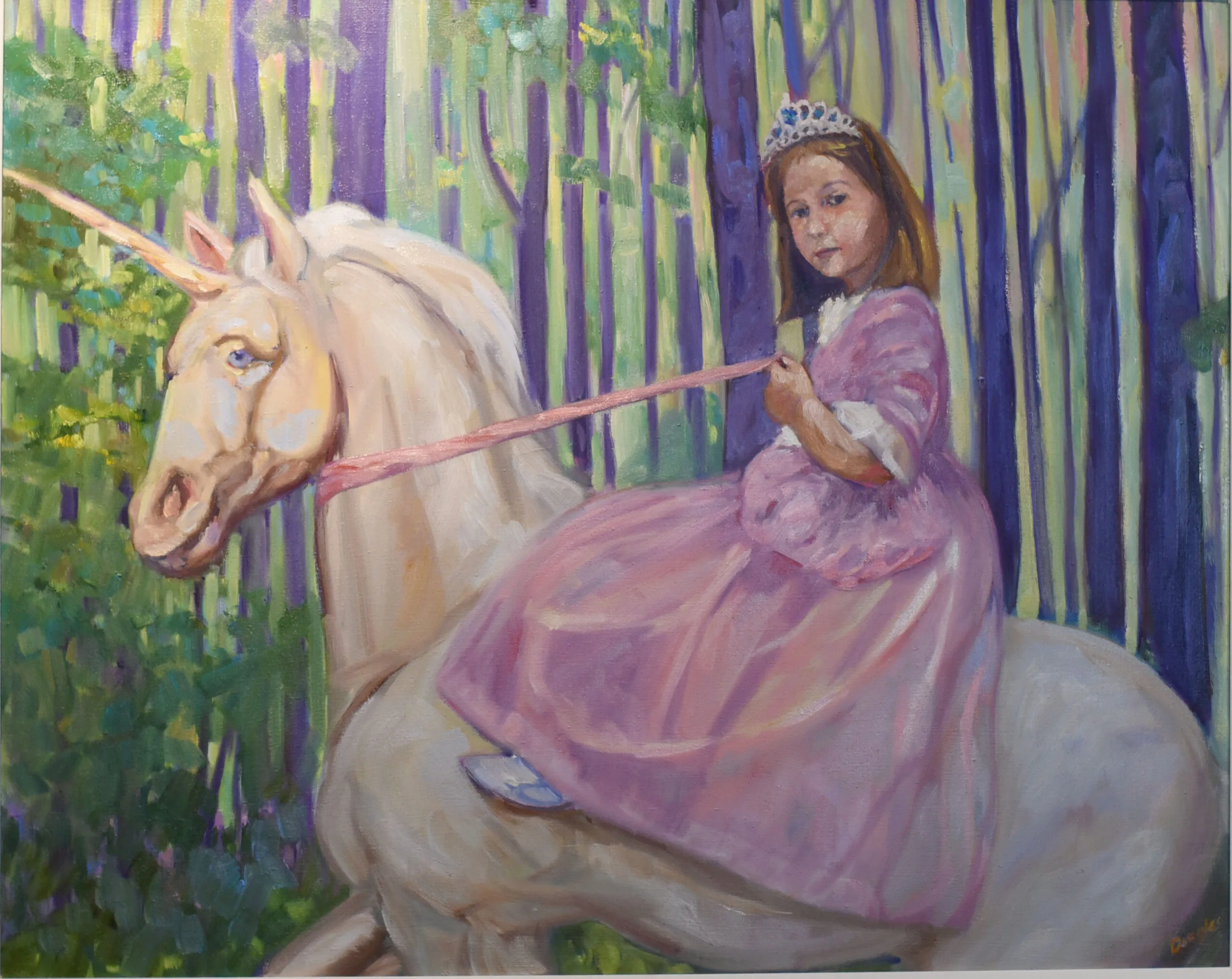
In Control (Grace and her Unicorn), 24X30, $3,478 framed, oil on canvas, includes shipping in continental United States.

In a tangible sense, art can be made of anything. Traditionally, it’s created with materials like paint, canvas, clay, metal, wood, and stone. But modern and contemporary artists push boundaries by incorporating unconventional materials like digital pixels, found objects, sound, light, living organisms and waste.

But of course, that’s just the modern way of saying that art isn’t just about physical materials. It also includes the ideas, emotions, and meaning behind the work. So, in a way, art is made of both tangible things and intangible creativity.

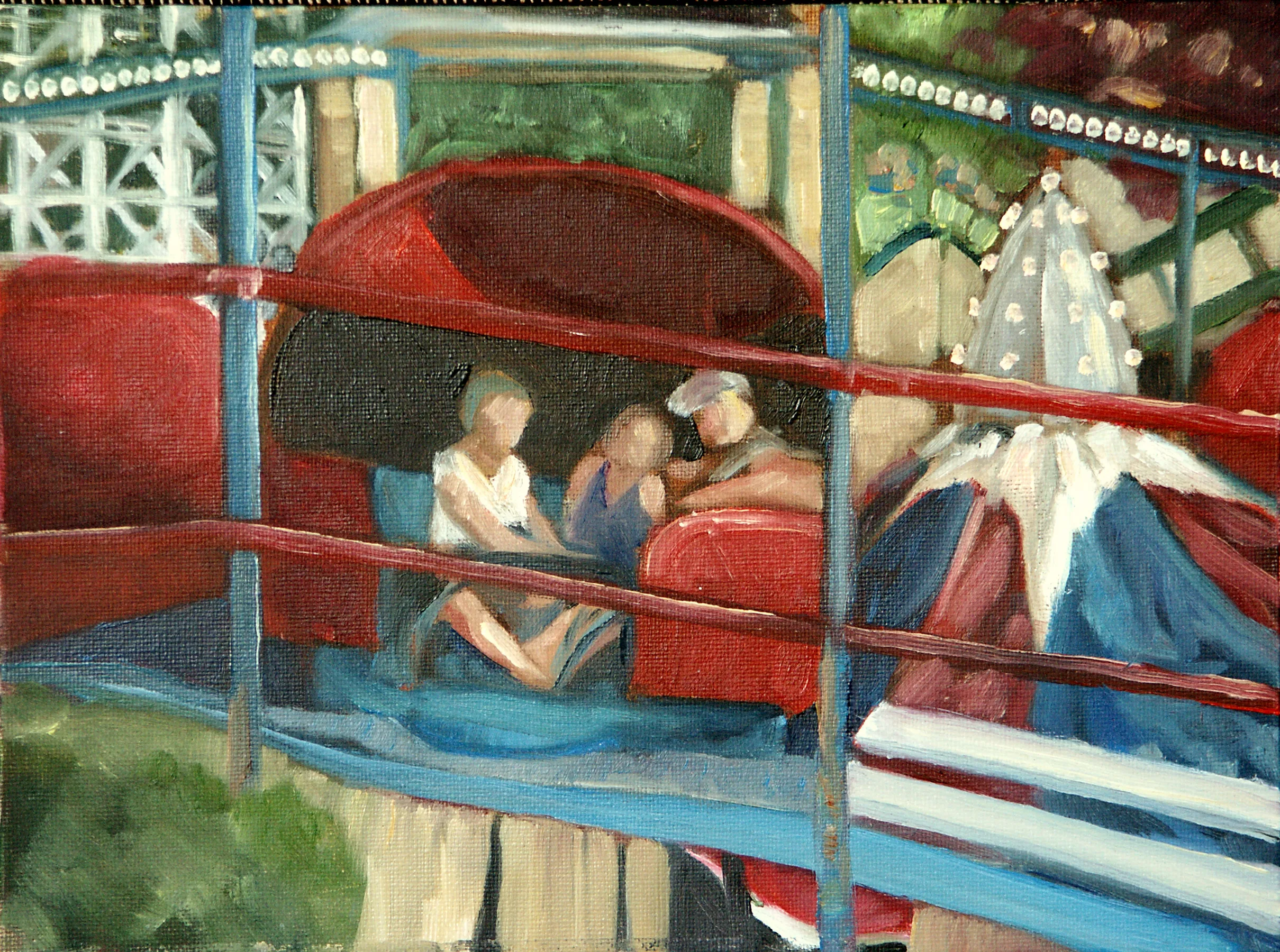
Tilt-A-Whirl, oil on archival canvasboard, $869 framed includes shipping and handling in continental US.

What is art made of? How about time?

Art takes time. It therefore contains time. In fact, you could argue that, above anything else, art is time.

Creation. Yes, there is art that takes three minutes to dash off, but that’s not that common. Far more frequently, art takes years to realize. And even those three-minute sketches rest on a history of other sketches, all of which telescope into that one final work.

“How long did that take to paint?” we’re asked. We answer, “four hours, plus the fifty years I’ve been practicing my craft.” For the artist, all the effort of creation coalesces into their most recent work.

Time as a medium. Many art forms, like performance art, film and music, unfold over time. These temporal arts could not exist without time itself.

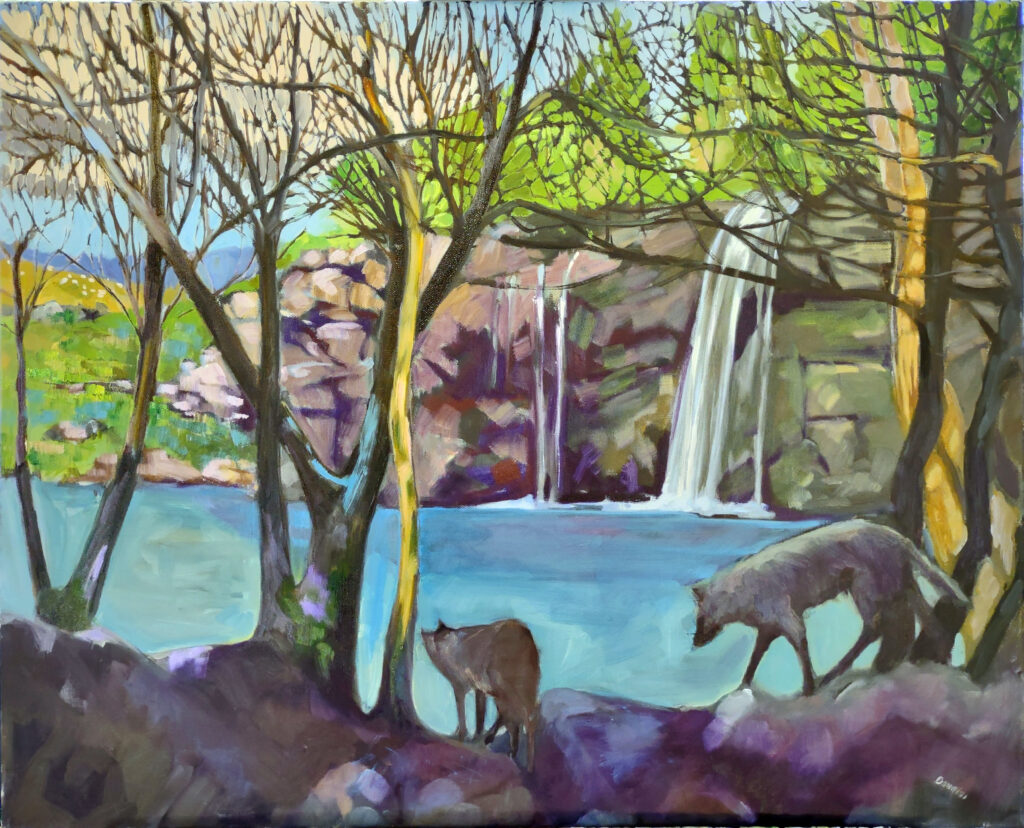
Ravenous Wolves, oil on canvas, 24X30, $3,478.00 framed includes shipping and handling in continental US.

Time as transformation. Down the street from me is a statue of Rockport’s most famous citizen, Andre the Seal. A few years ago, his marble nose cracked, necessitating some plastic surgery. Paintings crack, sculptures erode, and even digital art is lost as technology shifts. Nothing lasts forever, at least in the form in which it was created.

Time as context. Shakespeare and John Donne may be responsible for much of modern English, but their writing is not always easy on the modern ear. The same is true of memento mori or any other artform resting on symbolism. Can you decipher the objects in Napoleon I on his Imperial Throne by Jean-Auguste-Dominique Ingres? Meaning changes constantly, and culture discards ideas that are no longer relevant.

The time we put into viewing or listening to the art. I spent a long time with the Wilton Diptych at the National Gallery in London, with its White Hart badges and strange prefiguration of Shakespeare’s Richard II:

The breath of worldly men cannot depose
The deputy elected by the Lord:
For every man that Bolingbroke hath press’d
To lift shrewd steel against our golden crown,
God for his Richard hath in heavenly pay
A glorious angel: then, if angels fight,
Weak men must fall, for heaven still guards the right.

Yet I don’t remember anything about George Stubbs’ Whistlejacket. It is in the same museum and is a painting I love, but I was tired when I got to it. The time we put into a painting influences what we take out of it.

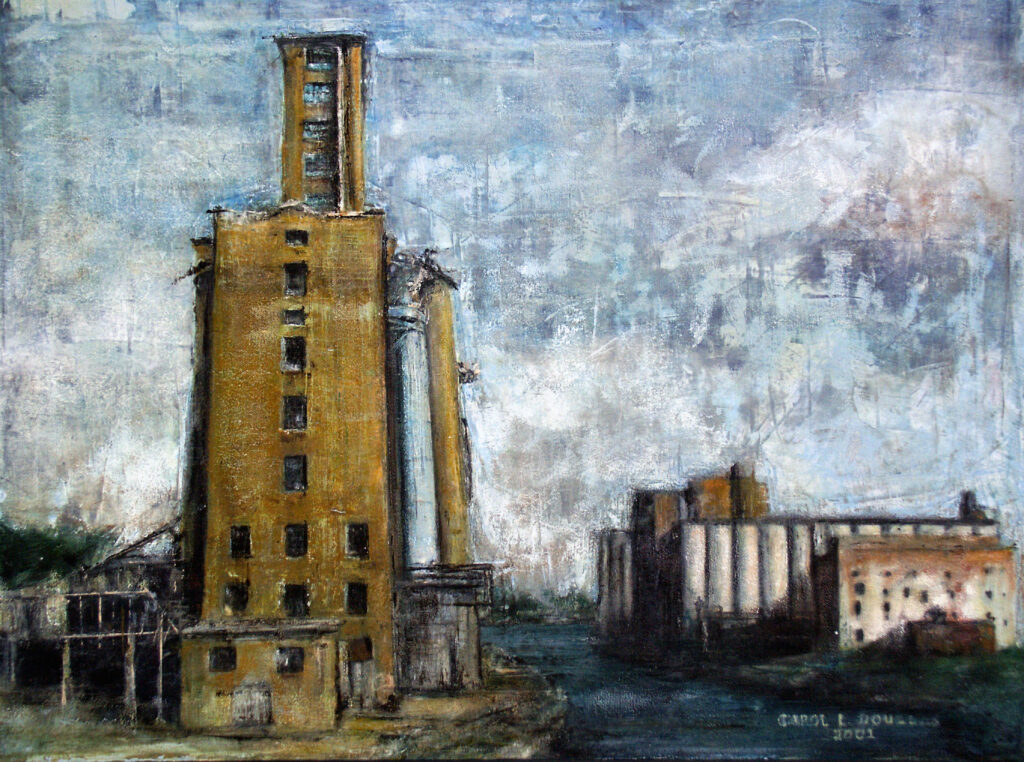
Grain elevators, Buffalo, NY, 18X24 in a handmade cherry frame. $2318 includes shipping in continental US.

Time and the narrative painting. The challenge of the narrative painting is to tell a story in a snapshot. When we’ve painted them, we’ve frozen time.

I have just two workshops left in 2026! Reserve your spot:

Can’t commit to a full workshop? Work online at your own pace:
Seven Protocols for Successful Oil Painters

Graffiti and creative expression

The Late Bus, oil on archival canvasboard, 6X8, $435.00 framed, includes shipping and handling in continental US.

My daughter was in Los Angeles last week. Like so many people who visit the City of Angels, she was struck by the sheer volume of graffiti. Graffiti looks different in different places; it’s not common where I live, but my brother in San Diego regularly cleaned it from the apartment complex he managed.

There are Roman examples of graffiti from 2500 years ago, mostly of the sexual or scatological variety, although the Kilroy was here kind also popped up regularly. If you’re willing to argue that art without words is also graffiti, it’s far older than written language: as old as the oldest cave art.

People do graffiti for lots of reasons, including a desire to mark territory, to shock, to rebel, or to state membership in a group. Then there’s the simple desire to create beauty. I come down firmly on the ‘graffiti is vandalism’ side, but my Australian cousin’s florist shop was proudly decked out in graffiti.

Possum, 6X8, oil on archival canvasboard, $435 includes shipping in continental US.

I think graffiti on a bridge overpass is annoying, but the Viking mercenary runic inscription in the Hagia Sofia is awe-inspiring. Yes, I’m being hypocritical, but ask me again in a thousand years.

There is a story—perhaps apocryphal—that an American reporter discovered this inscription on the wall of a Verdun fortress in 1945:

Austin White–Chicago, Ill.–1918
Austin White–Chicago, Ill.–1945
This is the last time I want to write my name here.

If so, nothing could have expressed war-weariness better.

Downpour, 6X8, oil on archival canvasboard, $348 includes shipping and handling in continental US

Creative expression

Spray paint hit the American market in the 1950s but it wasn’t until the late 1970s that a product specifically designed for graffiti was introduced. America’s youth never looked back. Graffiti was influenced by nascent hip-hop culture. From there it was only a hop, skip and a jump to graffiti’s commercialization. Banksy (whoever he really is) is now a graffiti-millionaire, and global brands use graffiti for marketing. So much for rebellion.

Although there are times when middle-class kids make feints at being graffiti artists, it’s more commonly seen in poorer neighborhoods. There’s always been a gap in lower-income education in the arts, and No Child Left Behind made it worse. Where do you go if you haven’t had the opportunity to learn traditional art? Even I can be seduced by my local hardware store’s paint department, and I have a whole studio of materials to pick from.

That graffiti is a learned art can be read from its stylistic disciplines. There are wildstyle, bubble (bloated), tag, 3D, stencil, streetart, character and many more. Kids are not learning them in art class, but they are demonstrating that the human mind longs for beauty and will work hard at developing the chops to create it. If creative expression is shut down in traditional channels, it will find its way in train yards, empty factories, bus depots, and water towers.

Regrowth and regeneration (Borrow Pit #4), 6X8, oil on archival canvasboard, $348 includes shipping and handling in continental US.

I have just two workshops left in 2026! Reserve your spot:

Can’t commit to a full workshop? Work online at your own pace:
Seven Protocols for Successful Oil Painters

Monday Morning Art School: how can I sell my art?

Spring Greens, 8X10, oil on archival canvasboard, $652 framed includes shipping and handling in continental US.

One of the questions I’m asked most frequently is, how can I sell my art? The answer is different for each person, but it always requires a shift in outlook. We artists create work that’s specifically from our mindset. However, selling art is no different from any other sales. It’s not about us, but about the customer.

Sales is about showing how our product effectively addresses our customer’s needs. It means building a relationship with the customer and addressing his or her concerns. That two-way communication may be transient or evolve over a long period of time. 

Your customer may want to beautify a space, prove something to himself or others, engage with the artwork on an intellectual level, or even just match his wallpaper. All are perfectly valid reasons to buy a painting.

Early Morning at Moon Lake, 6X8, oil on archival canvasboard, $348 includes shipping and handling in continental US.

Do you have a strong, consistent body of work?

Your work should be constantly evolving; if not, you’re probably just parodying yourself. Still, you should have a strong, consistent line of development. Somewhere online you should have a portfolio showcasing your best work. This presence needn’t be elaborate or expensive; a free blog host might be sufficient if you’re just starting out. It shouldn’t be scattershot—nobody wants to see your poetry, hand-embroidery, pottery and recipes if you’re trying to sell paintings.

Your website should have a reasonably complete bio and you should have a brief artist’s statement available. You will be asked for it.

Pensive 8X10, oil on archival canvasboard, $522 includes shipping and handling in continental US.

Selling in bricks and mortar galleries and stores

Are galleries dead? Certainly not, although they’ve drifted sideways in the past few years. I particularly like well-run cooperative galleries.

The day of cold-calling with a portfolio under your arm is (thank goodness) over. Start by thoroughly researching the gallery’s current exhibitions and artists, including visiting if possible. The gallery’s website may have explicit application instructions, which simplify matters. If not, prepare a cover letter, an artist statement, and a portfolio (with links to the work online and to your social media), and send them by email.  If you don’t hear back, follow up by phone after a reasonable time has elapsed.

But coffee shops, restaurants, and offices may actually sell more work, and often charge no commission at all. Besides my own gallery, I have work in a dental office and a realtor’s office; the realtor has used my work to stage property. The more my work is seen, the higher my profile.

Selling online

If I were starting today, I’d use FASO; Eric Jacobsen, Poppy Balser, and many of my other friends are on it. It’s commerce-enabled and will scale up as you grow. I have known artists who’ve auctioned their work on eBay, but I think that needs a high profile to start with.

Spring Allee, oil on archival canvasboard, 14X18, $1594.00 framed includes shipping and handling in continental US.

Social Media

Regardless of how you plan to sell, you’ll need to make a truce with social media. I like LinkedIn and Instagram best right now, followed by Facebook, but I do post on all available social media several times a week.

This is a constantly-shifting landscape, so keep your options open. My student and friend Cheryl Shanahan is fantastic at witty reels, and I want to be more like her. Since we’re apparently keeping TikTok, it’s time to loosen up that part of my brain.

Art fairs

I’ve done art fairs from St. Louis, MO to New York City. They’re a lot of work setting up and tearing down, so I’ve aged out of them. Their great advantage is that once you’ve paid the booth fee (which can be steep) the profits are all yours.

If you do them, diversify your merchandise. For painters, that means offering prints of your work along with originals. Many people attending these events don’t really want to spend $2000 on original art, but they will spring for a nice print.

(I’m thinking about these things because I leave on Friday to present at the Sedona Entrepreneurial Artist Development Program. After that, I’m teaching a workshop, below. There are still some openings, if you’d like to join me.)

I have just two workshops left in 2026! Reserve your spot:

Can’t commit to a full workshop? Work online at your own pace:
Seven Protocols for Successful Oil Painters

Deskilling art

“Pull up your Big Girl Panties,” 6X8, oil on archival canvasboard, $435.

A lot of my sentences these days start, “When I was a child…” Here’s one: when I was a child, most people had basic sewing skills. They were so fundamental that the government issued free instructional pamphlets to encourage people to sew more. The same was true of canning, gardening, and appliance repair.

Today, why fix or make it when you can buy it for less? Sewing has gone the way of the buggy whip, and unless something radically changes in the world economy, sewing has become a hobby.

Technology hasn’t replaced work; here in the US, those of us who work are putting in the same basic workweek as our grandparents did in 1940. But what we do in that time is very different.

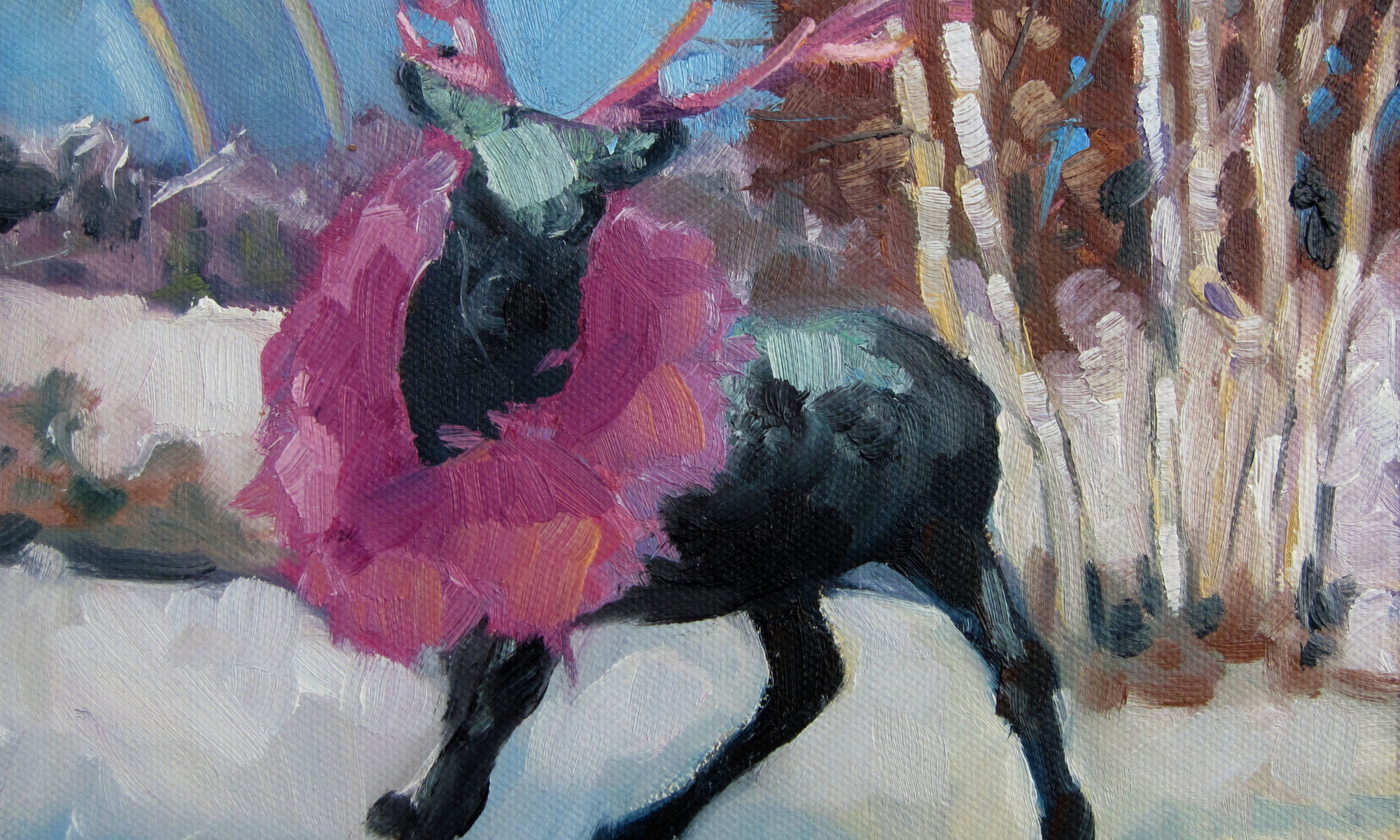
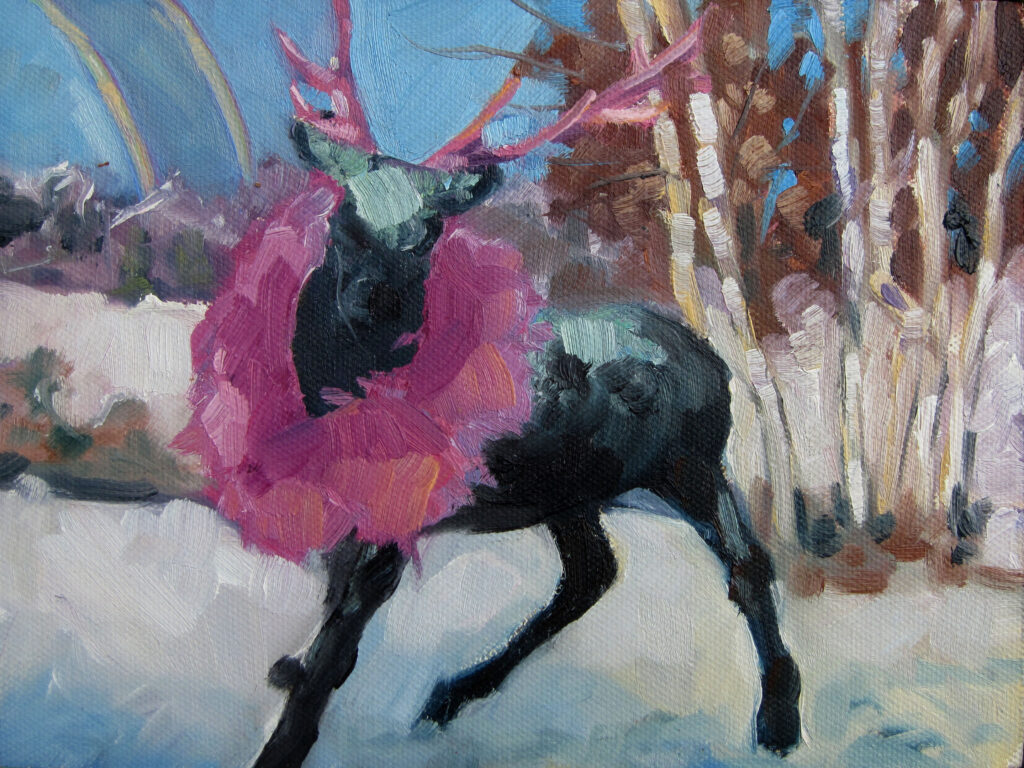
Toy Reindeer with double rainbow, oil on archival canvasboard, 6X8, $435 framed, includes shipping in continental US.

Deskilling or changing?

The extended-play version of my wedding album was shot on just a few rolls of film. The photographer was extremely skilled at metering and setting exposures. Today’s typical wedding photographers shoot hundreds of pictures, focusing much more on candid shots. The camera does the technical work and the difference between any two shots in a sequence will be mostly chance.

That doesn’t mean a trained monkey can take your wedding pictures. There remain the questions of composition, visual storytelling and context. None of those can be automated and they certainly can’t be added after the fact.

Baby Monkey Riding on a Pig, oil on archival canvasboard, $435.

Deskilling art

A few years ago, most AI-generated images were laughable. They have gotten frighteningly better; there are times when only the context tells us they’re impossible (like these Trump-Biden AI-generated ‘buddy’ pictures). The only thing standing between us and a complete breakdown of factual verification is the integrity of our news sources. Ouch.

I recently wrote a lesson about still life and was looking for an example in hyperrealism. Despite having decades of experience looking at and analyzing art, I could not tell from online images if what I was seeing was painted by human hands or was computer-generated. That means that the only thing the hyperrealist painter has is his or her brush strokes, and I am not certain that AI isn’t coming for those, too.

Hyperrealism isn’t, of course, photorealism—it’s as much an edited form of reality as impressionism. But it’s easier to fake with a computer.

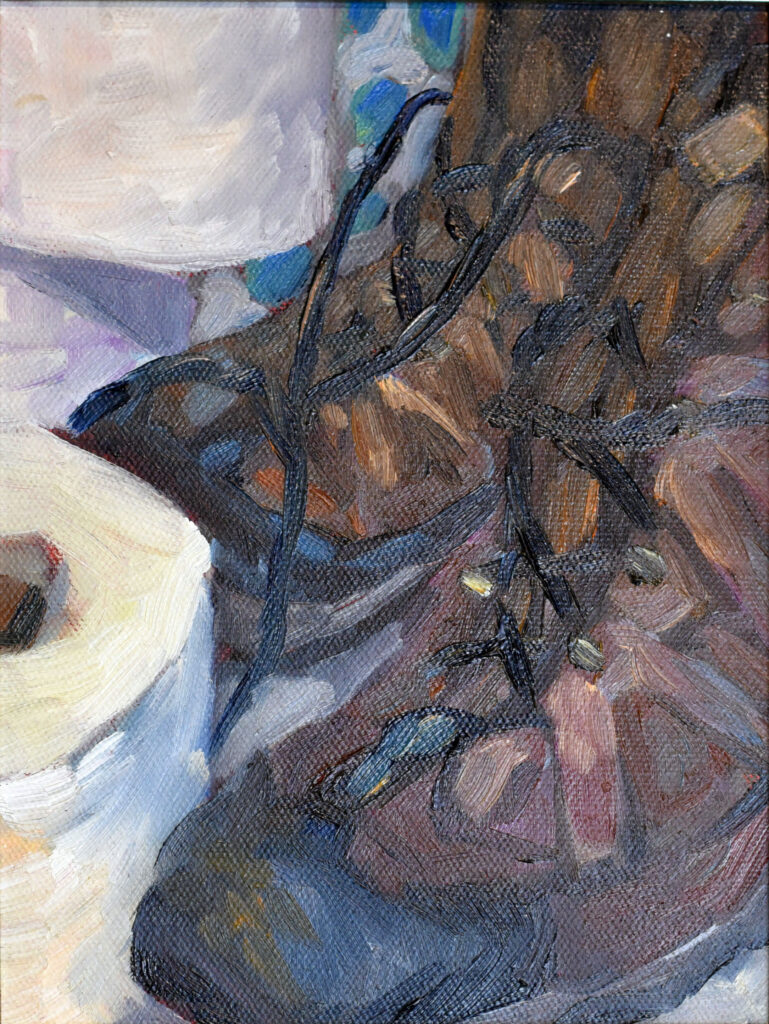
Hiking, 6X8, oil on archival canvasboard, $435 includes shipping in continental US.

What this means for the rest of us

Most of us are not interested in the absolute bell-like clarity of hyperrealism. That gives us a little breathing room, but it still leaves the question of why we’re making art, and how we can do it in a way that says more than AI will.

I wrote Monday’s post about funny paintings in part because for the last month or so I’ve been seeing variations on a worn-out theme. These are not-particularly well-painted portraits of politicians spattered with verbiage. Their faces being well-known and the words being obvious, I think this would be very easy for AI to dupe. However, one thing AI seems incapable of doing is writing good jokes.

It’s harder to be funny than to be didactic. It’s harder to be winsome than to be angry. It’s harder to be subtle than to hit the viewer over the head with a sledgehammer. And, yes, it’s harder to think about beauty and logic and proportion than about dogma. So, if you’re looking for job security in the age of deskilling art, be smarter than your average AI image generator.

I have just two workshops left in 2026! Reserve your spot:

Can’t commit to a full workshop? Work online at your own pace:
Seven Protocols for Successful Oil Painters