Monday Morning Art School: make your own canvases

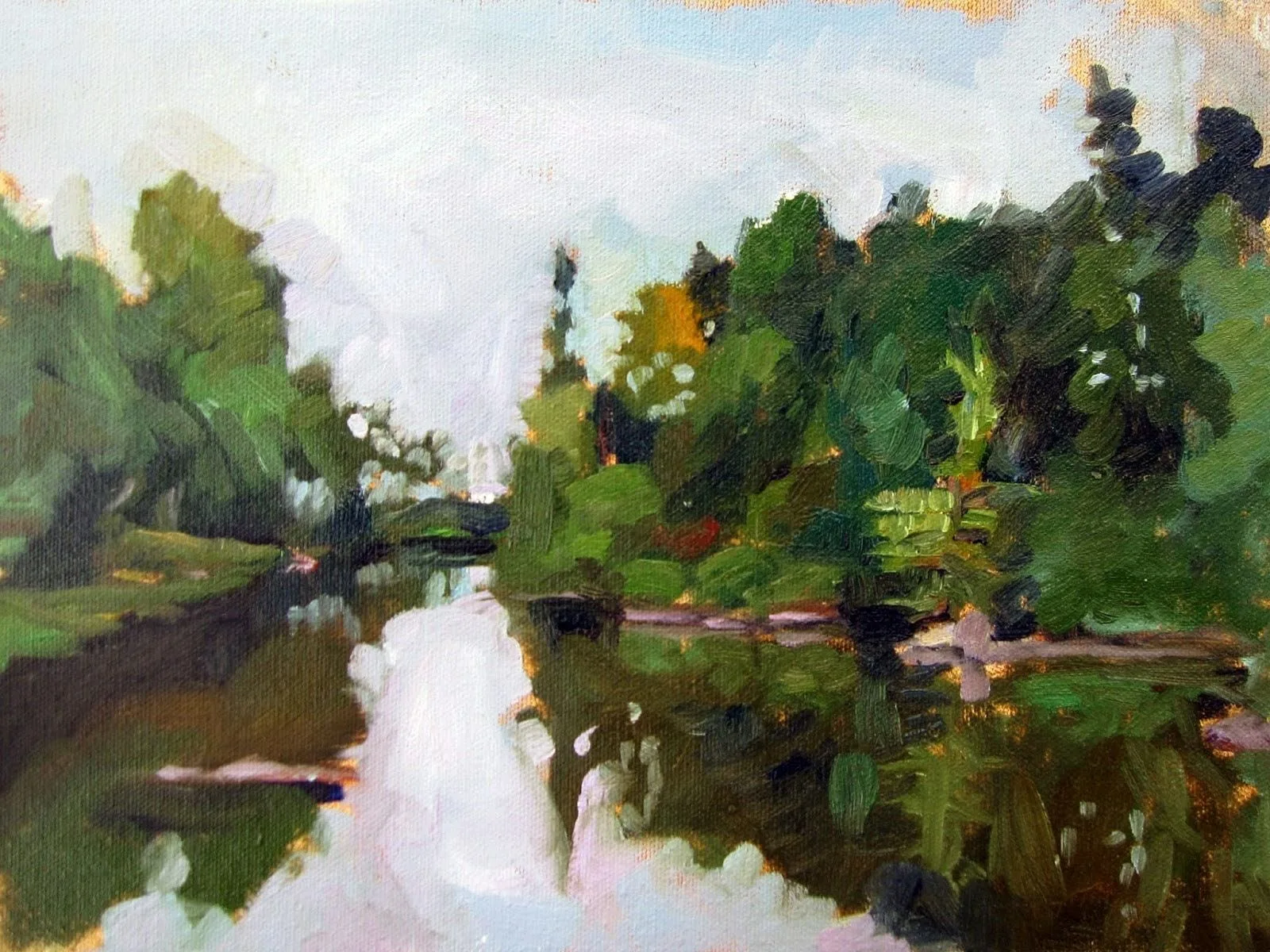
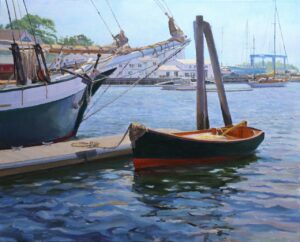
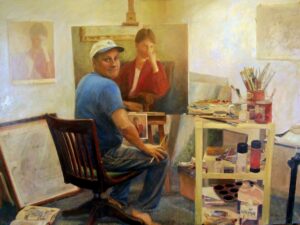
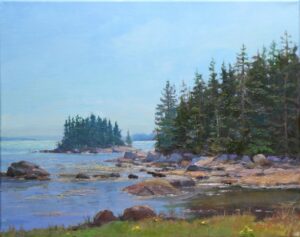
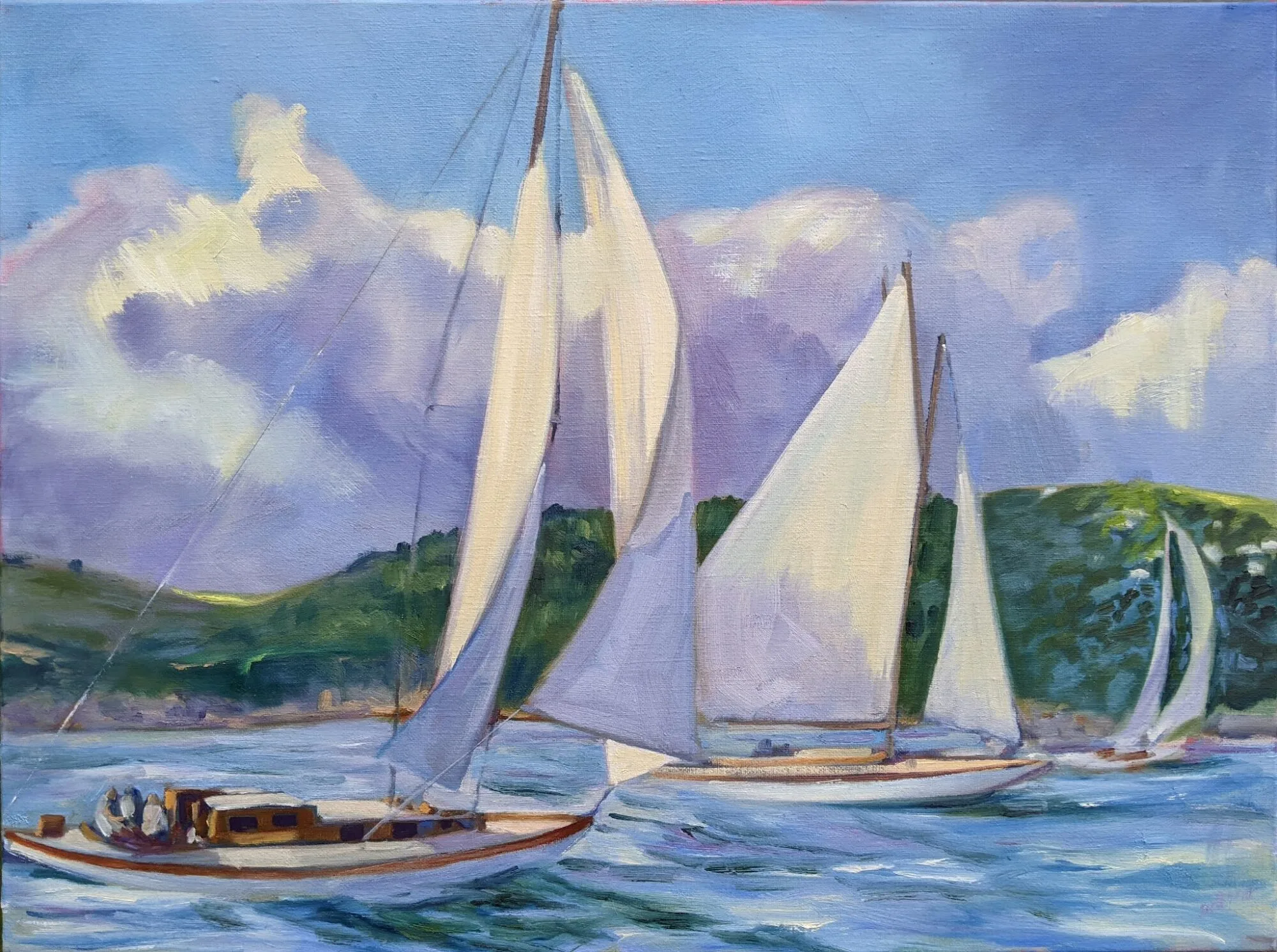
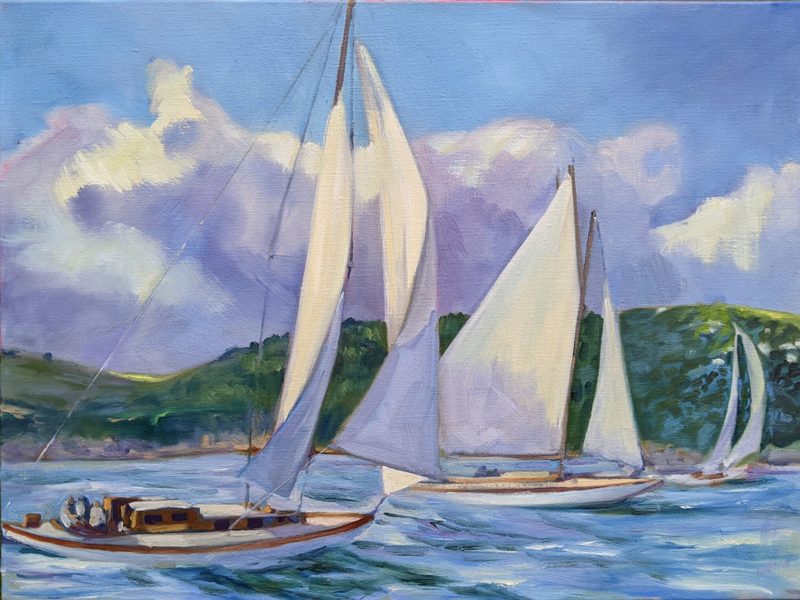
Skylarking 2, 18×24, unframed $1855, oil on linen. I stretch my own linen canvases.

“I have a roll of cotton duck kicking around here,” B- asked. “Can I just duct tape a big piece of that to a piece of plywood and put a few coats of acrylic gesso on it? Should I leave a few inches raw around the edge in case it comes out decent, so I can mount it on a stretcher?”

B- needs to know whether her fabric is unshrunk and unsized, or loomstate. Standard sewing fabric won’t work. The gesso is meant to shrink the fabric into tautness. Duct tape isn’t designed for that strong pulling stress and will leave a sticky residue. Instead, use staples. Stretcher frames are designed for this process, so it’s easiest to stretch canvas on them, although it can be done over plywood.
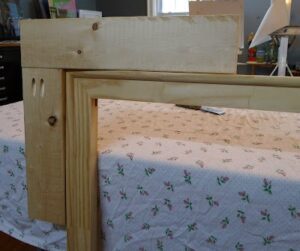
Start by squaring off the stretchers. Use a mallet to get them true and check all four corners.

She could also buy already-primed linen or canvas. This is easily stapled or taped to a board because the shrinking is done. This is especially handy for class assignments or practicing chip shots.

It’s generally cheaper to buy small canvases and canvasboards than make them yourself. Only when you get to larger sizes, or you want to paint on linen, does DIY becomes a practical option.
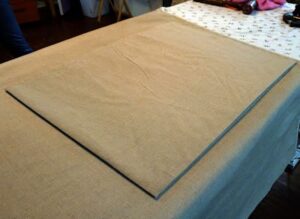
Once I had the fabric true on the warp and weft, I carefully folded it in quarters and set it aside.

Stretcher bars are designed to float with atmospheric changes, hence the little wooden “keys” that come with them. There is no benefit in locking down the corners by screwing them together. When it shrinks, a big sheet of loom-state linen or canvas is going to pull the stretchers into compliance. That’s why the grain matters.
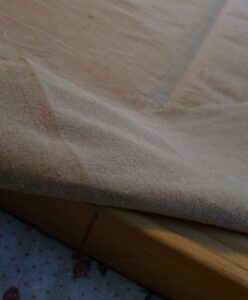
Lining up the creases with the marked midpoints of my stretchers assures me the canvas will be truly square.

The weft in fabric (horizontal threads) isn’t always perfectly perpendicular to the warp (vertical threads). The only true straight-edge in fabric is the selvage edge. You want to cut along the grain, but you can’t just assume the weft threads are perpendicular to the selvage.

If it’s out of true, fabric will bag when folded selvage-to-selvage. You can easily square it off with the help of a friend. Fold the fabric in half along the vertical. Grasping each corner firmly, tug diagonally in alternating directions. Eventually, the fabric will square off and fall true. The ends might be cockeyed; ignore them.

Although dressmakers and quilters might use water or steam in this step, you can’t. It will shrink the fabric.
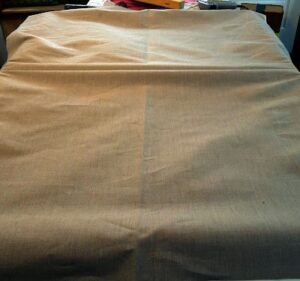
The first staples should be hand-tight, no more.

Once you’re certain the fabric is squared off, fold it in quarters. The creases will be your stapling guides.

Mark each stretcher bar’s midpoint with pencil. Line the creases up with these pencil marks, and your canvas will pull tightly on the square. Your first set of staples should be across the middle of the canvas on the warp. They should be hand-tight, no tighter. Next, staple the vertical midpoints. These four staples should all be hand-tight, without cupping around the staples, and the corners of your canvas should be square. If these four staples yield a straight cross at the right tension, the rest of the canvas will line up true.
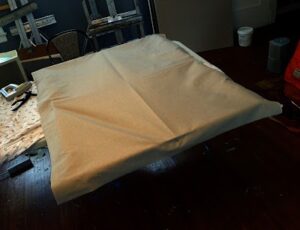
You might have to remove and replace staples to get the cross straight, but it’s worth taking the time.

From here use canvas pliers or your hand to pull the canvas tight but not taut. Work out from the center of each side, adding one staple and then rotating the canvas. The goal isn’t to tighten the fabric as taut as you can; the goal is to tighten it as evenly as you can. Watch the fabric grain as you go; if it’s out of line, you’ve messed something up.
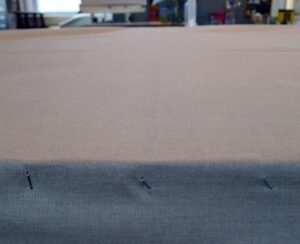
Work around the canvas in a circle, adding a staple to each side until you reach the edges. The linen doesn’t need to be drum-tight.

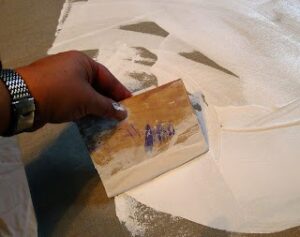
Applying the gesso is easy; just keep it light and even. I use a small piece of ¼” plywood as a strigil rather than a brush; it’s faster and more effective. Make sure the gesso goes around the sides of your canvas. Don’t dilute; good gesso is already the proper thickness.
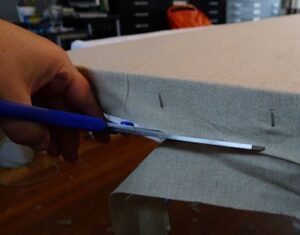
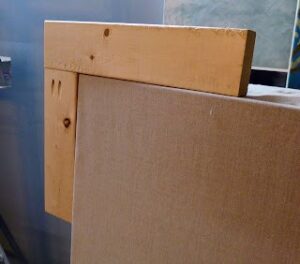
Trim the edges when you finish.
Check the square again when you’re finished stapling.
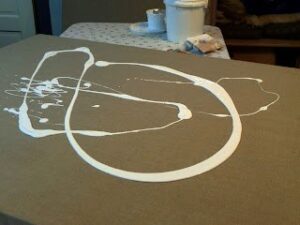
Finally, it’s time to pour a little acrylic gesso on your loomstate linen.
Use your strigil to push the gesso into the grain. At this stage, less is more; it’s easier to add more gesso than to remove a gloppy excess from a canvas.
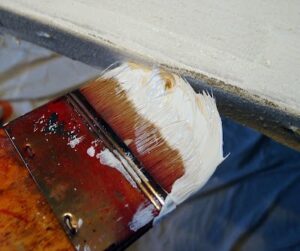
Do the edges and clean up any ridges with an old spalter brush and you’re done. Go have a glass of wine; you’ve earned it!

Holiday gift guide for budding artists

There is no age that’s too old to paint.

Drawing for adults and teens

Art starts with drawing. I use a Strathmore Bristol Visual Journal in a smooth finish and a #2 mechanical pencil. Bigger isn’t always better; the smaller notebook fits in a purse or backpack easily. If you’re looking for a higher-end pencil try the Uni Hi-uni Graphite Pencil Set or woodless pencils with a sandpaper pointer. A Pentel stick eraser and simple pencil sharpener will round out the gift.

(For my last word on drawing materials, see Monday’s post.)

If your artist is interested in figure drawing, consider a sketch board with a tablet of newsprint and some willow charcoal. A few kneaded erasers will round out this kit.

Who doesn’t like a Micron pen? There’s another pen that I love these days: the FriXion gel pen. It erases with heat, so you can use it to draw under watercolor and make it disappear with a hairdryer, eliminating the permanent guidelines in your work.

Fewer colors, better paints, make for a less-frustrating start in art.

Adding color

Give budding artists a few good tools, rather than overload them with the junk you see on department store end-caps. That doesn’t necessarily mean spending more money.  Faber-Castell Polychromos pencils come in small starter sets. That’s true of Prismacolor watercolor pencils as well. Both will work in the Visual Journals I mentioned earlier. If you want to up the paper game, consider Strathmore 400 Series mixed media pads.

NuPastel color sticks are the gateway drug to a life of pastel painting, and they come in starter sets. I’d add a tablet of Canson Mi-Teintes paper, so your artist can experiment with vellum and smooth surfaces.

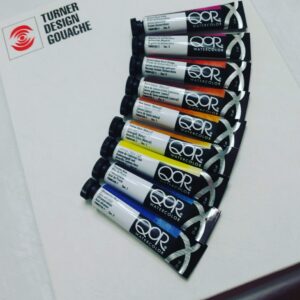
Many new painters I teach start with watercolor. QOR’s halfpan kit would be a luxurious gift coupled with a set of Princeton Neptune Brushes and an Arches watercolor block. Or, replace the halfpan set with QOR’s introductory tube set of six paints and the paper with a Strathmore 400 watercolor block. But don’t switch the brushes to cheap knock-offs; they’re the most important part of the watercolor puzzle. It’s better to buy one decent brush than ten cheap ones.

Golden Acrylics come in several introductory sets. I recommend the ‘modern theory’ set, but any of them will be well-received. Add a set of Princeton Taklon brushes and cotton canvas panels and your budding painter is ready to rumble. No mediums or finishes are necessary.

One good brush is worth ten lousy ones.

If he or she is interested in oil painting, an economical, high-quality option is Gamblin’s 1980 series, which also comes in an introductory set. Alla prima oil painting requires a stiffer brush than watercolor or acrylic.  I recommend Princeton SNAP! Some cotton canvas panels and your lucky recipient will have a full painting kit.

A word about easels

Every year, retailers trundle out cheap, heavy French easels during the holiday season. They then appear in my painting classes to frustrate and annoy my students. Even worse are the Meeden pochade boxes that are all over the internet right now.

For beginners, a simple floor easel and folding table is sufficient. I still have the folding easel from my teen years; it’s small and portable.

That easel has earned its way many times over.

For kids

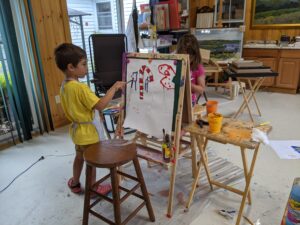
I bought my grandkids this double-sided easel several years ago, and it was a great investment; they use it for hours every time they visit. Pair it with Crayola Tempera Paint. They’ll also need brushes, inexpensive palettes, and aprons.

Kids never have enough washable markers. Lots of paper is critical; burning through it is how they learn art. Likewise, every child should experience Sculpey; it’s a million times more fun than Play-Doh.

Books and more

For conventional drawing, I recommend Sketching – from Square One to Trafalgar Square by Richard E. Scott. Younger people might prefer How to Draw Manga: Basics and Beyond.

Art & Fear: Observations On the Perils (and Rewards) of Artmaking should be on every artist’s bookshelf.

Kids will enjoy The Drawing Book for Kids: 365 Daily Things to Draw.

Casey Cheuvront introduced me to these plastic mesh zipper pouches. They cost a fraction of the ones in an art store and instantly turn any mess of art supplies into a kit.

This is part of a series on holiday gifts for the painters you love. Next up: Holiday Gifts for the serious artist.

This page contains affiliate links for some but not all products. If you choose to make a purchase after clicking a link, I may receive a commission at no additional cost to you. Thank you for your support!

Bare naked in the middle of the street

The Dugs, 8X10, Carol L. Douglas, $652 framed.

This fall two of my students threw together their first commercial art shows. Karen in San Francisco sold out. That’s an unusual achievement; I’ve never done it and know few artists who have. Karen kept her prices low and invited everyone she knows, she told me.

Mark is doing a studio show as part of a holiday walk of artists in Austin, TX. On Saturday I asked him how it was going. “I’ve sold a few things,” he said.

Sea Fog over Castine, Carol L. Douglas, 9X12, $869 framed

Neither of these painters are lifelong artists who secretly nurtured genius until their Big Reveal. Mark has been painting for about two years. He started with me when I started teaching on Zoom during the pandemic. Karen came to me from Bobbi Heath’s beginner class some time last year. Both are at the phase where style and technique are starting to gel. Importantly, both are realists who understand exactly where they fit in to the continuum. How, then, did they muster up the courage to put their work out there?

Karen was motivated by space. “I had all these paintings hanging around,” she told me. That’s why I did my first show decades ago, and the result has been a career in art.

Mark told me he’s not doing it to make money, but to improve as an artist. “You need to push,” he said. “Put yourself out there, bare naked in the middle of the street. Paint in public, sign up to sell, create an Instagram account. The pressure of being seen makes you strive to do better and exposes you to artists who are better than you. You will also be surprised and comforted at seeing those who are not.”

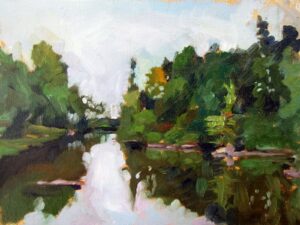
River Light, 11X14, Carol L. Douglas, $869 unframed.

(Note that I said nothing about ‘talent’ here. It’s a spurious concept that has little to do with excellence. Genius, as Edison said, is 99% perspiration and 1% inspiration.)

Vulnerability is never a comfortable feeling. I’ve sometimes felt totally outclassed at shows, like a duffer who was accidentally admitted into the presence of the Big Boys. That leaves me feeling tiny and elderly and unimportant. But when I get past that, there’s almost always something I can learn from the other painters there. The trick is to drop my own defensiveness and look at their work with an open mind.

The irony is that there are very few painters who don’t also experience that insecurity somewhere, because there will always be painters who are ‘better’ than we are. I know an artist with a reputation for cockiness. I saw him over the summer at an event that’s outside his usual sphere. He was palpably nervous and uncomfortable.
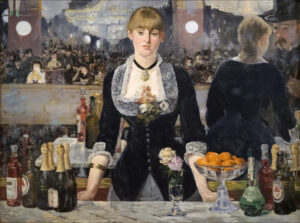
Inlet, 8X10, Carol L. Douglas, $652 framed.

We all harbor the secret belief that we’re geniuses, and the cold hard light of the public square exposes all our weaknesses.

It’s true that the marketplace often rewards mediocrity and conventional thinking. That’s the story behind the 1863 Salon des Refusés, which inadvertently legitimized Impressionism. Think of all the horrid art you’ve seen in hotels and doctors’ offices. There’s the Thomas Kinkade phenomenon.

However, the marketplace is also an intelligent voice of criticism. People buy art that speaks to them. If the public square doesn’t reward you at all, you need to improve your communication skills, either with a brush or in words.

“Anything that won’t sell, I don’t want to invent. Its sale is proof of utility, and utility is success,” Edison also said. There are limits to that kind of thinking in fine art, but he wasn’t entirely wrong.

How have you conquered your fears and put your work out there to be judged?

Monday Morning Art School: what do you use for drawing?

For figure drawing, I prefer softer materials, primarily willow charcoal.

“I wonder if you can give me some tips on getting back into drawing,” a reader asked recently. She’s a retired professional artist, so she didn’t need help with the mechanics, just the materials.  “I only have those hard leads that I put in mechanical pencils.  I like drawing with a mechanical pencil and lead but I need leads that are much softer for the kinds of thing I might be drawing, along with the thinner lines I use now. I don’t like clumsy crayon-type of drawing or anything like that.  I am not at all interested in drawing with ink.”

“I also need a good quality sketching paper.  Later I might move into a higher-grade paper if I keep up with this kind of work.”

I always carry a sketchbook with me when painting, and I always start with a drawing.

Although this reader doesn’t need help with the mechanics of drawing, many of my students and readers do. I recommend Sketching from Square One to Trafalgar Square by Richard E. Scott. Drawing is a technical exercise, not a magic trick. Anyone can learn it.

These days, I do 99% of my drawing in a Strathmore Bristol Visual Journal with a #2 mechanical pencil, using my finger for a stump. I like the hard-press finish and can go off on watercolor or gouache tangents when I feel like it.

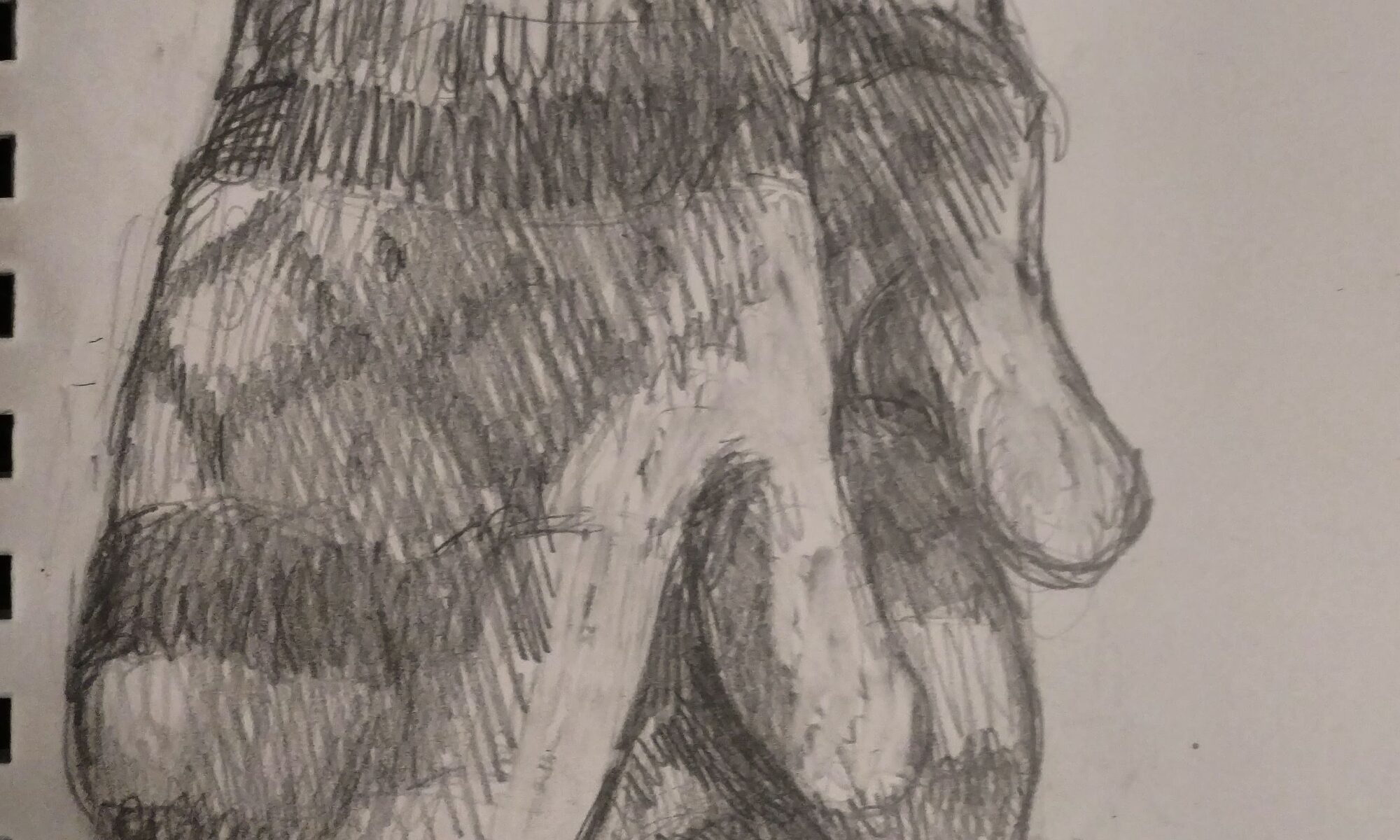
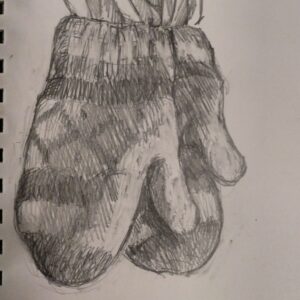
My winter mittens. I’ve been saved a world of boredom by always carring a sketchbook and #2 mechanical pencil with me.

But that’s not the kind of finish my reader is seeking. I’m never doing more than a quick sketch for a painting, or drawing in church. Neither need the depth of shading that better materials would supply.

I prefer mechanical pencils because they don’t need a sharpener and eraser. If that appeals, you can buy replacement leads in a variety of densities. These, however, are wider than the pencils one buys at Staples, so they require a matching lead holder, only some of which come with internal erasers.

That exceeds my tolerance for fuss. When I’m doing more finished pencil work, I use woodless pencils. They can be sharpened with a sandpaper pointer. If you like a bigger, bolder look, liquid charcoal and graphite blocks cover a lot of area quickly.

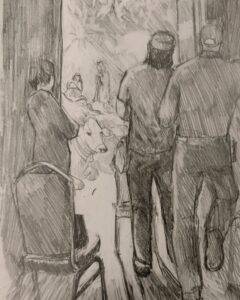
The animals in our annual church Christmas service suddenly came alive.

Another reader suggested I try Uni Mitsubishi Hi-Uni pencils for a traditional lead pencil that has satisfyingly smooth graphite. And there’s Blackwing, which a writer friend swears is the best pencil in the world. But since I don’t use traditional pencils, your suggestions would be helpful.

Good graphite deserves good paper. You could take a deep dive into a wove paper, but for everyday drawing, I rely on that old standby, Canson Mi-Tientes. It has a different surface on either side and comes in a plethora of colors.

Moving away from mechanical pencils means a good eraser. I use a Pentel stick eraser, but the softer the lead, the less precision you’ll need. I used kneaded erasers for years, but I’m finding them too gummy these days. The Koh-I-Noor Hardtmuth Soft Eraser is made of old-fashioned rubber.

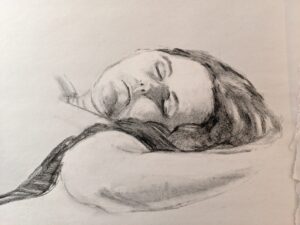
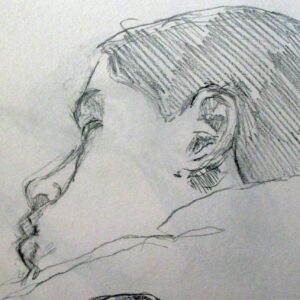
Drawing in church leads to some priceless observations, including this teenage boy falling asleep.

And last but certainly not least, there’s the question of pencil sharpeners. I have several, including a wall-mounted one in my studio. None are as durable and reliable as the old metal ones from our school days. In the end, I find the simple, cheap, handheld metal ones where you can replace the blades to be the most reliable.

What products do you love for drawing, and why? Just remember to put your recommendations in the comments below, not on Facebook. That makes them universally accessible to readers from any platform.

This page contains affiliate links for some but not all products. If you choose to make a purchase after clicking a link, I may receive a commission at no additional cost to you. Thank you for your support!

The last fun time

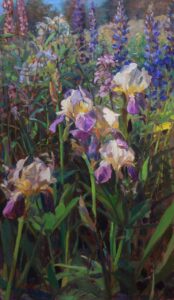
Iris Blossoms, by Peter Yesis, courtesy of the artist.

On March 6, 2020, Peter Yesis had an opening at the Picker Room of the Camden Public Library. That night, Ken DeWaard introduced us to the elbow bump, which was supposed to replace handshakes and hugs and keep us safe from this new disease from China. It was a dark winter’s night and we were a party of close friends. We laughed and joked and practiced bumping elbows. I wasn’t overly worried; we’d seen this with SARS and Ebola-a whole lot of fuss over nothing.

I flew off to Argentina with my pal Jane Chapin and all hell broke loose (proving that I can’t leave you kids alone for fifteen minutes). Among the first casualties was Peter’s solo show-closed down a day after it opened. After that, we weren’t bumping elbows; we weren’t even allowed in the same room. The library shut down all art shows for the foreseeable future.

A Clear Day, by Peter Yesis, courtesy of the artist.

An abrupt closure is painful for an artist, since we work for a year or more for the materials for a one-month show. The library staff understands this; they offered Peter a reprise date in November, 2021, when life had begun its slow, sluggish return to normalcy.

Cellar Dweller, by Peter Yesis, courtesy of the artist.

Unfortunately, life intervened in another cruel way. Peter was slammed by cancer. He was in the depths of treatment and in no condition to be hawking paintings.

But today he is in remission, and we’re all celebrating with another opening. Let Peter’s annus horribilis end, and let this be the start of his annus mirabilis.

Light on the Water, by Peter Yesis, courtesy of the artist.

Every Canvas Has a Story opens this Saturday, Nov. 5th, from 3:30 PM to 5:30 PM. Enter on the Atlantic Avenue side of the Camden Library; there’s ample parking on the street and in the library lot. The show will be up for the month of November, but I always encourage people to show up for the party.

Still Waters, by Peter Yesis, courtesy of the artist.

Peter’s wife, Kim Yesis, will also be giving a book talk on Tuesday, Nov. 29th at 6:30 PM. She’s the author of Side by Side: Tales from Behind the Canvas. It talks about Peter’s decision to give up engineering for painting. They were in early middle age, which for people with children is a terribly expensive phase of life. Come ask Kim why she didn’t just kill him for the insurance money.

Tried and true, by Peter Yesis, courtesy of the artist.

Peter’s a crackerjack painter; for example, there is nobody around who paints flowers so well. I’m so glad to see him back up and punching his full weight. The paintings in this show are beautiful, and I encourage you to come out and see them in person.

Does surrealism work in painting?

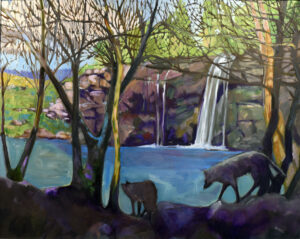
Winter Lambing, 48X36, oil on linen, $6231 framed.

I slept through most of Halloween, meaning I missed one of America’s key spending holidays. My fellow citizens were expected to lay out more than $10 billion on-what, exactly? Candy? Fake spider webs?

“When you think of it, all the world’s great stories have an element of the supernatural,” my student Mark Gale told me recently.

Ravening Wolves, oil on canvas, 24X30, $3478

It’s a thesis I’ve tested against my own taste in literature. It’s there in the Homeric epics, where the gods intervene in human affairs in very human ways. All the books of the Bible are about relationship between God and man. Dante‘s Divine Comedy is a fantasy about cosmic justice. Charles Dickens and Anthony Trollope wrote within the Victorian understanding that God is ever-present. Kurt Vonnegut (if you didn’t read him at 20, you had no heart) was an atheist, but wrote in the supernatural. Haruki Murakami is a modern-day shaman. Even dystopian novels like Nineteen Eighty-Four and Brave New World are about malign power beyond the merely human.

Apparently, contemporary readers feel the same about magical realism. Fantasy literature is one of the great successes of modern bookselling.

The Harvest is Plenty, 30X40, oil on linen, $6231 framed.

The supernatural, in the form of religious painting, is the foundation of western art. We invented painting largely to explain the Bible. Now that almost everyone reads, religious art no longer serves that purpose. But we can see its power in works like the Ghent Altarpiece.

However, magical realism never made the leap to modern painting. Surrealism was a minor mid-century phenomenon that was rendered superfluous by moving pictures. Giorgio de Chirico and Salvador Dali were probably its greatest practitioners, but neither had any profound impact on art history. Surrealism lives on in the work of Frida Kahlo, but Fridamania is probably more a cult than an art movement.

This is a disconnect I feel strongly. I’ve been a Christian convert for about thirty years. You’d think I could express that through art. However, I’ve had little success. The exception was a series of paintings I did for a solo show called God+Man at Roberts Wesleyan’s Davison Gallery in 2014. It was hardly a cutting-edge idea or treatment, even if the paintings themselves are good.

All flesh is as grass, 30X40, oil on linen, $6231 framed.

Part of that is the crushing weight of sixteen centuries of great religious art. There is nothing that I can say about the stories of the Bible that hasn’t already been said by hands and minds trained to the task.

I’ve argued that this is enough; that in Creation we see God. But that’s starting to feel like an insufficient argument. Is landscape enough? If not, how does an artist start insinuating his or her higher thoughts into the work?

Monday Morning Art School: Four masters show us how to use scale

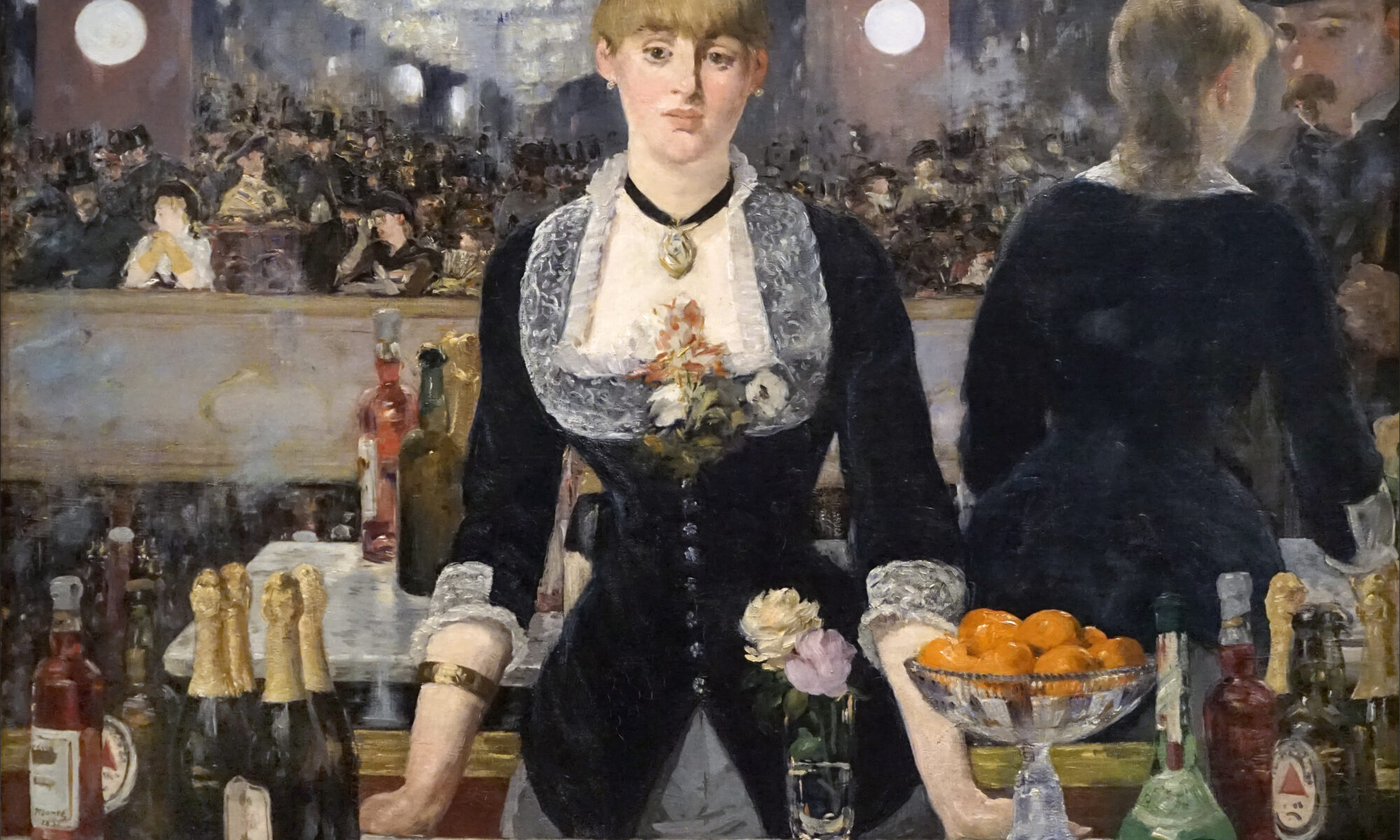
A Bar at the Folies-Bergère, Édouard Manet, 1882, courtesy the Courtauld

We don’t know why prehistoric man created the 360 ft.-long prehistoric Uffington White Horse in Britain, but every generation is both amazed and moved by it. Conversely, miniatures dazzle us with their meticulous craftsmanship. In very large or very small works, we’re immediately transported out of the ordinary. That is why The Heart of the Andes by Frederic Edwin Church must be seen in person-the scope is lost in photos.
The scale of the figures within a painting can make its message more powerful. Here, four masters show us how it’s done.
Wanderer above the Sea of Fog, Caspar David Friedrich, c. 1817, courtesy Hamburger Kunsthalle

Wanderer above the Sea of Fog is by the great German Romantic painter Caspar David Friedrich. He doesn’t spell out the identity of the model; in fact, the man is turned away from the viewer. He is an Everyman with whom we are meant to identify. He is centered in the canvas (saved from being static by the S-curve of his body) and is larger than the landscape itself. Friedrich wants us to focus on our human responses and not the landscape itself, as symbolic of uncertainty as it is.

A Sunday Afternoon on the Island of La Grande Jatte, Georges Seurat, 1884-1886, courtesy Art Institute of Chicago

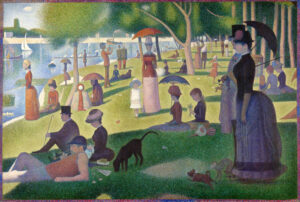
A Sunday Afternoon on the Island of La Grande Jatte by Georges Seurat is one of the most famous paintings in art history. It’s the seminal work of Neo-Impressionism. It was birthed with some difficulty, as Seurat labored over it for three years. Observe the scale of the figures. They range from the monumental couple on the right with their weird little monkey to the distant figures in the background. Using figures of various sizes, Seurat deftly created depth without atmospherics or modeling. Compare this painting to its companion piece, Bathers at Asnières, which takes a more conventional approach to creating depth.

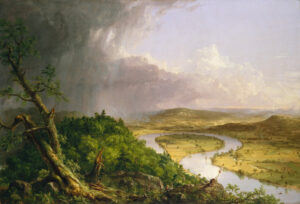
The Oxbow: View from Mount Holyoke, Northampton, Massachusetts, after a Thunderstorm, Thomas Cole, 1836, courtesy Metropolitan Museum of Art

Many Hudson River School paintings are sermons on canvas, and Thomas Cole‘s The Oxbow: View from Mount Holyoke, Northampton, Massachusetts, after a Thunderstorm is no exception. You are meant to see the American landscape as an Arcadia where man and nature live in harmony. There’s also nascent American myth here, celebrating our story of discovery, exploration and settlement just as they began to fade into history. Cole hammers this home with the Hebrew lettering in the logging clearcut. It spells either “Noah” or “Shaddai” (the Almighty) depending on whether you’re reading it right-side-up or from the God’s-eye-view.

Cole painted himself into The Oxbow. He’s so tiny it will take you a moment to find him. Look in the ravine to the left of his kit and umbrella. By making himself so small he drives home the point that we are mere specks in Creation.

Much has been written about the ‘impossibility’ of the reflections in Édouard Manet‘s A Bar at the Folies-Bergère (at top). The gentleman at the far right is enigmatic; he’s both transactional and nightmarish. Note the feet of the trapeze artist at the far left and the Bass Pale Ale bottle, which hasn’t changed in 140 years.

The barmaid’s face is life-size, and she is assessing us straight-on. Whether we’re looking at exhaustion, sadness, or resignation is hard to say. By making her life-size, Manet hammers home the power of her straightforward gaze. This painting isn’t just a mirror in a bar; it’s a mirror on our own souls.

Manet was dying of syphilis when he painted this, suffering severe pain and paralysis. Controversy has raged about the identity and character of the model, known only as Suzon. That hardly matters, because what we see in her eyes is a reflection of Manet’s, and by extension, our, thoughts.

If you’ve ever thought about taking one of my workshops aboard schooner American Eagle, here’s a lovely account from writer Georgette Diamandi, who joined us this past September.

Okay, now it’s your turn to be the jury… you pick.

Dome of Light, 9X12, Carol L. Douglas, $869

I have completed eight paintings for this event, seven of which are in this blog post. By 9 AM Sedona-time (noon on the East Coast) I have to narrow it down to three for judges John Caggiano and Susan Lynn to view. We’re essentially pre-filtering; it’s far more difficult for a juror to filter through 300 paintings to determine what he or she likes.

River Light, 11X14, Carol L. Douglas, $1087

This is, for some of us, the hardest part of the event, so I’m turning it over to you. Think in terms of formal criticism, including:

  • Focal point
  • Line
  • Value
  • Color
  • Balance
  • Shape and form
  • Rhythm and movement
Crescent Moon, Dawn, 9X12, Carol L. Douglas, $869

Then ask yourself, “Does this painting move me?”

The photo quality isn’t the greatest; I took these indoors. But there’s enough information there for you to see the fundamental structure.

Let me know your answers in the comments below.

Cypresses and Sunlight, 11X14, Carol L. Douglas, $1087
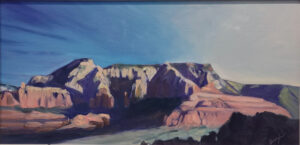
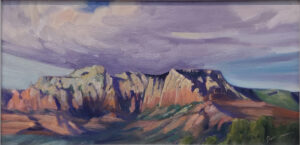
Persistent clouds along the Upper Wash, 11X14, Carol L. Douglas, $1087
Sunrise, 8X16, Carol L. Douglas, $903
Sunset, 8X16, Carol L. Douglas, $903

Moving in with strangers

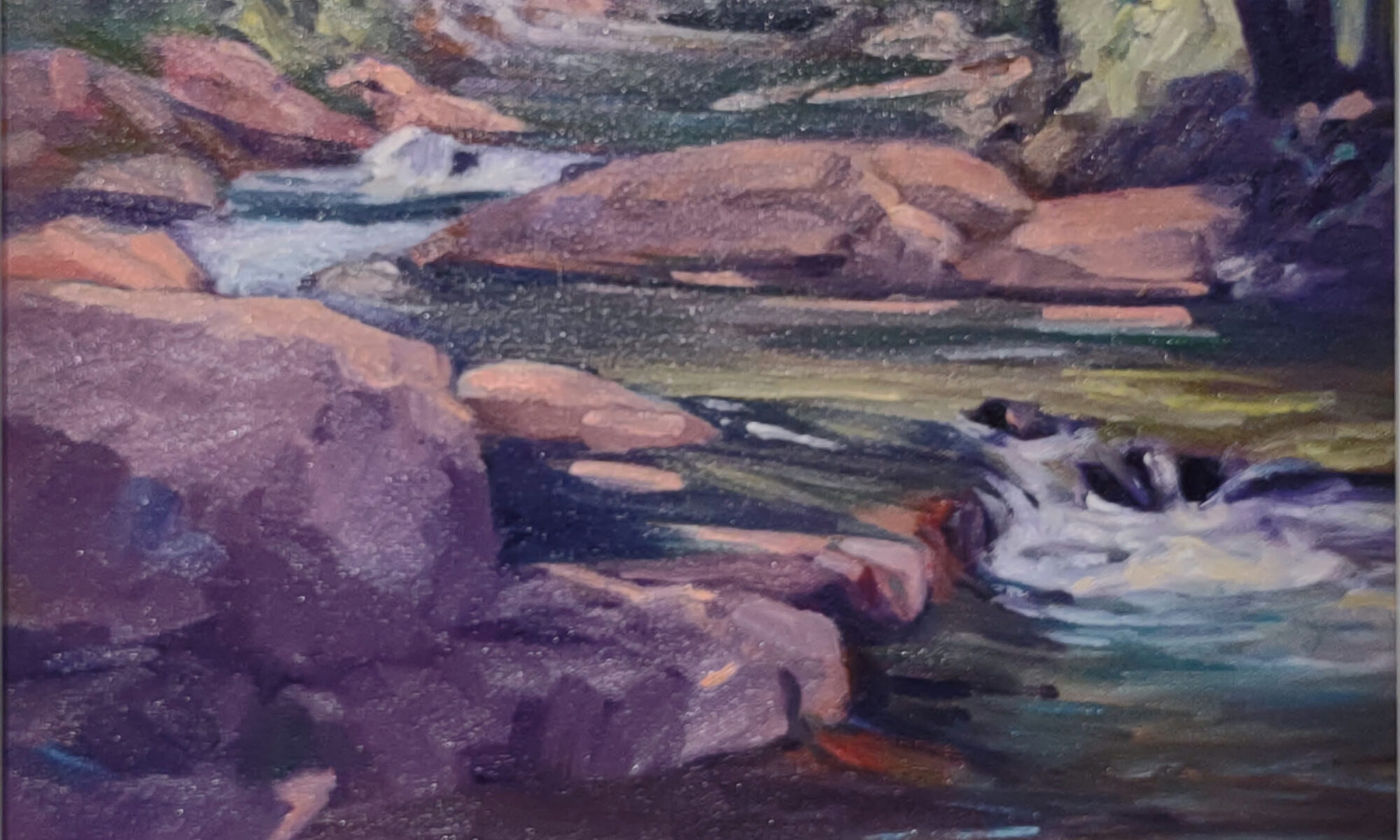
River Light, 11X14, oil on canvasboard, Carol L. Douglas, $1087, available through Sedona Arts Center.

Host housing is an imperative on the plein air circuit; buying a hotel room for ten days in a town like Sedona would wipe out any profit from the gig (and anyone playing at this level is in it for the money). But it’s difficult to show up at a stranger’s house, drop your paint-stained luggage in their entryway, and ask to be shown their guest room. Amazingly, it seems to work.

Earlier this month at Cape Ann Plein Air, I gamed the system by asking to stay with Rae O’Shea. I’d never met Rae in person, but we have a mutual friend in Jane Chapin and we’ve been Facebook friends for years. We’re both Anglophiles, so with the recent death of Queen Elizabeth we had a lot to talk about. Even with that, it was a little tough to pull into Rae’s driveway and announce, “Honey, I’m home!”

Sunrise, 8X16, oil on linenboard, Carol L. Douglas, $903, available through Sedona Arts Center.

I met Jane Chapin when she was my host for Santa Fe Plein Air Fiesta. I think she had six artists staying with her; wisely, her husband was elsewhere that week. As there is no cell service in the Santa Fe wilderness, we were frequently draped over her furniture, using her internet. Amazingly, she not only tolerated me then, we’ve become fast friends. We went to Patagonia together, where we were stranded at the start of COVID. There we developed giardiasis (so-called Beaver Fever). “Friends that suffer unremitting diarrhea together, stay together,” I always say.

Lisa BurgerLentz and I once shared an austere but beautifully-sited summer cottage at an event. It wasn’t being used by the owner, perhaps because it didn’t have potable water. We’d been warned; we were careful; we still managed to catch Beaver Fever. While I like extreme plein air painting, it can be tough on the gut.

Sunset, 8X16, oil on linenboard, Carol L. Douglas, $903, available through Sedona Arts Center.

My all-time favorite billet was a tiny cabin in the deep northern woods by a lake. There was an outhouse and an outdoor shower and I slept in a loft. I could have cooked as there was a propane stove, but as usual I made do with sandwiches.

Like most of us, I’m a creature of habit. I’m early to bed and early to rise; I don’t eat out, and I don’t watch television or movies. After a day interacting with strangers, I want to crawl into a hole to read. Depending on my hosts’ habits that can make me either a fabulous guest or a terrible one.

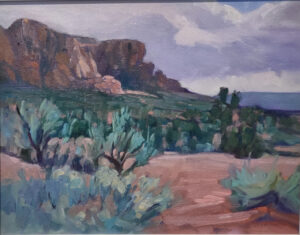
Cypresses and Sunlight, Carol L. Douglas, 14X18, oil on canvasboard, available through Sedona Arts Center.

This week I’m billeted with a lovely couple named Deb and Lisa at a luxurious home overlooking Sedona. Casey Cheuvront is also staying here, but she’s on another floor entirely. We could-if we chose-meet only by appointment. There’s a heated pool, a hot tub, and a gourmet kitchen. That last is completely wasted on me, but I have taken advantage of the pool.

Usually, our hosts are interested in the arts themselves, either because they’re artists or they volunteer for the organization hosting the event. Lisa is a jeweler herself, so she and Deb understand the nature of our days. And they’re wonderful company. Once more, I’m afraid, strangers have become my friends.

Monday Morning Art School: painting and flying

“Dome of Light,” 12X9, available through Sedona Arts Center.

I’m in Sedona, AZ for the 18th annual Sedona Plein Air Festival. My friend Jennifer mocks my packing list as unnecessarily exhaustive. However, it’s meant to be a complete list from which you choose what’s appropriate. For example, I bring foul-weather gear on my schooner workshops, but not dress clothes. This week, I brought a dress but no foul-weather gear. True to form, it rained yesterday.

“That’s all just materials and tools,” I hastened to tell a woman at the airport who watched me struggle with two large suitcases and a carry-on, her lips pursed. “Do I look like a person who owns three suitcases full of clothing?”

“Crescent Moon, Dawn,” 9X12, available through Sedona Arts Center.

At home I drive a full-size pickup truck and have more than 500 square feet of studio space. Here, my tools are crammed into a rental car. I don’t have the luxury of bringing everything I might want.

Travel is always a compromise between canvas size and practicality. I like to paint big, but the largest thing I can pack in a suitcase is 16/20 (in a very narrow frame). I’m carrying four sizes here in Sedona (16/20, 11/14, 9/12, and 8/16) and that’s too many. The less variation in size, the easier it is to pack.

Every art material comes with a Safety Data Sheet (SDS), an exhaustive document that is, for the most part, irrelevant to you as an artist. What matters is the flash point, which is in section nine, Physical and Chemical Properties. This tells you what you can and cannot fly with. A flash point at or below 140° F (60° C) indicates it is a flammable liquid and may not be carried in airline baggage.

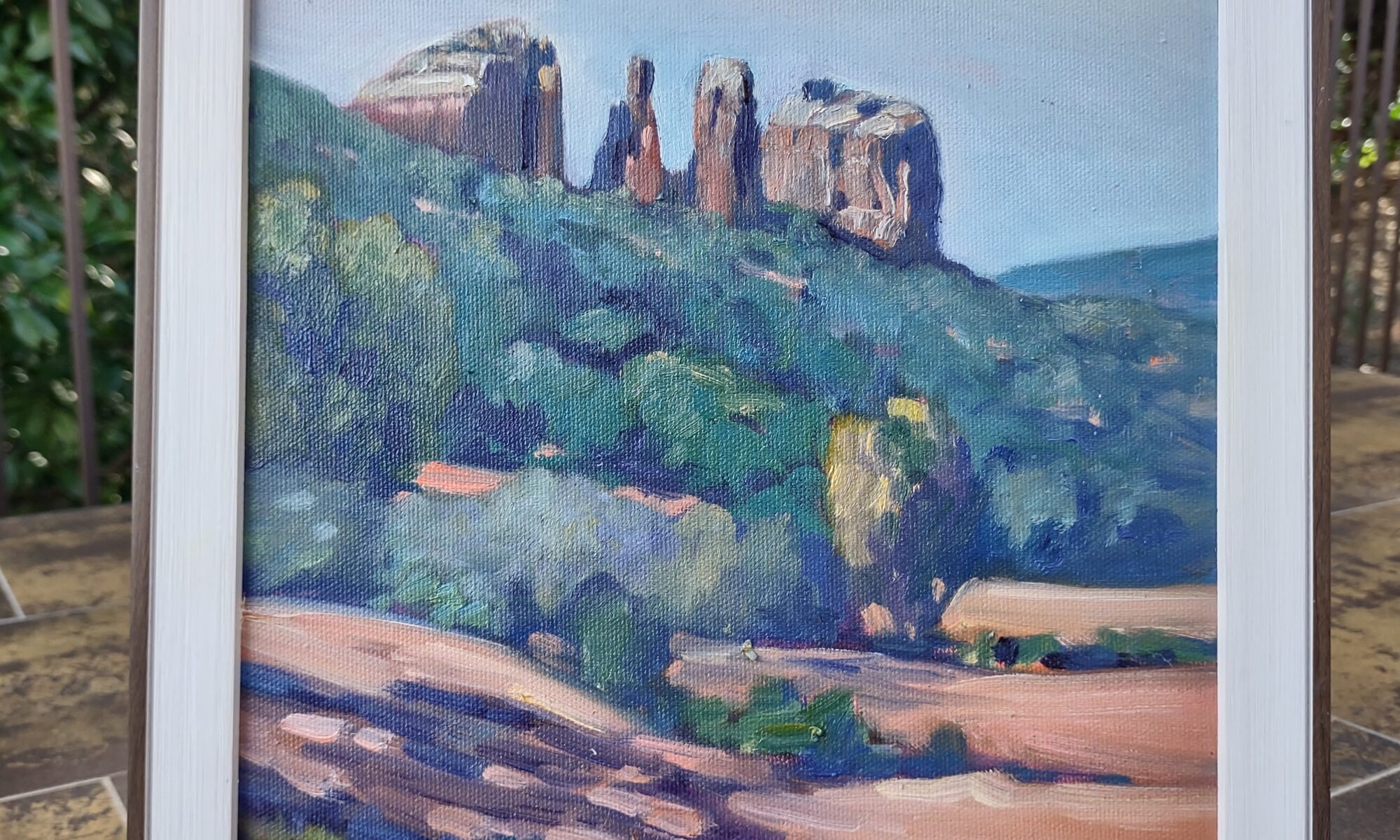
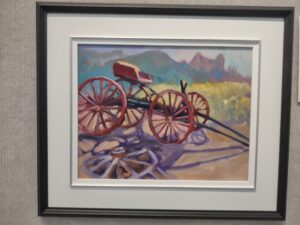
“Buckboard,” 11X14, Carol L. Douglas, available through Sedona Arts Center.

You’ll have to hunt, but all vendors are required to provide SDS for every product.

Not all solvents are created equal. Turpenoid has a flash point of 129° F (54° C), so it can’t fly. Gamsol’s flash point is 144°F (62°C) so it’s safe. I buy a fresh pint and wrap it in its SDS with the flash point highlighted.

My favorite painting medium (Grumbacher Quick Dry) has a flash point of 140° F, meaning it can’t fly. After buying countless bottles of it after the road that were ditched after using only a few drops, I switched to using linseed oil as a medium. That sacrifices dry time for convenience, but it hasn’t been a problem. Again, I wrap the bottle in its SDS with the flash point (500° F) highlighted.

A small tube of oil paint is 37 ml. or 1.25 oz, so is safe for your carry-on. A large tube is 150 ml., or 5 oz. It must be checked or it will be confiscated. I pack this handy label with my oil paints. Watercolor tubes are tiny and harmless, but the only trouble I’ve ever had flying with paints was with watercolors. An inspector at Heathrow dumped them back into my checked luggage without putting them in their plastic container. My clothes were stained on my return home.

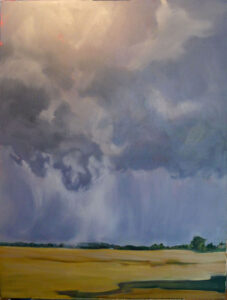
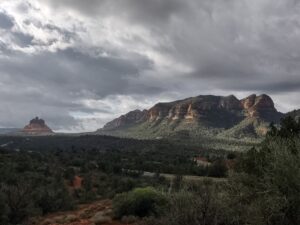
A glowering sky yesterday morning.

It’s very easy to forget your brushes in the heat of travel, and dried brushes are unredeemable. If you can do nothing else, rinse them thoroughly in solvent and wipe them down until you can treat them properly.

Most accommodations don’t have utility sinks. I sometimes take my brushes into the shower, where the force of the water clears away all lingering pigments. That’s not practical in places where water is a luxury. There, I use a superfatted soap and clean all residue from the sink when I’m done.

There are a number of portable painting racks, including RayMar’s DryAngle, but when painting in a festival, I simply snap the painting into its frame. If it doesn’t sell, it can travel home like that. Unframed work gets separated with waxed paper, taped together, and packed in my checked luggage. As long as the paint isn’t too thick, it won’t be harmed.