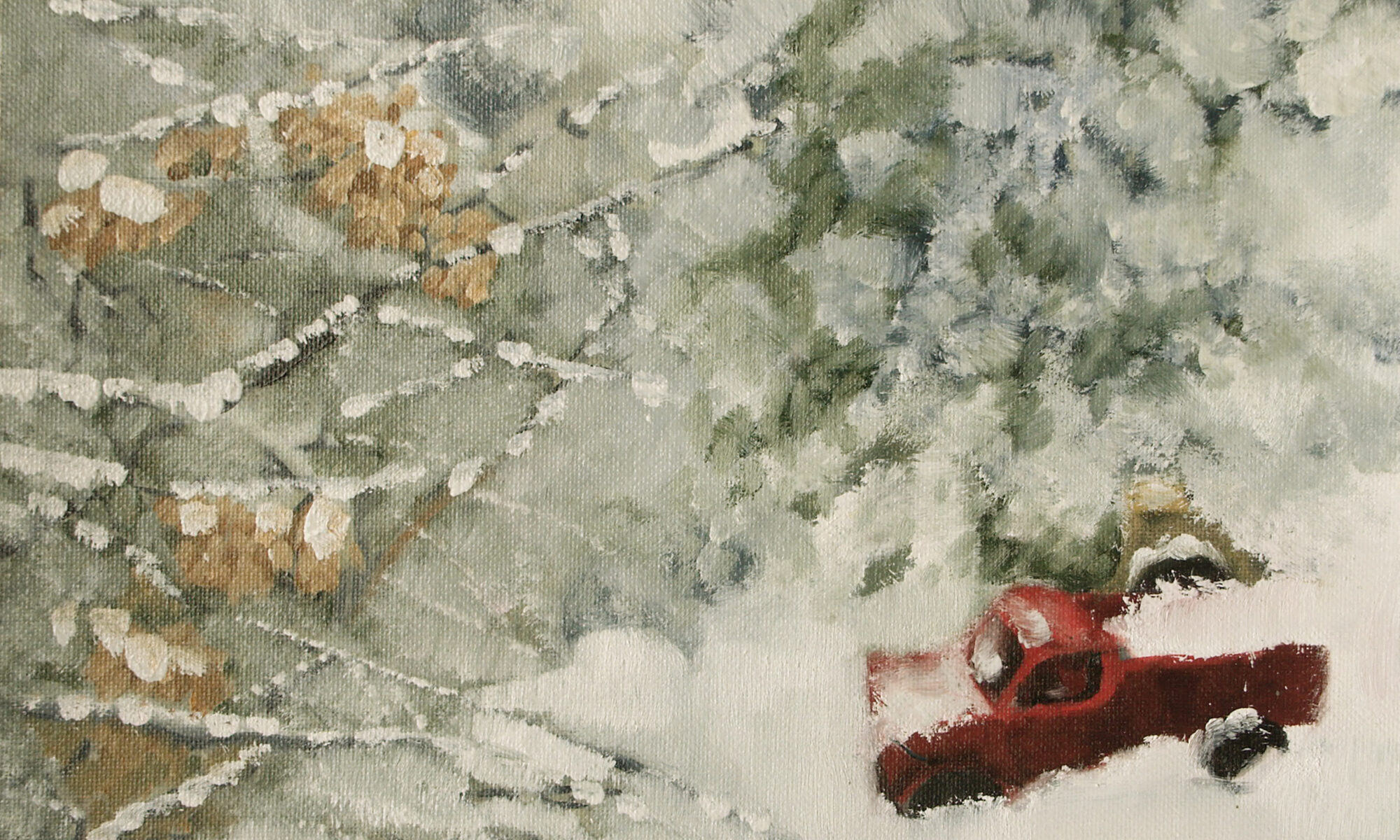
The limitations of style

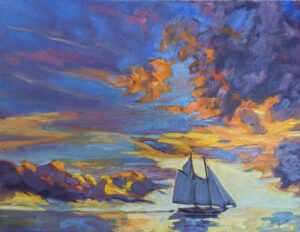
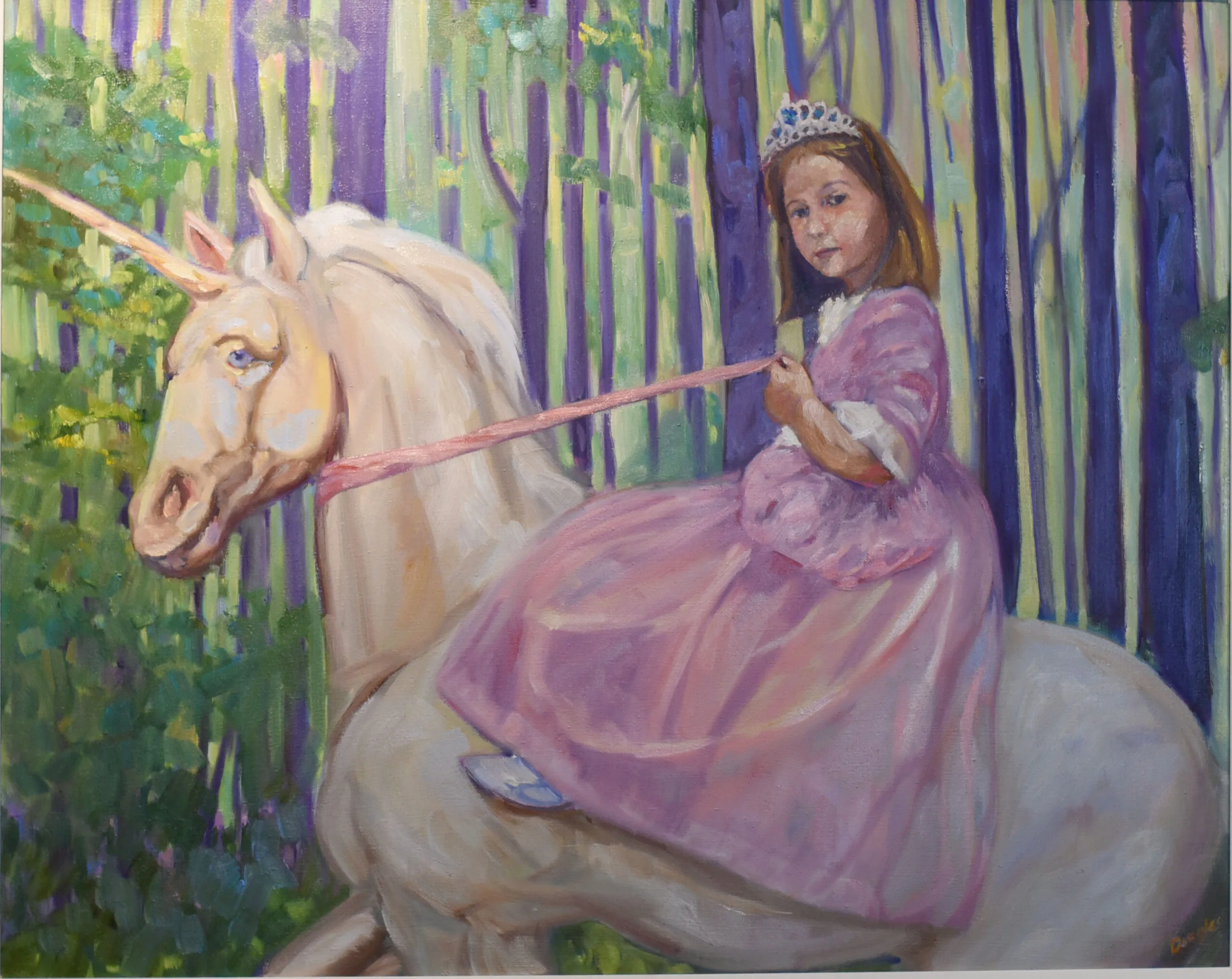
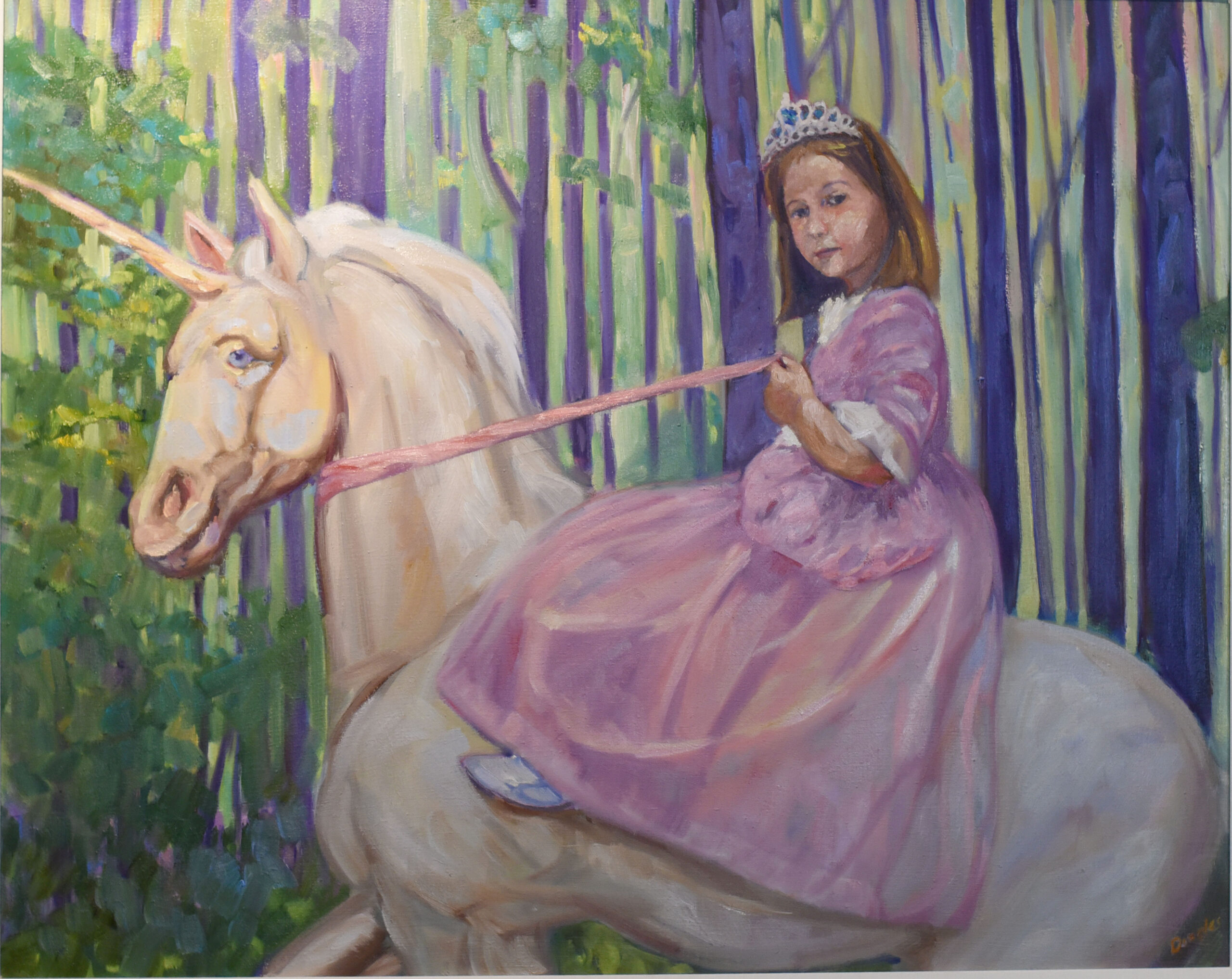
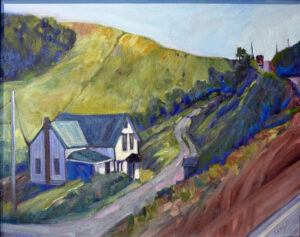
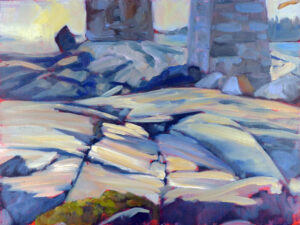
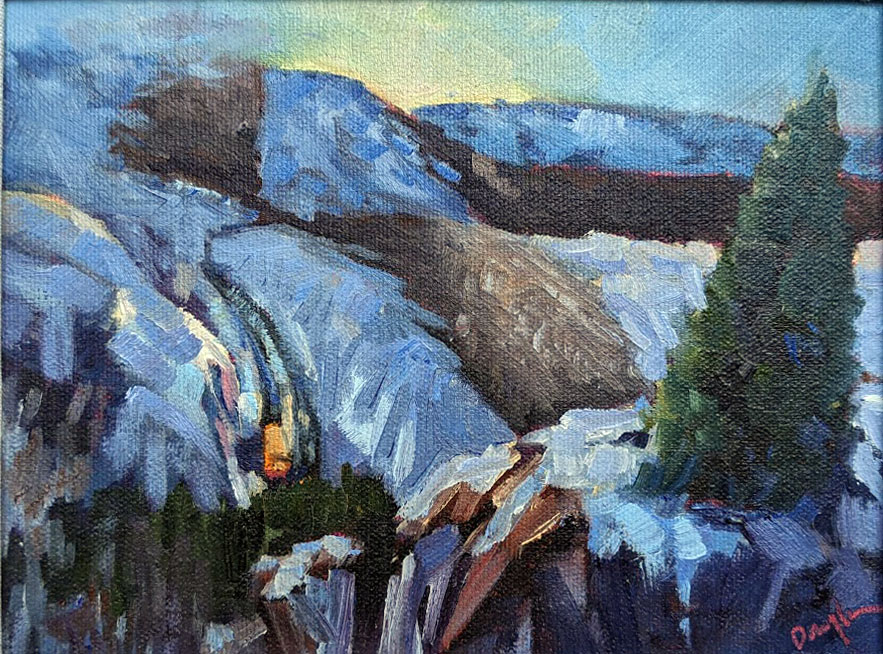
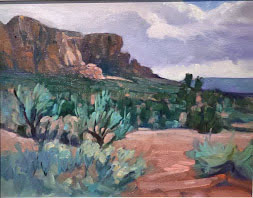
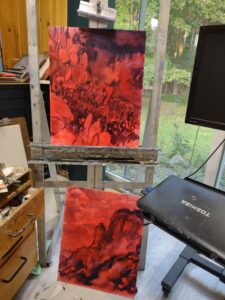
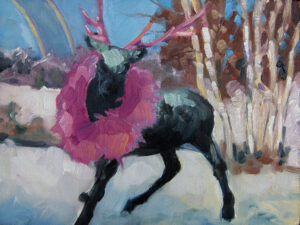
“Ravening Wolves,” oil on canvas, 24X30, available.

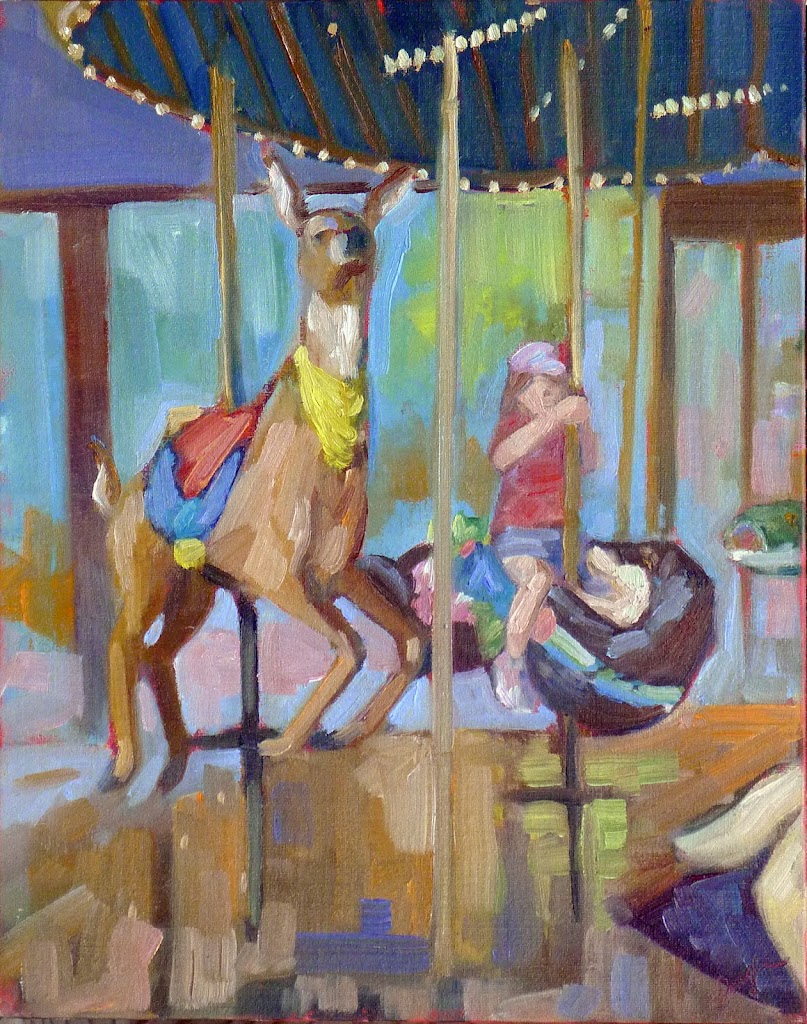
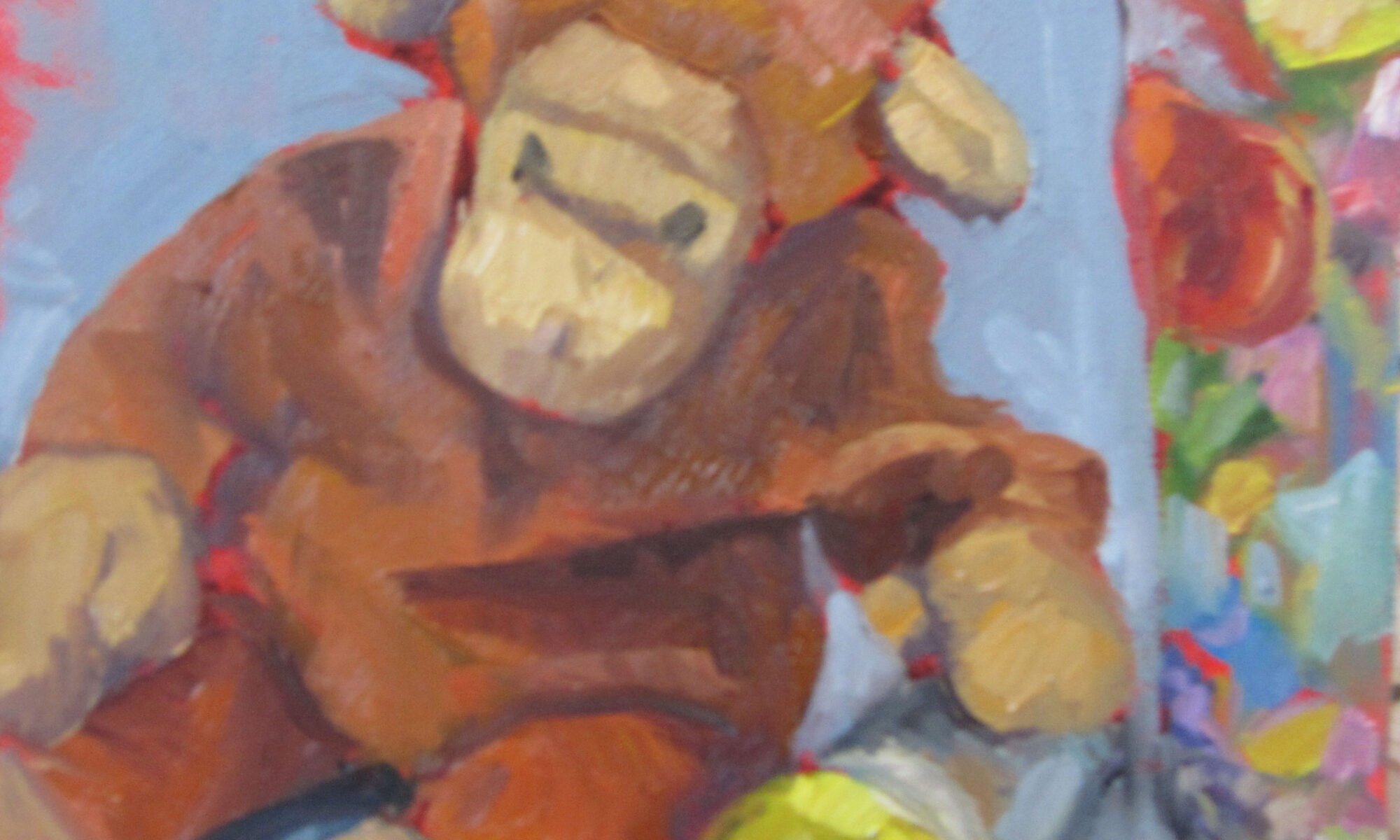
I’ll be painting next weekend in Camden on Canvas. I’m a little rusty because my time right now is being taken up by things that have nothing to do with painting. While I can’t go out and do a full plein air painting, I’m taking an hour a day to practice. These little ditties have no higher-level thinking and the subject is unimportant. For example, yesterday I painted a basket of beach toys.

I don’t worry about finishing these sketches. To paint like that occasionally is a relief, for style can be a trap and a delusion.

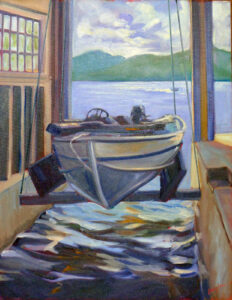
The Late Bus, 8X6, oil on canvasboard, $435 framed, available.

A reader told me yesterday, “My goal this summer is to get closer to a point of view and/or style.” I’m all for understanding point of view; it’s the deepest discipline in painting (and life). But style is something that should develop naturally. Forcing it stymies development.

Style is the mark-making, composition, color palette and other attributes in a finished work. Style ties an artist’s work together in one body, and it ties that artist to a specific time and place. It’s the art historian’s best tool for classifying artwork.

I can never be a Scottish colourist, any more than I can be Wayne Thiebaud. We’re each tied to our own specific moment. Imitating the style of Dead Masters is a sure path to irrelevance (while copying them is a great learning technique).

Great painters choose beauty over stylishness, even to the point of seeming awkward to their contemporaries. The difference is depth and staying power. It takes some scratching to get down to fundamental truth.

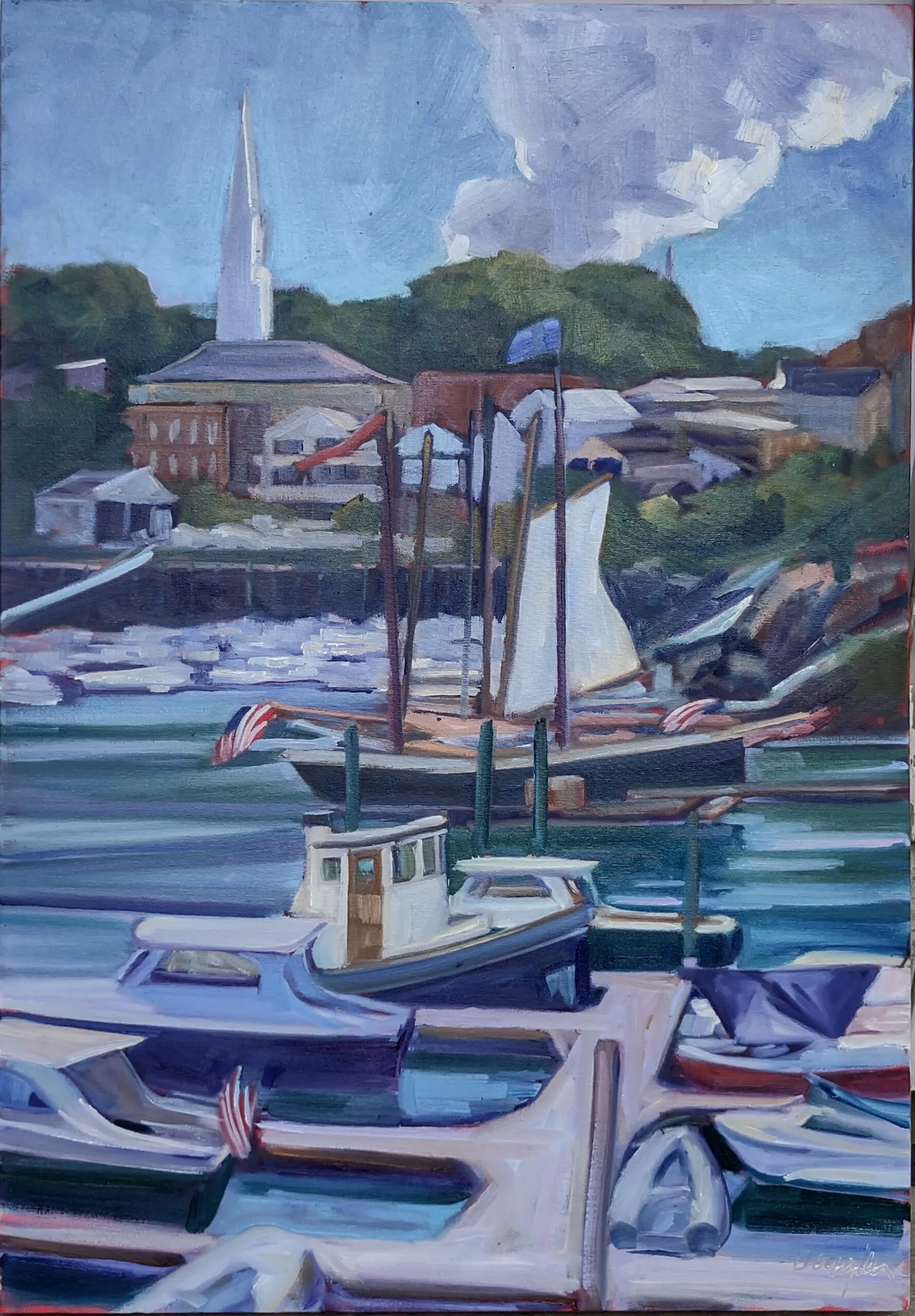
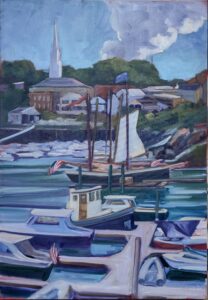
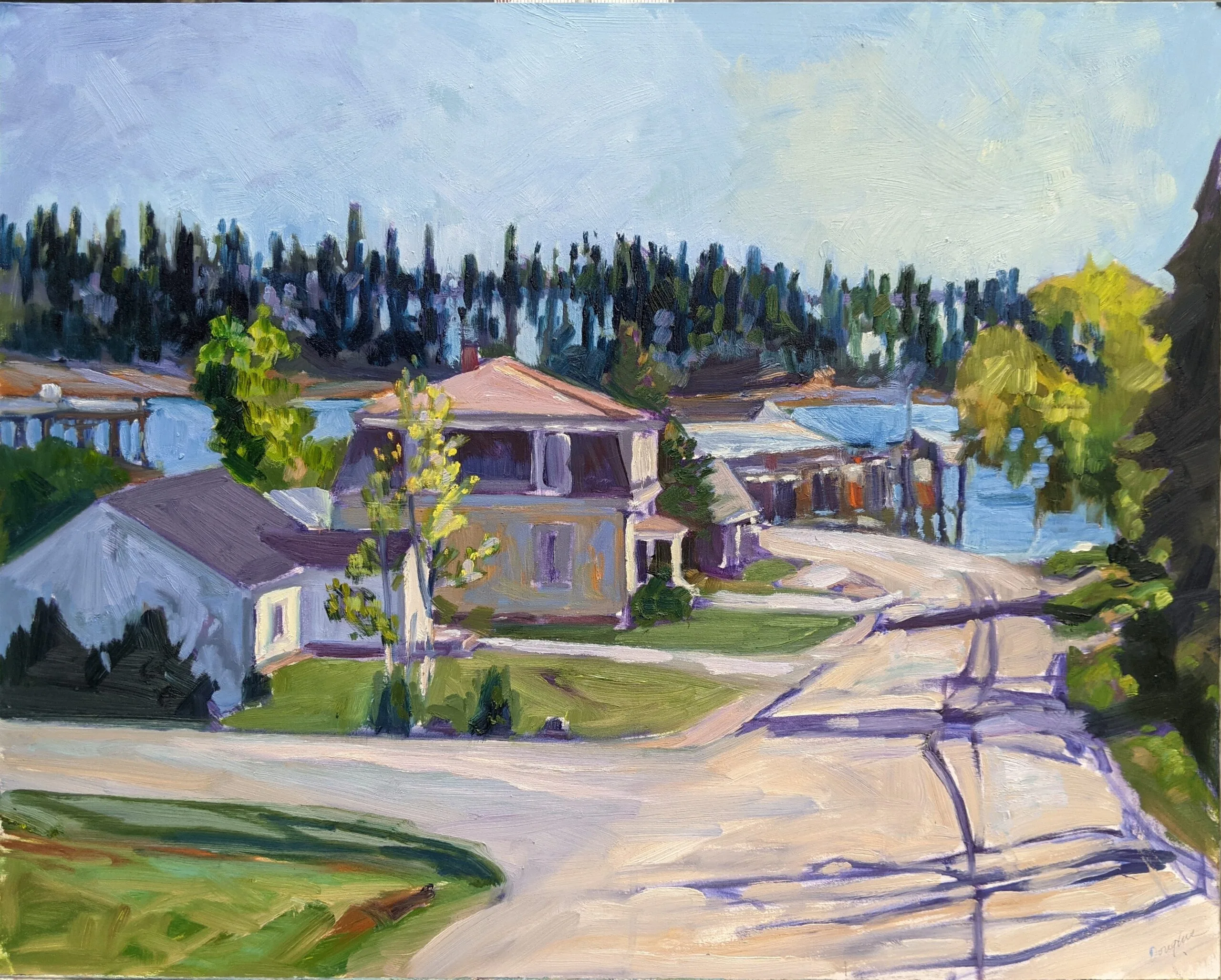
Beautiful Dream (Rockport Harbor), oil on canvasboard, 12X16 $1,449.00 framed.

A good artist investigates thorny questions, not just about the world, but about painting itself. When they are answered, he moves on, just like Omar Khayyam‘s moving finger. Often, by the time we get through the cycle of making and mounting a body of work, we’re no longer that interested in it. We’ve moved on to another struggle.
Each time we pick up the brush, there’s variation in how we approach painting problems. I might use a palette knife for a sky, even though palette knife painting is not part of my regular repertoire. I’ll occasionally revert to painting the way I first learned, with lots of detail and modeling. I refuse to box myself in by saying that a technique is inappropriate because it isn’t my style. ‘Embracing your style’ is a trap that painters may not be able to escape.

There’s a difference between style and being stylish. I enjoy Olena Babak’s ability to describe reflections in a single, fluid brush line. That’s not styling; it’s self-confident skill that results in stylish brush work.

Sometimes, what people call style is just technical deficiency. For example, some painters separate their color fields with narrow lines-white paper in watercolor, dark outlines in oils. I’d like to know that they embraced this voluntarily, not because they never learned how to marry edges.

Wreck of the SS Ethie, oil on canvas, 18X24, available

I do not admire painters who use the same scribing or pattern-making on the surface of every painting. It’s style for its own sake, and it often is just a ruse to cover up badly-conceived paintings.

Mature artists don’t generally think about style. At that point, style is the gap between what they perceive and what comes off their brush. That’s deeply revelatory, and it can be disturbing when we see it in our own work.

Some of us try to cover that up with stylings, not realizing that those moments of revelation are what viewers hunger for. They-not the nominal subject of the piece-are the real connection between the artist and his audience.

Common sense isn’t that common

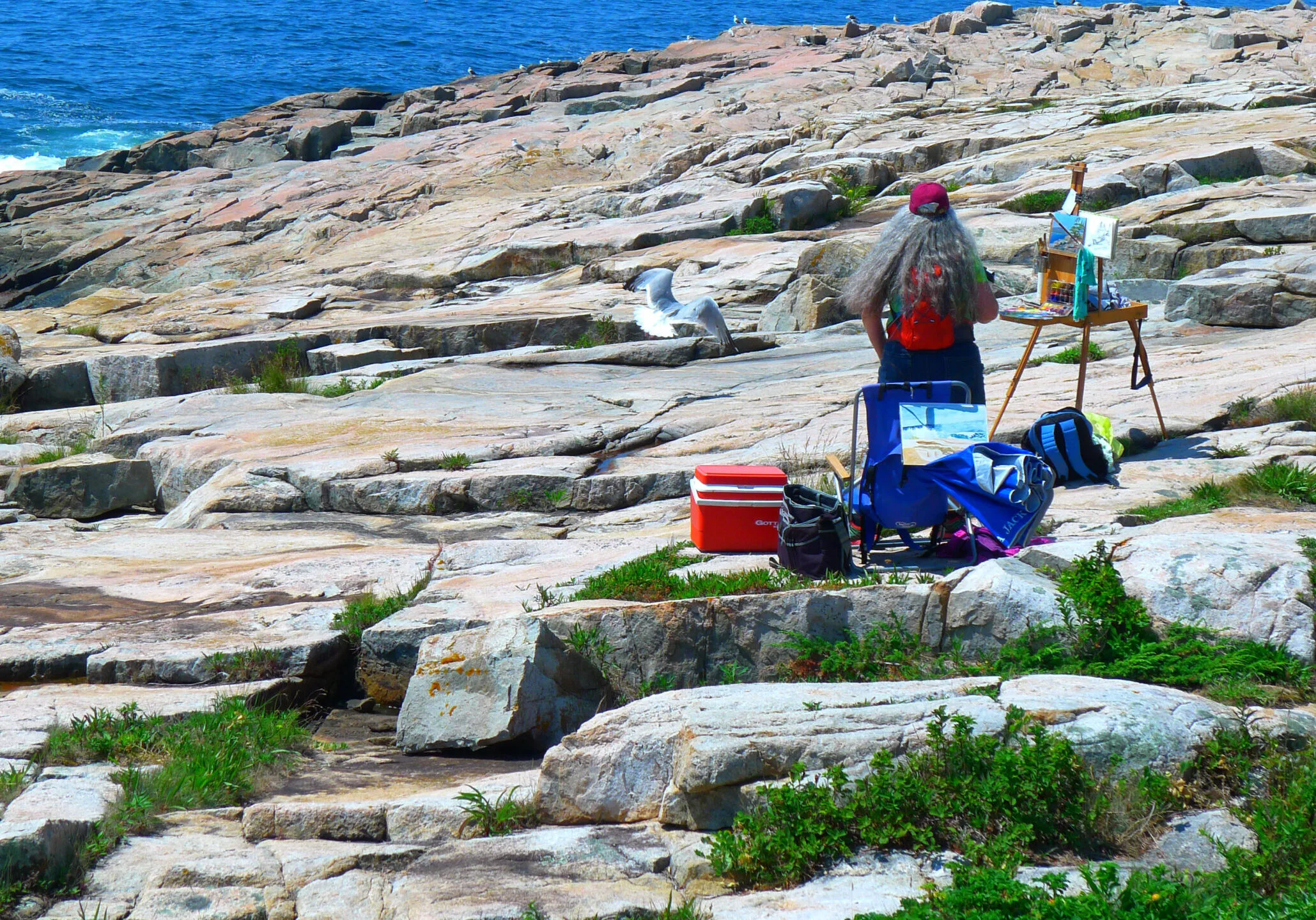
The Schoodic Peninsula has some wild and wooly scenery. The Schoodic Peninsula has some wild and wooly scenery.

Jennifer Johnson has been my monitor for Sea & Sky at Acadia National Park for six years. In all matters other than painting, she knows more about the workshop than I do. I’m not impractical, but my focus is on the instruction. Plus, to be perfectly honest, I’ve never really learned how to keep a sensible calendar.

Every year, I send students a supply list and a copy of my own personal packing list. Every year, I get the same question back: “Do I really need dress clothes?”

Jennifer takes the photos while I get to paint, which is why I don’t have any pictures of her.

In Maine, dress clothes can mean your best flannel shirt, not to be confused with the everyday flannel shirt in which you go fishing or change the oil. That’s not mere reverse-snobbery; a good flannel shirt can be an investment. Also, there’s no telling when it might suddenly be necessary-the most clement summer wedding can suddenly be swept by a cold wind from the north that will set your bunions aching. That, by the way, is one reason mass transit will never really catch on here-we need cars to stash our spare gear in the event of a sudden turn in the weather.

At any rate, this packing list has taken me around the world. I modify it for the places I’m heading and the situations I expect. No, I don’t wear jewelry in Yukon Territory. I’m unlikely to need my Grundens waterproofs in Delaware. Unlikely, but not impossible. I once painted an event in the dregs of a hurricane in Rye, NY with my buddy Brad Marshall, and I’ve never been wetter.

I spend a lot of time traversing rough terrain to get from painter to painter. It’s a good thing I’m so dang young and fit!

Things have changed over time. For example, there’s no call now for reading material when we all carry the universe on our phones. When I first wrote this list, nobody wore watches that needed charging; you either replaced a battery or wound them up.

This is a universal list, from which the painter can pick or choose as appropriate. However, it would never have occurred to me to do something as simple as add a heading to explain that. This year, Jennifer, in exasperation, wrote her own, revised copy of the list. From now on, I’m sending both to my students.

Over the years, my monitors have had to deal with some odd problems, like broken easels, interpersonal conflict (it happens occasionally), and lost students. Jennifer is pretty unflappable, so I haven’t yet met the circumstances where she’ll lose her cool. A bear might do it, but that hasn’t happened yet.

But I like nothing more than sitting at Schoodic Point discussing watercolor with my old pal Becky, who has come back year after year for more of my malarkey.

This is an unusual workshop in that residents are supplied their meals. That’s sensible, because Schoodic is isolated; you can buy a sandwich at the local gas station, and there’s a small grocery store in Winter Harbor. However, the macadamia pancakes and freeze-dried fruit smoothie crowd is SOL, as they say. That’s the price we pay for a real wilderness experience.

But it does put food service in some ways into our hands. Left to my own devices, I’d eat Slim Jims for a week. It’s really helpful to have someone working with me who remembers to handle the lunches.

Yesterday, Jennifer pointed out to me that I have an impossible scheduling conflict at the beginning of the workshop. I’m supposed to be at the auction for Camden on Canvas on Sunday from 4-6, and welcoming students to Schoodic at the same time. They’re two hours apart.

Oops. Such is my faith in her that I can just plan to get there as soon as I can. I could never do that if I didn’t trust her absolutely. A good monitor is worth her weight in gold.

By the way, this week a humpback whale was visiting the Rockland breakwater and Camden harbor. Here’s a video off the deck of schooner American Eagle, and one from Curtis Island Light. Between that and a seal kill by a Great White Shark off Owls Head last week, it’s been an awfully exciting week for marine spotters.

Monday Morning Art School: is this painting finished?

"Best Buds," oil on canvasboard, 12X16, oil on canvasboard, $1449 framed. “Best Buds,” oil on canvasboard, 12X16, oil on canvasboard, $1449 framed.

On Friday I wrote about a painting I’d been carrying around in the hope of finishing, only to realize that it was already done. That provoked an outpouring of emails. Most of us have had the opposite experience, where we painfully noodle a good painting to death.

Sometimes, paintings are finished but are just plain bad. No amount of reworking can fix a fundamental design flaw. The classic Hail Mary pass in this situation is to add a tchotchke-for example, a seagull in flight. These last-minute additions merely complicate bad design, they don’t resolve it. Sometimes fundamental design flaws can be resolved by recropping the canvas with a knife or saw, but most are destined for the burn pile. This is why painting teachers harp on sketching and planning.
Bracken Fern, 9×12, oil on canvas, available.

Apply formal standards of criticism to your own painting

Assuming the fundamental composition is solid, the painter can analyze his own work against the formal elements of design, which include:

  • Focal point-is there a focal point and series of focal points, and is the viewer’s eye directed to them with contrast, detail and line?
  • Line-is line used effectively and reinforced in the painting?
  • Value-does the painting have a solid value structure? Does it need to be restated or is it clear?
  • Color-is there a cogent color scheme? Is it expansive enough to be interesting?
  • Balance-does the painting hit that sweet spot between static and riotous?
  • Shape and form-are there interesting shapes in the painting?
  • Texture-is there enough paint on the canvas to make the brushwork compelling?
  • Rhythm and movement-is there energy driving you through the canvas?

If any of these elements are unfinished or poorly realized, the painting is not done.

Tom Sawyer’s Fence, oil on canvasboard, 14X18, $1275 unframed.

Listen to your gut.
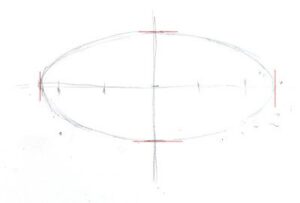
I don’t like the imperious “Not another brush-stroke!” approach to telling people to not overwork a painting. After all, we can’t know where the finish line is unless we occasionally overshoot it. But our own gut often tells us the same thing. I generally work on paintings until I’m tired of them. That’s my intuition speaking.
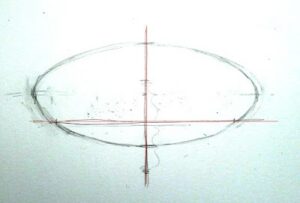
Be careful whom you ask for critique

“I painfully witnessed someone undo a beautiful painting yesterday in the figure studio,” a student told me. “I stepped into a continuation of a pose from Monday. The painting was a striking likeness of the model and quite charming. It improved with a background and some tweaks during the first 25-minute sitting. Then the artist asked the studio for suggestions. From there, it was a snowball downhill.

“There were more questions and tweaks at every break during the three-hour session. The portrait ended up muddy, the face too fat, the likeness and charm gone.”

With very few exceptions I don’t solicit criticism from my peers. When it’s offered, I carefully consider the source. In most instances, I’m better off setting the work aside and reviewing it when I’ve disengaged emotionally from the work.

Furthermore, that painter was doing a small (9×12) head over a six-hour session. That’s simply too long to fuss over such a tiny canvas. He or she would have learned more doing three two-hour studies in the same time-frame.

Mountain Fog, 12X9, $869 framed, $696 unframed.

Stop when you’re tired.

One of my students has a quilting rule of putting her work away immediately when she hears herself saying, “I’m going to sew just one more seam today.”

I push past that limit every time I sew, and it always results in a long, irritating session with a seam-ripper.

Are you hungry, thirsty or tired? Are you rushing because you only have a few more minutes left to work? If you’re starting to lose focus, stop and put the work away, because whatever you do next won’t be pretty.

Is that painting finished?

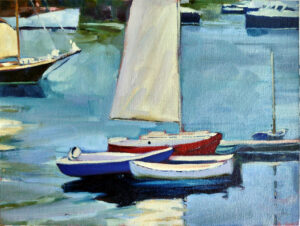
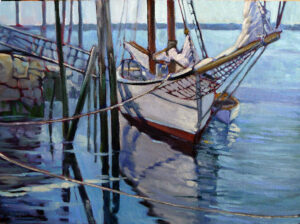
Drying Sails, oil on canvas, 9x12, available on my website later this morning. Drying Sails, oil on canvas, 9×12, available on my website later this morning.

When I’m wondering, “is this painting finished?” the answer is usually yes.

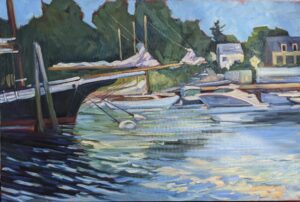
Camden Harbor before the day begins, 8×10, oil on canvasboard, available on my website later this morning.

I’ve been carrying a small 8×10 around in my backpack for a few weeks, hoping to run into Ken DeWaard so I could ask him if he had a reference photo from that day. It’s of the ketch Angelique, on the left, and Lazy Jack II. I’ve got a good visual memory, but that was last summer or perhaps the summer before. Not only has the detail faded in my mind, any sense of what I wanted to ‘finish’ has disappeared as well.

I caught up with him Tuesday, when our respective painting classes ended up on the same beach. (If you haven’t seen this story from Owl’s Head, it’ll encourage you to keep your footsies out of deep water this summer.) Ken shook his head and said, “I got nothin’,” and laughed. “If it was earlier this summer, maybe.” Such a day is indistinguishable from a thousand other painting days, unless it results in a painting one loves enough to keep. (We paint a lot of dreck along the way.)

I propped it up on a bench and pondered. Is it really not finished? There’s detail I’d love to add, and the masts look chunky. But they so often do on windjammers, which were originally built not as yachts but as working boats. The color is coherent and evocative, and the brushwork is unified and expressive. What’s really left to add?

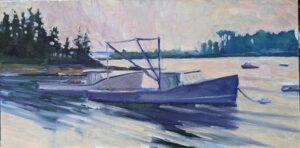
Owl’s Head, Early Morning, 8X16, available.

The painting of Owl’s Head lobster boats, above, is another example of one I toted around until I realized it was done. I recently popped it into a frame and now I love it just as it is.

I’m in a boat-painting tear, and it’s not always going well. “I’m channeling George Bellows,” I told Bobbi Heath as I hacked farther and farther into the weeds on a canvas that probably ought to go in the woodstove. As always, the problem started out compositionally, but the students in my Zoom critique class suggested that I get rid of a big green dumpster on the dock. That helped, but it’s still way too busy and way too bright-without Bellows’ incisive wit and commentary. No reference photo will save this canvas. It’s overbaked and underthought.

Meanwhile, I met Björn Runquist to practice our chip shots in advance of Camden on Canvas. “There’s a nice angle of Lazy Jack from that bench over there,” I told him. Had either of us been smarter, we might have asked why I wasn’t painting that schooner myself. The answer, riding in my subconscious, is that she’s a daytripper. You can’t trust her. You get her limned in, all beautiful, and she up and leaves you. Sure enough, that’s what happened to Björn. Oops.

Coming Around Owl’s Head, 6×8, is available through Cape Ann Plein Air’s online sale.

It had rained, so Lazy Jack was running her sails up and down to dry them off. This is a subject that fascinates Ken DeWaard, so I try to avoid it. Occasionally, however, it’s irresistible, because it adds another compositional dimension to boats in harbor. Having learned my lesson, I finished the painting, at top, quickly, before I forgot what I was doing.

I’m absolutely horrible at taking reference photos. I get caught up in the moment and the light. By the time I remember, it’s too late. Still, it’s something I’ve resolved to do better. But taking the painting back into the studio and adding details has the potential to stomp on its beauty. When I’m wondering, “is this painting finished?” the answer is usually yes.

First world problems are real problems

Black House, 18X24, oil on canvas, Carol L. Douglas Black House, 18X24, oil on canvas, Carol L. Douglas

I’ve got a student who’s been waiting for a chip for his GM pickup truck for several months. “First world problem,” he says good-humoredly when I ask him about it. I get that he means it as an expression of gratitude that his problems aren’t bigger, but it’s an expression that bugs me. It rests on a logical fallacy. First-world problems are not inherently less-important than those of the developing world.

Yes, food poverty is an extreme and crushing problem, but so too are fatal drug overdoses. Affluence increases longevity, but it’s not a strictly linear relationship; otherwise, Bangladeshis (averaging 72.1 years) would not outlive Indians (averaging 69.7 years).

Manhattan bridge approach, 9X12, oil on canvasboard, Carol L. Douglas

Obviously, I can’t speak for the developing world, but I doubt their lives are characterized by endless misery and suffering. We all have our joys and sorrows, big problems and trivial ones.

A vehicle, a reader chastised me recently, is not a necessity. “High gas prices are a good thing. We should walk more and use public transportation,” she wrote. I don’t know where she lives, but that’s not practical for most of us. Even those who live in large cities rely on internal-combustion engines. Everything they consume is delivered by truck; their trash is invisibly whisked away in trucks. Subway trains and busses are, overwhelmingly, diesel. Food is grown on farms, using tractors, powered by diesel.

A truck sitting at a dealership, undriveable, represents something more than inconvenience. It’s a major financial asset that’s depreciating without being usable. It represents trips that can’t be taken and work that cannot be done. For the dealership, not finishing the job means lost productivity.

Beach toys, oil on canvasboard, Carol L. Douglas. Four out of five travelers are experiencing disruptions this year. It hurts.

Multiply that by 95,000 GM vehicles sitting on lots without chips, and we’re talking about billions of dollars of lost revenue. That will inevitably translate to laid-off workers. And that’s just one car manufacturer.

“First world problem” is sometimes used as a comical apology about trivial concerns. In this sense, it’s a humblebrag, since it points out that you can afford $5 for a cup of coffee in the first place, or to lose another set of AirPods. It’s checking your privilege before someone else has the chance to check it for you, and that’s where it gets really ugly.

Tomatoes, oil on canvasboard, Carol L. Douglas. Not being able to grow your own food is definitely a first-world problem.

If you complain that you spent two hours in a security line at an airport and missed your connection, and someone responds “first world problem,” they’re really just saying “STFU; I don’t care about your troubles.” Travel problems are very real; 4 out of 5 travelers this year are reporting some kind of disruption.

Artists are the canaries in the coal-mine of the economy, as aesthetics are pretty high on the hierarchy of human need. I’ve worked through six recessions, and they’re no fun. We’re not in one yet, but we’re in a period of economic turmoil. We’re seeing all kinds of fallout in the art business this summer. Dismiss this as a first world problem if you want, but please don’t say it within my earshot.

Monday Morning Art School: most rules of painting are written in sand, not stone

The Logging Truck, 16X20, oil on canvas, available. The Logging Truck, 16X20, oil on canvas, available.

Rules are meant to be learned-and then, after mastery, some can be broken.

A few weeks ago, my plein air class was working on Knox Street in Thomaston. Eric Jacobsen was painting in his own yard nearby. A student asked me the secret to painting bigger canvases. “Bigger brushes,” I told him. “Walk over there and see how Eric’s doing it.” I know Eric’s a generous soul and wouldn’t begrudge him the peek over his shoulder.

It turns out that Eric was limning in big, fat, audacious peonies with a delicate #8 brush. “It thinks like a big brush,” he explained. Even as I smiled at his infectious humor, I understood his point. He wasn’t making sweet little marks with it, but sweeping gestures.

Spring Allee, 14X18, oil on canvas, available.

Most plein air painters create a plan before they start. Depending on the complexity of the painting, this sketch can be either simple or quite detailed; however, it lays out the composition as a series of values. Ken DeWaard, on the other hand, starts with a series of charcoal hash marks across his canvas. Natalia Andreeva is another painter who omits the sketch stage. She believes it makes for fresher work.

Everyone ‘knows’ that watercolor is painted light-to-dark, but I’ve watched Poppy Balser paint in a wall of black spruces and then wash the sky right over it, giving the whole composition a trembling northern glow.

Dark-to-light is one of the principle rules for oil painting, and for good reason; it is very difficult to make corrections over tints in alla prima painting, even when you’ve carefully wiped out your mistake. It’s a rule I often break. Having laid in my darks, I sometimes place the mosaic of lightest lights against it to see how the composition reads. I can do this because I work from a careful sketch. Ken DeWaard has jokingly called my technique ‘paint-by-numbers’.

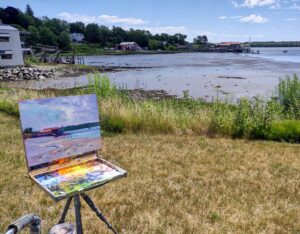
My set-up for a large plein air painting. Note my sketchbook at my feet, and that I jumped from the darkest darks to capture the clouds before they left.

I teach a protocol that takes students through design, preparation, and execution. I tell my students that what I’m teaching are the most accepted practices in painting, but they’re not the only way to do things-people have broken painting rules since the beginning of time.

Sometimes that ends very badly, as with the canvases of Albert Pinkham Ryder. He was an inveterate tinkerer, working canvases for a decade or longer, applying sequential layers of paint, resin and varnish. He paid no attention to the drying speeds of his materials, and tossed in things like candle wax, asphalt, and non-siccative oils. These weird techniques gave his paintings unparalleled luminosity that dazzled his contemporaries. Sadly, the results were unstable. His paintings darkened, cracked, and sometimes completely disintegrated.

Ryder ignored two fundamental rules of painting: fat over lean, and don’t add weird stuff to your paints. (The latter isn’t really a painting rule but plain common sense.) But, aside from the fundamentals, other rules can be broken, or at least modified. They’re meant to give the artist a good working method and a way of seeing quickly. If, as an artist develops, a particular step becomes a hindrance, it makes sense to get rid of it. But that’s only appropriate after mastering the process in the first place.

Perfect is the enemy of good

Mudflats. It’s a start.

This blog was on Google’s Blogger from 2007 until the present (with a short hiatus during which it was hosted by the Bangor Daily News). Blogger is a simple platform, but in 2021, it suspended support of its RSS web feed. That meant that people could no longer subscribe.

After consulting with the usual experts, I determined that it was sensible to bring it in-house, onto my own website. I have a tenuous relationship with my website-it’s a large beast that I placate by throwing content over the fence and then quickly running away.

Importing 15 years of blog posts was way above my skillset. In May, I wrote about hiring an expert. Unfortunately, she finished just as I started my hike across England. It was easier to just keep writing on Blogger. The posts piled up. I didn’t dare ask Deepika to do another import, so yesterday I finally sat down and moved the remaining mess on my own.

Drying sails in Camden harbor. We’re taking practice shots before Camden on Canvas.

It’s not elegant. I’ve had 15 years to make Blogger look exactly as I want-font, header, nested links, advertising. But it’s done, and as of today, you should be getting this feed in your mailbox if you’re subscribed. And if you’re not, you can subscribe … oh, darn, the subscription box has migrated away again. Another task for Deepika, until I can master this interface.

When my father was 63, he was secure in his expertise, partially because there was a secretary who did all the technical stuff for him. When my grandfather was 63, he was dead. In contrast, my husband and I spend inordinate amounts of time and effort mastering new technology. In almost every field, we’re barraged by new information and equipment.

Apple Blossom Time, 9×12, oil on canvasboard, $696 unframed. I painted this with Eric Jacobsen last summer.

There are two lessons here, both of which I think are hopeful. The first is that, at 63, I see no sign of mental exhaustion or slippage. All this struggle is keeping me mentally agile.

The second is… oh, shoot, I forgot the second.

It’s summer, so I go out in the morning and painting for a few hours. Then I head home and open my gallery. It’s exactly the right amount of time for a good start. Last week I painted with Ken DeWaard. I painted an absolute stinker. This week, Björn Runquist and I have been practicing our chip shots together and mine have gotten better.

Spring Greens, 8X10, oil on canvasboard, $522 unframed.

“How can you be rusty?” my husband, who’s a bass player, asked me. “Isn’t painting a mental skill?” Painting and music are both combinations of the mental and the physical, and the two are closely intertwined.

Are my painting starts perfect? Heck, no. Do they show promise? Yes.

Oh, yeah, that was my second point: it doesn’t matter if my blog or paintings are good or bad. They won’t get better unless I actually work on them.

Change is an inevitable part of growth, but it’s not easy

We like certainty, but plans are to some extent illusory; things can and do change in an instant.

Sunset sail, 16X20, oil on canvas, Carol L. Douglas, available.

I’ve noticed a strange split this year-my east coast workshops are sold out, and my western ones are languishing. To be completely accurate, my Acadia workshop has sold out 1.5 times, because as people made plane and car reservations, they realized the difficulty and expense of travel to smaller markets. They dropped out and were replaced by others on my waiting list. I’m extremely blessed to have had a waiting list.

That list is now exhausted. I have a last-minute opening at my Acadia Sea & Sky workshop (July 31-August 5, 2022), because one of my students is waiting on a nitrogen oxide sensor and microchip for his GM truck. As GM has nearly 100,000 vehicles sitting in lots waiting for microchips, my optimism is dimming. I told him I’d ask if anyone wants his seat, so if you’re interested in a last-minute jaunt to Maine, let me know.

Owl’s Head Early Morning, 8X16, oil on canvas, available.

This strange year, by the way, is not limited to just me, or to the painting workshop market. I’ve talked to people across the tourist industry in England and Maine and heard much the same laments. There’s an international labor shortage and things are still topsy-turvy from COVID.

It’s not that business is down-it’s not-it’s that it’s spotty and weird. We each have our own explanation. I’m hearing a lot about travel concerns, particularly the cost of rental cars. Another teacher says Zoom is killing his workshops. It’s easier to stay home and learn on one’s laptop.

Skylarking 2, 18X24, oil on linen, available.

At this point in the summer, my workshop schedule should be set in stone, but instead I’ve been dithering about my western workshops. After much agonizing (and advertising) I’ve decided to cancel Steamboat Springs and Cody.

That leaves only Gateway to the Pecos Wilderness, August 28-September 2. I kept it because it’s accessed through a major airport (Albuquerque), where I’ve found car rentals to be manageable.

Equally importantly, Our Lady of Guadalupe Abbey, which has inexpensive accommodations, did not burn down in the Hermit’s Peak wildfires this spring. I wish that last sentence was a joke, but this year has been a wild ride.

Beautiful Dream, 12X16, oil on canvasboard, available.

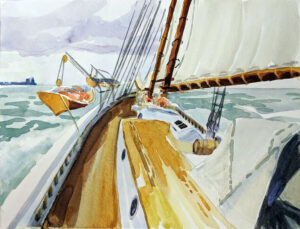
Lastly, there’s my second watercolor Age of Sail workshop aboard the schooner American Eagle, September 18-22. Although I’d have said Captain John Foss was irreplaceable, he’s made a mighty good stab at it in his replacement, Captain Tyler King. Tyler has the same equable temperament and top-notch sailing skills as John. When Tyler turns 70, I’ll be 107, and it will be time for both of us to retire.

Change is, of course, an inevitable part of growth, but it’s not easy. We like certainty, but plans are to some extent illusory; things can and do change in an instant. By not traveling so much in September, I’m making room for other opportunities. I can hardly wait!

Happy Independence Day!

Breaking Storm, oil on linen

In just four years, we’ll be celebrating the 250th anniversary of our grand social contract. Here’s a challenge to you to paint what challenges us.

Breaking Storm, 48X30, oil on linen. Available. Apparently, every time I paint the flag it involves a boat.

In just four years we’ll be celebrating the 250th anniversary of our grand social contract, the United States. At my age, it’s not unreasonable to wonder if I’ll make it. I have no doubts about Uncle Sam; he’s tough.

I was 17 at our bicentennial. The world should have been my oyster, but that wasn’t exactly how it played out. My older sister and brother had died in two separate, horrific accidents. Every memory from the time is tinged in bleak.

Six bucks a pound, 12X16, was painted in 2020 when lobster dropped to that price. It was $7.70 on my local dock on Friday, at the same time that diesel fuel has doubled in price. Not everyone is getting rich in the current inflation spiral.

However, I loved history, and I spent lots of time with people much older than me, people who decorated their homes with antiques, debated the strategies of the Civil War, and pored over Eric Sloane books.

I never believed that there was any hope I’d live long enough to see our semiquincentennial (my beloved siblings having set such bad examples), but I’ve never doubted our nation’s fundamental toughness. We’ve been through far worse-civil war, repeated cycles of boom and bust, political corruption, world war.

Striping, 6X8, oil on canvas, available.

Interestingly, we’ve never suffered a famine. The economist Amartya Sen has argued pretty persuasively that famine and democracy are inconsistent with each other. Famine occurs not only from a lack of food, but from inequalities in the food-distribution systems. While the Dust Bowl and the Year Without a Summer produced local hardship, people could and did vote with their feet.

When I hear young people talk about us having approached the ‘limits’ of democracy, I remind them that, as they love to eat, they have a strong interest in preserving democratic institutions.

Safety check, 6X8, oil on canvas, long gone to another home.

At 17, I’d have been surprised by the issues that convulse us today-not because they’re so different, but because they’re so familiar. I have a foster brother who came out as gay in the late 60s, I am from a multiracial city, I lived in a Jewish neighborhood, and abortion has been legal in New York since 1970. Race, religion, sexual preference and abortion are discussions that have been going on for my whole life. The difference is the bandwidth they take up today. We had just exited the Vietnam War at the time of the Bicentennial, and that was where our hearts and minds were concentrated.

However, there is a difference, and it has to do with our reaction to violence. In May, 1970, the National Guard fired on anti-war rioters and killed four students at Kent State. The nation was convulsed, and that event galvanized anti-war opinion. Last week, 53 illegal migrants died in an overheated tractor-trailer in Texas and we just hunker down and wait for the next catastrophe. We’re inured to death, which is a very frightening thing.

I don’t want to add to the ugliness of the world, but I do think it’s time to think about bigger issues. The problem is that social-justice art doesn’t pay, which is why I have a storage-room full of the stuff. But sometimes these things need to be painted.

My friend Mark suggested I create a challenge to artists to paint about social justice, and to post their work publicly. To this end, I have created a public group is on Facebook, here. I ask just three things:

  • The work be genuine painting, not just billboards of angry words;
  • We must respect differing opinions and try to understand the thinking that went into work with which we disagree;
  • No political arguments; if you feel strongly, paint your feelings, don’t engage in verbal invective. I’ll just delete the comments.

And on that note, happy Independence Day! Enjoy your cookout!

An unknown woman who changed art history

Behind every successful man is a woman, they say. She’s not always his wife.

Portrait of Johanna Bonger, 1905, Johan Cohen Gosschalk

Johanna Gezina Bonger is an unknown name to most of us. She was described by those who knew her as ‘cheerful and lively’ and ‘smart and tender’, and her remaining portraits depict a woman of grace and intelligence. For her times, that would have been enough, but she also changed the course of art history.

Johanna was born in 1862 in Amsterdam to a large middle-class family. Unusually for the time, she pursued higher education, including a stint at the British Museum library. She became an English teacher, which is where her story would have ended had she not met one Theo van Gogh. She rejected his first proposal, an indication that she was a woman who knew her own value. A year later, she said yes.

Portrait of Theo van Gogh, 1887, Vincent van Gogh, courtesy Van Gogh Museum

Theirs was a sadly short marriage, lasting less than two years before Theo died of what was recorded as dementia paralytica, a symptom of syphilis. Theo certainly didn’t transmit it to his wife, who lived a long and productive life. The couple had one son, named Vincent after his uncle.

Theo’s death left Johanna and her infant child relatively impoverished. Their assets were their Paris apartment and around two hundred paintings by her late brother-in-law, Vincent van Gogh.

Van Gogh’s legacy as a painter was not yet established. The critic Albert Aurier, who was his greatest champion, died suddenly of typhoid in 1892. Van Gogh’s former friend, artist Paul Gauguin, was disinclined to help the young widow market his late competitor’s work. Although today we think of van Gogh as the primary figure in Post-Impressionism, at the time he was on the fringes of acceptability. Most art experts thought his pictures were worthless, and told her so.

Johanna van Gogh-Bonger with son Vincent Willem, 1890, Raoul Saisset, Paris

Thankfully, Johanna ignored them. She moved back to the Netherlands, opened a boarding house, and began to tirelessly promote Vincent’s work. For extra income, she translated short stories from French and English. Meanwhile, she raised a toddler.

“Mrs Van Gogh is a charming little woman,” wrote the now-forgotten painter Richard Roland Holst, “but it irritates me when someone gushes fanatically on a subject she knows nothing about, and although blinded by sentimentality still thinks she is adopting a strictly critical attitude. It is schoolgirlish twaddle, nothing more. The work that Mrs Van Gogh would like best is the one that was the most bombastic and sentimental, the one that made her shed the most tears; she forgets that her sorrow is turning Vincent into a god.”

Her son Vincent was 11 when Johanna married painter and art critic Johan Cohen Gosschalk, who shared her appreciation for her late brother-in-law. He helped her organize an exhibition of van Gogh’s paintings at the then-new museum of modern art in Amsterdam, the Stedelijk. Johan died after a decade of marriage, and Johanna then organized a retrospective of his works.

Before her own death, Johanna arranged for her late husband to be exhumed and reburied in France with his brother so that the inseparable pair could lie together in eternity. Photo courtesy Yannbee Dutch Wikipedia.

Through her second widowhood, Johanna continued to tirelessly promote Vincent. She arranged showings of his works and translated and published the brothers’ correspondence. The Letters of Vincent van Gogh established his reputation as a suffering genius. By saving and selectively showing his works, over and over, Johanna created the modern myth of Vincent van Gogh, which in turn influenced 20th century art in incalculable ways.

Johanna lived to age 62, working on the van Gogh letters right to the end. But as important as her art legacy is, her personal legacy is also arresting. Her grandson Theo was executed as a resistance fighter during the Nazi occupation of the Netherlands. Her great-grandson, also called Theo van Gogh, was a filmmaker who was murdered by an extremist for making a movie with Ayaan Hirsi Ali that criticized the treatment of women in Islam. Courage and vision run in that family.