Why does one painting move you to tears while another bores you to tears? The human brain is remarkable, but never more so than in how it processes visual art.
Despite being completely debunked as a theory, people persist in believing we ‘draw on the right side of the brain.’ But art requires a vast network of specialized regions working together.
Let’s run through the hardware
Our retinas detect light levels and process contrast before signals go to the brain. Where there’s value contrast, our retinal neurons amplify the difference.
That’s why the most important element in composition is value. High contrast and hard edges grab attention because your visual system is wired to notice these.
Our retinas also compare color signals in opposition: red vs. green, blue vs. yellow. This is why complementary colors seem to vibrate when next to each other. It’s also why neutrals can appear warm or cool depending on what’s nearby.
The human retina contains roughly 125 million photoreceptors but only (!) a million optic nerve fibers. Information is already analyzed and compressed by more than 100-to-1 before leaving the eye.

The visual cortex
The visual cortex rapidly records the raw information coming through your eyes: lines, edges, colors, values, movement and contrast. From there, the information travels along two major pathways. The ventral stream identifies objects. It tells you whether you’re looking at a dog or a lighthouse. Meanwhile, the dorsal stream analyzes spatial relationships, perspective, distance, and movement.
While non-artists often focus on what an object is, painters tend to focus on where it sits in space and how it relates to everything around it.
Interpretation
At the same time, the amygdala is assessing emotional content. Long before you’ve consciously decided whether you like a painting, your brain has responded emotionally. Color, contrast, rhythm, and composition trigger feelings of excitement, calm, tension or boredom.
Meaning emerges from the prefrontal cortex. The brain connects what you’re seeing with memory, experience, culture and personal history. That’s why two people can come away with completely different interpretations of a painting.
We read realism and abstraction differently
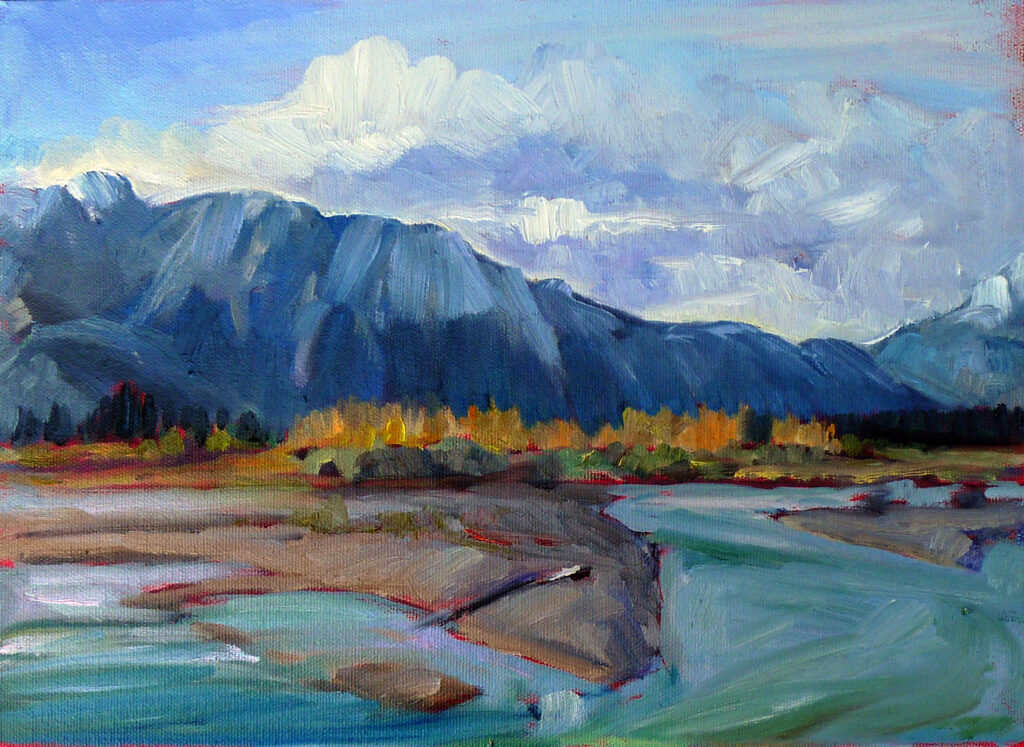
With realistic images, the brain recognizes familiar forms and quickly identifies them. We experience a sense of comfort proportional to how closely the image matches our experience.
Abstract art doesn’t give the brain this opportunity. While we’re always prone to recognize objects in patterns (the basis of the Rorschach test), we primarily see colors and shapes in abstract art. The viewer becomes an active participant, searching for meaning, emotion, and relationships in the absence of labels.
How we perceive color and depth
Color is an illusion of the brain. Our retinas compare wavelengths of light and create the sensation we call color. As noted above, context matters enormously. This is why painters think in terms of color relationships rather than individual colors.
Perspective works similarly. Paintings are flat but the brain eagerly accepts the illusion of three-dimensional space. Overlapping forms, atmospheric perspective, value shifts, edge quality, and relative size all activate the dorsal stream’s spatial processing. The brain assembles these clues into a convincing semblance of distance.
Collaboration
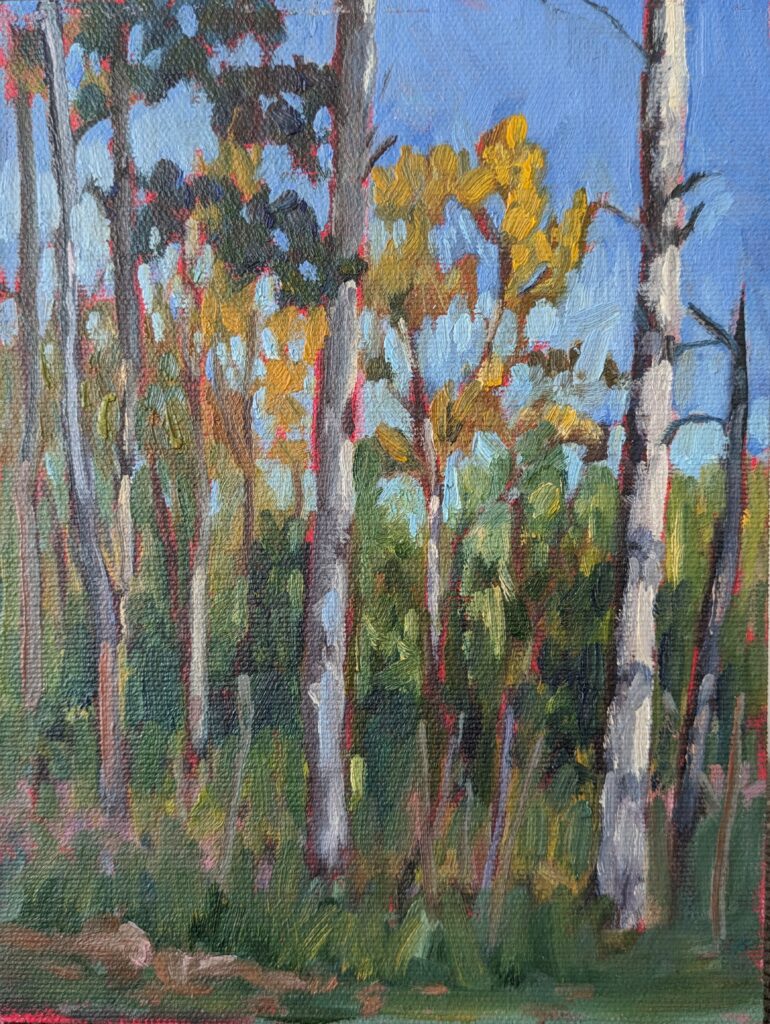
Every successful painting is a partnership between artist and viewer. The painter provides the clues. The viewer responds.
Of course, viewers never see paintings as they exist on canvas. They see a version constructed by their visual system.
This is why painters can create convincing form with very few brushstrokes. Our brains don’t need complete information. They were built to infer reality from incomplete clues.
Online classes start again soon!
- Cozy Winter Painting, Monday evenings, 6-9 PM for three weeks starting November 2.
- Painting Figures in Real Spaces, Tuesday evenings, 6-9 PM for six weeks starting November 3.
- Painting Nocturnes, Monday evenings, 6-9 PM for three weeks starting November 30.
I have just two workshops left in 2026! Reserve your spot:
- New! Color Clinic 2026 | Rockport, ME, October 3-4, 2026
- New! Composition Week 2026 | Rockport, ME, October 5-9, 2026
- High-Desert Light & Monumental Form | Sedona, AZ, Apr 26, 2027 – Apr 30, 2027
Can’t commit to a full workshop? Work online at your own pace: