I never give private lessons; they’re not good value for money. The hive intelligence in a class beats any painting critique I can come up with on my own. My students are uniformly polite, thoughtful and honest. (If they weren’t, I’d fire them). More importantly, they often have insights that would never occur to me.
When we evaluate student paintings, nobody cares much about experience or polish. Rather, we’re analyzing the decisions that were taken and decisions that will strengthen the work going forward.
Good painting isn’t magic; it’s the result of a series of clear choices. When something isn’t working, it’s because one of those choices needs to be revisited. My job as a teacher is to guide people to see them, and to develop the skills to self-critique. That is what happens in my classes and workshops.
The first big question
Before color, before brushwork, before style, there’s structure. Does a painting hold together as a series of simple, readable shapes?
Beginner paintings often suffer from excessively democratic composition. Everything gets equal attention. Strong paintings have hierarchy. They tell the eye where to go and what matters most. If design isn’t clear, nothing will rescue it.
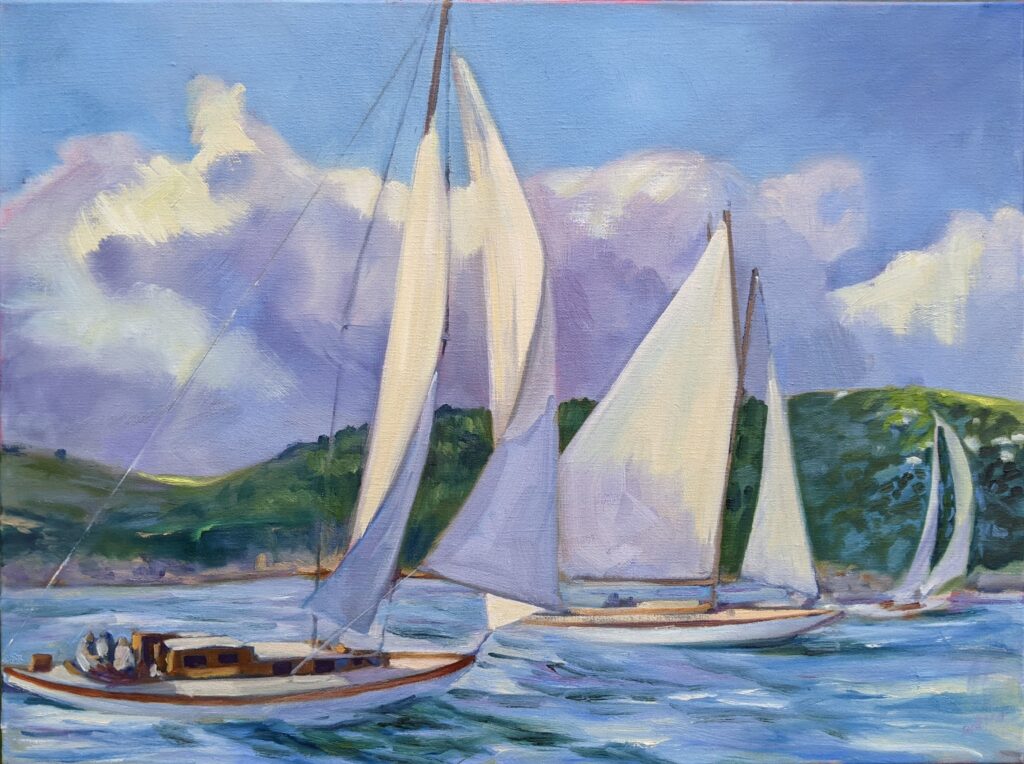
Value is the backbone of composition and where most paintings fall apart. I am constantly talking about this even when I’m primarily focused on something else. For example, this week I assigned my Monday students to paint a cloud picture with three values, two color temperatures and simplified shapes.
A grey soup of bland midtones may look to the outsider like a vision question, but it’s really the result of a series of bad choices about light sources, the proper balance of paint and medium, noodling after the paint is laid down, etc.
Likewise, if focal points aren’t working, it’s a question of line or contrast in value, hue or chroma. Those are the only tools we have to direct the eye.
Confusing style and technique
When I was a student painter, I didn’t know how to marry edges, which meant there was a hard line around everything. One teacher told me, “That’s your style.” But that was wrong; it was technical failure caused by lack of knowledge.
There can be two extremes in edges: everything is outlined and equally sharp or everything is blended into too much softness. Diagnosing that is the easy part; working out how to fix it is harder.
It all works together
Paintings are built in a series of discrete steps, but they aren’t a checklist. You can’t fix design (check), then values (check), then color harmony (check), then edges (check). All these issues are interconnected. In class, we focus on them one subject at a time, but in practice we’re making choices about them simultaneously.
It’s not easy to see these things clearly in your own work. What you intended makes it harder to see what’s actually there. My friend Brad Marshall recently said, “We base success and failure on what we were attempting to do, not the results others see. Paintings are never 100% successful, and how close we come to ‘getting it right’ is not the same as what the viewer experiences.”
The importance of painting critique
Once you’ve gotten past the first technical steps of painting, learning to analyze choices is the most important part of classes and workshops. A workshop based on structured painting critique helps the student understand how paintings work. That enables them to make better decisions, faster.
If you’ve ever felt stuck, or unsure why a painting isn’t coming together, you’re not alone. And you don’t have to guess your way through it.
Registration is now open for workshops in 2026! Reserve your spot:
- Find your Authentic Voice in Plein Air | Berkshires, MA, August 10-14, 2026
- New! Color Clinic 2026 | Rockport, ME, October 3-4, 2026
- New! Composition Week 2026 | Rockport, ME, October 5-9, 2026
Can’t commit to a full workshop? Work online at your own pace: