
My friend Bobbi Heath and I were talking about external validation recently. We agreed that sales mean something, awards mean something and students mean something. To pretend otherwise is silly. When someone spends their hard-earned money to buy one of your paintings, or a juror selects your work for an exhibition or people tell their friends about you, these are all powerful forms of validation.
They mean that other people see something in what you’re doing. Your work is communicating beyond your own brain case. Since making art is such a solitary process, this can help remind you that you’re not entirely delusional.
The problem with external validation
External validation comes too late. Before anyone buys your painting, you have to conquer your own fears and get into the studio and make the work. Before you get into a coveted show, you have to actually submit the work.

How to like your own paintings
I don’t mean, “Is it perfect?” I don’t mean, “Is it what I visualized?” (Neither of these will ever happen.) And I certainly don’t mean, “Will other people like it?” (That’s the road to paintings of kittens and sunsets.)
I mean: “Do you look at it and recognize something unique and powerful in it?”
Does it say what you wanted it to say? Does it have passages that makes you happy? Does the color excite you? Does the brushwork feel like yours? Does the composition have energy? Does it make you want to keep looking? More importantly, does it make you want to keep painting?
Oddly enough, even for experienced painters, this is something that waxes and wanes. I have come to loathe some of my paintings several times, only to turn around and realize they were actually pretty awesome. Other times, I don’t like a single thing I’ve done, only to look at that body of work six months later and be very happy with it. Worse, I’ve loved work of my own that now bores the pants off me. It’s a constantly-shifting sea of self-perception. That tells me that it is, fundamentally, unreliable.
In order to survive it, I have to keep looking for the parts that work and build on them. That might be a little turn of the brush, or one specific color. It could be an edge or the lack of an edge. Sometimes it’s the simple trudge to the studio.
Our inner voices say failure
Artists are really good at looking at our finished paintings and seeing only their failures. We compare them to our friends’ work, or to our own ‘best’ work. We constantly assess them against that insidious perfect painting in our minds. That’s a great way to become discouraged.
Instead, ask what you did right
Then ask how you can do more of that.
This doesn’t mean you should stop listening to criticism. Quite the opposite. Critique is useful precisely because we can’t always see our own work clearly. Other people can point out weaknesses, blind spots and possibilities we missed. But it’s even better to learn to critique your own paintings.
Which brings me back back to sales, awards and students. They are evidence, of a sort, but they shouldn’t be why you like your own paintings. Many, many great artists have turned a blind eye to the world’s judgment in order to find their own voices. Many other artists earned many accolades only to be forgotten in just a few years.
Painting is a long game. There are lots of paintings that don’t sell, shows you don’t get into, competitions you don’t win. There are far more of them, in fact, than successes. If your only measure of success is somebody else’s response, you’re going to wait forever to believe you’re a good artist.
I have just two workshops left in 2026! Reserve your spot:
- New! Color Clinic 2026 | Rockport, ME, October 3-4, 2026
- New! Composition Week 2026 | Rockport, ME, October 5-9, 2026
- High-Desert Light & Monumental Form | Sedona, AZ, Apr 26, 2027 – Apr 30, 2027
Can’t commit to a full workshop? Work online at your own pace:
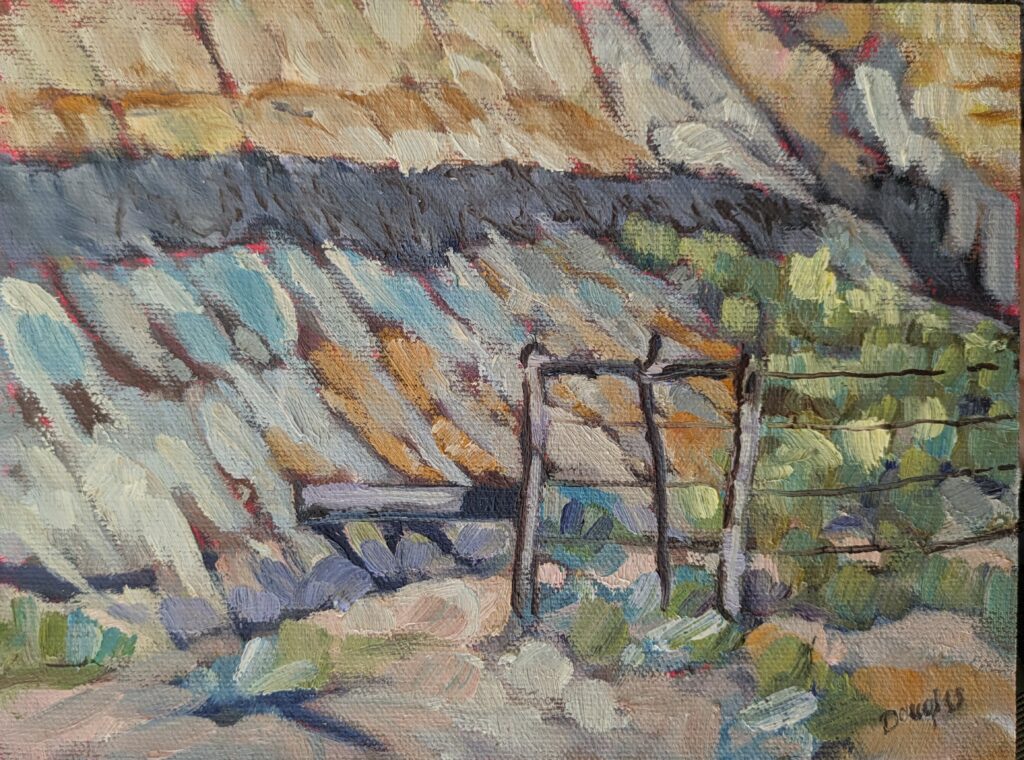
Coal Seam is so engaging. The contrast between the rock pattern and the fence’s linearity is perfect. I spent more than two decades in the coal fields of Appalachia, and this painting pulls me right back there.
Thank you, Pamela.
I just printed this and hung for ME to see!
I am grateful to have taken your Critique class — it helps me look at the “what was successful” about my painting I dislike. Even as I wonder why others like it!
“Do you look at it and recognize something unique and powerful in it?”
Does it say what you wanted it to say? Does it have passages that makes you happy? Does the color excite you? Does the brushwork feel like yours? Does the composition have energy? Does it make you want to keep looking? More importantly, does it make you want to keep painting?
That makes my day, and segues perfectly into Monday’s post. Watch this space…