

Sometimes my aha moments don’t happen in the studio; they come as I’m writing a lesson. That happened to me yesterday as I was prepping for From Field Sketch to Final Studio Work. I included these discussion points:
- How many images are on your phone/cloud right now? (20,308.)
- How many images do you have stored on your laptop? (51,406, and there are more on our server.)
I can do two image searches on my phone using the same keywords and come up with different results. That is also true of file searches on my laptop. A terabyte here, a terabyte there… sooner or later it adds up to a real mess.

A quick note on classes before we get into it
Claim your spot in Painting clouds, which starts in two weeks. There are just three seats open.
Too much reference material
I’m drowning in useless visual information that I can’t access in any consistent way.
If you’re like me, you’ve accumulated innumerable photographs, sketchbook pages, plein air studies, workshop demos and unfinished paintings. They’re tucked in hard drives, filing cabinets, cloud storage and bins. As with my attic, I keep shoving things in but never have a clear-out.
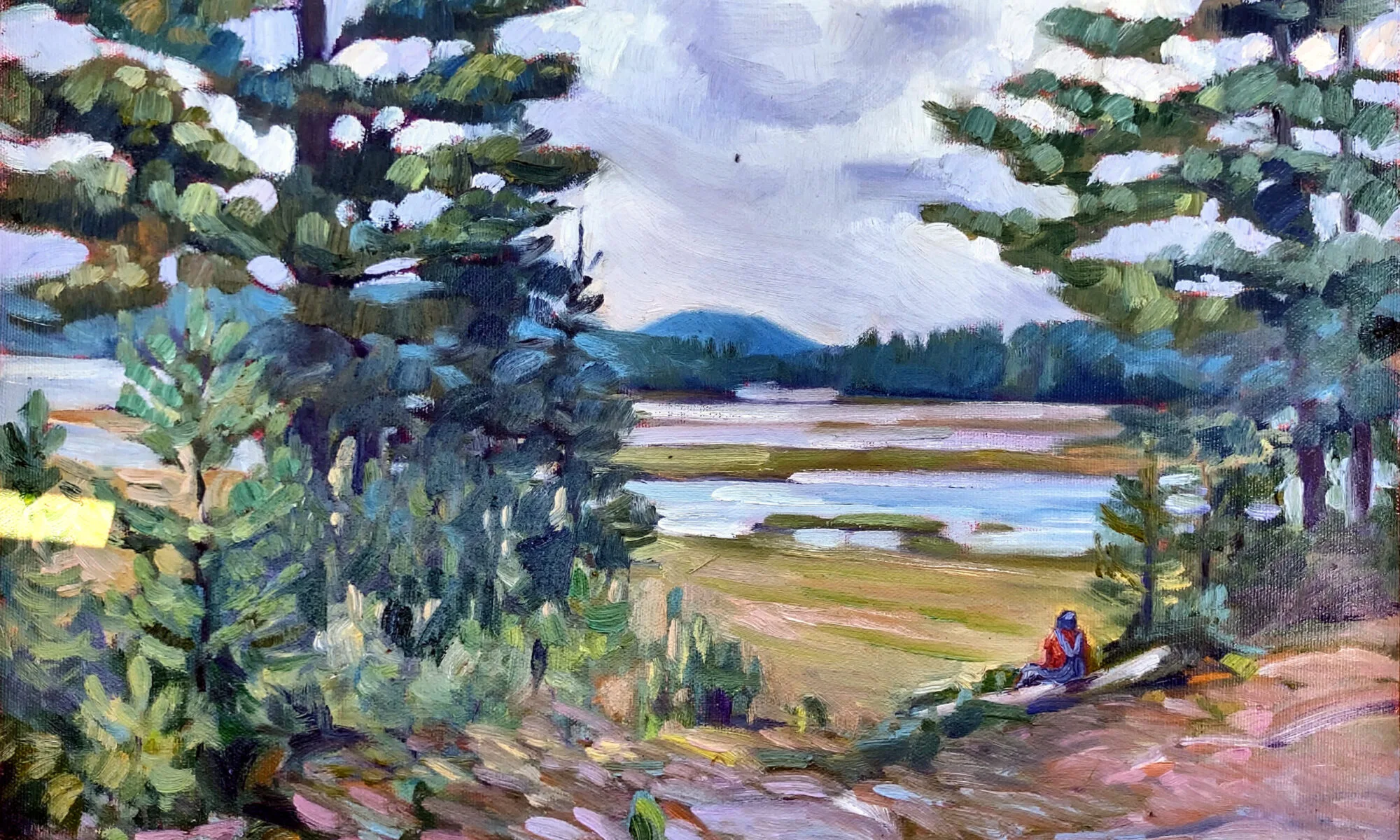
This week I cracked opened the door just a sliver. I photographed the top 42 unfinished oil sketches in my slush pile, hoping to see some pattern.

Painting a series
Another question I asked my students last night was, “Have you ever painted a series?”
I usually think of a series as like Richard Diebenkorn’s Ocean Park paintings, and no, that’s not my jam. But of course, I’ve painted lots of series, connected thematically and assembled for solo or group shows. I just didn’t call them that.
Assembling my sketches, I realized that they are also a series, keyed to a few simple themes.
But that was then, right?
We’re always tempted to chase something new. We imagine our next great painting is waiting in the national park we’ve never visited, overseas or the next workshop destination. Sometimes that’s true; for example, there was a time when I’d never painted in Arizona, and now the high desert is one of my favorite places.
Often, however, your real interests are visible in work you’ve already done. For me, that was clear in those 42 sketches—they were rocks, clouds, boats, water, buildings and trees, repeated in different combinations. Figure (which is where I was trained) doesn’t figure at all.
Time has already done the editing in your slush pile. You’re no longer standing in front of a spectacular scene where everything is monumental and the weather is doing backflips. What’s left is the germ of an idea and composition. If it still interests you a year or five later, there’s something there worth exploring.
Most of the paintings in my slush pile are flawed, which is how they ended up there to start with. But almost all of them have compelling fragments. There’s a workable idea in almost all of them.

Some paintings are really, truly terrible
Of course I have total fails. I’m not going to repaint them but they’re also instructive. Often, that’s because I just wasn’t engaged—I was tired, cold, hungry, or painting something that I didn’t care about. It’s amazing how clearly that lack of interest rings out, even after many years.
Online classes start again soon!
- Cozy Winter Painting, Monday evenings, 6-9 PM for three weeks starting November 2.
- Painting Figures in Real Spaces, Tuesday evenings, 6-9 PM for six weeks starting November 3.
- Painting Nocturnes, Monday evenings, 6-9 PM for three weeks starting November 30.
I have just two workshops left in 2026! Reserve your spot:
- New! Color Clinic 2026 | Rockport, ME, October 3-4, 2026
- New! Composition Week 2026 | Rockport, ME, October 5-9, 2026
- High-Desert Light & Monumental Form | Sedona, AZ, Apr 26, 2027 – Apr 30, 2027
Can’t commit to a full workshop? Work online at your own pace:
Do you ever get to a point where you cull things entirely out of your slush pile? I’m wondering at what point you ask “what purpose is this serving by me keeping it?
Occasionally, but not nearly enough. I’m hesitant unless I know it’s a complete dog.
Thank you – I totally understand the hesitation.
I have culled some, sanded them down and re-toned the canvas to use again. But the other day I dug out a sketch of my old horse that I started during the pandemic, never finished, and thought, “ Not bad. Definitely salvageable.” I look back at some of my earlier paintings and see what I did well and what I could do better if I should decide to repaint them.