Improvement doesn’t necessarily come from grand gestures like buying new brushes. The biggest leaps come from simple, repeatable, immediate actions. These are things you can do today to make tomorrow’s paintings stronger. Here are five that never fail.
Take off your glasses or squint
I’m nearsighted; I paint with my glasses on a string around my neck and they’re there only because I need them to drive home. Some of you were unfortunately born with perfect eyesight. For you there’s only one remedy: squint.
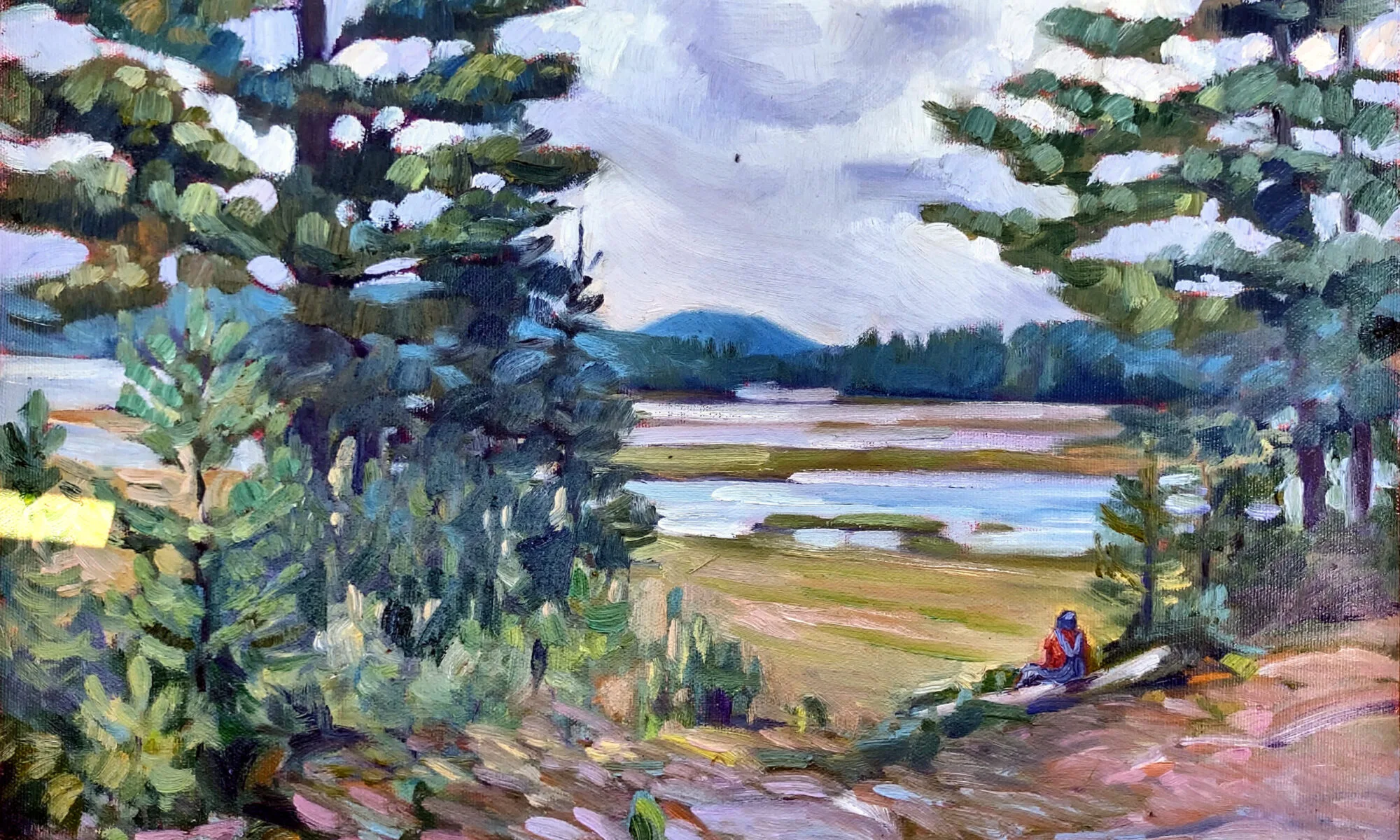
Blurriness simplifies the world. It mutes unnecessary detail and helps you see big shapes, value relationships and underlying design. Paintings fall apart when we chase every detail without considering how they fit into the whole. Before you touch your brush, remove your glasses or squint until you see only three or four major value shapes. Then paint those. Detail is for the end of a painting, and it’s not always necessary.
Stop buying more paint
You don’t need three trays of watercolors or 40 tubes of oil paint to make great color. In fact, that just stops you from learning color theory. That’s why I suggest paired primaries, which are just a warm and cool version of each primary. I augment them with a few earth pigments because they’re cheap and versatile, and (in solid media) white. Mixing within them teaches you, whereas buying lots of paint just impoverishes you.
Buying more paint can be a form of flailing around. It can be displacement behavior; it’s simply easier than buckling down, especially when what’s on your easel isn’t going well.
Step back and look
There’s a maxim that a painting should compel from thirty feet, three feet, and three inches. That just means it needs to draw you in from across the room and hold your interest once you’re close. It’s amazing how different a painting looks from a few feet away. Up close, a passage can look and feel like a struggle to the death. From a distance, it’s just a patch of color in either the right or wrong place.
Make stepping back part of your rhythm. If, say, you’re standing on a cliff and you can’t back up, take a photo on your phone. That creates an emotional distance that’s almost as useful.
Simplify, simplify
Every painting ought to be a distillation of a truth, not a transcript of an event. Ask yourself, what is the story? Then edit out the extraneous detail that doesn’t support it. If your painting is about an old house, don’t get lost in the weeds. If your painting is about those blackberry brambles, don’t get lost in the house’s trim.
Those are decisions that should be made in the composition phase. Everything irrelevant should be subservient to the point you’re trying to convey.
Paint more
Skill doesn’t arrive like a thunderclap. It grows, one session at a time. You can read, talk, and think about art all day long, but there’s no substitute for time in front of a canvas. Twenty minutes of focused drawing or painting will move you forward faster than hours of browsing. Set your alarm early tomorrow and paint something small. You’ll surprise yourself. That’s why daily paint challenges are so helpful; they get us moving even when we don’t feel like it.
Improving as a painter isn’t about waiting for inspiration or reinventing your technique. It’s about building better habits, right now, with what you already have.
So go ahead—squint, simplify, mix from a smaller palette, step back, and paint more often. Those five small choices will do more for your art than any magic brush ever could.
All good advice, Carol. Visited a friend’s studio this week. I was amazed at the amount of work she does just from her imagination. So I’m thinking of throwing in sketching daily from imagination or loosely from references. I think it could pull me out of getting caught in the weeds much like your suggestion of taking your glasses off.
Excellent idea, Bonnie! Let me know how it goes.
This was very helpful Carol!
Thank you, Cuz!
Very wise words, Carol. Thanks.
Thank you!
Great advice and spot on observations!
Thank you!