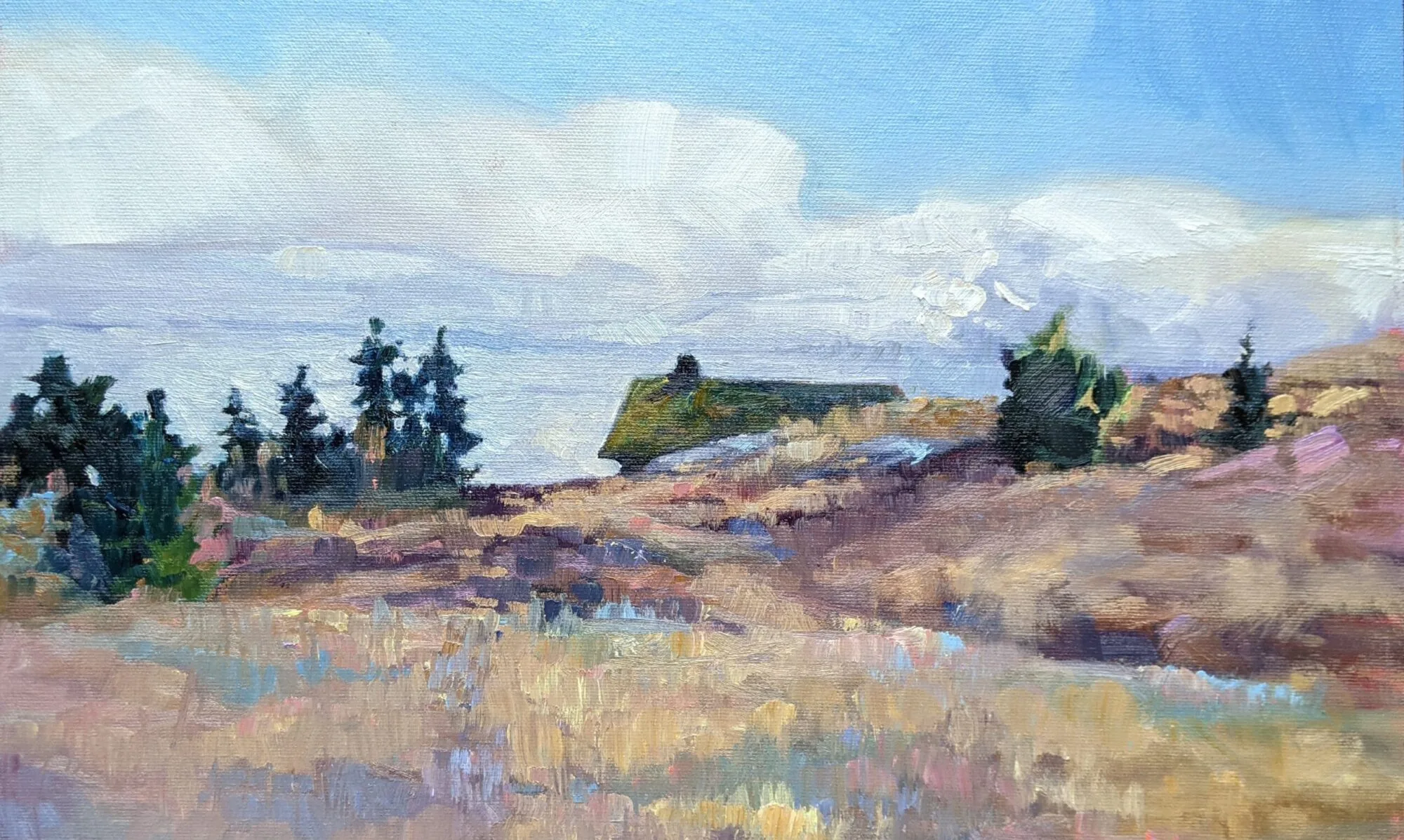
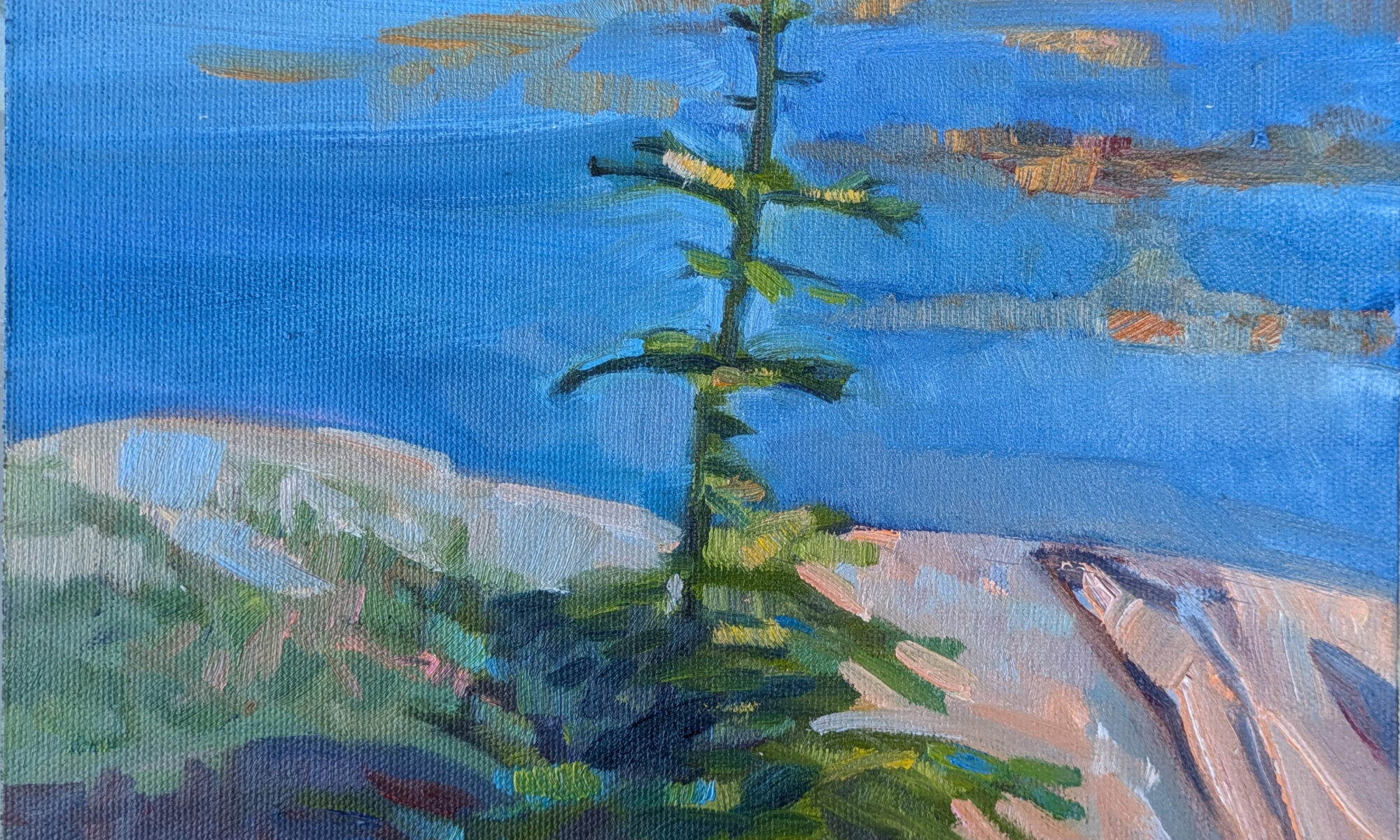
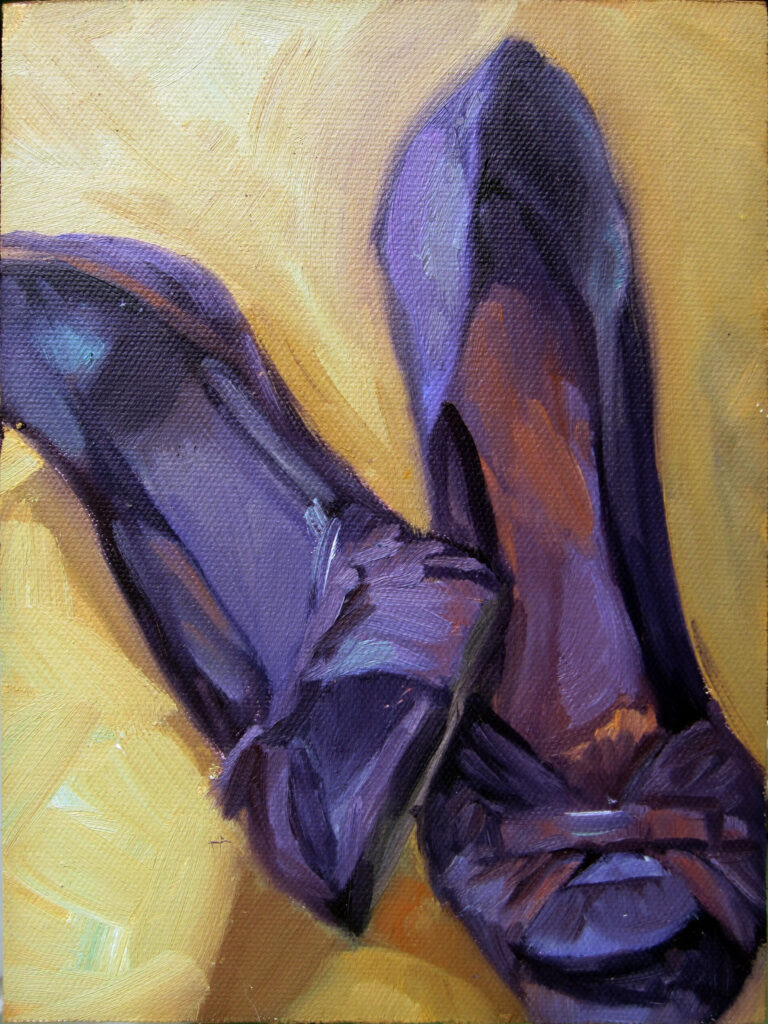
We tend to lump shadows together into one vague, dark idea, kind of like Halloween. Despite the dangers of noun-thinking in painting I’m going to throw two more labels at you: cast shadows and form shadows. When you understand the difference, your paintings will sit solidly in space.
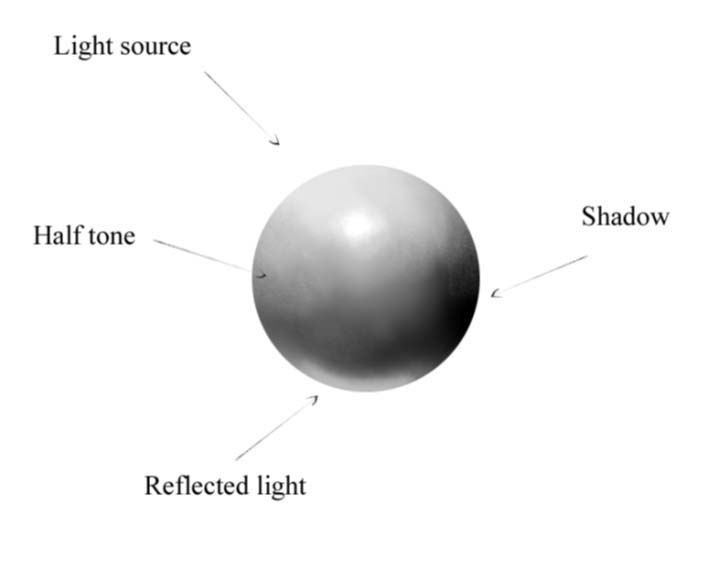
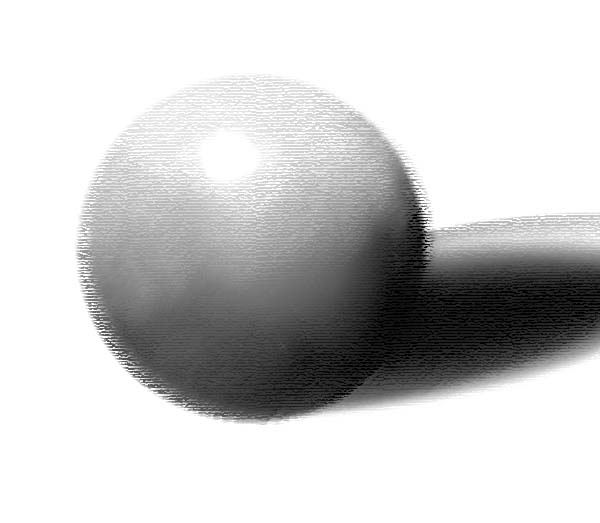
Form shadows belong to the object itself. They describe the turning of a surface away from the light. Above, I’ve illustrated a sphere: one side faces the light, the other gradually rolls into darkness. That transition—from light into halftone into shadow—is a form shadow. It’s soft, gradual, and tied directly to the geometry of the object. Form shadows are what give volume. They’re how a circle becomes a ball.
Cast shadows, on the other hand, are thrown by one object onto another surface. A tree casts a shadow on the ground. A nose casts a shadow across a cheek. These shadows are graphic and shape-driven. Their edges depend on the sharpness of the light source. They primarily describe the interruption of light rather than the turning of form.
Not all shadows behave the same way
Form shadows will have softer edges when they are created by gradual changes in light across a curved surface. The more matte the surface, the softer the shadow. Even in strong light, the transitions of a form shadow are rarely abrupt. A hard edge in a form shadow will flatten the object. When we paint with form shadows, we’re doing what’s called ‘modeling’.
Cast shadows, especially close to their source, tend to have firmer edges. They can soften as they move away from the object, and the softer the light source, the softer the shadow. But cast shadows are usually crisp near the object that’s casting them. If you paint cast shadows with mushy edges, your painting loses definition. Everything feels vague and unanchored.
Form shadows are part of the object’s local color family, darker and often cooler. Cast shadows, however, can drop dramatically in value; they represent areas where light is blocked entirely. That said, they’re rarely as dark as beginners make them. There is almost always reflected light bouncing into them, especially outdoors.
Where cast and form shadows meet
There may be almost no differentiation where cast and form shadows meet; they can sometimes run into each other as an unbroken dark. A great example is Johannes Vermeer’s Girl with a Red Hat, which is a delightful exercise in lost and found edges.
Color temperature
Form shadows will generally shift cooler relative to the light, particularly in natural light. Cast shadows also follow this general rule. However, depending on the environment, they can pick up surprising color such as warm, reflected light.
In either case, shadows can have reflected color in them. For example, the insides of daffodils—despite being in shadow—will be a clear, deep yellow. They’re reflecting the yellow back on themselves.

This is a good place to ban black
Shadows may, in certain situations, appear black. If, for design purposes, that works for you, make yourself a chromatic black from ultramarine blue and burnt sienna or a blue-magenta-yellow combination if you’re working in severely-limited palette. Tube black is useful for making greens, for making tones and shades, or for painting your grand piano. But it has no place in your shadows.
But in any case, most shadows are simply more charming if they have color in them, or many colors in them.
Your practical takeaway
One of the great virtues of painting still life is learning to manage cast and form shadows differently. When you see a shadow, ask yourself what it’s doing. Is it describing the turning of a form, or is it being cast onto a surface? That will help you handle its edge crispness, its value and its color.
Registration is now open for workshops in 2026! Reserve your spot:
- Find your Authentic Voice in Plein Air | Berkshires, MA, August 10-14, 2026
- New! Color Clinic 2026 | Rockport, ME, October 3-4, 2026
- New! Composition Week 2026 | Rockport, ME, October 5-9, 2026
Can’t commit to a full workshop? Work online at your own pace:
Thank you for this! Excellent explanation. Will print, highlight, study and practice this information as well as try to get this information to stick some place in my aging brain!
You’ve got it! If you do any one thing, study Vermeer’s “Girl with the Red Hat” to see how the form shadow spills into the cast shadow. It’s brilliant.