

Geologic time is humbling. It took more than 300 million years to make the layer cake of sandstone, siltstone, and limestone that eventually became the Schnebly Hill formation in Sedona. The tectonic uplift and erosion that carved it into what we see today took 80 million years. Compared to that, our own span of existence is impossibly short.
The shapes and colors of the red rocks of the Colorado Plateau are astonishing. This is iron-rich sandstone. It catches the light and shifts from cool violets to blazing oranges and reds. There are hoodoos and spires, canyons and buttes. Although they change at a sub-glacial pace, there is movement and rhythm written all over them.
Every time I’m in Arizona to paint, I understand their form a little better. Oak Creek Canyon isn’t just a cavernous hole, and the massifs are not simply towering shapes. They are dynamic, the very language of color, light and geological poetry.

The dialogue between earth and time
Many Native Americans viewed rocks as animated, rather than inanimate. The Ojibwe considered rock formations and cliffs to be alive with unseen spirits. Algonquin-speaking peoples used terms like manitou to describe the spiritual power that rests everywhere, including within ‘spirit stones.’ I don’t think of rocks as alive in that sense, but I can read their geology well enough to picture how they’re constantly in motion.
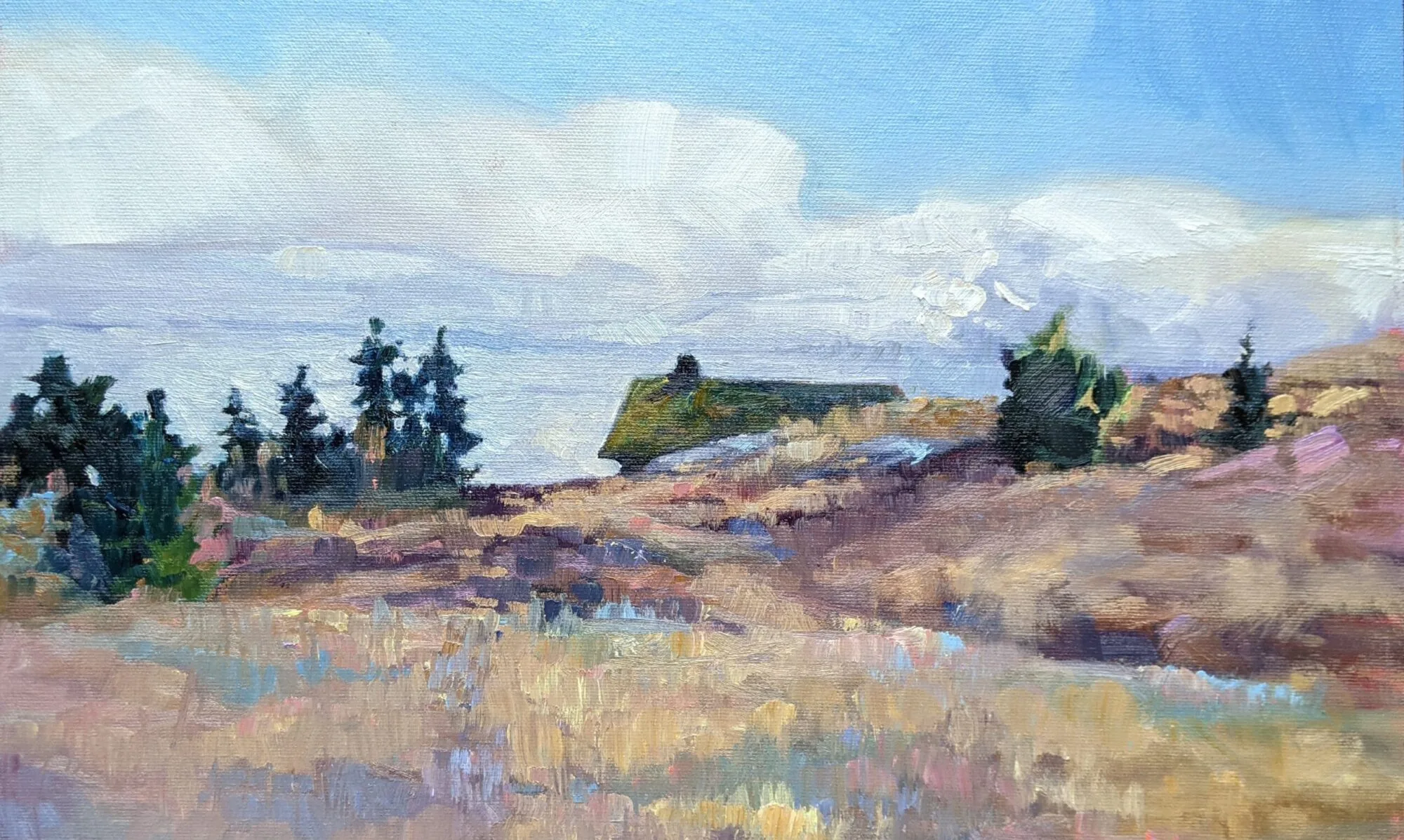
The dialogue between earth and time is difficult to paint. Since reference photos don’t adequately describe the scale or light, painting the high desert requires actually being there. The dust-dry air of Sedona filters light in ways you can’t fully grasp until you’ve seen it firsthand. Shadows have a cool clarity, and highlights sing with warmth and saturation.
Then there’s the swift movement of the light, in the warm glow of dawn against a cliff face or the shifting shadows that move across layered rock strata. It helps to visualize these gigantic rock formations as vast theaters of shifting color and contrast.

They are complex compositions of value, edge and form. Shifting, reflected light, atmospheric perspective and above all the rhythm of shapes tell their story. I find the long views to be the most difficult subject (which is why I return to them over and over). Done right, the towering forms are a scaffold, the story moving from foreground to midground to distant horizon, each plane with its own emotional tone. That’s why I think paintings capture the high desert better than photos do.
In plein air painting, every form is a challenge—to simplify the complexity, balance the hard edges of rock against the fleeting softness of cloud shadows, or make deep crevices feel alive on a modest 9×12 panel. Canyons and buttes become conductors of color relationships, inviting you to push beyond the literal.

If you’ve ever felt the tug of a landscape, if you’ve ever wanted to paint buttes, spires and hoodoos, or if you’re just plain cold after this long winter, I invite you to join me for Canyon Color for the Painter: a Plein Air Workshop at the Sedona Arts Center, March 9–13, 2026. You’ll learn to lead with color, build compelling compositions, and translate the hidden symphonies of light and land into your own plein air paintings. Register now and let the canyon teach you to paint with deeper insight and confidence.
I have just two workshops left in 2026! Reserve your spot:
- New! Color Clinic 2026 | Rockport, ME, October 3-4, 2026
- New! Composition Week 2026 | Rockport, ME, October 5-9, 2026
- High-Desert Light & Monumental Form | Sedona, AZ, Apr 26, 2027 – Apr 30, 2027
Can’t commit to a full workshop? Work online at your own pace: