Monday Morning Art School: choosing a plein air easel or pochade box

The Gloucester-style easel is great for park-n-paint but I really can’t carry mine very far.

I finished last week’s workshop with a plein air easel show-and-tell at my gallery, because a recurring question is, “what kind of easel is best for me?”

There’s no one-size-fits-all answer, so before you start looking, ask yourself these questions:

  • What size paintings do you typically do outdoors? There are maximum sizes for each plein air easel, and they don’t perform well once you exceed that.
  • What medium do you use—oil, acrylic, watercolor, gouache or pastel?
  • Do you prefer fast setup and light weight, or something more stable in high winds?
  • How do you usually travel to paint?
    • Park-n-paint, where you paint near or out of your car.
      Backpacking or hiking to painting sites.
      Flying to workshops.
  • How frequently will you paint outdoors? A daily painter needs a more stable plein air easel than a once-a-month painter.
  • How handy are you? Paint boxes are simple; a good craftsman can build or modify most designs. However, if you don’t know which end of the screwdriver means business, you’re better off buying one off the shelf.

Remember, all plein air easels and pochade boxes are compromises, which is why I’ve ended up with so darn many of them.

How not to treat your Mabef M-27 watercolor easel…

Watercolors vs. oil painting

Watercolor painters who work small may need no plein air easel at all; they can do just fine with a folding chair and their work on their lap. If you plan to work larger, a pivot head is important. There are a number of options for this, including the Mabef M-27 field easel (here at Dick Blick, here at Amazon).  It can hold a full sheet of watercolor paper on a Gatorboard support and the angle adjusts very quickly. It’s also usable for other mediums, but there are easier plein air easels for oils and acrylics. Also, balancing a palette on its arms is sometimes an exercise in frustration.

Pivot heads are not just for watercolor

There are several other pivot-head systems on the market, and I generally like them because they divorce the support from the often-heavy paint box. The Leder easel at $159 (not including the tripod) is reasonably priced for a solid, stable, painting system. It can hold a canvas up to 24″ tall, which is large enough for most plein air work. You must buy your own tripod and paint box, but that has some advantages. You’re not hauling around a heavy wooden box, because you can pair it with a Masterson Sta-Wet palette box, which is far lighter. It’s also a great system for pastels, because it allows you to use your existing pastel box. In fact, you can flip between media quickly. (Ed says that if you use the code Carol10, you’ll get a 10% discount.)

Terrie Perrine’s pastel box on her Leder easel. Building your own box is a great solution if you’re handy with tools.

Guerrilla Painter boxes are rock solid but too heavy for me (I just gave my last one to a friend). They do make a fabulous support, the No. 17 Flex Easel. It still requires a tripod with a pivot head and some kind of box, but En Plein Air Pro makes an excellent shelf that will hold your stuff.

Another option in this family is the Coulter Art Box, which has a pivot head and a box with a wraparound support that grabs the legs of your tripod.

This is where being handy is helpful; many artists have modified or built flat paint boxes at a fraction of the cost of an off-the-shelf version. I built mine.

Pochade boxes

There’s so much variety in pochade boxes that I can’t possibly mention every choice. For most fieldwork I use an Easy L box, which I have in three sizes, including an 8X10 that’s light enough to backpack. I bring an Easy L box when I’m flying.

The New Wave u.go pochade is a simple, elegant design, but even the largest is really only suitable for smaller work. Its mixing area is very shallow; that’s a problem if you use lots of paint. However, the palette does lift out so you can freeze it, and it’s lightweight.

Strada makes the only aluminum pochade boxes that I know of. That’s a pity, because aluminum is less prone to moisture damage than wood. It doesn’t result in much weight savings, however.

About your tripod

A good carbon-fiber tripod and a ball head with a quick-release plate may set you back more than your pochade box. The good news is that they’re lightweight, stable, and almost indestructible. I have only one; I swap it out every time I change pochade boxes.

My students from my plein air workshop last week. Front row: Phoenix Barra, Aurise Randall, David Griffin. Back row: Helena Van Hemmen, Jeanne-Marie Van Hemmen, Lori Galan, Yves Roblin, Marlene Van Aardt, Amy Sirianni, LuAnn Dunkinson, Tim Moran, and me. Missing: Rachel Houlihan. (Photo courtesy of Bill Marr.)

Gloucester-style easel

For years, I used a cheap knock-off of the Gloucester easel. Mine finally snapped in a high wind. The replacement was so warped that I returned it. If you want this style easel, you need the Take-It Easel.

The Gloucester-style easel is invaluable for large work or windy days, but it’s too heavy for me to carry very far. Weight is the big reason so many artists use the park-n-paint approach to plein air. It’s easy, but it’s limiting.

What not to buy

I’ve written about how Google drove me toward inexpensive and fatally-flawed Meeden pochade boxes. It’s always frustrating to watch students struggling with terrible equipment..

Many people have been given a French box easel by loving friends or relatives. If you have one, by all means use it, but don’t voluntarily inflict one on yourself. They’re heavy and difficult to set up. Pochade boxes are lighter and nimbler.

Registration is now open for workshops in 2026! Reserve your spot:

Can’t commit to a full workshop? Work online at your own pace:

Seven Protocols for Successful Oil Painters

Two art shows, coming right up!

Oh, announcements, announcements!

David Griffin painting this week (photo courtesy of Amy Sirianni)

Come over this evening and see my students’ art show

Advanced Painting workshop student show
Friday, July 11, 2025, 4-7 PM
394 Commercial Street, Rockport, ME 04856

My Advanced Painting workshop students have been working like mad all week, and this evening, we’ll exhibit their vibrant, exciting work at my gallery, at 394 Commercial Street, Rockport. Let’s celebrate their passion, creativity, and, above all, the growth they’ve achieved in this intense week of work.

Painting on Beech Hill (photo courtesy of Amy Sirianni)

This show features work by twelve painters who’ve had the courage (and endurance) to follow me around to my haunts in midcoast Maine, from the harbor at Owls Head to the panoramic view off Beech Hill, to a village street scene in Camden, and more. These artists paint in a range of styles, from loose expressionism to careful observational drawing. And they range in age from 16 to… well, my contemporaries.

It’s been a fabulous weather week (photo courtesy of Amy Sirianni)

This exhibition isn’t just about the finished paintings—it’s about what happens when people give themselves permission to let loose. I’ve been teaching adults for several decades, and I’m always amazed by how willing they are to take artistic risks.

The reception will take place tonight from 4-7 PM, with light refreshments and an opportunity to meet the artists. Please join us!

Prom Shoes 2, oil on archival canvasboard, 6X8, $435.

Next week, bring your dancing shoes

Disco Fever
Thursday, July 17, 2025, 5-7 PM
19 Elm Street, Camden

Shine up your sequins and dust off your platform shoes. Lone Pine Real Estate (and I) will present Disco Fever,a night of art, glitter, groove and good vibes, from 5-7 PM, July 17, 2025 at 19 Elm St., Camden.

In addition to the glitz and glamour of the disco era, the event will feature work by Camden painter Rachel Houlihan, Rockport painter Stephen Florimbi, and, of course, me. The DJ will be Nate Quinn, who wasn’t even born when disco was in fashion.

I came of age in the disco era, so I never mind a little bling. I’ll be wearing my sequined Betsey Johnson platform sneakers (because too much of a good thing is a great thing). And of course, disco makes a ruckus, which is why it’s the perfect compliment to the Camden Art Walk. Let’s see if we can make more noise than those crazy kids down on Bay View Street.

Registration is now open for workshops in 2026! Reserve your spot:

Can’t commit to a full workshop? Work online at your own pace:

Seven Protocols for Successful Oil Painters

Why don’t I teach shorter painting workshops?

Camden Harbor from Curtis Island, oil on canvas, $2782 unframed includes shipping and handling in continental United States.

I’m teaching an advanced painting workshop this week. Today is the third day, and when my students departed yesterday, they all looked a little tired. OK, a lot tired. It’s a lot to work from 9 to 4 in open air, while trying to integrate new concepts.

A fellow teacher once told me that she had been asked to compress a four-week beginner course into two days. “I think it’s a disservice,” she said. “That’s a lot of information to compress into a much shorter time. So, either it’s a very shallow dive or there’s so much information compressed so tightly that half of it gets lost.”

I’m terrible at taking pictures while teaching, but one of my students set up in the shade of an old schooner, and I thought her easel looked darn cute there.

I am often asked about shorter painting workshops as well. They fit neatly into a weekend and the cost is lower, so they’re easier to sell. If they’re subject-based, like ‘painting sunsets,’ they can work because these painting workshops are inherently shallow. They work best for people who already know the rudiments of painting; otherwise, they’re a bit too much like sip-and-paints.

But two or three days are insufficient when it’s a question of really developing style, color fluency, composition and form. And if you understand these concepts, you don’t need a special painting workshop on sunsets or water; you have the tools to paint anything you want.

Downtown Rockport, 14X18, oil on archival canvasboard, framed, $1594 includes shipping and handling in continental US.

What can go wrong? A lot.

Basic protocols for watercolor and oils run to about seven discrete steps, depending on how you break them down. Here are, roughly, the steps for oil painting:

  1. Set up your palette with all colors out, organized in a useful manner.
  2. Do a value drawing.
  3. Crop your drawing and identify and strengthen big shapes and movements.
  4. Transfer the drawing to canvas with paint as a monochromatic grisaille.
  5. Underpaint big shapes making sure value, chroma and hue are correct.
  6. Divide big shapes and develop details.
  7. Add highlights, detail and impasto as desired.

Let’s just consider #2. It’s almost useless for me to just tell you to do a sketch. In fact, if I did that, you’d have to wonder why you didn’t just draw on the canvas instead. You need insight into what you’re looking for, what makes a good composition, and different ways to do that preparatory composition.

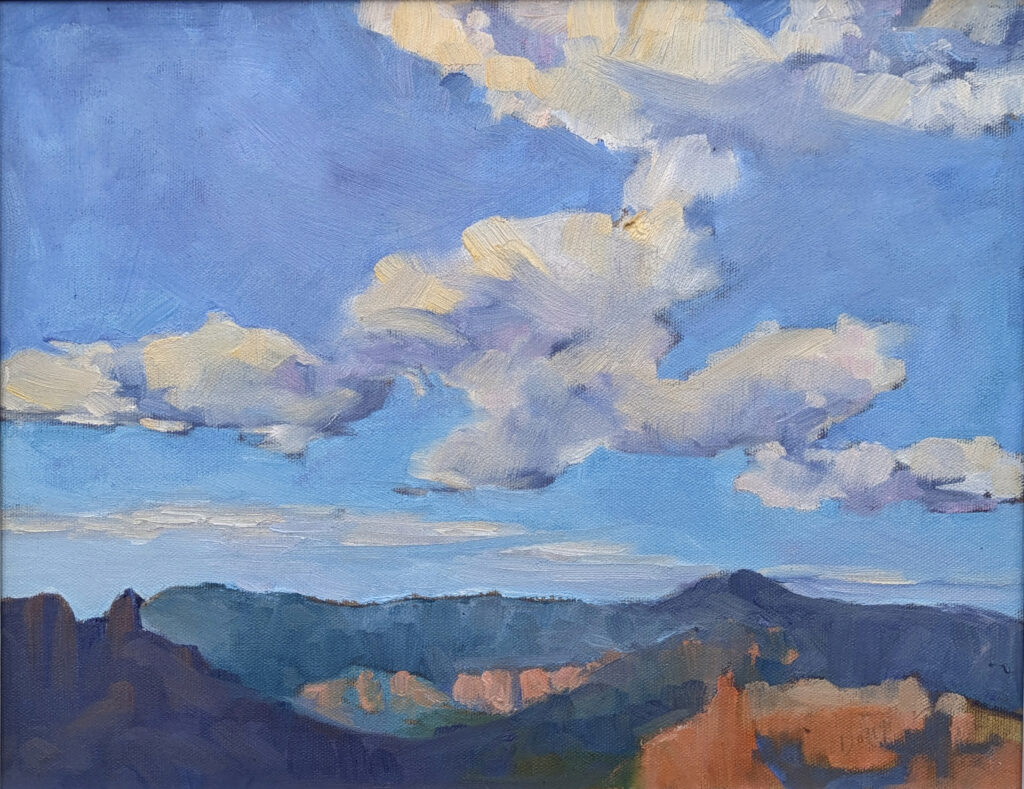
Maynard Dixon Clouds, 11X14, oil on archival canvas board, $869 includes shipping in continental US.

I can (and sometimes do) rattle off a lecture on these points, but that is the just the start of the process of discovery. Unfortunately, in a two-day painting workshop, that’s about all the time we’d have for the step many artists consider most crucial to the development of a good painting. You, the student, then go home and consult your notes. They become a slavish list of dos-and-don’ts, rather than a framework for a deeper understanding.

It’s far better that I start with an exercise that allows you to build understanding of composition on your own. That, in a nutshell, is the difference between a book and interactive teaching. It’s why people take painting workshops in the first place.

That kind of teaching takes time.

Arthur Wesley Dow, the popularizer of Notan, had his students work for weeks on line before they eventually graduated to masses and then finally to greyscale and color. His students included Georgia O’KeeffeCharles SheelerCharles Burchfield, and other 20th century art luminaries, so he was definitely onto something. Learning to paint properly takes time.

This is a revision of a post from 2022.

Registration is now open for workshops in 2026! Reserve your spot:

Can’t commit to a full workshop? Work online at your own pace:

Seven Protocols for Successful Oil Painters

The color of place

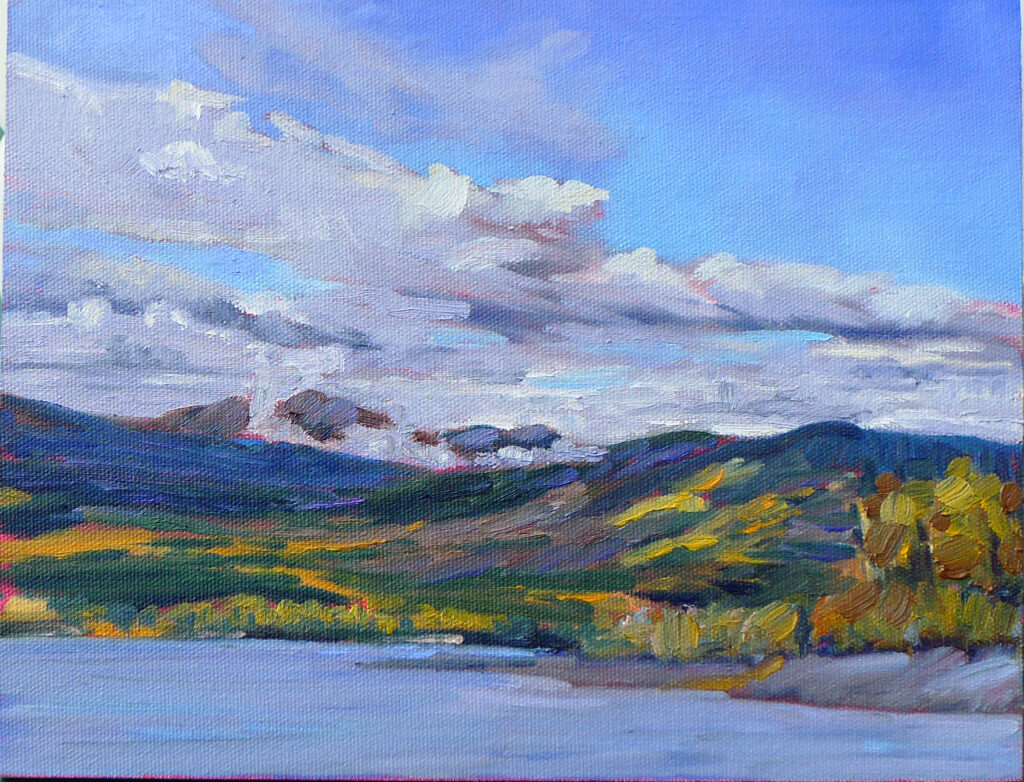
Teslin Lake, 8X10, oil on archival canvasboard, $522 includes shipping and handling in continental US.

Years ago, Bobbi Heath, Joelle Feldman and I went to the Bahamas to paint. There were many lovely things about that trip, including the warmth. However, I found myself absolutely uninspired for painting. Grand Bahama lacked three variables I crave in landscape painting: variety of foliage color, compelling architecture, and fascinating line. (I’m sure that if we’d been there in hurricane season, the weather would have spiced things up nicely, but alas, it was all calm seas and blue skies.) I have a limited interest in the beach and I came home with very little in the way of finished work.

It was also my first experience in a resort area, and I found it frankly disturbing to be in a place where visitors and natives were so cleanly separated. That’s not something I’d ever seek out again.

No Northern Lights Tonight, 6X8, oil on archival canvasboard, $348 includes shipping and handling in continental US.

An artist born in the tropics might love the subtle variations of turquoise for his landscape painting, whereas I found the gentle surf boring. He, in turn, might find the sulky violence of the Maine surf to be cold and forbidding. He undoubtedly would like conch, and I prefer cod.

If all goes well, as you read this I’m jetting from Manchester to Malta and Gozo for a week of hiking. I’ve no real idea what Malta looks like, although I’ve dutifully read up on its history. It will, I suppose, be dry, sandy, sunny, and more anciently-settled than most of the places I hike—not too different, I suppose, from the dusty village from whence my Calabrian ancestors emigrated.

Keeping my expectations low—hah!

I’ve painted in many corners of the world, and I always tell myself to keep my expectations low, that landscape painting in one place doesn’t necessarily translate automatically to another place.

That never actually works. I’m always carried away.

I’m not taking my oil painting kit, but I will have a sketchbook and a small watercolor kit. In the past on these hikes, I haven’t had time to do much painting. Even when I do, the results are just a passing fury. It’s not just a matter of focus, but of exploration. There’s a difference between landscape painting for finish and effect and plein air painting for exploration and thought. I never seem to move past the latter.

Consider the difference between Thomas Moran’s trail sketches from the Hayden Geological Survey of 1871 and his magnificent oil paintings of the same subject. The sketches are meant to record impressions; the paintings are meant to awe and inspire. Would Moran even have gotten into a major modern plein air event? Perhaps not.

Maynard Dixon Clouds, 11X14, oil on archival canvas board, $869 includes shipping in continental US.

This spring’s painting classes

Zoom Class: Advance your painting skills (whoops, the link was wrong in last week’s posts)

Mondays, 6 PM – 9 PM EST
April 28 to June 9

Advance your skills in oils, watercolor, gouache, acrylics and pastels with guided exercises in design, composition and execution.

This Zoom class not only has tailored instruction, it provides a supportive community where students share work and get positive feedback in an encouraging and collaborative space. 

Zoom class: Signature series

Tuesdays, 6 PM – 9 PM EST
April 29-June 10

This is a combination painting/critique class where students will take deep dives into finding their unique voices as artists, in an encouraging and collaborative space. The goal is to develop a nucleus of work as a springboard for further development.

Registration is now open for workshops in 2026! Reserve your spot:

Can’t commit to a full workshop? Work online at your own pace:

Seven Protocols for Successful Oil Painters

Business for artists and painting in Sedona

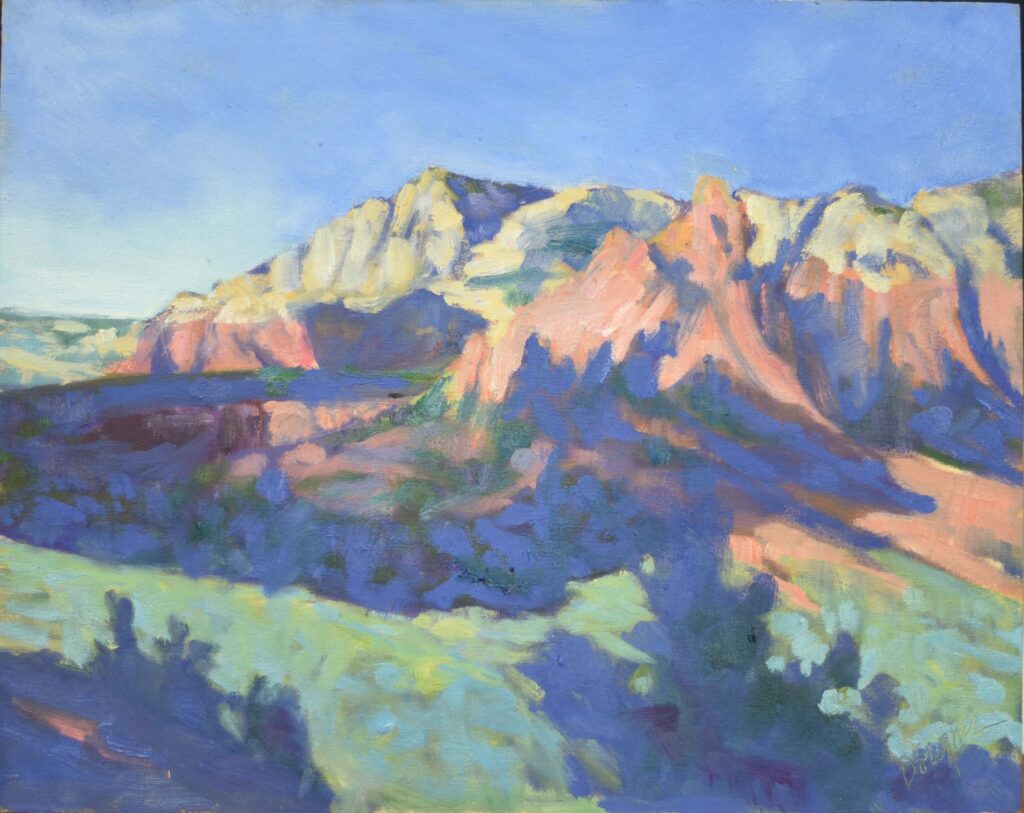
Shadow Fingers, 11X14, oil on Baltic birch, $869 includes shipping and handling in continental United States.

First, the business

My friend Dennis used to tell me, “I’m an accountant with the soul of an artist.” That’s all very well, I’d counter, but every successful artist also needs the mind of an accountant. (Luckily, I never believed in that now-discredited left-brain, right-brain malarkey.)

On March 8-9, I’ll be presenting at the first Sedona Entrepreneurial Artist Development Program. This is open to Arizona residents aged 18 and over. The two-day intensive covers a range of topics from financial management and marketing to crafting an artist statement, developing work samples and selling artwork online. My part will be accounting for artists, and I plan to make it exciting.

Even if you hire someone to do your taxes, you still need to understand what expenses to record and what don’t matter. You need to be able to track your inventory, and, if you teach or run a gallery, how to protect yourself against liability.

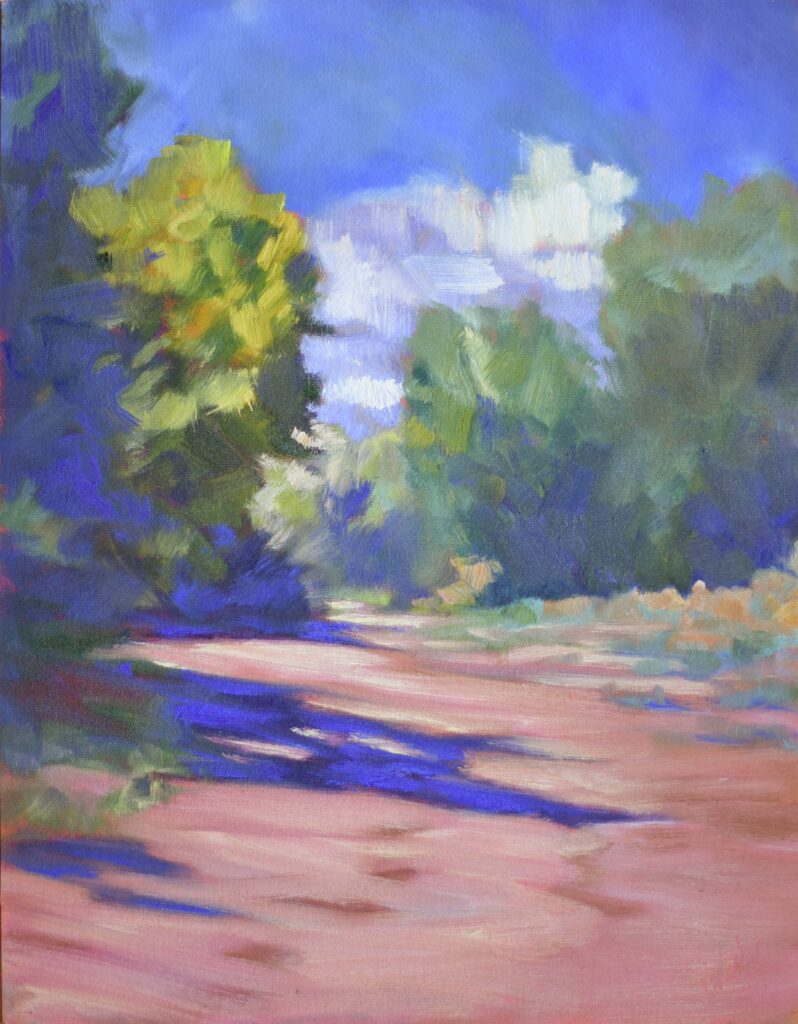
Country path, 14X18, oil on archival canvasboard, $1,275 includes shipping and handling in continental US.

Painting in Sedona

Immediately following the Entrepreneurial program, I’m offering Canyon Color for the Painter from March 10-14. There are still a few seats left.

I’ve taught and painted in Sedona for several years and know great places for morning light, evening light, and all the light in between. We’ll meet on location at 9 AM, work steadily until 4, and then you’ll have the evening to hike, take one of the famous Pink Jeep tours, or try one of Sedona’s many fine restaurants. If the weather is poor—and it almost never is—we can meet in a classroom at the Sedona Arts Center (SAC).

Dawn on the Upper Red Rock Loop Road, 20X24, oil on canvas, $2,318 includes shipping and handling in continental United States.

The top five things I love about painting in Sedona

  1. The weather—there is a scene in PG Wodehouse’s Quick Service where the old prizefighter Steptoe is trying to convince his wife to give up on Merry Olde England. “What you want wasting your time in this darned place beats me. Nobody but stiffs for miles around. And look what happens today. You give this lawn party, and what do you get? Cloudbursts and thunderstorms. Where’s the sense in sticking around in a climate like this?”

    He was urging her back to California, but in Sedona it’s also almost always fine. After this winter, we deserve fine.

  2. The scenery—Sedona combines some very brilliant colors: the reds of Bell and Cathedral Rock, the lush greens of Oak Creek Canyon, the sere yellows of the chaparral, and the deep blue of the sky. Because it’s seldom overcast, shadows jump and the light shimmers. It’s just magical.

  3. The people—I’ve known Julie Richard, the executive director of SAC, for a decade. It’s the same with Ed Buonvecchio, my workshop monitor. The rest of the support staff, including Bernadette Carroll and JD Jensen (with whom you’ll have the most contact), are kind and terrifically helpful.

  4. The hiking—There are 400 miles of hiking trails in the Red Rock Ranger District on the Coconino National Forest. Then there are state and city parks. Sedona is a hiker’s paradise, and I swear Julie Richard can tell you about every single trail.

  5. The funny things that always seem to happen to me there—Painting in Sedona has led to extremely funny interactions between the punters and me. I don’t think that’s from ley lines and vortexes, but because in the grand scheme of things, plein air painters are just one more dot on the overwhelming landscape. Come prepared to smile.
Hail on the Cockscomb Formation, oil on Baltic Birch, $522 includes shipping and handling in continental United States.

Registration is now open for workshops in 2026! Reserve your spot:

Can’t commit to a full workshop? Work online at your own pace:
Seven Protocols for Successful Oil Painters

Bells on Bob’s trail ring

Drifts and gusts at Erickson Field (if it doesn’t blow me over, it will trip me up), 8X10, oil on archival canvasboard, $522 includes shipping and handling in continental US.

Today is my 66th birthday. By choice I’ve lived every one of those long years in the far north. I like winter; I hate heat. I was born in Buffalo, NY, which means my blood is an amalgam of snow and beer. So, when I tell you this winter has been a unique pain in the arthritic joints, I speak from deep personal experience.

Can you paint in the winter? Heck, yeah.

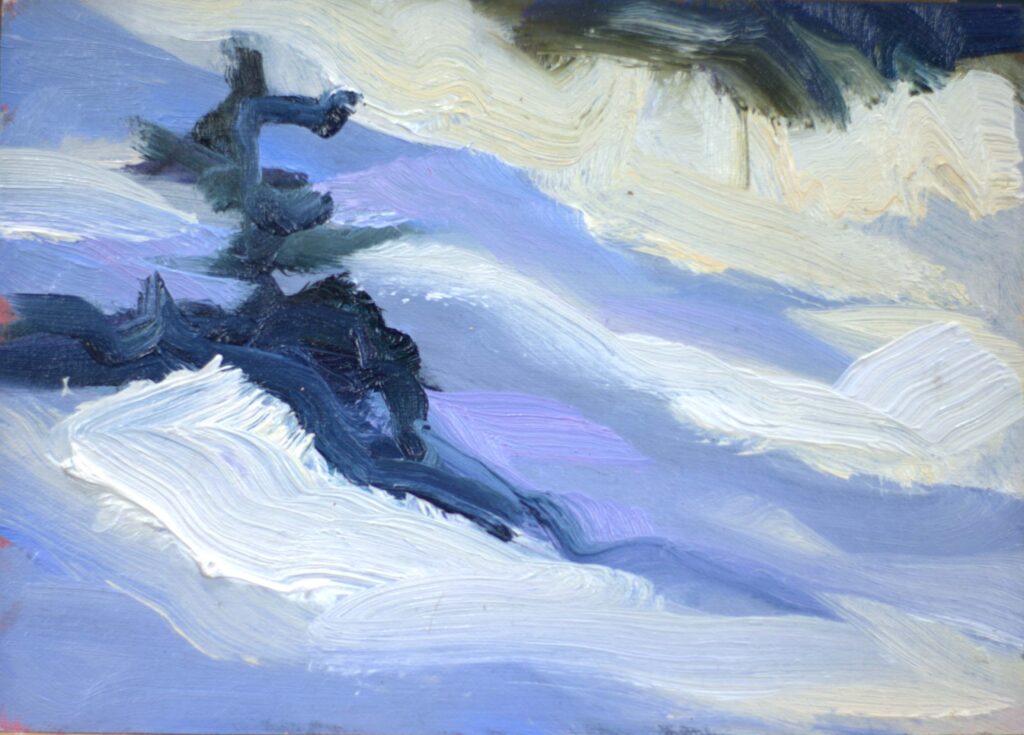
Little Tree in the snow, 4X6, oil on archival canvasboard, $217 includes shipping and handling in continental US.

About 25 years ago, I set out to paint every day of the year. I was living in Rochester, NY, which is every bit as tempestuous weatherwise as Buffalo. There were blizzards, there was sleet, there was hail, there were torrential rainstorms, there were line squalls, there were those awful, sticky, still, humid summer days that resolve into thunderstorms. Do you know what my take-away lesson was? I never need to do that again.

That doesn’t mean I won’t paint in the snow if the spirit moves me. Can you paint in the winter? Of course, if you dress right. It’s not quite true that there’s no such thing as bad weather, just bad clothing. However, my friend Poppy Balser paints outside in winter a lot. To be fair, though, Nova Scotia is milder than Maine. (If you want to try snow painting, my friend Catharine swears by these rechargeable pocket warmers.)

We’ve had a steady snow cover since December and many sunny days, so why haven’t I gotten out to paint? It’s been too frigid, the snow is deep and covers a slick layer of ice, and the wind seems to howl incessantly. While it looks lovely from my living room window, it’s been miserable out there.

We had an awful storm at the beginning of this week, with snow layering on sleet layering on snow. I got a glum text from Ken DeWaard. “I am officially sick of the snow,” he said. “I can’t even push it off the deck.” I felt badly for him until I went outside and realized that the portable garage-tent over my Ford 9N tractor had collapsed. And that was before the 50 MPH gusts hit later in the day.

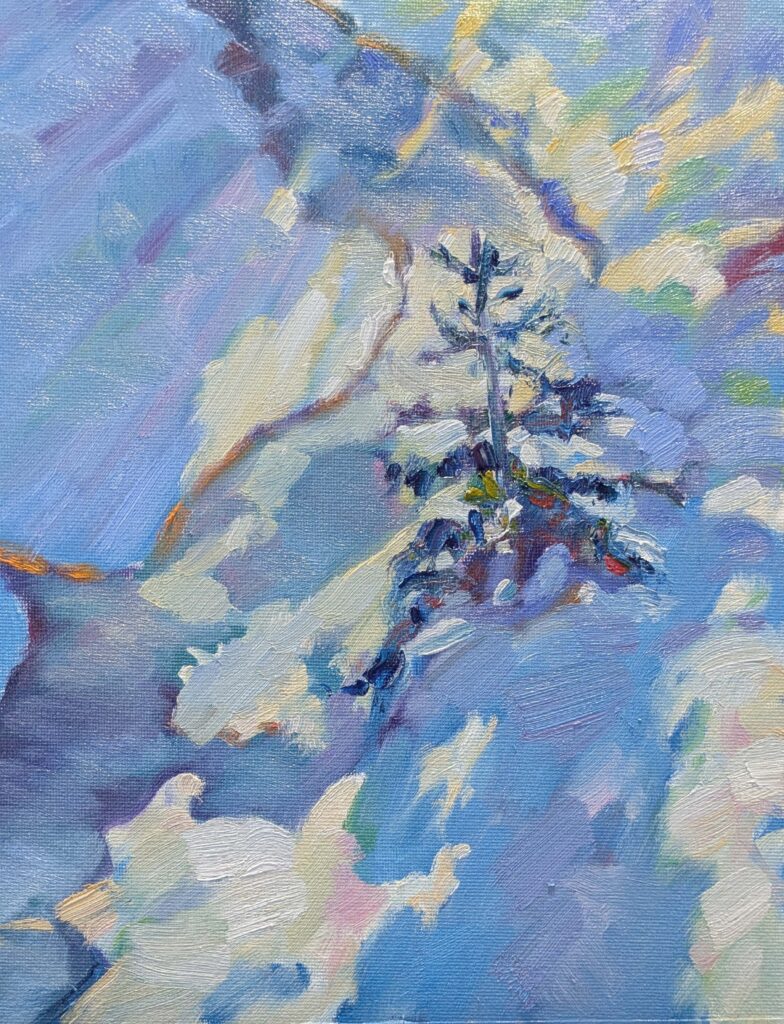
Baby pine tree in the snow. That’s a different baby pine tree. 9X12, oil on loose canvas.

Bob’s trail

I’m 66 and in rude good health, despite having had three different cancers. I blame this on my lifelong exercise habits. I ran until my first cancer at age 40; I’ve been walking and hiking long distances since then.

I’m supposed to be training to hike around Malta and Gozo in early April. My training regimen meant I should be doing five miles a day now. (All three of my hiking partners are younger, fitter, and possibly better-looking.) But the trails here are deeply buried; over the past week, I’ve struggled to do 2.5 miles. On Monday it took me an hour to push through just one mile. By Monday afternoon, even the dogs wouldn’t go out into that wind.

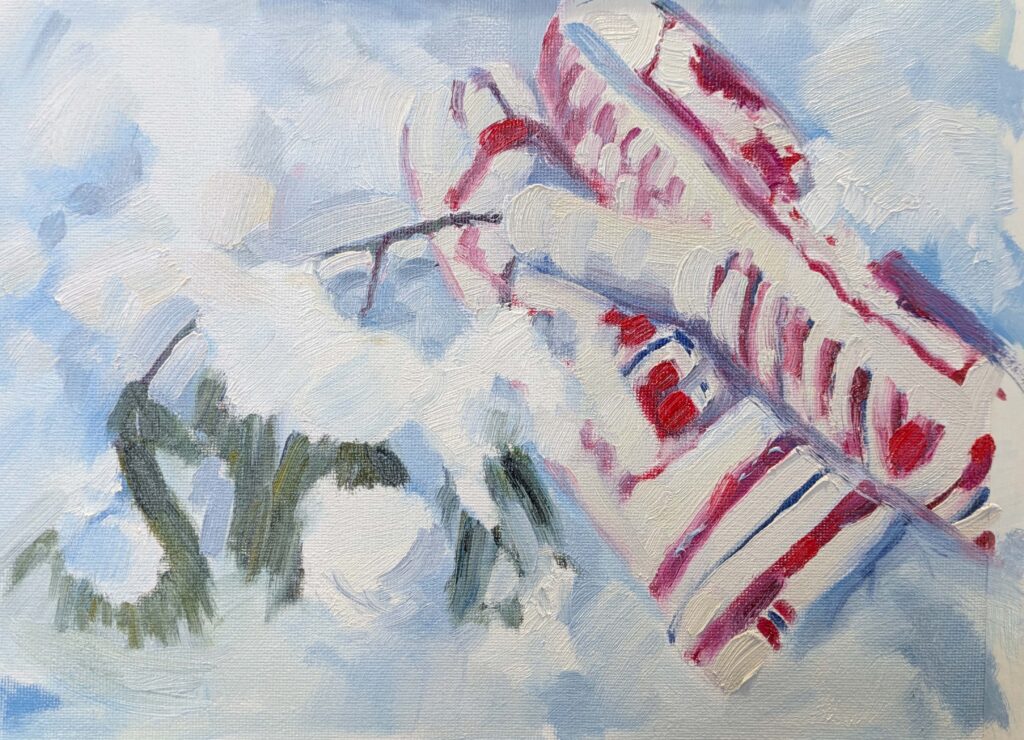
My mittens, 9X12, oil on loose canvas.

‘Bob’s trail’ is what I call an informal extra loop on my regular ascent, because my trail-buddy Bob first stomped it out. For the past several days, I’ve been pushing uphill on it and then realizing I’m too spent to make the rest of my loop.

Bob and his wife are regulars on these trails. Sometimes they do them on snowshoes. That’s a real blessing, because snowshoes pack the snow down evenly and make it possible to walk in their tracks. “Oh, where the heck are you,” I breathed, as I pushed through yet more snow. And then I realized that they’re in Vietnam, where the temperature is hovering around 70° F.

I guess I’d better go out to the shed and fetch my own dang snowshoes.

Registration is now open for workshops in 2026! Reserve your spot:

Can’t commit to a full workshop? Work online at your own pace:
Seven Protocols for Successful Oil Painters

Two paintings heading west

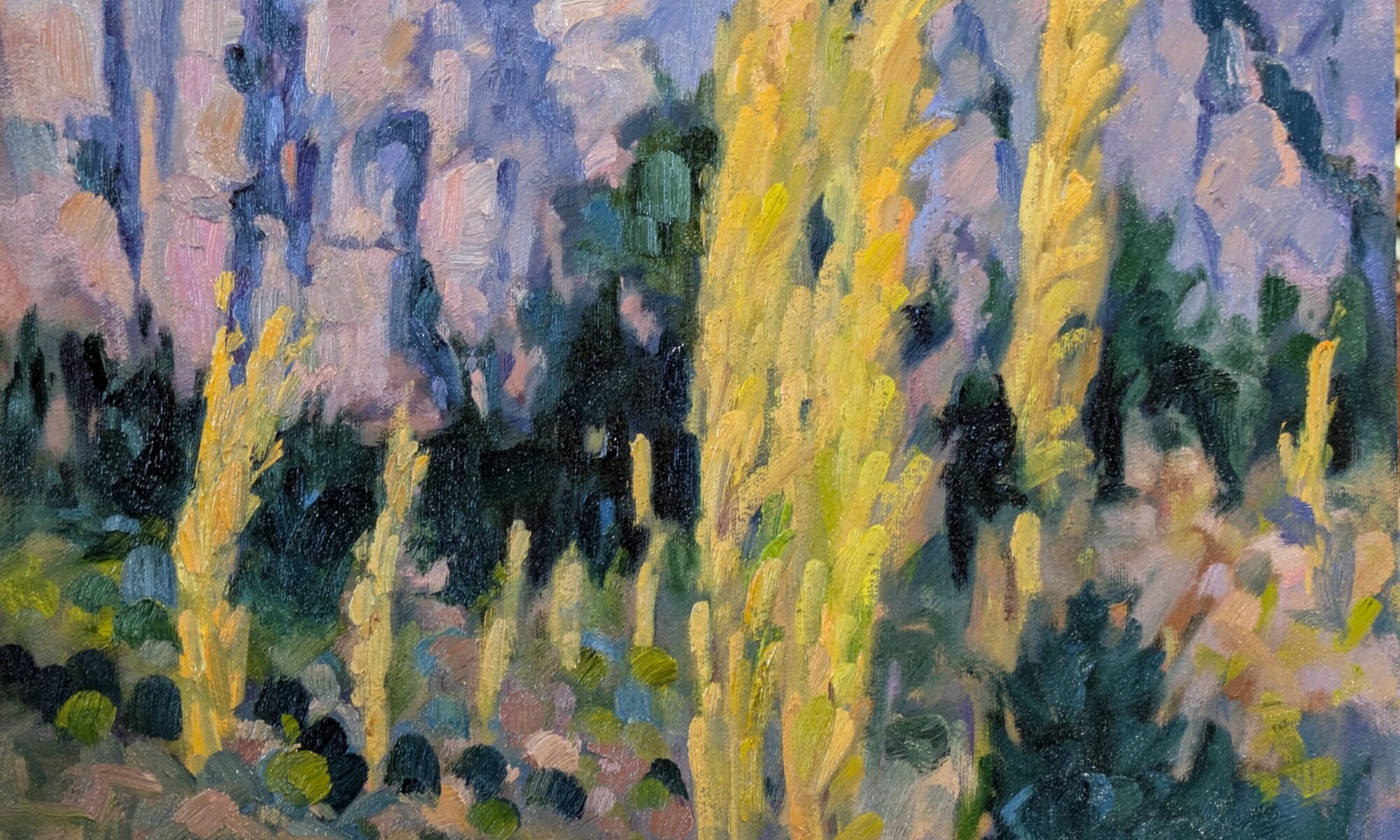
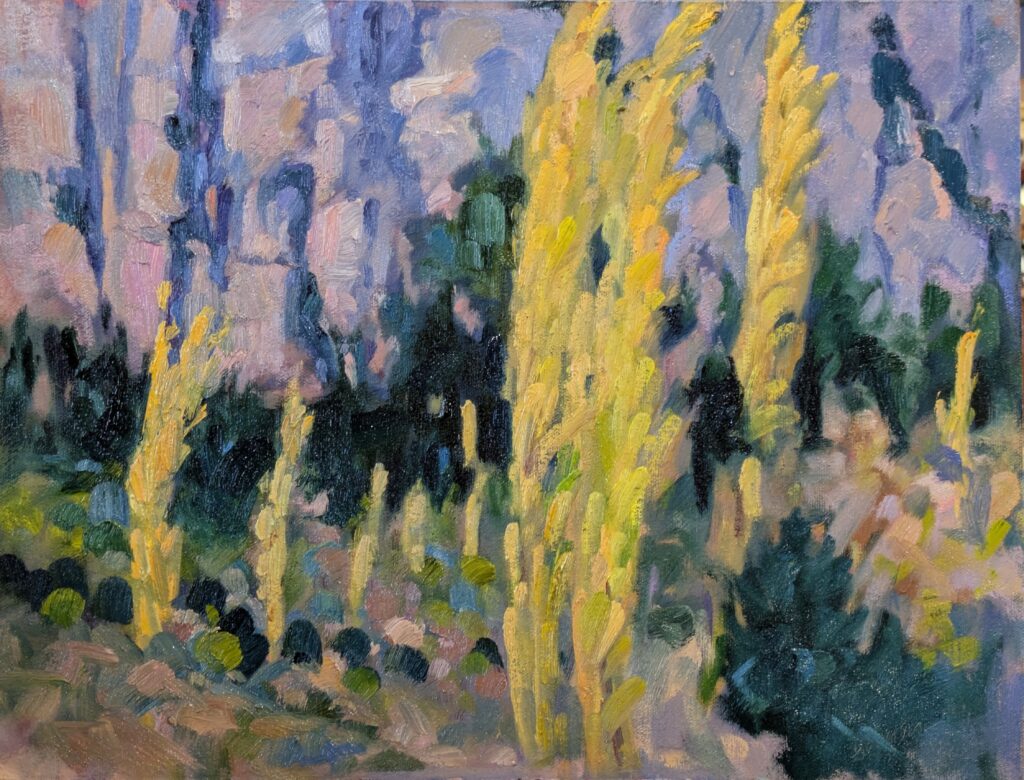
Poplars, 12X16, oil on archival canvasboard, available through Sedona Arts Center.

Going to Sedona Arts Center

I did about 95% of this painting while whooping it up with Ed Buonvecchio and Laura Martinez-Bianco in the Oak Creek Valley north of Slide Rock State Park. It was the last day of Sedona Arts Center’s 19th Annual Sedona Plein Air Festival. Ed wisely focused on the rocks rather than the trees. Laura and I waded into the foliage, looking for the abstraction that would define the place.

The scene has a flat meadow of dry grasses that cut straight across the base of the trees. Although the color was exquisite, I could find no way to include the grass without making a compositional blunder. Furthermore, black poplars are leggy and ungainly trees, although they were a magnificent golden color on that autumn day.

Claude Monet repeatedly visited poplars in a series of now-famous paintings. Nominally, these are about the trees, but their real subject is the interplay of light and pattern.

What I found so compelling (and difficult) about the scene was the repetition of the strong vertical motif in the trees and the rock spires behind them. I emphasized this by making the far-left tree bleed into the vertical chasm above it.

Sometimes we take risky decisions. Inevitably someone will come along and tell us how to correct our ‘mistakes’. I could have avoided the confluence of tree and rock, but it wouldn’t have been nearly as interesting to paint. Monsieur Monet never took the safe path; why should I?

Poplars is going with me to the 20th Annual Sedona Plein Air Festival later this month. I’m always happy to go to the Sedona Arts Center; not only do I get to see lots of my friends, but it’s a great organization.

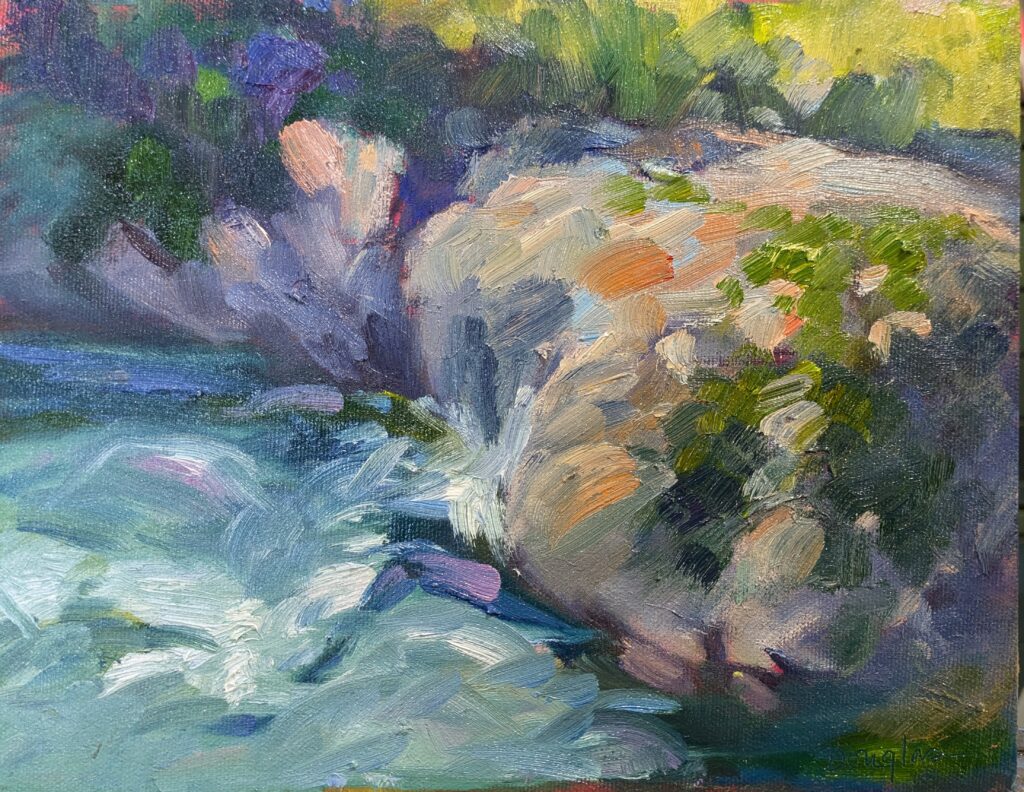
Floof, 8X10, private collection.

Floof!

This is going to a private collection out west. Its owner wanted a coastal Maine painting (who doesn’t?) so she’s getting this tiny confection of surf and rock, with a bit of pine in the top left corner. That’s pretty much what this state is all about, after all.

I am not sure why I called it Floof, except I kept saying that to myself as I churned the water up. As for the rocks themselves, they’re along the Bagaduce River in the town of Penobscot, ME.

A reminder

Student show
Richards Hill Gallery
394 Commercial Street
Rockport, ME 04856
4-6 PM
Friday, October 11, 2024

Artworks for Humanity

Sunrise, City Park, by Carol L. Douglas, 18X24, oil on linen, available in Artworks for Humanity auction.

This summer I ambled up to Belfast with Ken DeWaard, Peter Yesis, and Stephen Florimbi to paint for the third annual Artworks for Humanity. As usual, we puttered around but nothing stuck. I did, however, learn what a captain’s gig is: a long narrow boat with both a slew of oars and a mast and sail. And I did several starts, which I may or may not finish.

From Harbor Park, Alison Hill

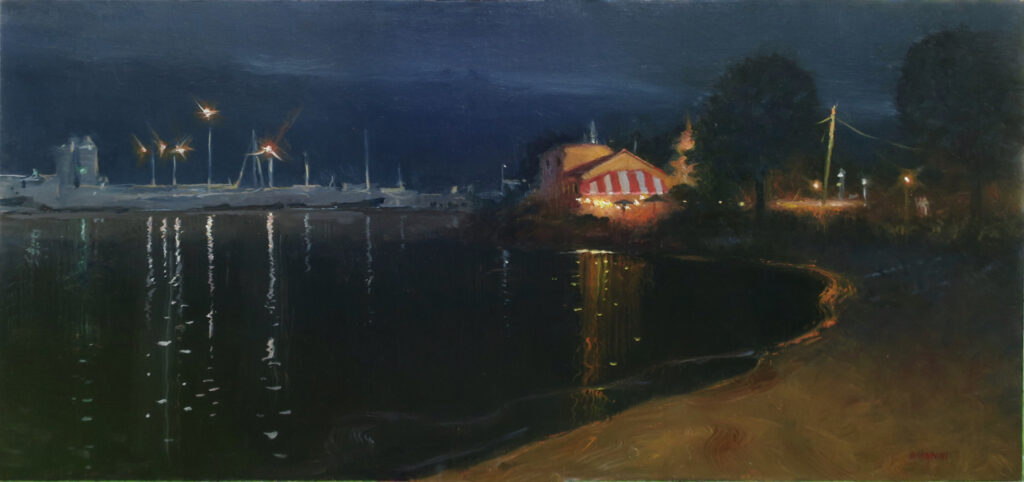
I can only wonder why Stephan Giannini loves to paint nocturnes, but he’s very good at it. I only like nocturnes if I can start them just before dawn, as I’m very much a morning person. Luckily, my subject, City Park in Belfast, looks great at dawn. It faces east.

McLaughlin’s Lobster Shack, Lincolnville, Stephan Giannini

I’ve given you just a sample of this year’s paintings, but the full complement is viewable here. There are 25 lots in all; just click on the main image to start scrolling. (I’m lot 20.)

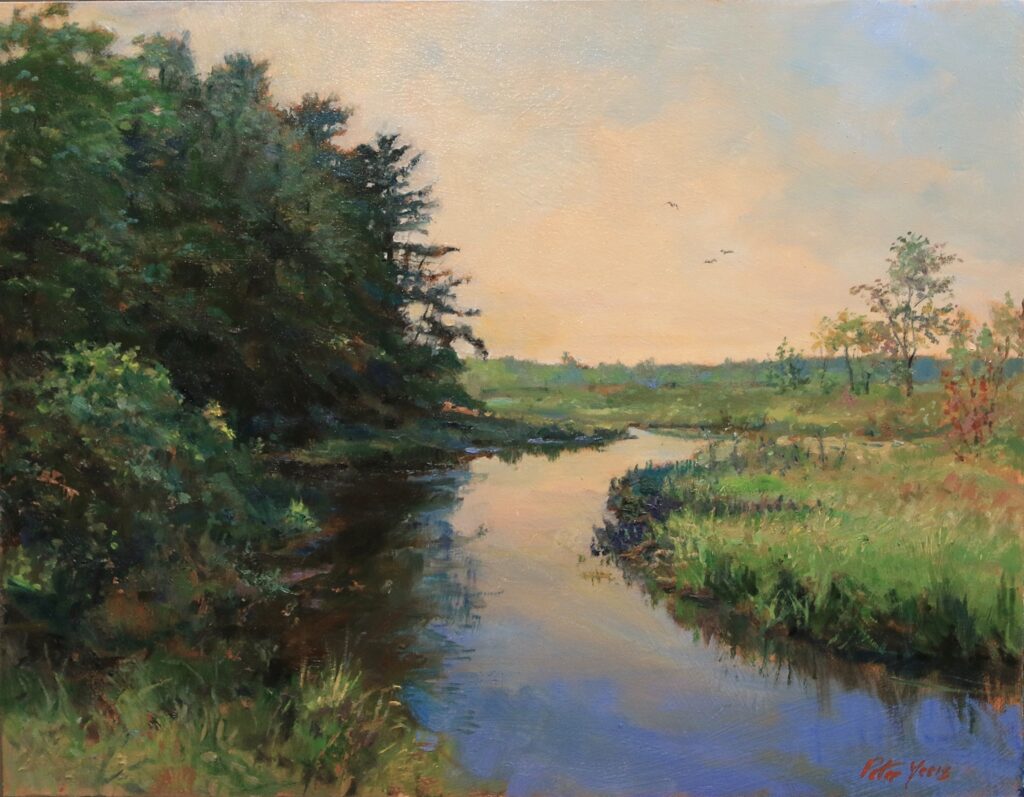
Goose River Morning, Peter Yesis

These paintings will be auctioned to support Habitat for Humanity of Waldo County. Sadly, I’ll be out of town. If you too will be away from midcoast Maine I urge you to bid on your favorite painting by contacting Kim at Waterfall Arts. She will take your information in advance and Habitat will have stand-in bidding on your behalf, up to your maximum bid.

In recent years, affordable housing has become difficult to find in coastal Maine. Visitors are affected just as much as full-time residents, because this disproportionately impacts service-industry workers. Buying a painting in this auction does more than just give you a lifetime memento of the place you love.

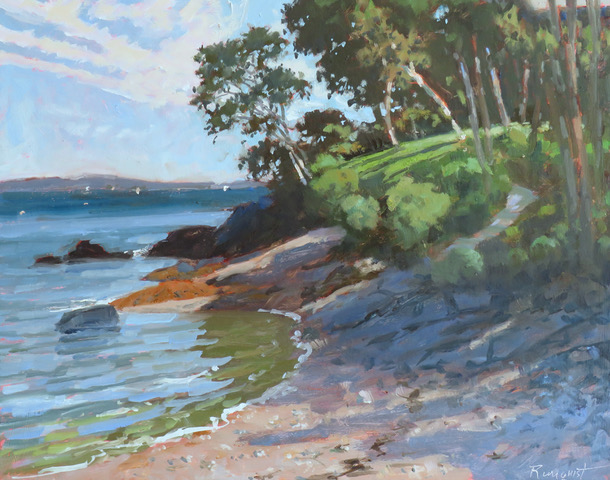
Afternoon Light, Björn Runquist

The public is invited to view the work in the Bayview Room of the United Farmers Market of Maine between 2:30-3:30 on September 28th. A ticketed reception with the artists will run from 4:30-5:30. The auction, by Belfast Mayor Eric Sanders, will begin at 5:30.

Belfast Morning, Eric Jacobsen

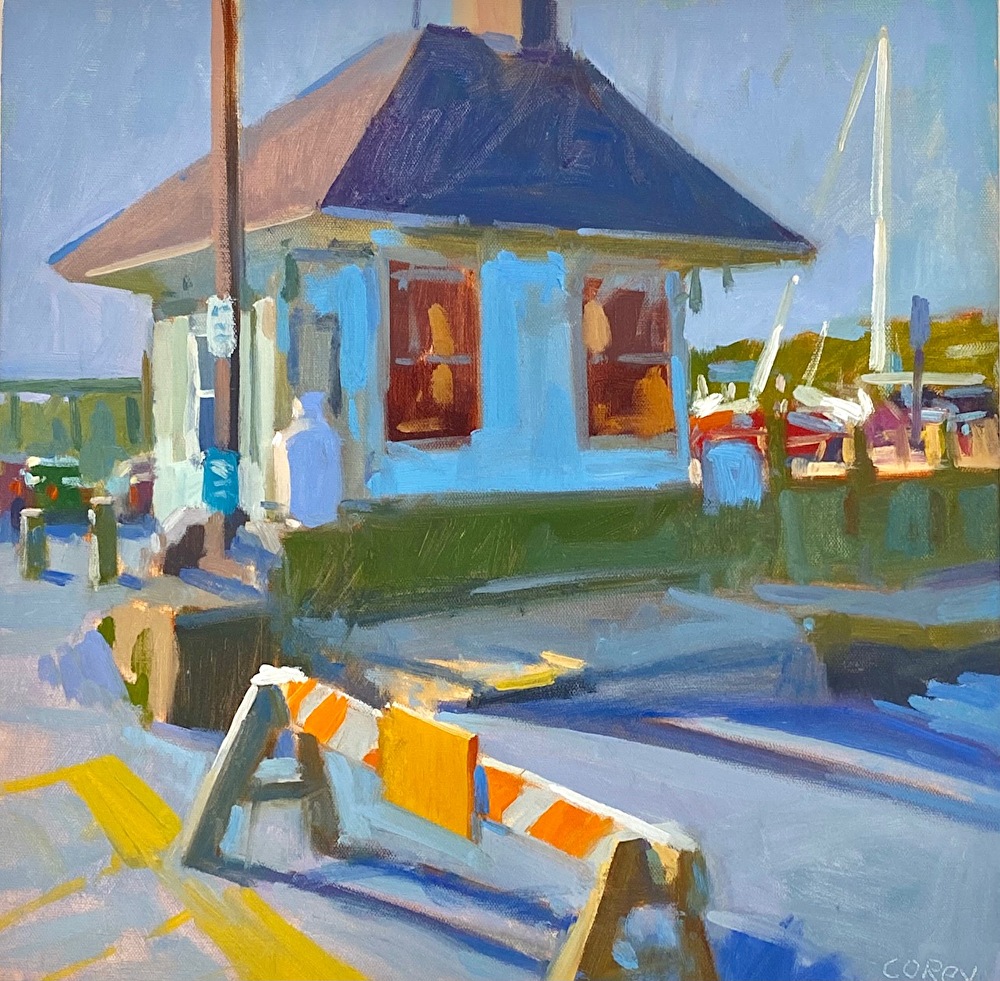
Harbormaster, Dan Corey

Visit www.artworksforhumanity.org for more details. Tickets can be purchased online, in advance at the office of Mailloux & Marden, P.A. (151 High St., Belfast), or at the door. 

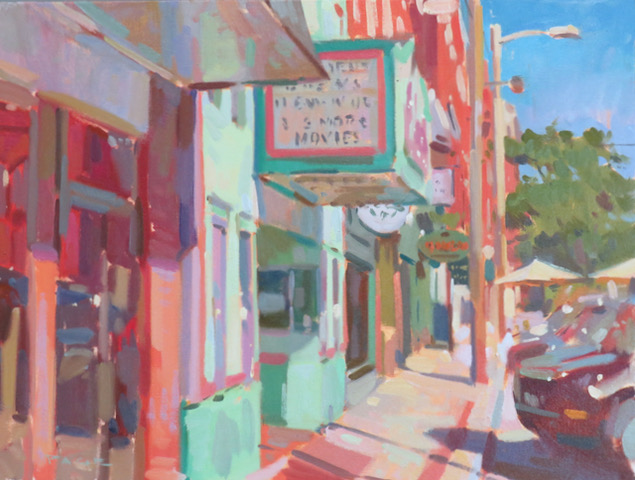
The Colonial, Colin Page

Registration is now open for workshops in 2026! Reserve your spot:

Can’t commit to a full workshop? Work online at your own pace:
Seven Protocols for Successful Oil Painters

Weeds, pests and other good design

First intimations of fall, 8X10, oil on prepared birch surface.

We’re in a long run of beautiful weather here in Maine. Ken DeWaardEric JacobsenBjörn Runquist and I have been out plein air painting as much as possible. I really need to do some paperwork, but there’s no rain on the forecast. How do people in southern California get anything done?

Here in New England, we know that any long stretch of warm, sunny, rain-free weather is the exception. Like squirrels storing up nuts for winter, we’re storing up visual memories of these warm days.

Overgrown, 8X10, oil on archival canvasboard.

I haven’t concerned myself with results. I’ve just painted fast and immersed myself in the process. Are any of these finished? Absolutely not. But they’re better than what was on those boards before.

For some reason, it’s been all about the weeds for me this week. I’m a big fan of God-as-gardener; I don’t think artificial gardens can touch wild meadows for beauty.

Nature’s palette shifts as the season progresses. Spring starts with delicate pastel blossoms blooming alongside the lilacs and dog roses. By midsummer, the blossoms grow more colorful, with crown vetch, clover and fireweed (and the brief, glorious burst of red wood lilies). Now that we’re approaching our first frost, we see radiant spirals of white and purple asters among the goldenrod. All are punctuated with the dried husks of milkweed and other earlier-blooming plants.

An unmowed field, 9X12, oil on archival canvasboard.

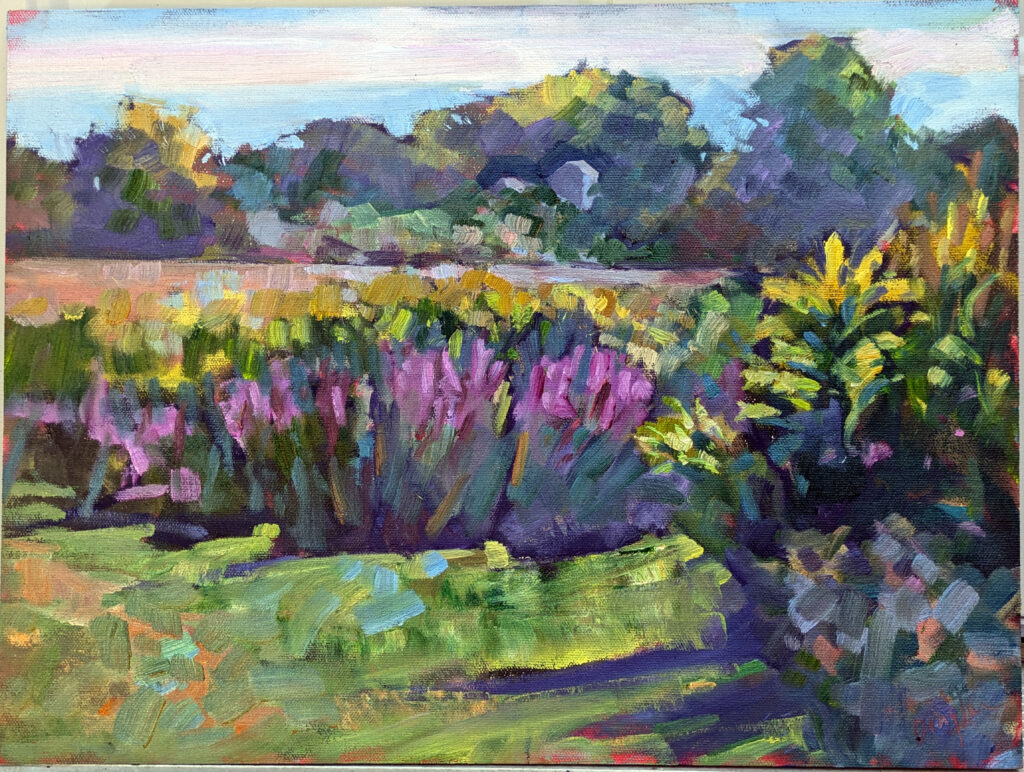
Purple loosestrife is, of course, an invasive pest and noxious weed; the experts all tell us that. They suggest pulling the plants before they can set seeds or, if it’s not in a wetland, spraying with an herbicide. (However, it likes its feet damp, so it avoids wholesale chemical slaughter, for the most part.)

It’s been around longer than I have, but its press is so bad that I’ve avoided painting it. However, the color is like nothing else in nature, and it complements goldenrod wonderfully.

The heck with it, I decided. If Eric doesn’t mind that it’s growing in his back field, neither do I. “The bees love it,” Eric told me. And anyways, I’m kind of an invasive species here, myself.

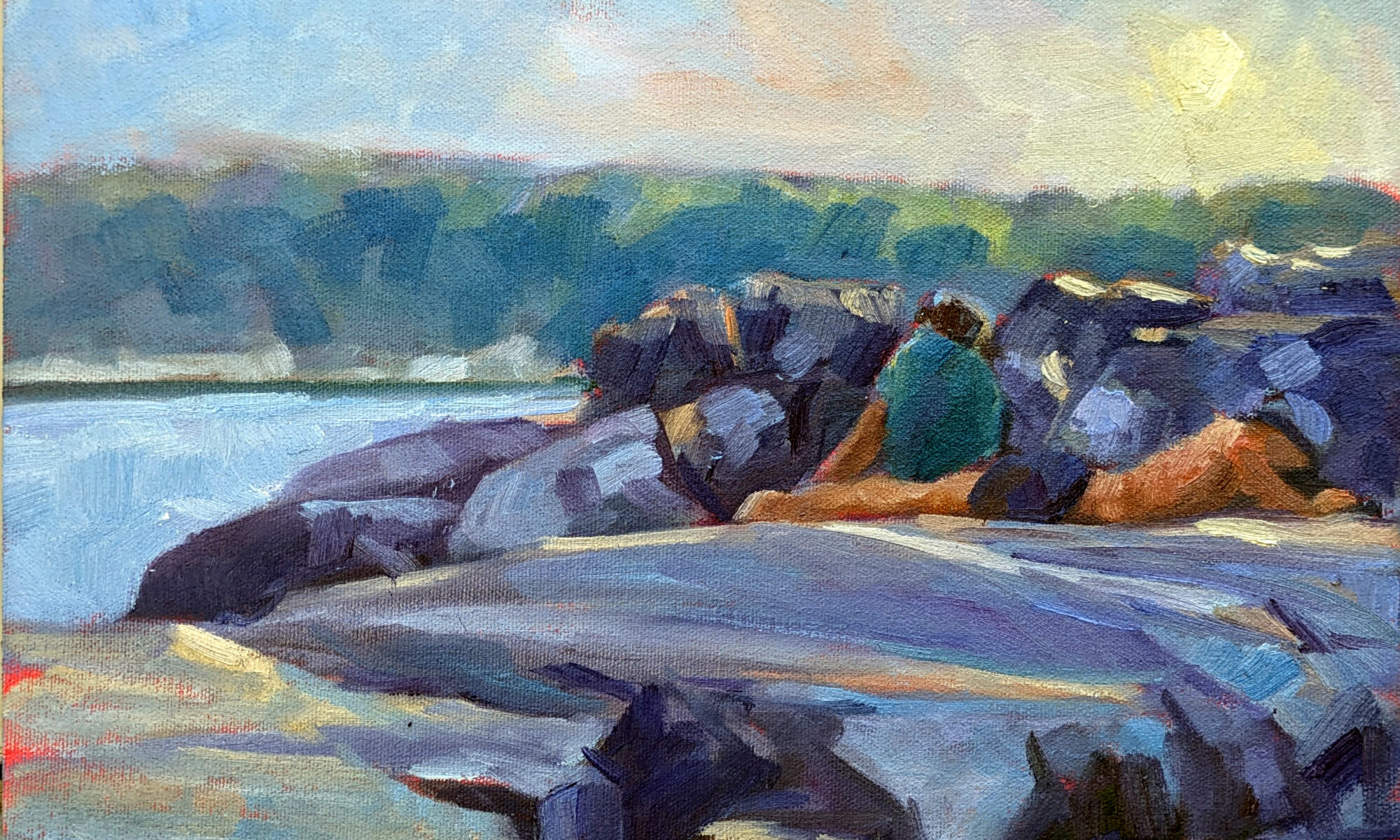
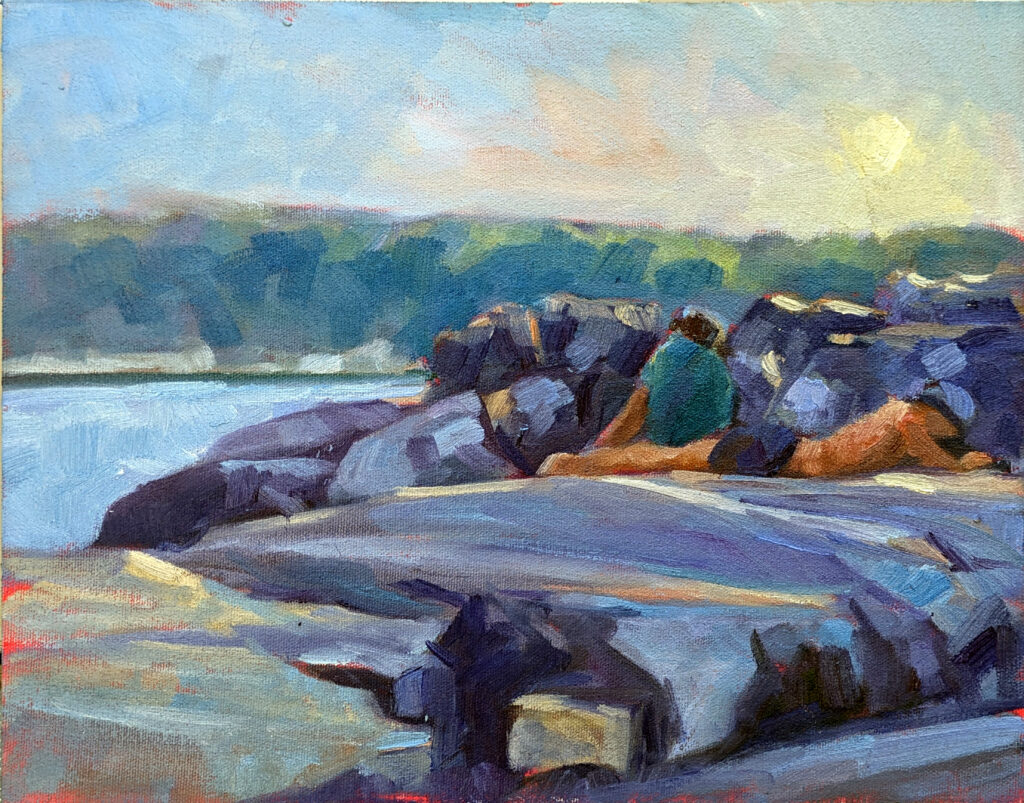
Sunbathers at Beauchamp Point, 9X12, oil on archival canvasboard.

I’ve painted boats at Beauchamp Point many times, since Rockport is a haven for wooden-boat enthusiasts. This week, I was distracted by a group of sunbathers, laughing and talking in the sweet evening air. There’s no sand on this ‘beach’, just rocks and bigger rocks, but there’s something satisfying about stretching out on a sun-kissed boulder. Pro tip: if you want people to leave, just start painting them.

Yesterday afternoon, Björn and I were finishing up, the others having moved along. An onshore breeze picked up. The temperature dropped, the leaves showed their undersides; a large flock of gulls pirouetted over our heads. “Where I’m from,” I told Björn, “the leaves turning over means a weather change.” He’d heard that too, but no such weather change is on the forecast.

After a lifetime in western New York, I could predict the weather from the sky, the wind, and even the smell of the air. Even after a decade, I have no such ability in Maine. I once asked Captain John Foss, what signs he looked for to predict a weather change. “I listen to the weather forecast,” he told me.

Mark next Friday on your calendar

Grand opening
Carol L. Douglas Gallery at Richards Hill
Friday, September 13, 5-7 PM
394 Commercial Street, Rockport, ME 04856

For more details, see here.

Registration is now open for workshops in 2026! Reserve your spot:

Can’t commit to a full workshop? Work online at your own pace:

Seven Protocols for Successful Oil Painters

Looking at summer in my rear-view mirror

Mature white pine at the Olson House, Cushing, ME, one of three things I painted on Thursday. Being contrarian, I refused to paint either the iconic view or the iconic house.

In past years, painting with Ken DeWaard, Eric Jacobsen and Björn Runquist wouldn’t have been worth a mention. This year I didn’t manage it until last Thursday. My summer has been terribly overbooked, something I’ve been complaining about for decades. That’s a pity when one lives in the northeast, where summer and fall are the best seasons.

I recently suggested to my daughter that we make a pact to not work more than 45 hours a week on non-family things. “I can’t possibly!” she responded. She’s a third-generation over-scheduler; my mother was the same way. When I was 35, my mother tried to get me to stop it, with about the same success. At 65 I begin to see what she was talking about. You don’t do anything well if you’re trying to do everything.

Having unsuccessfully laid down the gauntlet to my daughter, I spent the Labor Day weekend wrestling with myself about where I’ll cut down.

Brigantine Swift in Camden Harbor, 24X30, oil on canvas, framed, $3478 includes shipping and handling in continental US. Yes, this was painted en plein air, and if you want to see it in real life, it’s at Lone Pine Real Estate, 19 Elm Street, Camden, ME

What good is a teacher who doesn’t paint?

I sometimes feel as if I’m potting along in a Chevy Aveo while my friends pass me left and right in their Corvettes. I love teaching and I’m good at it. But that makes it too easy to sacrifice painting for teaching time. Painting should be constant revelation, change and discovery, and you can’t do that without a brush in your hand.

This, of course, is nobody’s fault but my own.

As I always tell my students, painting in the studio is good, but painting outdoors in natural light is the best possible training for an artist. In Maine, summer and fall are the best seasons, but, dang, they’re short!

Athabasca River Confluence, 9X12, $696 includes shipping and handling in continental US. I might crank about travel right now, but this is a place I’d go back to in a nanosecond.

I’m limiting my 2025 workshops.

I’m only going to teach four workshops in 2025, and none of them will involve flying.

Advanced Plein Air Painting (Rockport, ME), July 7-11, 2025

This is an opportunity for more advanced painters to work on the complex concepts in painting, like directing the viewer’s eye, narrative flow, serious drawing, etc. If you’ve already studied with me, email me to ask if you should take this workshop. If not, send me some sample work as per the course description.

That’s the only workshop that’s only for advanced painters. The rest are open to students of all levels (and I like a mixture of experience; it makes it livelier for everyone).

Sunset over Cadillac Mountain, oil on archival canvasboard, $869 includes shipping and handling. There’s a reason this is my longest-running workshop.

Sea and Sky at Acadia National Park, August 3-8, 2025

This is an opportunity to spend time at America’s first national park. I’d encourage you to live in if possible; it becomes a bonding and immersive experience. However, I always have commuters and they seem to benefit as well. I’ve been teaching this workshop longer than any other, because it’s a personal favorite.

Find Your Authentic Voice in Plein Air, Berkshires, August 11-15, 2025

This is centered in historic Lenox, MA. I chose this location because it’s in easy driving distance of NYC (3 hours) and Boston (2.5 hours). The Berkshires are relaxed, agricultural, historic and scenic. Plus, you can get good cider doughnuts. It’s the only workshop I teach where I also have been known to go shopping.

Immersive In-Person Fall Workshop, Rockport ME, October 6-10, 2025.

This is the height of fall color, for which of course New England is famous. Add the tang of the ocean and the peculiar reds of blueberry barrens and it’s downright otherworldly. I throw in a few curveballs, like a model in the landscape and a visit to the Farnsworth Art Museum in Rockland.

(By the way, if you want to do this in 2024, I still have a few openings.)

What does that mean for you?

It means that only 59 people will have the opportunity to study with me in person in 2025. (I’ll still be teaching on Zoom, of course.) I’ll be promoting these workshops all fall, but if you know you want to take one, you might as well register and make your deposit now.

Registration is now open for workshops in 2026! Reserve your spot:

Can’t commit to a full workshop? Work online at your own pace:
Seven Protocols for Successful Oil Painters