A friend recently wrote to me about the importance of taking breaks while painting. One of her professors at Yale had recommended A Writer’s Time, by Kenneth Atchity. It argues that stepping away from a project gives you more than physical rest. It can also give you a perspective on your work that you simply couldn’t have while you were in the middle of it.
It was relevant to me because this is my busiest time of the year. I’ve been working obsessively, and my reward has been another case of shingles (yes, I’ve had the vaccine).
I took an hour’s break on Friday morning to shoot clay pigeons with my girls. Surprisingly, I didn’t do too badly at all, and I was in a great mood for the rest of the day.
Work harder, not smarter
We are trained from childhood to believe that the answer to knotty questions is to work harder. We extend that idea to painting. The sky isn’t right? Keep painting. The composition feels awkward? Poke at it some more. The whole thing is going south? Surely another hour at the easel will fix it.
Sometimes it does. More often, we just get more deeply involved in the problem.
When you’re standing three feet from a canvas, you’re making hundreds of tiny decisions. Is that edge too hard? Should that green be warmer? Does the shadow need more blue? You’re so busy solving individual problems that you can lose sight of the painting as a whole. You don’t notice that the darks are gone, or that you’ve introduced awkward parallel shapes.
A change is as good as a rest
Find a cup of coffee and a bathroom. Eat lunch. Talk to a fellow painter. Read something. The point isn’t to abandon your work. It’s to give your brain a chance to stop wrestling with it.
When you return, you’ll see things that were invisible before. You’ll realize that the things you spent time dithering about were overdone or unnecessary, or—the best outcome—that your painting is working better than you thought.
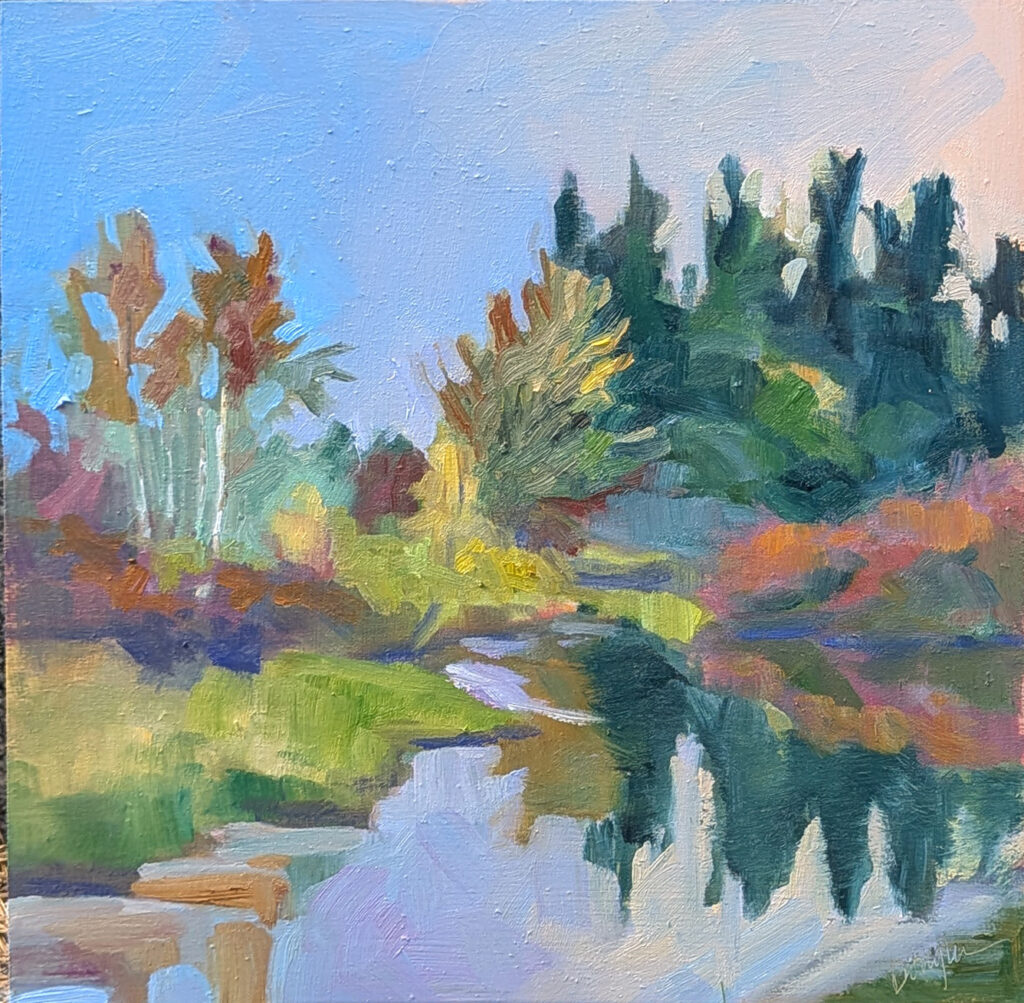
Distance changes the way we see.
Let your paintings rest. Don’t carry them around, scrutinizing every brushstroke. Tomorrow morning, you may see a problem immediately, or realize that the problem you were perseverating over wasn’t a problem at all.
Take a photo on your cell phone, turn your canvas over or look at it in a mirror. This can provide emotional distance. But the most useful tool is simply time and rest.
I’m painting in an event right now
I’m painting at Plein Air Litchfield this week. Yes, we have limited hours, limited daylight, and perhaps only a few precious days to work on a particular subject. Surely, we should make every minute count.
But creativity isn’t an assembly line. More hours do not automatically produce better paintings. I keep reminding myself that sometimes the most productive thing I can do is stop.
I regularly reach a point where I’m no longer seeing the subject clearly. I’m just reacting to the canvas. That’s a good time to take a break while painting. I’m disciplining myself to put down the brush, step away, and then look at the landscape again with fresh eyes.
I have just two workshops left in 2026! Reserve your spot:
- New! Color Clinic 2026 | Rockport, ME, October 3-4, 2026
- New! Composition Week 2026 | Rockport, ME, October 5-9, 2026
- High-Desert Light & Monumental Form | Sedona, AZ, Apr 26, 2027 – Apr 30, 2027
Can’t commit to a full workshop? Work online at your own pace:
“the most productive thing I can do is stop.” What a profound message! I’m going to figure out how to immortalize that idea and post it in Mike’s studio. I hope you’re feeling better soon.
Beautiful paintings! Get well soon Carol!
Great advice that is sometimes hard to heed!
Thank you, Mark!