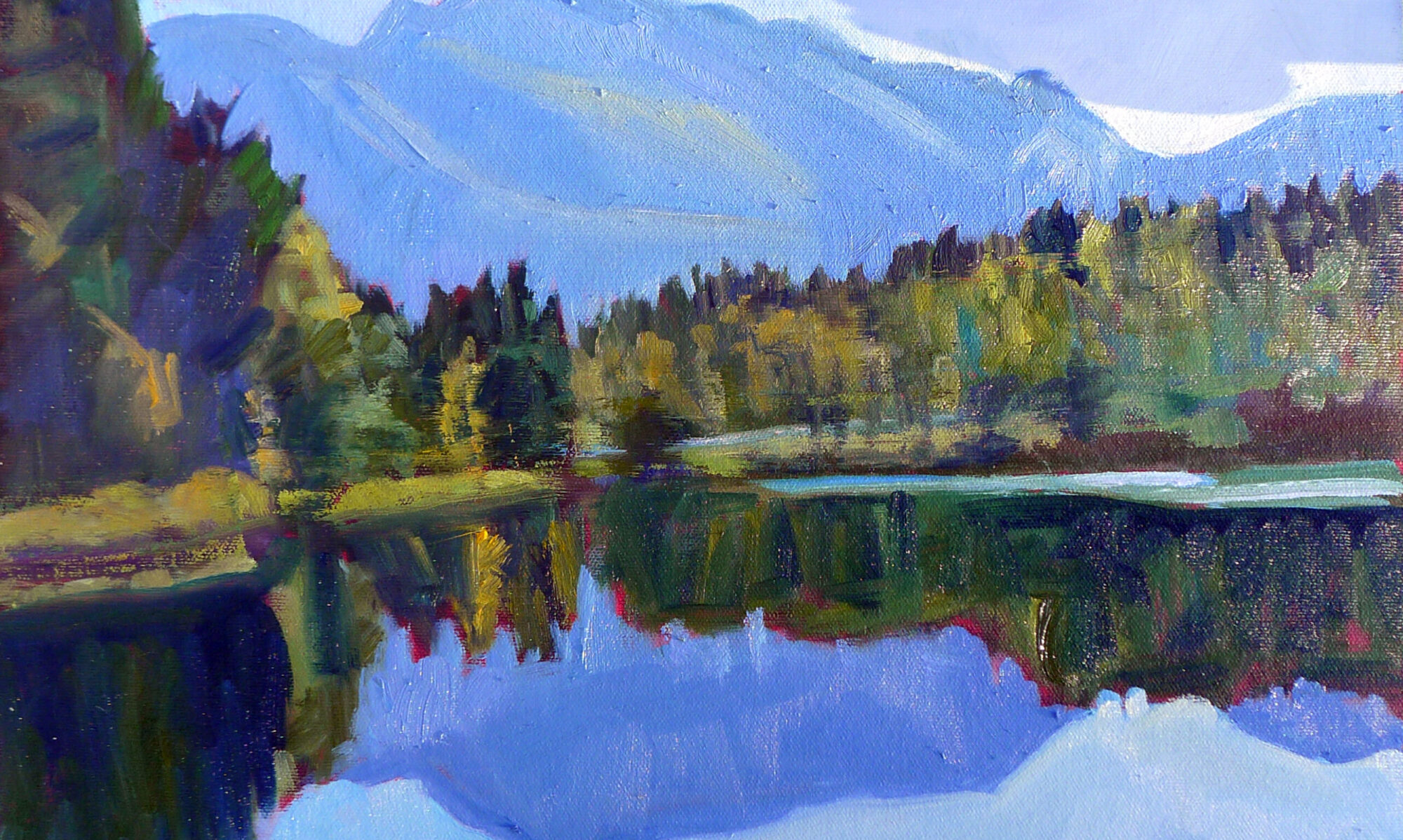


I’ve just spent the week with a very competent group of student artists in my annual Sea & Sky at Acadia National Park workshop. “What a talented group!” a passer-by said yesterday.
What’s wrong with calling artists ‘talented’?
Calling an artist ‘talented’ might at first glance seem complimentary. However, successful artists come from all kinds of different skill sets—some are good at spatial relationships, some at math, some at language. They have one thing in common—a capacity for hard work. I’m seeing that here this week, as my band of painters spend hours standing in the hot sun on the rocky ledges of Schoodic Peninsula. Their goal is to develop their skills, and they’re indefatigable.

Calling them ‘talented’ is dismissive. It downplays their hard work and discipline. It implies that they were born with a gift, rather than having earned their skill through years of effort, learning, failure, and practice. It makes their accomplishments seem effortless, which is never the case. Great art doesn’t spring fully-formed from the minds of geniuses. It is made incrementally.
Artists are often asked how long it took to make a specific work. The smart ones answer, “Three hours, and many years,” because every work of art is based on all our prior works.

‘Talented‘ is discouraging
Ascribing success to talent discourages beginners. A person who believes that great art is the result of talent rather than skill-building may conclude that they’re not talented, so there’s no point in even trying.
Being told you’re talented (as I was as a child) can also be crippling. The child raised to believe he or she is talented may coast, or be reluctant to challenge that talent in the marketplace of ideas. How much easier it is to believe that you could be the best, if only…

The Cult of Genius
The Cult of Genius gained prominence in the 18th century. It was the idea that genius is an inherent, almost divine, gift. It has resulted in the elevation of select individuals, overemphasizing their unique and seemingly superhuman abilities.
True genius is just rebellion against conventional thinking. It’s an iconoclastic way of looking at things. As such, it belongs to anyone of reasonable intelligence. A momentary, “yes, but…” can lead to revolutionary ideas.

Labeling someone as “talented” feeds into the romantic idea that great ideas spring fully formed from an inner muse. Artists, like other professionals, refine their craft over time. Real success comes from a combination of curiosity, grit, feedback, and many, many hours of work.
Our society denigrates art. That’s easier to do that when you think ‘talent’ is just a genetic trait, like eye color.
It’s fine to admire someone’s abilities
Not all art criticism needs to be expert. It’s okay to tell an artist, “That’s beautiful,” or “I love the colors,” or “this moves me.” It’s equally okay to ask questions, like “why did you use that composition,” or “what are you trying to say in this painting?” These are comments directed to the piece, not something in the artist’s makeup.

Registration is now open for workshops in 2026! Reserve your spot:
- Find your Authentic Voice in Plein Air | Berkshires, MA, August 10-14, 2026
- New! Color Clinic 2026 | Rockport, ME, October 3-4, 2026
- New! Composition Week 2026 | Rockport, ME, October 5-9, 2026
Can’t commit to a full workshop? Work online at your own pace:
THANK YOU FOR SAYING THAT! I quit painting after 25 yrs. bec. I did not believe I had talent and it still bothers me. I have given many watercolors away that people loved. I’ve sold some–not many but I just am not good at promoting myself and am largely self taught. But I was a really good 8th grade teacher with a philosophy similar to yours! Wil start your 20 ideas for getting started someday when I can convince myself to do so. Thanks for the inspiration.
jan
I am cheering you on!