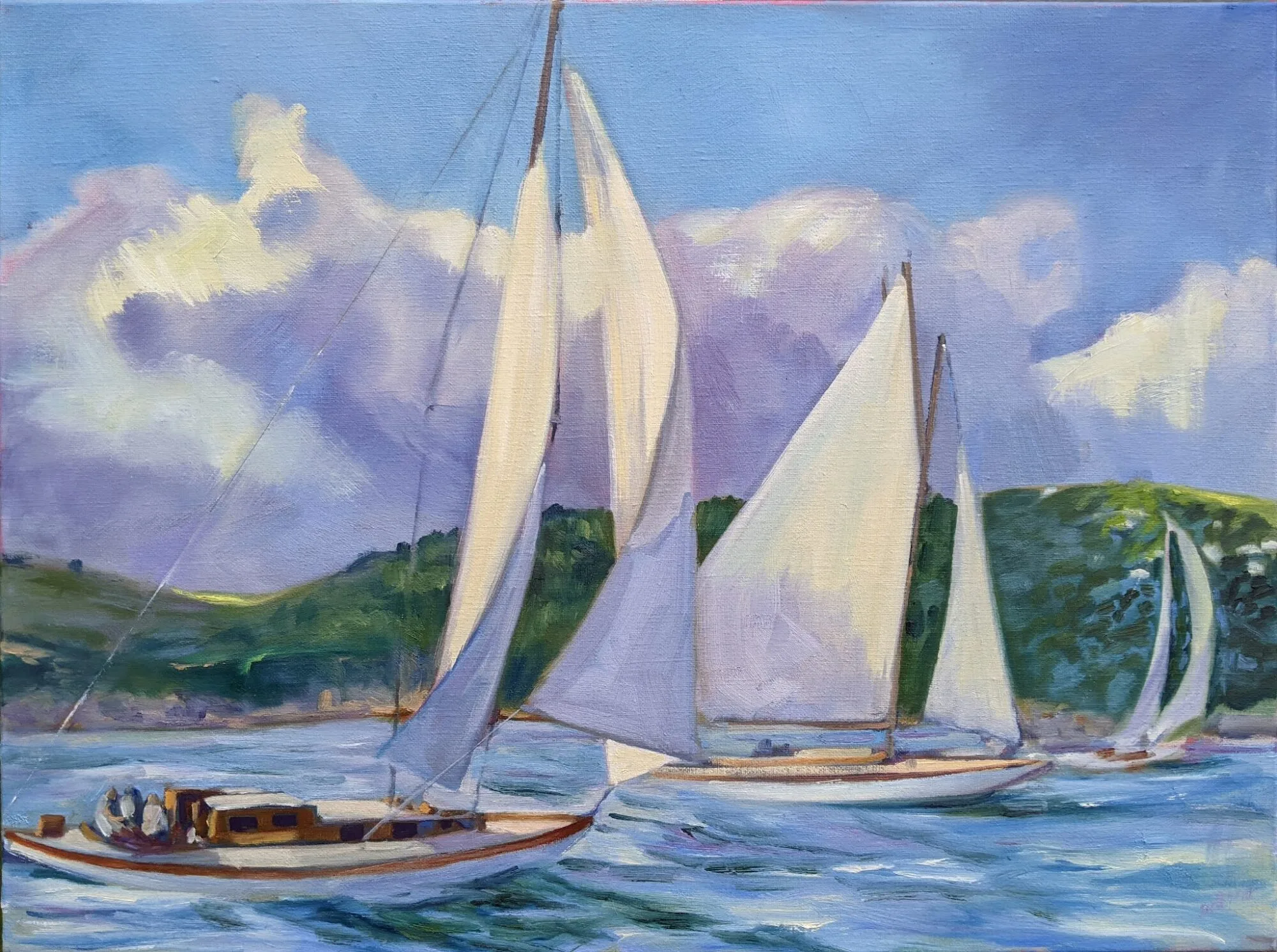


Composition is the quiet engine of a successful painting. It’s the part viewers feel before they start thinking rationally. It’s also the part painters often skip past too quickly. I’m busy writing my upcoming Zoom class, Trust the Process (making technique tell the story you want to tell), and of course composition is a big part of that.

The first pillar of composition is harmony
Harmony in notan is about space cutting—the abstract division of the picture into dark and light shapes. This is not strict value modeling or chiaroscuro. It’s closer to pattern and rhythm. When Whistler painted Symphony in White, No. 2, he wasn’t describing light so much as arranging shapes.
Harmony in line is about the boundaries between shapes and the relationships between those boundaries and the surrounding space. The Charioteer of Delphi is a masterclass in this. Even in stillness, the interlocking lines guide the eye with clarity and restraint. Strong line harmony keeps a painting readable from across the room.
Harmony in color depends on hue, saturation, and value working together. Monet’s Rouen Cathedral series shows how disciplined color harmony can create vastly different moods using the same motif. Color isn’t decoration; it’s structure.

What’s my number one rule?
If you’ve taken any of my classes, you’ve probably already answered, “Don’t be boring!” All rules can be broken, but only once you know what they are. Jacques Henri Lartigue’s Cousin Bichonnade works precisely because it bends expectations with confidence. Predictability is the real enemy, and that means being unpredictable even to yourself.

Dividing the frame in interesting ways helps avoid that trap. The rule of thirds is just the very beginning. There’s no law that says you can’t put the subject smack dab in the center of your composition. Look no farther than Leonardo da Vinci’s Vitruvian Man to see the power of symmetry and geometry in design.
Maynard Dixon’s Forgotten Man and Abandoned Ranch demonstrate how restraint, scale, and placement create emotional gravity. Both tell the story of the Great Depression indirectly, yet powerfully. Which brings us to focal points, which are different from the subject of a painting. Know what and where they are before you paint. Use contrast and line to support them—and never park them on the edge of the canvas.

Finally, consider the motive line, or kinetic line. It’s tied to the major area of focus, divides contrasting values, and must be complex and intentional. Edgar Degas and Winslow Homer both used motive line to energize still scenes, guiding the viewer through the painting with quiet authority.
Want to learn more about this? I’d love to have you join me for Trust the Process (making technique tell the story you want to tell), my live Zoom class designed to help you build a dependable, joyful, repeatable painting practice. We’ll dig into technique, creative decision-making and the mindset that frees you to paint with confidence. We meet Monday nights, 6-9 PM EST, starting on January 5, 2026. It’s suitable for all levels and all media. You can learn more here.
Registration is now open for workshops in 2026! Reserve your spot:
- Advanced Plein Air Painting | Rockport, ME, July 13-17, 2026
- Sea & Sky | Acadia National Park, ME, August 2–7, 2026
- Find your Authentic Voice in Plein Air | Berkshires, MA, August 10-14, 2026
- New! Color Clinic 2026 | Rockport, ME, October 3-4, 2026
- New! Composition Week 2026 | Rockport, ME, October 5-9, 2026
Can’t commit to a full workshop? Work online at your own pace: