After getting rid of advertising on my blog, it’s hard to believe I’m directing you to this ad. It’s artist-as-romantic-archetype, and it’s annoying. However, she does have great hair.
It starts with a young woman at an easel, looking dissatisfied with her careful, controlled daubs. (Of course she is; there’s no structure there, and no sketchbook. She clearly hasn’t worked out her ideas.) She stalks off in frustration; she chances upon a graffiti artist. Suddenly our painter’s canvas is enlarged, as is her studio, and she’s embracing the freedom of spray-paint art.
The penultimate scene, showing her finished work, had me confused until I realized it read “free,” not “Fred.” But that’s not the point. It’s that the ad sells a lie.
The myth of instant artistic freedom
In thirty seconds, we’re told that careful painting is stifling, structure is oppressive, and freedom comes from throwing out discipline. If you feel stuck in your painting practice, what you need are bigger gestures, looser marks and more art supplies.
That’s a seductive story. It’s also wrong.
Order spray paint, gouache, pastels, sumi-e ink if you want a change, but you’ll find them all as technically demanding as whatever you’re using now. Large scale is not the same thing as vision. And spontaneity without structure is just noise.
The young woman in the ad wasn’t frustrated because she was painting small. She hadn’t done the hard work that undergirds all strong painting: drawing, value studies and compositional planning.
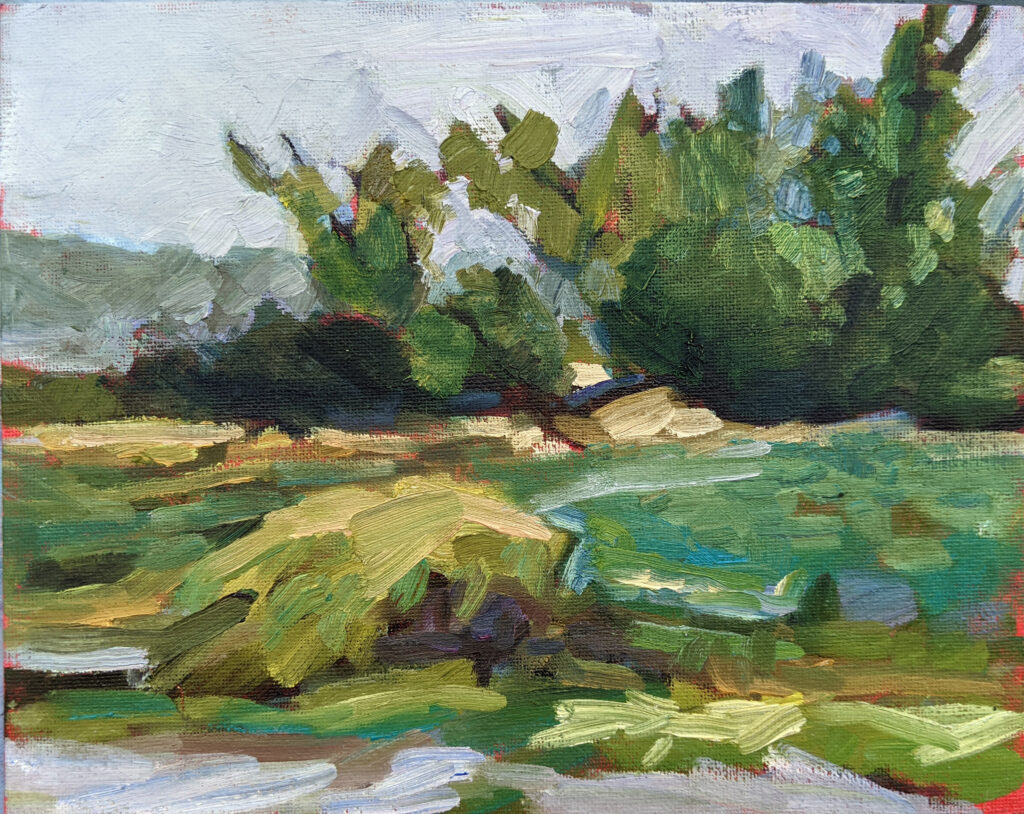
Structure is not the enemy of creativity
Students sometimes seek expressive brushwork without first understanding value. They want bold color without mastering color temperature. They want freedom before fluency. But they have to flip those things around and master the basics first.
Technique in painting isn’t a cage. It’s a scaffold.
When you do thumbnail sketches in your sketchbook, you’re not killing creativity; you’re clarifying it. When you work out a value study, you’re not being rigid, you’re building a framework that will support expressive paint handling later.
The reel implies that discipline is a phase you outgrow. In reality, discipline is what makes artistic freedom possible.

Bigger isn’t better
The transformation in the ad hinges on ‘more’: bigger studio, bigger canvas and bigger gestures. That’s a very modern American way to think, but if your composition is weak at 12×16, it will look even worse at 48×60.
Social media encourages the sizzle over the steak, confusing spectacle and substance. We’re encouraged to think that scale means significance, and that visible energy equals authenticity. But energy without clarity is exhausting. Expressive brushwork without design is chaos.
Real growth in painting doesn’t come from swapping mediums. It comes from wrestling with composition, refining your drawing skills, and figuring out what you actually want to say.
Do the unglamorous work
The ad’s heroine doesn’t appear to be looking at any reference, real or pictorial. She just looks into her mind, finds it vacant and abandons the easel for something flashier.
Art supplies are about a $4 billion annual market, and how much of that is down to frustration? If you’re unsatisfied as a painter, the solution is rarely to start over with new materials, no matter what marketers might suggest. It’s to slow down, draw more, study objects more deeply, plan better, and above all confront your weaknesses honestly.
Registration is now open for workshops in 2026! Reserve your spot:
- Find your Authentic Voice in Plein Air | Berkshires, MA, August 10-14, 2026
- New! Color Clinic 2026 | Rockport, ME, October 3-4, 2026
- New! Composition Week 2026 | Rockport, ME, October 5-9, 2026
Can’t commit to a full workshop? Work online at your own pace:
Think outside the box!
That phrase really bugs me–and I often let my engineering student know that. The box is there for a reason and it has a purpose in the context for which it was designed.
In engineering parlance the box represents constraints on the design that could be based on resources, the state of technology at the time, or the laws of physics to name a few (push outside that last one and bad things will happen). Another constraint I tell them to consider is their experience that includes the courses they have had so far, the the things they have studied or tried, and other things outside the engineering discipline that they have seen that might inspire their next step (Steve Jobs called it “connecting the dots”). I also encourage them to consider their capacity to learn new things on their own so they can gain some more relevant experience that will help them with their design project before it is due.
I think of the approach of connecting dots outside the box and learning new things that allow them to peer over the edge of the box as “thinking BEYOND the box.” But the box is still there as the foundation, and they really need to understand the box before they go outside of it.
I see the same ideas in my art journey. My foundational “box” is made up of the constraints of fundamental design principles, my skill level for putting pigment on the paper as I intend, and (to a degree) the materials with which I have to work. With regard to the materials, I find I can do a fair job at just about anything I need to using what I have, but sometimes I think a new brush might make the job much easier! (But then I might find myself going back to the brushes I already had after the infatuation wears off). In the end, the idea that getting beyond the box is more about practice than anything else is slowly sinking in.
Thank you. That was perfectly said.
I want to see this add!
You should be able to click through, assuming I did it right.
Great reminder. I love this post.
Thank you!
And seriously…who paints in a white button-down vest???
Love the new ad-free blog, btw.
Certainly not me!!!
And thank you.
I have a particular local view that I want to draw and paint. I haven’t yet got the size and perspective right. I shall keep plugging away until I do.
That’s all we can do!