On Friday, a visitor to my gallery told me, “I’ve never learned to paint; I’ve only taken drawing classes.” If only everyone started that way! The ability to sketch out designs is integral to painting.
Paint has a way of making small mistakes expensive. Weak composition, confused values and awkward shapes are much harder to correct once you’ve mixed colors and committed brush to surface. Twenty minutes with a pencil lets you think through those issues.
Your sketch is both visual exploration and how you think through what your painting will be about.
A quick note on weekly classes before we get into it
Claim your spot in Painting Nocturnes, Tuesday evenings or Painting Water, Monday evenings. Both are 6-9 PM, starting the week of August 17, 2026.
I upload videos of these online classes and you have access to them forever (or for as long as there’s YouTube.) That means you can review them if you feel you need a refresher or have to cut out early for some reason.
Composition first
All subjects present you with an overwhelming amount of information. That’s especially true in landscape, where even the simplest scenes are visually cluttered.
Your impulse is to slavishly copy everything you see, especially when working from photos. Sketching helps you organize and prune.
You can test different arrangements quickly. Move the horizon. Shift the focal point. Crop out distractions. Combine shapes. This is where good paintings begin—not with paint, but with good decisions.
Value is easier to see in pencil
Dealing with hue and saturation at the beginning distracts us from what really makes a painting work—value. That’s what our eyes are programmed to see first, so it’s what we should focus on first. If the values don’t work, all the beautiful shades in the world can’t rescue your painting. And this is simplest to see in a pencil sketch (not an ink or marker drawing).
Sketching teaches you to see
Most beginners paint what they ‘know,’ rather than what they see. Experienced artists look for visual relationships rather than objects. What are the height and width relationships? Where do shadows start and end? Which plane is lighter or darker?
Regular sketching trains you to observe value relationships, proportion, perspective, angles and negative space.
Save time, paint and frustration
It’s much easier to erase a pencil line than repaint an entire canvas. Five or ten minutes spent sketching can save days of wrestling with a painting that’s built on a weak design. Professional painters aren’t necessarily faster because they paint quickly. They’re faster because they’ve already solved the important questions before starting to paint.
That’s so much more fun than flailing around.
Build your visual library
Every sketch you draw adds another page to your internal reference book. Over time you accumulate knowledge about cloud formations, tree structures, human proportion, architecture, light and countless compositional solutions. This visual library becomes invaluable when you’re working from memory, developing studio paintings or radically revising the scene in front of you. The more you sketch, the richer your artistic vocabulary becomes.
Better drawing leads to better painting
Confident drawing leads to confident, looser brushwork. Your marks are more decisive because your eye has learned to judge distance, angle and proportion instinctively.
Your sketch is not a blueprint, it’s a guide
I encourage my students to transfer their sketches to canvas by gridding, and then leave their sketches nearby so they can refer back to the patterns of light and dark that first interested them. This is especially important when painting outdoors, where light levels constantly shift.
But the purpose of this sketch is to establish composition, value pattern and design, not to dictate every brushstroke. Once the fundamentals are secure, that leaves room for discovery.
If you’d like to develop stronger compositions, better value structure, and a more confident painting process, my workshops (below) emphasize these practical skills.
Registration is now open for workshops in 2026! Reserve your spot:
- Sea & Sky | Acadia National Park, ME, August 2–7, 2026
- Find your Authentic Voice in Plein Air | Berkshires, MA, August 10-14, 2026
- New! Color Clinic 2026 | Rockport, ME, October 3-4, 2026
- New! Composition Week 2026 | Rockport, ME, October 5-9, 2026
Can’t commit to a full workshop? Work online at your own pace:
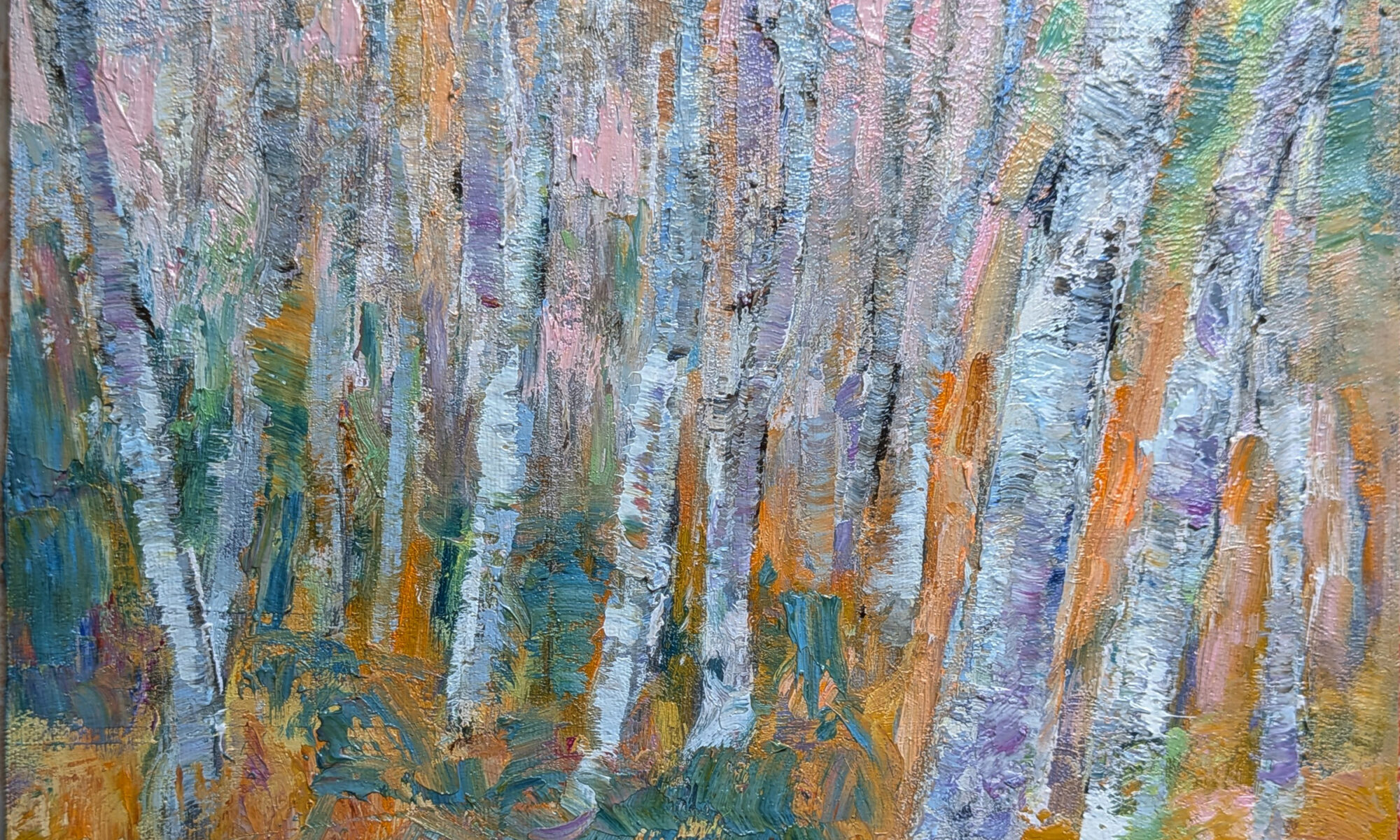
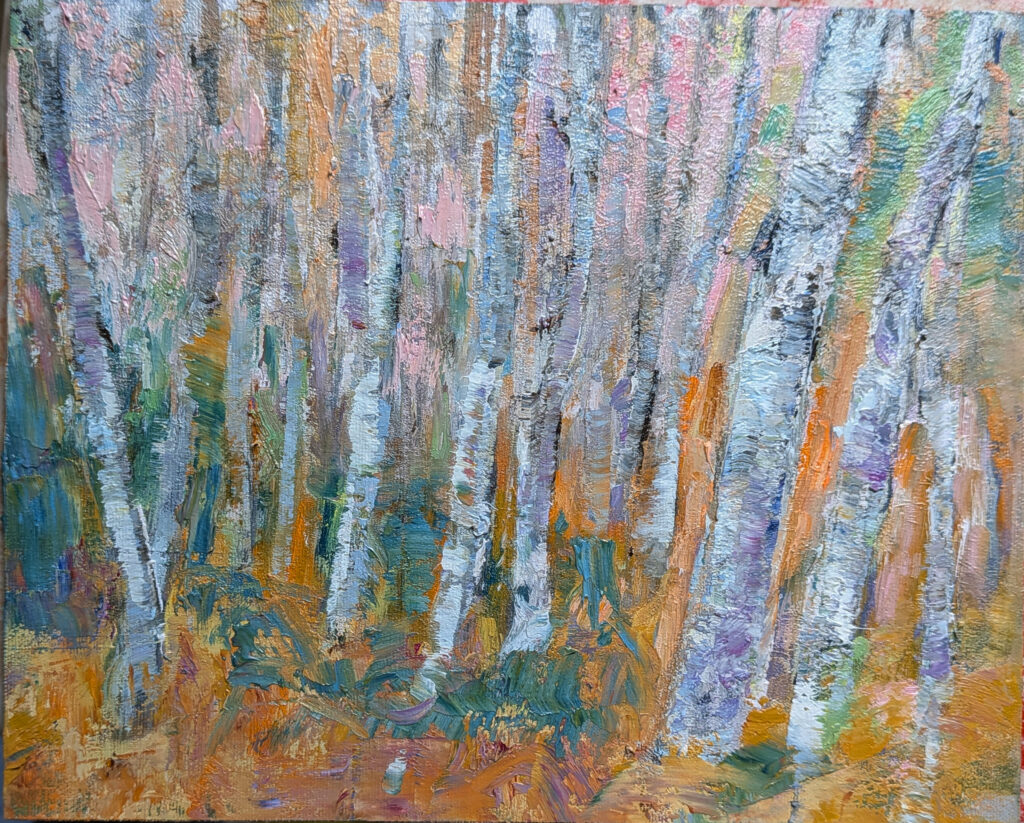
Looks like the link to the “Grey Birches” isn’t working. I clicked on photo and nothing.
Try now. I had weekend house guests so who knows WHAT I did!