
Most beginner paintings don’t fail because of lack of hard work. In fact, the problem is often the opposite: too much effort in the wrong places. Careful rendering and earnest attention can’t fix a fundamentally-flawed painting.
Detail is seductive
I’ve only known one painter who could start from a single detail and work outward; even he doesn’t always succeed. Most artists end up floundering when they do that. Of course, when you’re new to painting, detail is seductive; it’s just so much fun to focus on the apple rather than the branch. But when you do that, you’re overwhelmingly likely to put that apple in the wrong spot or use the wrong values. And then, you’ll either get to repaint the whole thing or admit defeat.
There have been times when I’ve been tempted to ignore this rule, for example when storm clouds are rolling in. I have learned from sad experience that this never works.
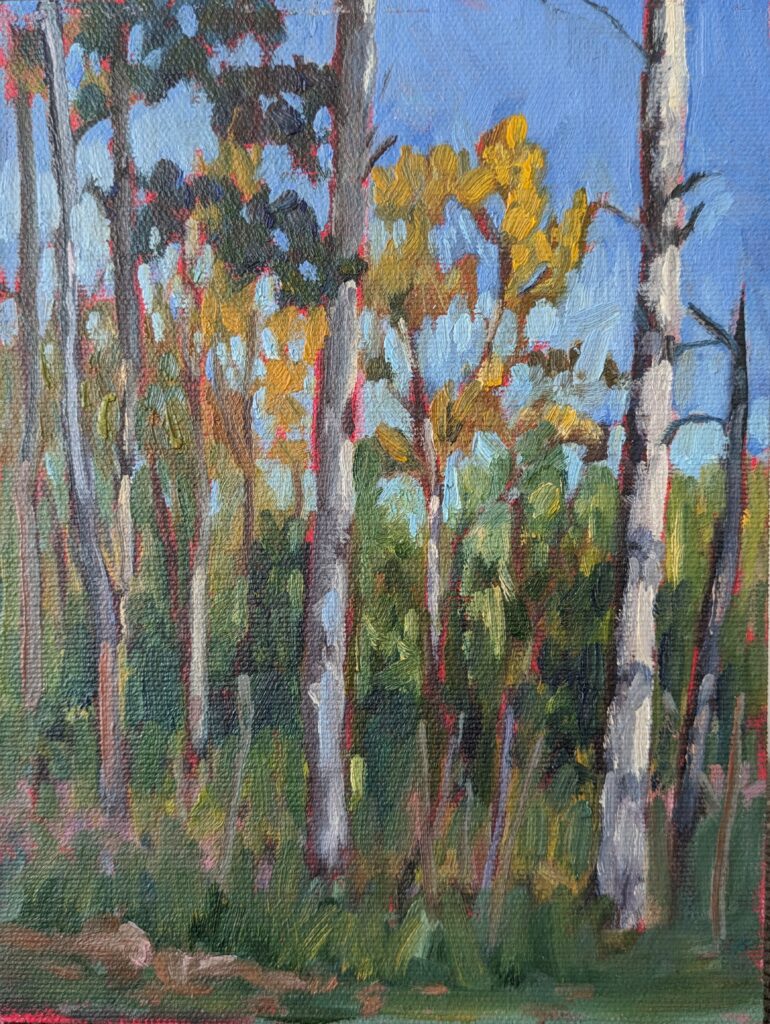
Good paintings are built from big shapes, not tiny parts. If the underlying structure isn’t solid, no amount of detail will fix it. And painting any one area to completion without considering its relationship to the whole is a recipe for failure.
Learn the art of aggressive simplification. Use a big brush and don’t pick up its smaller cousin until all your shapes are blocked in. Take your glasses off while looking at your subject, or, if you’re cursed with perfect vision, squint.
Value is king
Color has three facets:
- Value—how light or dark something is;
- Hue—the position on the color wheel (i.e., red, blue, yellow, etc.);
- Chroma—the intensity of the color.
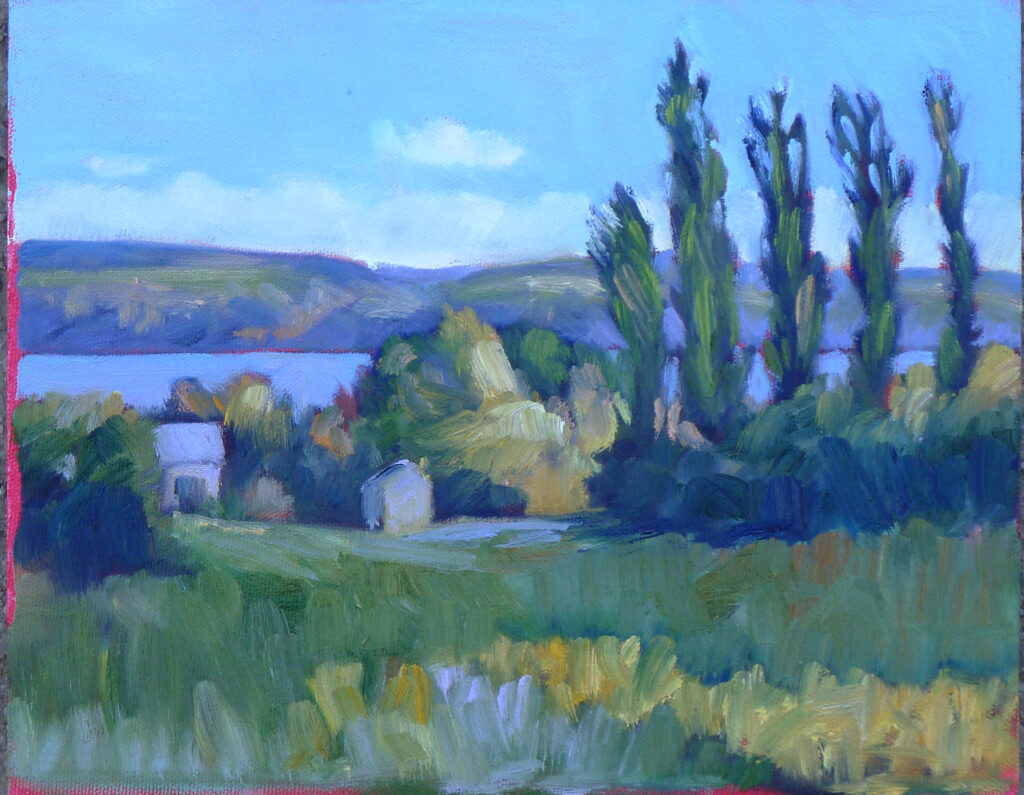
You can play fast and loose with hue, but if you don’t have a good value structure, your painting will collapse. Value is the bones of all 2-D art.
Beginner paintings often suffer from compressing the value range into a narrow band of midtones. The result is flat, muddy, and lifeless. That’s first an observational question, but it’s also an issue of design. The painter hasn’t considered whether there is an interesting pattern of lights and darks.
Start with a sketch limited to just four values. Make sure it’s attractive and interesting before you move on to paint. Then, establish your value range early and stick to it. Work the whole canvas at once, comparing constantly. Ask yourself: should this shape be lighter or darker than the one next to it? That simple question can transform your painting.
Step back frequently. If you can’t do that, use your cellphone to take a picture of your work in progress; that can sometimes give you the necessary distance. If you’re really in doubt, convert that photo to greyscale and see what it tells you.

You can’t fix a weak painting by adding more paint
No amount of detail or bravura brushwork can salvage a weak composition. Instead, stop and figure out what’s wrong. If you can train yourself to see big shapes first and organize your values with intention, your paintings will immediately improve.
Registration is now open for workshops in 2026! Reserve your spot:
- Advanced Plein Air Painting | Rockport, ME, July 13-17, 2026
- Sea & Sky | Acadia National Park, ME, August 2–7, 2026
- Find your Authentic Voice in Plein Air | Berkshires, MA, August 10-14, 2026
- New! Color Clinic 2026 | Rockport, ME, October 3-4, 2026
- New! Composition Week 2026 | Rockport, ME, October 5-9, 2026
Can’t commit to a full workshop? Work online at your own pace: