Think with your hands

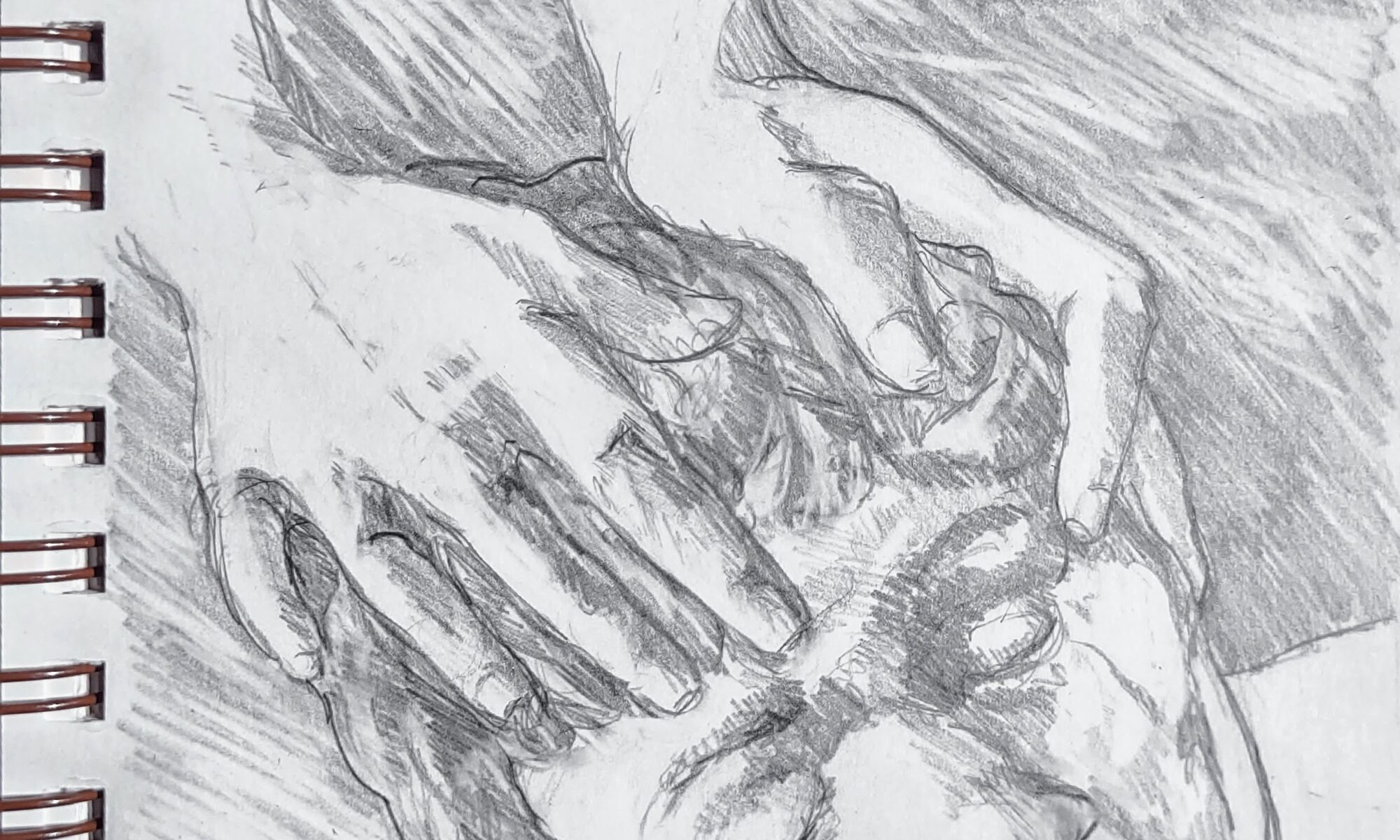
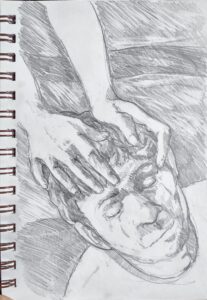
Think with your hands. 5X8, graphite on pencil in my sketchbook.

“I think with my hands, and it really cements my thoughts,” Theresa Vincent emailed me recently. She has a way with words; she’s the same person who told me a painting needs brides and bridesmaids.

I may be the only person in my church who draws, but I’m not alone in fussing while listening. There are occasionally people who knit, and lots of people who take notes. Whether they look back at them or not, writing notes results in better retention. More words are better than fewer, and writing by hand is better than tapping out notes in a phone or laptop.

Most importantly for us, drawing instead of writing results in even better memory retention. It doesn’t matter if what we’re drawing is ‘relevant’ or whether the pictures are objectively good.
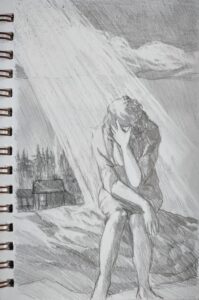
Drawing in church. 5X8, graphite on pencil in my sketchbook.

Take that, every teacher who disciplined a student for drawing in class! I sure had those teachers; they made school a misery for me. Fifty years later, I realize I was a deeply-traumatized kid who needed help, but that wasn’t happening back in the 1970s. All I had was my pencil, and school had no room for free thinkers.

Fast forward to the aughts, when my own kids were in school. You’d think it would have been better after thirty years of child psychology, but school then was even more rigid and more disciplined. I knew several kids who were disciplined for drawing in class, including my own.
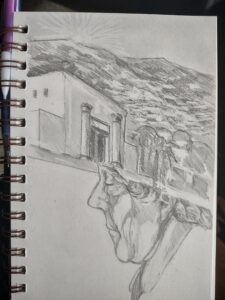
Drawing in church. 5X8, graphite on pencil in my sketchbook.

How does drawing help us remember?

Nobody knows precisely how this works, but it probably means that our moving hands help create new neural pathways to encode long-term memory. The brain-even the elderly one-continues to grow and mend itself. Even after great damage, like stroke or head injury, our brains make new neural pathways and alter existing ones. That’s how we adapt to new experiences and learn new information.

C. is a student in my Zoom brushwork class. She is 83 years old. The foolish might read that and think she’s an old lady taking art classes down at the senior center. They’d be all wrong. C. is a very serious painter, an excellent draftsman, and completely open to new ideas. Last week, I had my class do a small-brush exercise in the style of Les Nabis. It is difficult to give up the brushes you know and love, but C. embraced the challenge. And she crushed it.
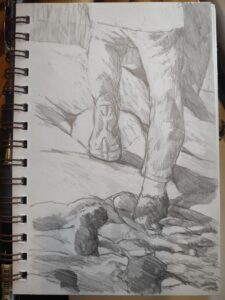
Drawing in church. 5X8, graphite on pencil in my sketchbook.

Obviously, it’s not drawing alone that keeps C. youthful. She sails, she travels, and she has good genes. But art has a big place in her life.

Our brains are not the only way we think. We have a complicated autonomic nervous system. The sympathetic nervous system activates our fight-or-flight response; the parasympathetic nervous system restores us to calm. Our enteric nervous system, which controls our gut (and thus our ‘gut responses’) can operate independently of our brains. And the cool thing is, we’re just beginning to understand how these systems all work together.
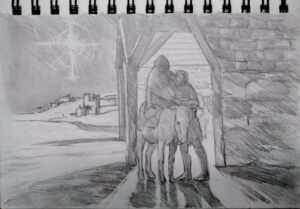
I’d almost bet I drew this at Christmas. 5X8, graphite on pencil in my sketchbook.

But they do, so it’s not unreasonable for Theresa to say she thinks with her hands. It might be quite literally true.

Registration is now open for workshops in 2026! Reserve your spot:

Can’t commit to a full workshop? Work online at your own pace:
Seven Protocols for Successful Oil Painters

Monday Morning Art School: ruthless pruning

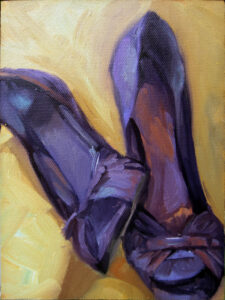
Prom Shoes 2, oil on archival canvasboard, 6X8, $435.

Sorry about my absence last week, but it was a lovely vacation.

A major part of learning to paint is learning to see, and in the process, learning to draw. This means not getting caught up in the details, but seeing the big shapes and how they fit together. This is fundamental to painting.

This means we stop thinking of the object we’re looking at as something we can identify, and start to see it as a series of shapes, or more accurately, a light pattern. That’s difficult, and even experienced painters can be tripped up.

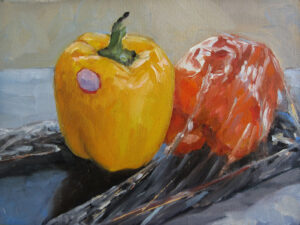
Two Peppers, oil on archival canvasboard, 6X8, $435.00

Oops! My bad.

A few years ago, my student Sheryl drew the lobster-boat Becca & Meagan, which is moored year-round at Rockport Harbor. It’s painted a signature red, and I have painted and drawn it many times. Sheryl measured and drew, and I patiently corrected her. This went on for most of the class, until Sheryl finally insisted that I sit down and take measurements with her.

Whoops! It wasn’t Becca & Meagan at all. Its owner had launched a new boat, Hemingway. She was painted the same red and moored at the same buoy, but with her own unique configuration. I was so used to seeing Becca & Meagan there that I had stopped really seeing at all. I was drawing what I ‘knew’, not what was there.

Back It Up, 6X8, oil on archival canvasboard, $435.

It’s not what you know, it’s what you can see.

If I set a teacup in front of you, you’ll be guided in part by what you know about teacups: they’re rounded, squat and hollow. That gives you some checks on your drawing, but it also allows you to make assumptions about measurements and values. That can lead you astray.

To draw it successfully, you must stop reading it as ‘teacup’ and start seeing an array of shapes, planes and values. For most of us, that takes time. My process is two-fold. First, I sketch to figure out what I’m looking at. That’s investigative. Then, I ruthlessly prune, forcing my drawing into a series of shapes and values.

All objects can be reduced to a certain, limited number of shapes. These build on each other to make a whole. When you see things as abstract shapes, you expand your possible subject matter. A plastic pencil case is not inherently much different in shape from a shed. A shed, in turn has the same forms as a house. If you start with a pencil case, you can ramp yourself up to Windsor Castle in no time.

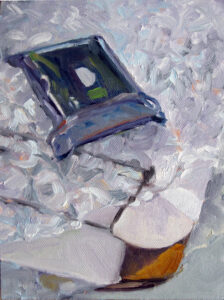
Primary Shapes, 6X8, oil on archival canvasboard, $435.

Notan and all other value studies are, above all, about cutting the picture frame into shapes, what Arthur Wesley Dow called “space cutting.”

Dow wrote the definitive 20th century book on composition, which sets down fundamental principles still used today. He taught his students to restrict the infinite range of tonal values in the visible spectrum to specific values-perhaps black, white and one grey. He wanted students see all compositions as structures of light and dark shapes. The success or failure of a painting rests on whether those shapes are beautiful.

Students sometimes chafe at being asked to do still life, but it’s the best training to learn space cutting. Just as important, it’s easy to set up and execute quickly, so you can practice on paper in just a few spare moments.

Registration is now open for workshops in 2026! Reserve your spot:

Can’t commit to a full workshop? Work online at your own pace:
Seven Protocols for Successful Oil Painters

How to practice drawing (when you don’t feel talented)

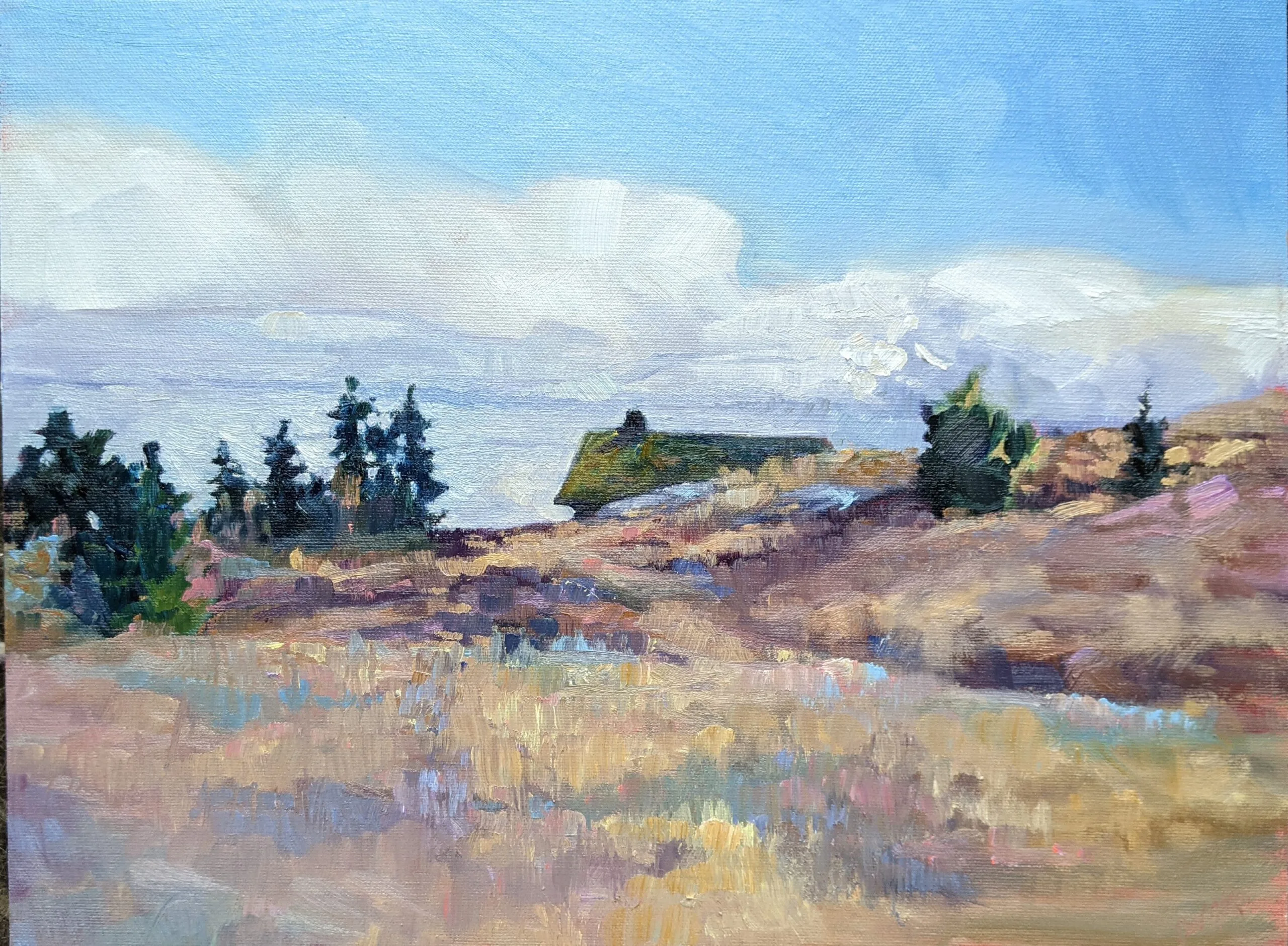
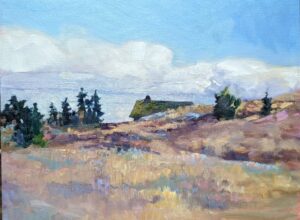
Early Spring on Beech Hill, oil on canvasboard, Carol L. Douglas, 12X16, $1449 framed

You’d have to be living under a rock to miss #joshallenjumpingoverthings, which is, oddly enough, about quarterback Josh Allen jumping over things. The term arm talent is often used about him. It means he has the strength and accuracy to drill the football exactly where he wants it to go.

Allen went to college in Wyoming and now plays for Buffalo. Both are known for miserable winters, so I’m sure there’ve been days when he’s been tempted to skip practice. I think of him and his fellow Buffalo Bills as I grouse about the cold this week. It magnifies aches and pains and makes it difficult to get moving.

Nobody would call me a talented athlete, but even on days when I’m feeling especially arthritic, I still get up and climb Beech Hill. I’m feeling another long ramble coming on and I know that goals are met in small, regular increments.

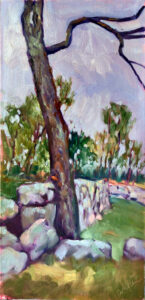
Walnut Tree, Stone Wall, oil on archival canvasboard, 8×16, $903.

It takes time

What the world calls talent in athletes is really a combination of good genes, perseverance and hard work. It’s no different in art.

Yes, there are people for whom drawing comes more easily, just as there are people who learn to read without a lot of fuss, or people who can do sums in their heads. None of that makes a brilliant career in art, language, or mathematics; they’re just a nice leg up. More important is the hard slog of learning and practicing.

I have no idea how many paintings and drawings I’ve done, but they number in the thousands. I can’t imagine how many times Josh Allen has thrown a football.

Mastery can’t be rushed. That’s true overall and it’s true piece-by-piece. Perhaps one of the least-helpful ideas the plein air movement has spawned is the notion that you can create a great painting in three hours. Occasionally that happens, but most painting is a tough slog over multiple iterations.

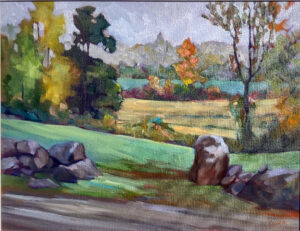
Stone Wall, Salt Marshes, 14×18, $1594 framed.

Practical ways to practice drawing

Drawing is not a magic trick-it’s a series of steps like long division or attaching a sleeve to a dress. It’s a great disservice for society to pretend it requires some mystical, unfathomable talent. I’ve written innumerable blog posts about basic drawing. (Someday I’ll index them all for you.) And I’ve frequently recommended this book for people wanting the basics.

But reading about drawing isn’t enough. You must practice. The good thing is, drawing is easy and cheap. I like Strathmore’s Visual Journal and a #2 mechanical pencil. If you want more refinement, my readers and I recommended fancier products here.

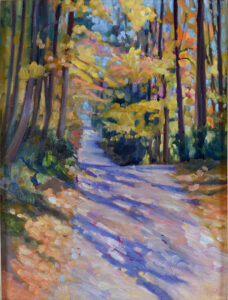
Beauchamp Point, Autumn Leaves, 12X16, oil on archival canvasboard, $1449.

Stick two pencils in the ring binder of your sketchbook and toss it in your backpack or purse. Pull it out whenever you have fifteen minutes to sit down. That can be on the train, in a meeting, at church, while cooling your heels waiting for your doctor-anywhere.

What should you draw? Whatever strikes your fancy. A plastic Ficus. A Christmas ornament. A toy. Mittens. Or, pull out your phone and search for something offbeat. Scissors. Donkeys. Sports cars. Grain silos.

Drawing from life is better than drawing from photos (because it’s more difficult) but any drawing is good practice. Just a few minutes a day is all you need.