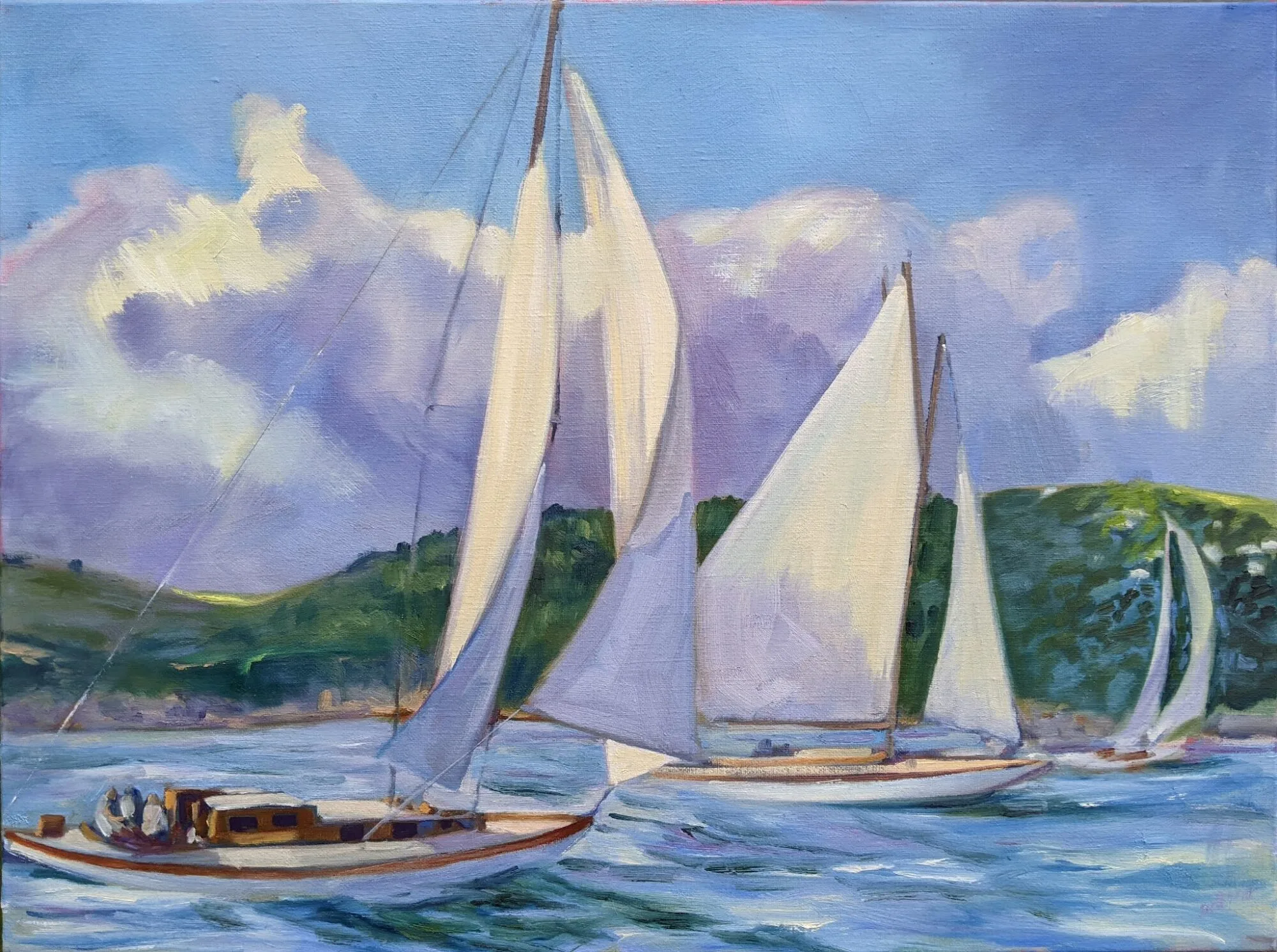


Stand anywhere outdoors and you’re flooded with information. Each leaf catches light differently. Every building has windows, trim, shadows, reflections and textures. Each cloud changes by the minute. You try to capture all this, and you quickly get lost.
You’d think this would be easier when working from photos, but it’s actually worse. That’s because a camera and the human visual system don’t see the world the same way.
A quick note on weekly classes before we get into it
Claim your spot in Painting Nocturnes, Tuesday evenings or Painting Water, Monday evenings. Both are 6-9 PM, starting the week of August 17, 2026.
I upload videos of these online classes and you have access to them for as long as there’s YouTube. That means you can review them if you need a refresher or have to cut out early.
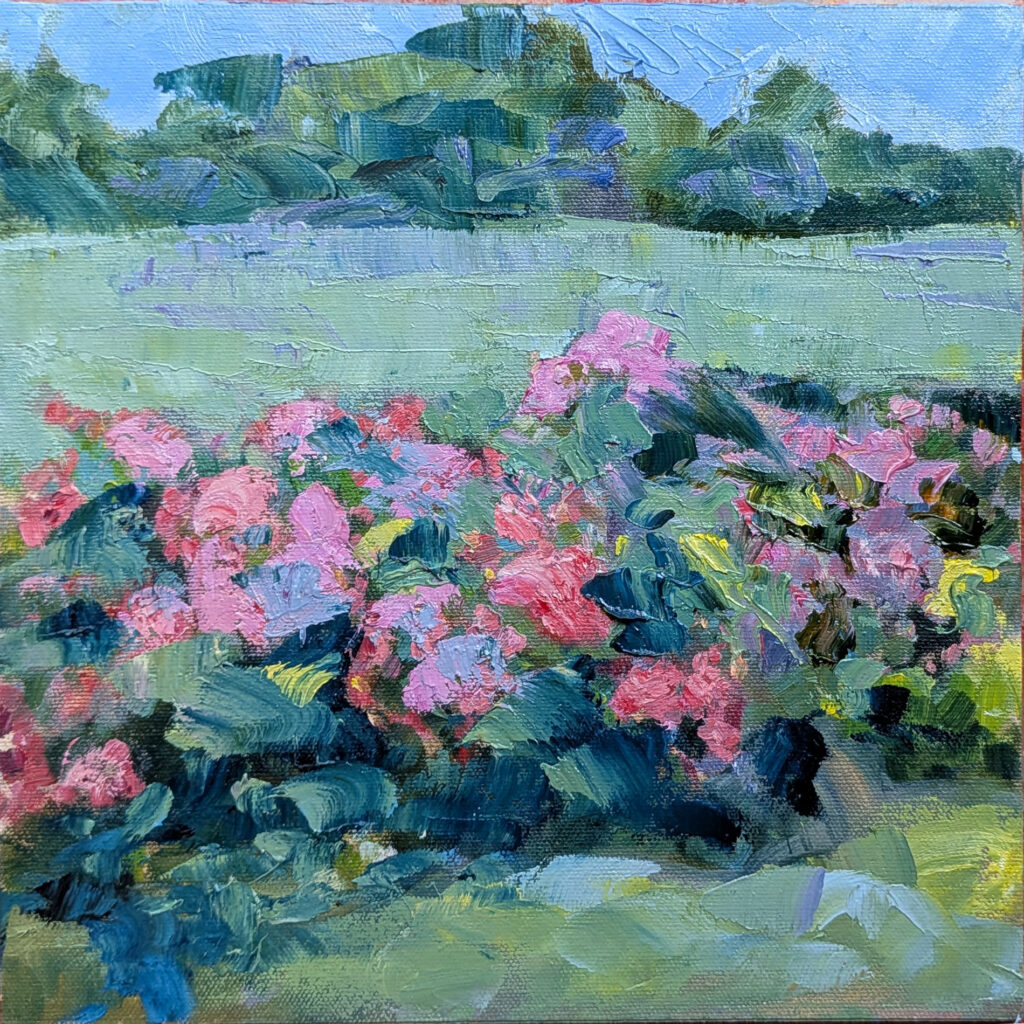
How the camera undermines painters
- In real life (IRL), your eyes are making tiny jumps (saccades) several times a second. Your brain is suppressing unimportant information automatically. A photograph can’t do that. It records everything with equal indifference.
- Humans have foveal vision. That means we only focus on what’s in the center of our sight. In contrast, photos make everything equally available. IRL, we naturally spend more time looking at the central points than at the edges of the scene. Our perception and memory is organized around those important shapes. In a photo, every square inch is equally accessible, and we tend to paint every square inch with equal attention.

- Cameras don’t have true depth perception. Our binocular and peripheral vision, along with our head movements, give us a true sense of distance. We instinctively group objects into foreground, middle ground, and far away. Photographs compress the three-dimensional experience into a two-dimensional rectangle, taking away our ability to edit spatial relationships in our paintings.
- Nature moves constantly—leaves shimmer, clouds drift and water laps in tiny waves. Our brains average these changes into impressions. A photo of the surface of gentle water will show a series of long elliptical shapes. But nobody perceives water like that; we see tiny lapping wavelets. Look at a closeup of a leaf; the background is blurry. That’s not how we see it IRL, where our eyes jump focus many times a second.
- I take pictures of interesting things only to get home and realize that my phone has edited the charm right out of the scene. The camera is as interested in the scrub in the foreground as it is in the sky in the background.
- Photos are bossy. We trot right along behind them, copying assiduously. Working from life encourages interpretation because the scene is changing too quickly to copy literally. We have to make choices.
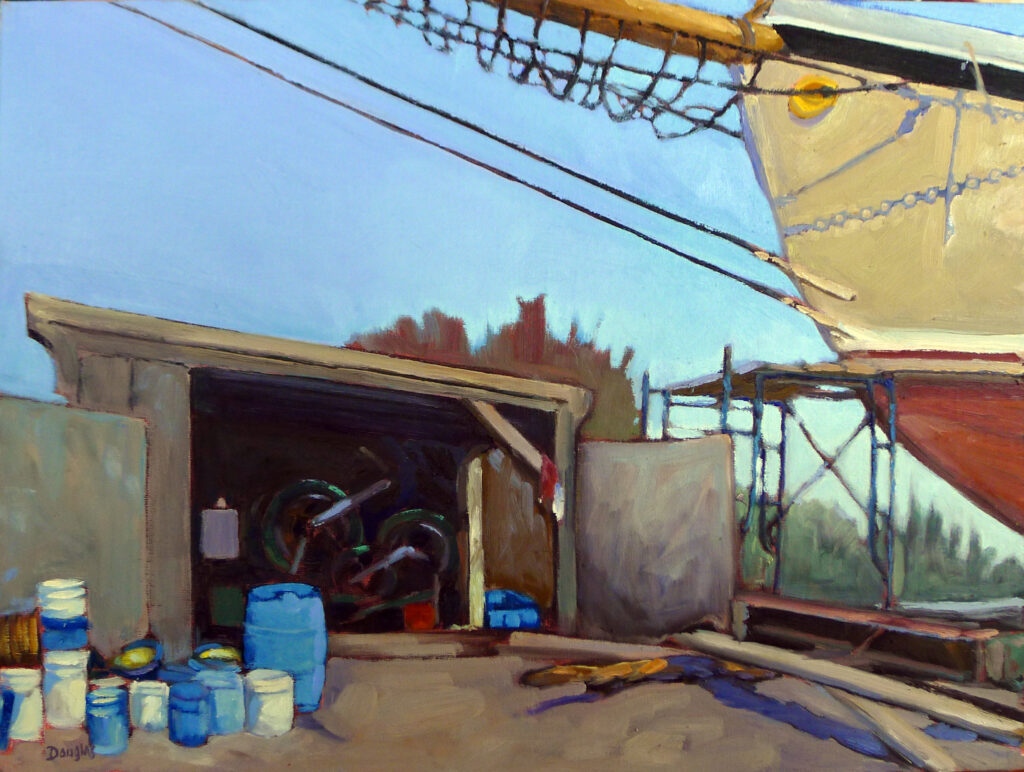
That doesn’t mean you can’t paint from photos.
I paint from photos frequently. However, there are ground rules:
- I sketch the scene IRL so the big decisions are already made, including composition and focal points;
- I have lots of experience painting en plein air and from life, which helps me understand the camera’s lies;
- I start from my sketch, and finish by working from memory. Photos only come out when I need to check matters of light, composition, and detail.
Professionals don’t see more detail than beginners; they see more structure. That’s a learned skill. It improves through learning and repetition. One plein air painting will teach you something, but five consecutive days painting plein air will teach you a lot.
You’ll begin recognizing recurring patterns. You’ll notice that every successful landscape starts with clear value organization before color enters the conversation. You’ll discover that simplifying actually creates stronger, more believable paintings—not emptier ones. Most importantly, you’ll learn to trust your first impression instead of second-guessing every brushstroke.
That’s why I teach five-day workshops, and why I hope you’ll join me for one.
Registration is now open for workshops in 2026! Reserve your spot:
- Find your Authentic Voice in Plein Air | Berkshires, MA, August 10-14, 2026
- New! Color Clinic 2026 | Rockport, ME, October 3-4, 2026
- New! Composition Week 2026 | Rockport, ME, October 5-9, 2026
Can’t commit to a full workshop? Work online at your own pace: