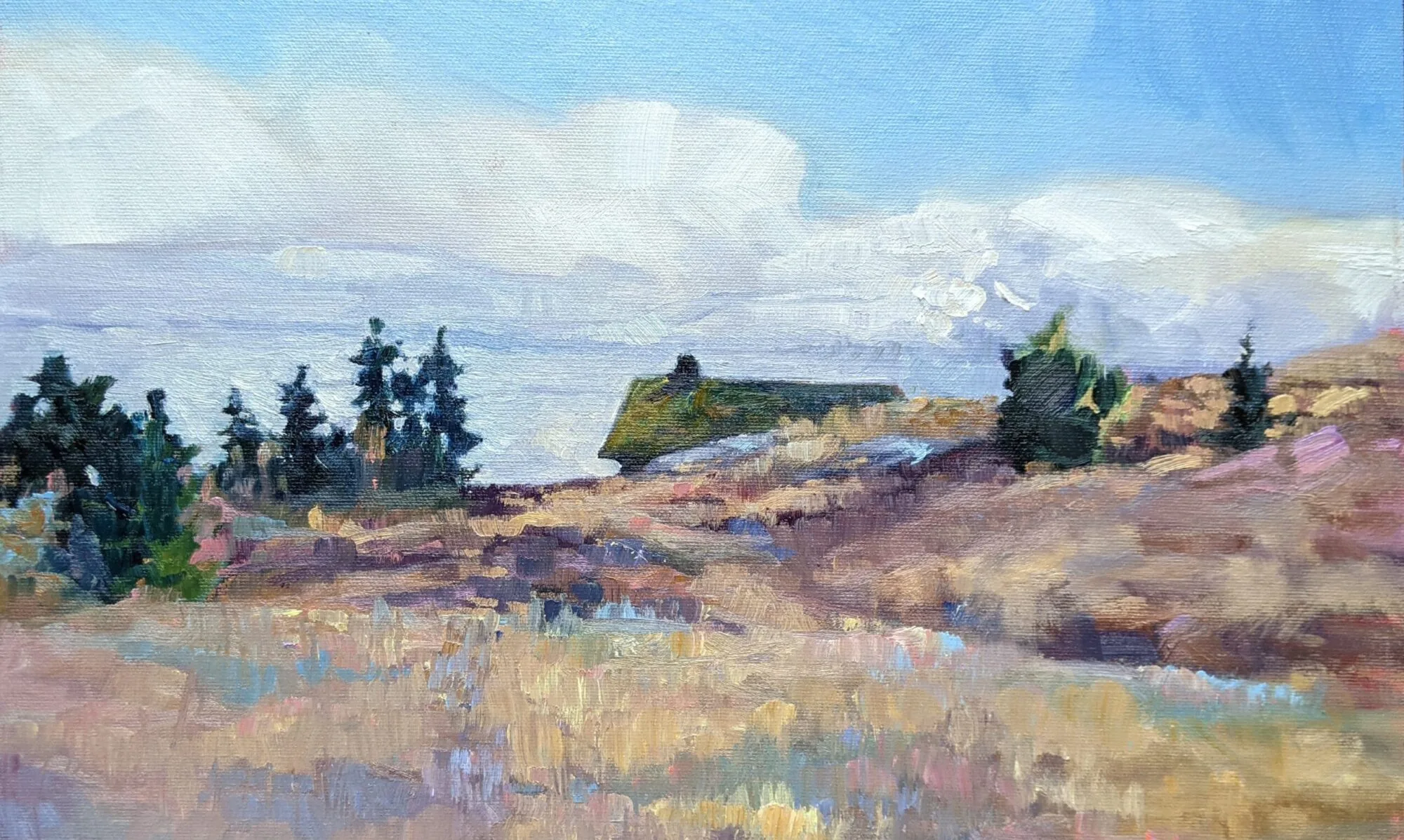


Artists should choose a bigger brush far more often than they think, especially when they want stronger compositions, clearer value statements, and more confident paint handling. I have few small brushes at all—a single #2 round for oils and a dagger brush with a fine point for watercolors.
Bigger brushes force us to think in big shapes
A painting succeeds or fails on its large value masses, not on its detail. When we work with a larger brush, we naturally block in shapes rather than fuss. This keeps our attention where it belongs: on composition, value relationships, and the overall movement of the piece.

Bigger brushes prevent overworking
Small brushes are perfect for poking, fussing, and destroying the freshness of a painting. Larger brushes won’t let us over-refine areas. They help avoid the muddy, overworked look that happens when we keep adjusting the same small spot again and again.
Bigger brushes teach us to paint with a light hand
I can paint a better fine line with a #4 flat on its side than I can with a rigger. A bigger brush is more stable and holds more paint, meaning less jiggling and fewer stops to reload. There’s a world of tonality that comes from learning to control the pressure in a brush. Bigger brushes can go from bold to delicate, something small brushes just can’t do.

Bigger tools make bolder decisions
When we’re holding a brush the size of a small spatula, we’re forced to paint with intention. We choose our strokes more carefully. We commit. When students tell me they want to learn ‘looser brushwork,’ I start by picking out bigger brushes for them. They encourage broad, authoritative marks, which bring energy and confidence to our work.
Bigger brushes improve surface quality
More paint means juicier, cleaner and more expressive strokes. Instead of scrubbing thinly with a tiny brush, we can place full-bodied, deliberate marks that convey texture, light, and form with immediacy.
Bigger brushes speed up our process
Of course a bigger brush covers more area, faster. But beyond the square-inch question, covering the canvas quickly means we see the painting as a whole early on. This is essential for alla prima work. We get to the heart of the piece before the light changes. I’ve included four paintings here that were done in rapidly-changing light. None of them would have been feasible had I messed around with a tiny brush.

Bigger brushes help us learn faster
Students often think their problems come from a lack of detail control, when in reality they’re struggling with proportion, value, or composition. A big brush forces us to address these essentials head-on. When the big shapes are right, the details practically paint themselves.
Are you a noodler?
I’ve watched countless students hesitate at the exact moment when their painting needs a courageous reframing. Painting with confidence sometimes means accepting that our first idea may not be our best. We need to be willing to accept that and make corrections with authority.
“Big shapes to small shapes” isn’t just a catchy phrase; it’s foundational to painting. When the big shapes are right, you can suggest detail with a few breezy, economical marks.
This approach is actually harder than futzing around with detail. It’s the discipline of stepping back, really looking, and making corrective moves while the painting is still fresh and malleable.
If you’re ready to break the habit of overworking your paintings, I go into more detail about this in my workshops.
I have just two workshops left in 2026! Reserve your spot:
- New! Color Clinic 2026 | Rockport, ME, October 3-4, 2026
- New! Composition Week 2026 | Rockport, ME, October 5-9, 2026
- High-Desert Light & Monumental Form | Sedona, AZ, Apr 26, 2027 – Apr 30, 2027
Can’t commit to a full workshop? Work online at your own pace: