A Day in the Field

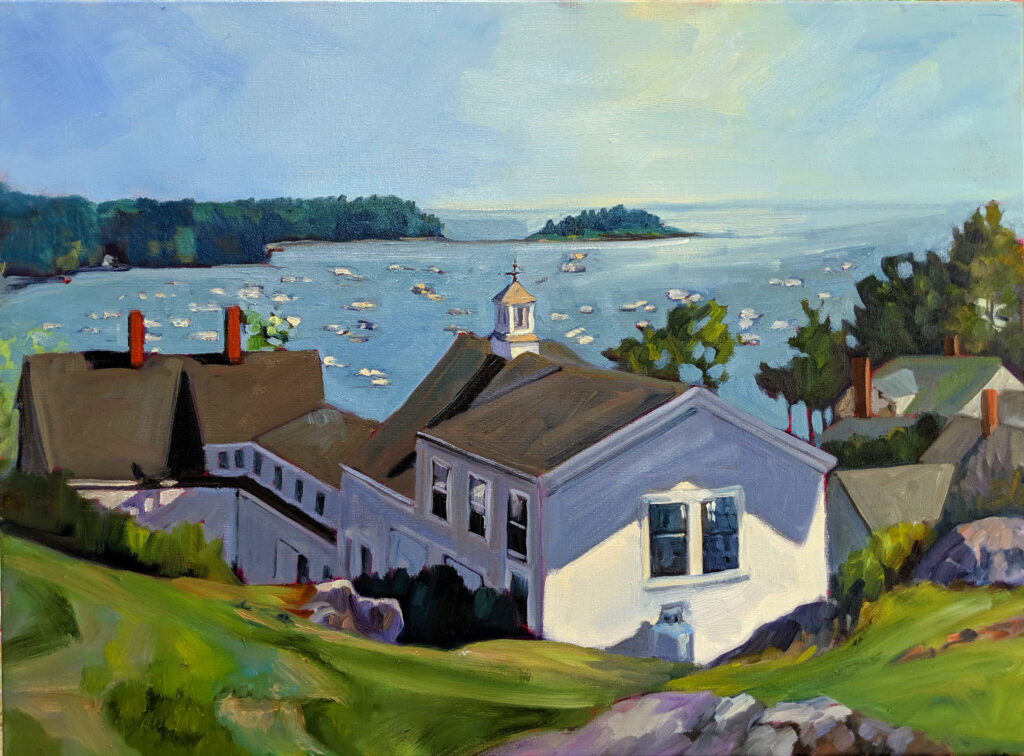
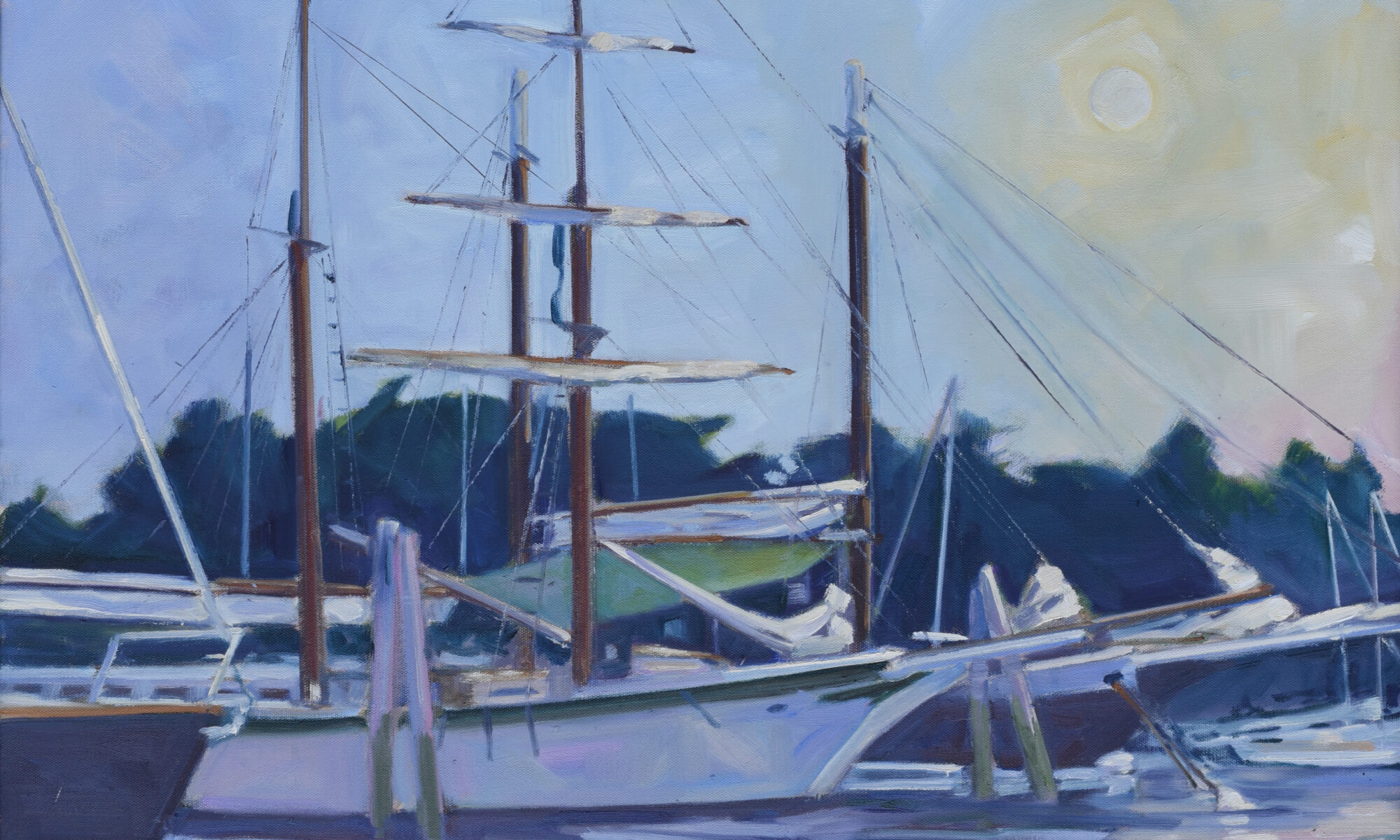
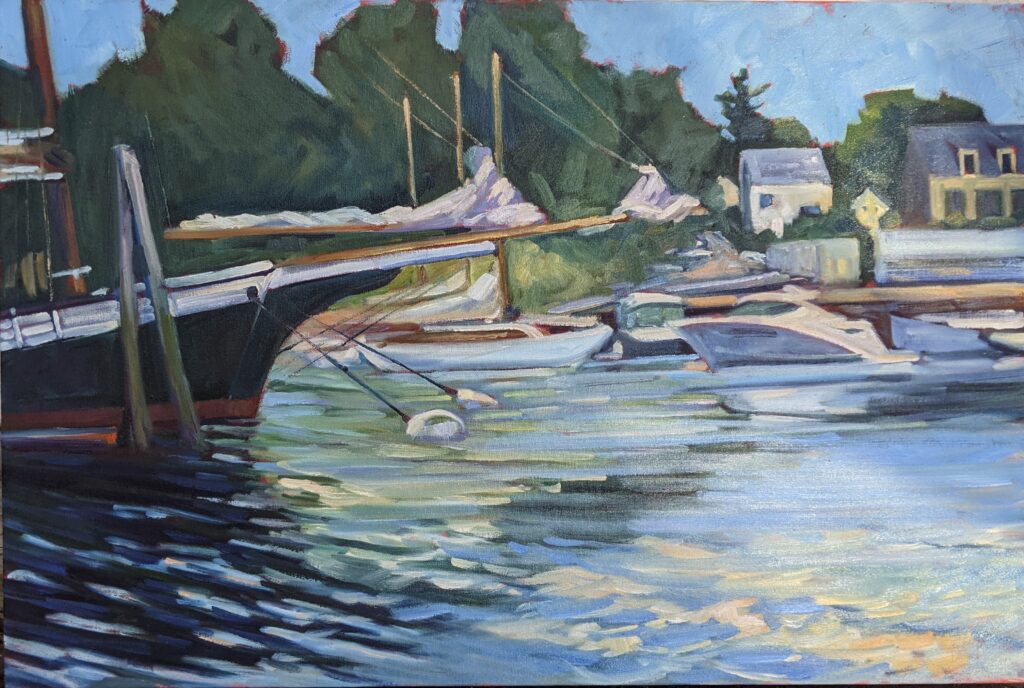
Camden Harbor, Midsummer, oil on canvas, 24X36. For more information, click on the image.

I’m juggling two different activities this week. I’m stripping the wallpaper and carpeting from my hallway in preparation for a bathroom renovation in September. (Yes, that’s mission creep.) I’m also packing my luggage, painting gear and teaching supplies for a two-week road trip. First, I’m teaching Sea & Sky at Schoodic Institute in Acadia National Park. Then I head south to teach Find your Authentic Voice in Plein Air in the Berkshires, from August 10-14.

What scares people the most about workshops

New students are afraid there will be better painters at hand and they’ll feel judged. But even the best painters are busy wrestling with their own painting problems. And plein air painters are—in my experience—overwhelmingly kind and generous.
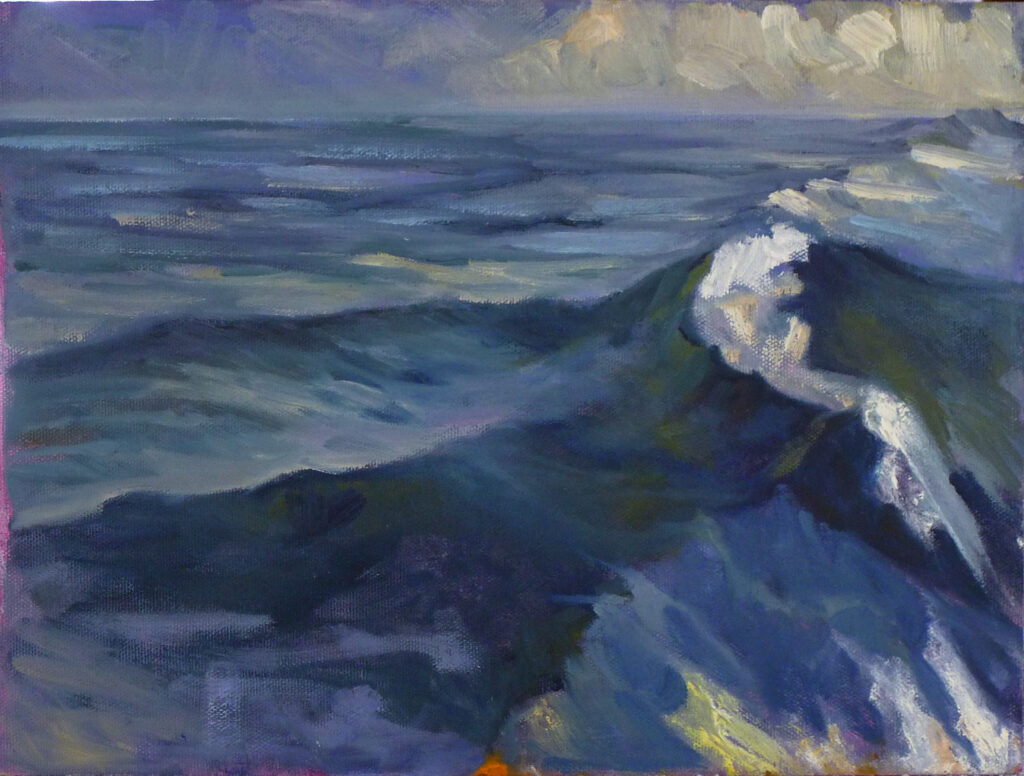
The Wave, 9X12, oil on archival canvasboard. For more information, click on image.

What they’re really asking

The real question is, “What a painting workshop really like?” The unknown is intimidating. Will you be rushed? (No.) Will you spend the day watching demonstrations? (No.) Will there be enough individual help? (Yes.)

A quick note on weekly classes before we get into it

Claim your spot in Painting Nocturnes, Tuesday evenings or Painting Water, Monday evenings. Both are 6-9 PM, starting the week of August 17, 2026.

I upload videos of these online classes and you have access to them for as long as there’s YouTube. That means you can review them if you need a refresher or have to cut out early.
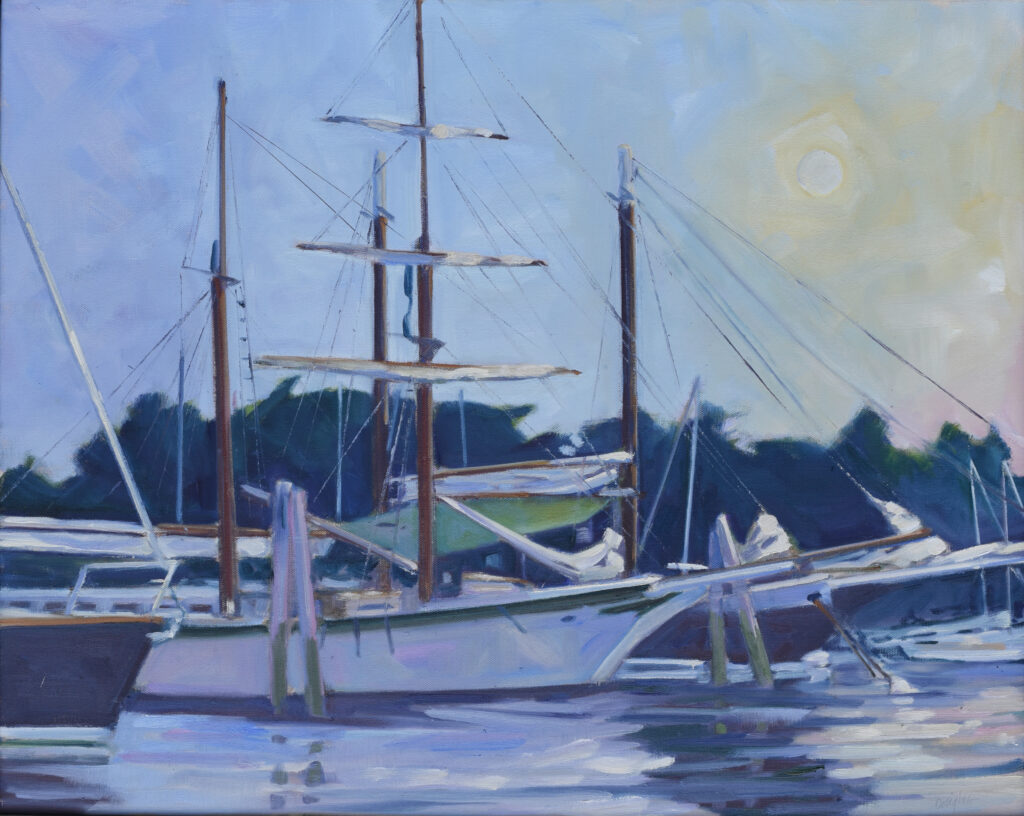
Brigantine Swift in Camden Harbor, 24X30, oil on canvas, framed, for more information, click on image.

Let’s look at a typical day

Serious teachers spend a lot of time investigating great locations. I’ll use Home Farm at Undermountain in the Berkshires as my example. This location has farm animals, elegant Victorian barns, and a long view across Parson’s Marsh.

We meet at 9 AM. I start with a short demo to demystify perspective, because architecture can be scary when you don’t know the tricks. Then students separate and start work on their own paintings. I do rounds from painter to painter, timing myself so that I don’t overload them with information. We understand best when new information comes in small bites.

Home Farm at Undermountain is different every year. Perhaps horses will amble over to see what’s happening, or a riding lesson is in the outdoor ring. Goats or sheep graze by the old chicken house. There are always elegant horses in the barn.

We gather to eat our bagged lunches and talk about our work. After lunch, some painters look for another view. Others are still deeply engaged in their first painting, and as long as they stay true to their value sketch they can take as long as they want.

My walk gets longer as students spread out, but I like walking.

What kind of advice am I giving as I circulate? Maybe composition needs simplifying. Perhaps a student lost the shadows that made his sketch so joyful. Maybe her color temperature has drifted, or she’s struggling to establish a clear focal point. Each painter receives advice tailored to where they are, whether it’s their first plein air outing or they’ve been painting outdoors for decades.

At 4 PM, I offer to take anyone who’s interested to Parson’s Marsh for a short hike. It’s a lovely way to stretch our legs and chatter.

Some painters room together, others decide to have supper together, others go explore Lenox’s many charms. Friendships form quickly when people share long days outdoors doing what they love.

Ketch and Schooner, 8X10 in a solid silver leaf frame. For more information, click on image.

I didn’t invent this model

This model used by all good teachers, indoors or out. It’s remarkable how much growth can happen in only a few hours when we’re working alongside other motivated artists in a supportive environment.

After decades of teaching, I know that 15 is the absolute maximum number a class should include. Small groups allow individual attention without sacrificing the energy that comes from painting alongside other dedicated artists. Everyone gets daily one-on-one easel guidance.

I have just two workshops left in 2026! Reserve your spot:

Can’t commit to a full workshop? Work online at your own pace:

Seven Protocols for Successful Oil Painters

Monday Morning Art School: how cameras undermine painters

Thomaston, ME, 14X18, oil on archival canvasboard. Click on image for more information.

Stand anywhere outdoors and you’re flooded with information. Each leaf catches light differently. Every building has windows, trim, shadows, reflections and textures. Each cloud changes by the minute. You try to capture all this, and you quickly get lost.

You’d think this would be easier when working from photos, but it’s actually worse. That’s because a camera and the human visual system don’t see the world the same way.

A quick note on weekly classes before we get into it

Claim your spot in Painting Nocturnes, Tuesday evenings or Painting Water, Monday evenings. Both are 6-9 PM, starting the week of August 17, 2026.

I upload videos of these online classes and you have access to them for as long as there’s YouTube. That means you can review them if you need a refresher or have to cut out early.

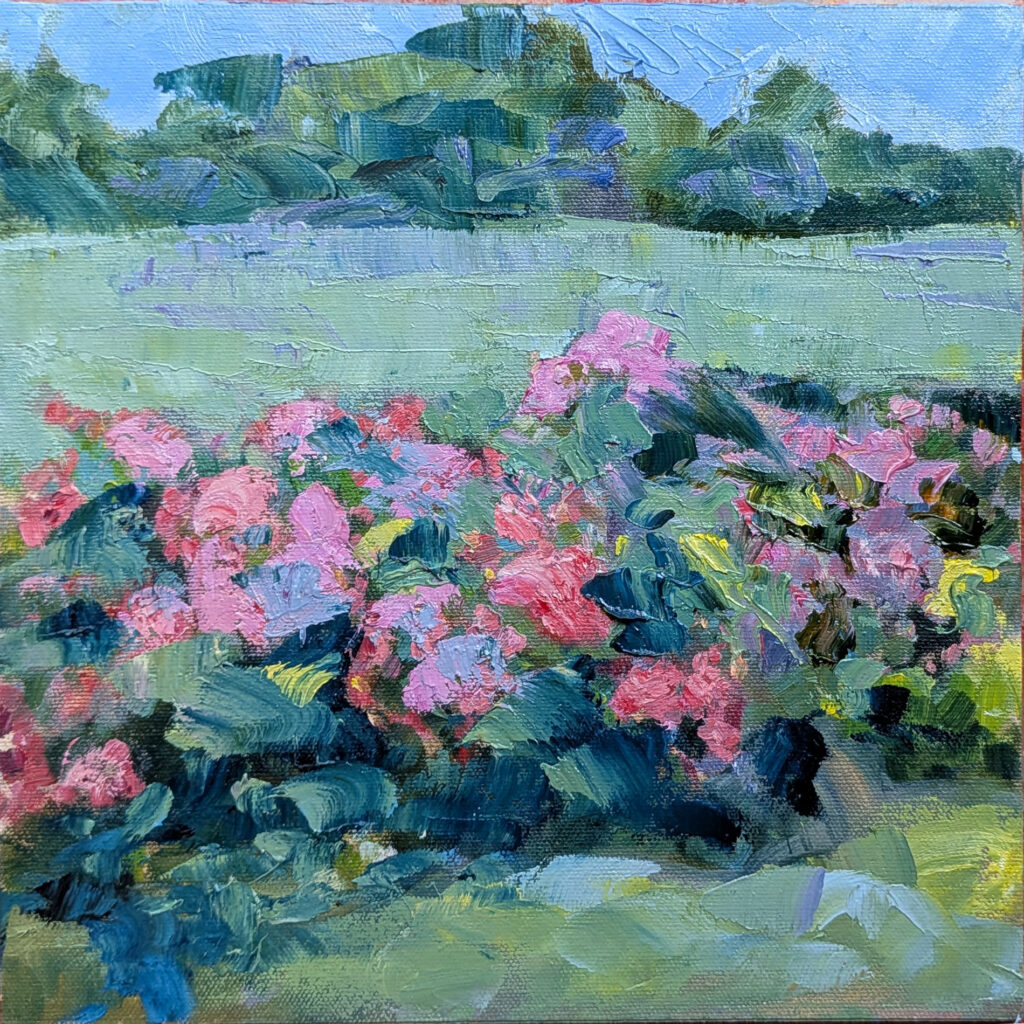
Beach Roses, 10X10 on sealed Baltic birch, for more information, click on image.

How the camera undermines painters

  • In real life (IRL), your eyes are making tiny jumps (saccades) several times a second. Your brain is suppressing unimportant information automatically. A photograph can’t do that. It records everything with equal indifference.
  • Humans have foveal vision. That means we only focus on what’s in the center of our sight. In contrast, photos make everything equally available. IRL, we naturally spend more time looking at the central points than at the edges of the scene. Our perception and memory is organized around those important shapes. In a photo, every square inch is equally accessible, and we tend to paint every square inch with equal attention.
Along Beech Hill Road, 12X16, oil on archival canvasboard, click on image for more information.
  • Cameras don’t have true depth perception. Our binocular and peripheral vision, along with our head movements, give us a true sense of distance. We instinctively group objects into foreground, middle ground, and far away. Photographs compress the three-dimensional experience into a two-dimensional rectangle, taking away our ability to edit spatial relationships in our paintings.
  • Nature moves constantly—leaves shimmer, clouds drift and water laps in tiny waves. Our brains average these changes into impressions. A photo of the surface of gentle water will show a series of long elliptical shapes. But nobody perceives water like that; we see tiny lapping wavelets. Look at a closeup of a leaf; the background is blurry. That’s not how we see it IRL, where our eyes jump focus many times a second.
  • I take pictures of interesting things only to get home and realize that my phone has edited the charm right out of the scene. The camera is as interested in the scrub in the foreground as it is in the sky in the background.
  • Photos are bossy. We trot right along behind them, copying assiduously. Working from life encourages interpretation because the scene is changing too quickly to copy literally. We have to make choices.
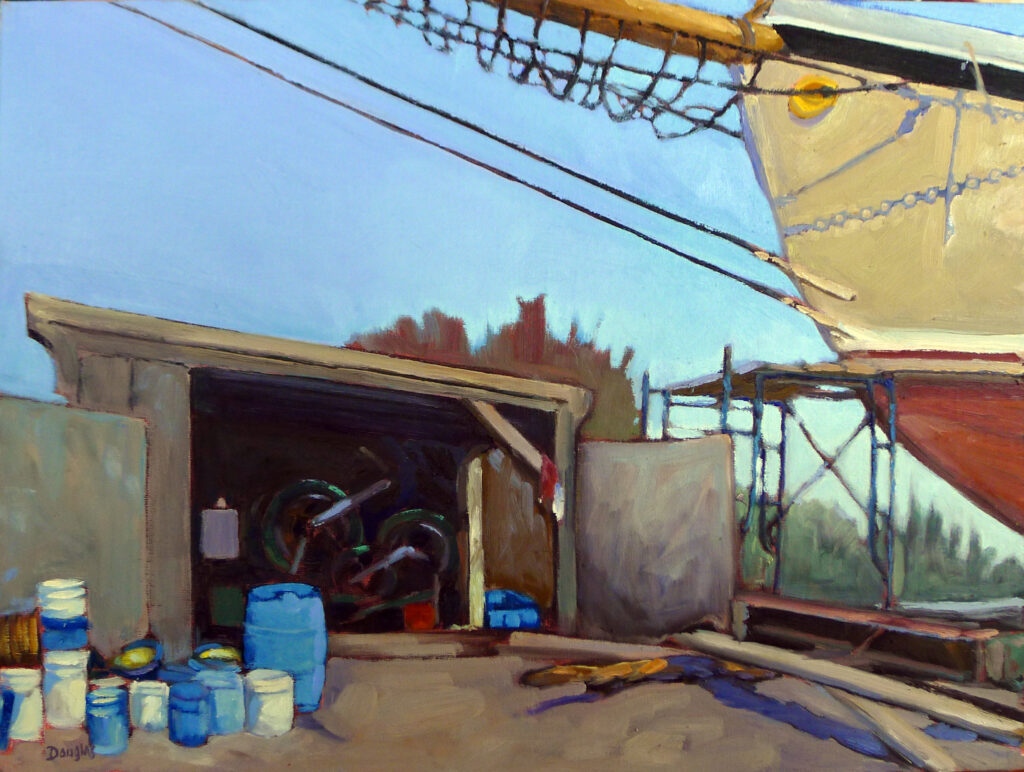
American Eagle in Drydock, 12X16, for more information click on image.

That doesn’t mean you can’t paint from photos.

I paint from photos frequently. However, there are ground rules:

  • I sketch the scene IRL so the big decisions are already made, including composition and focal points;
  • I have lots of experience painting en plein air and from life, which helps me understand the camera’s lies;
  • I start from my sketch, and finish by working from memory. Photos only come out when I need to check matters of light, composition, and detail.

Professionals don’t see more detail than beginners; they see more structure. That’s a learned skill. It improves through learning and repetition. One plein air painting will teach you something, but five consecutive days painting plein air will teach you a lot.

You’ll begin recognizing recurring patterns. You’ll notice that every successful landscape starts with clear value organization before color enters the conversation. You’ll discover that simplifying actually creates stronger, more believable paintings—not emptier ones. Most importantly, you’ll learn to trust your first impression instead of second-guessing every brushstroke.

That’s why I teach five-day workshops, and why I hope you’ll join me for one.

I have just two workshops left in 2026! Reserve your spot:

Can’t commit to a full workshop? Work online at your own pace:

Seven Protocols for Successful Oil Painters

St. Swithin loves plein air painters (this year, at least)

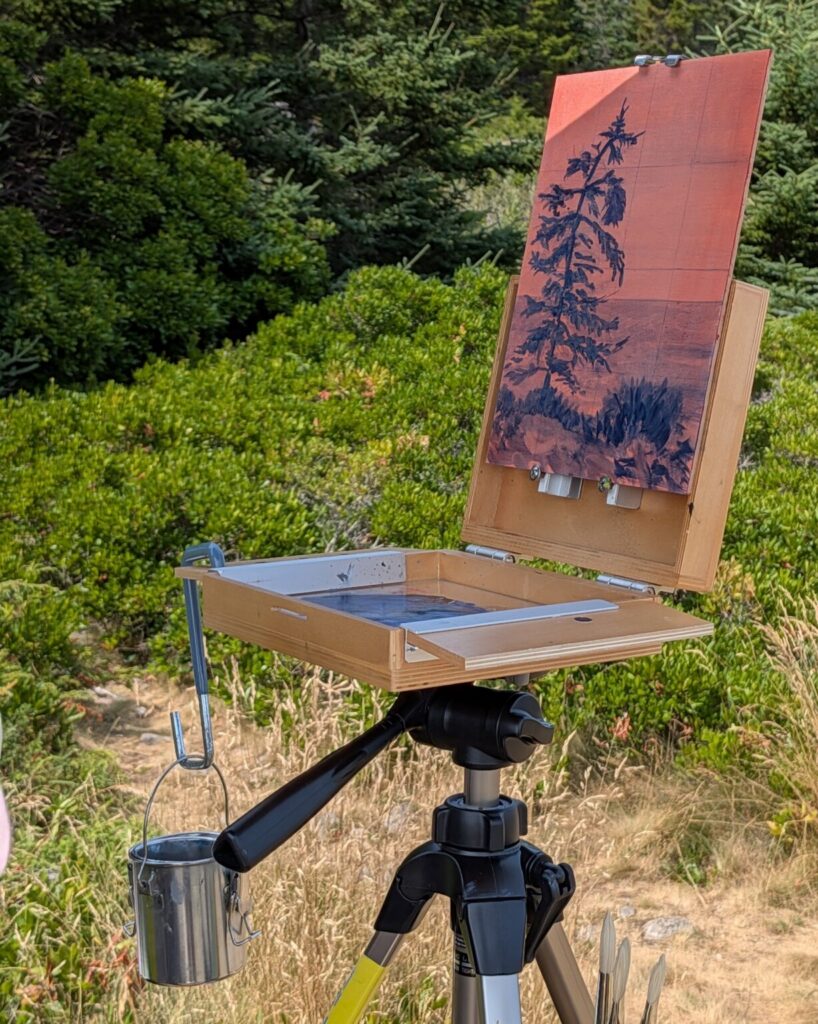
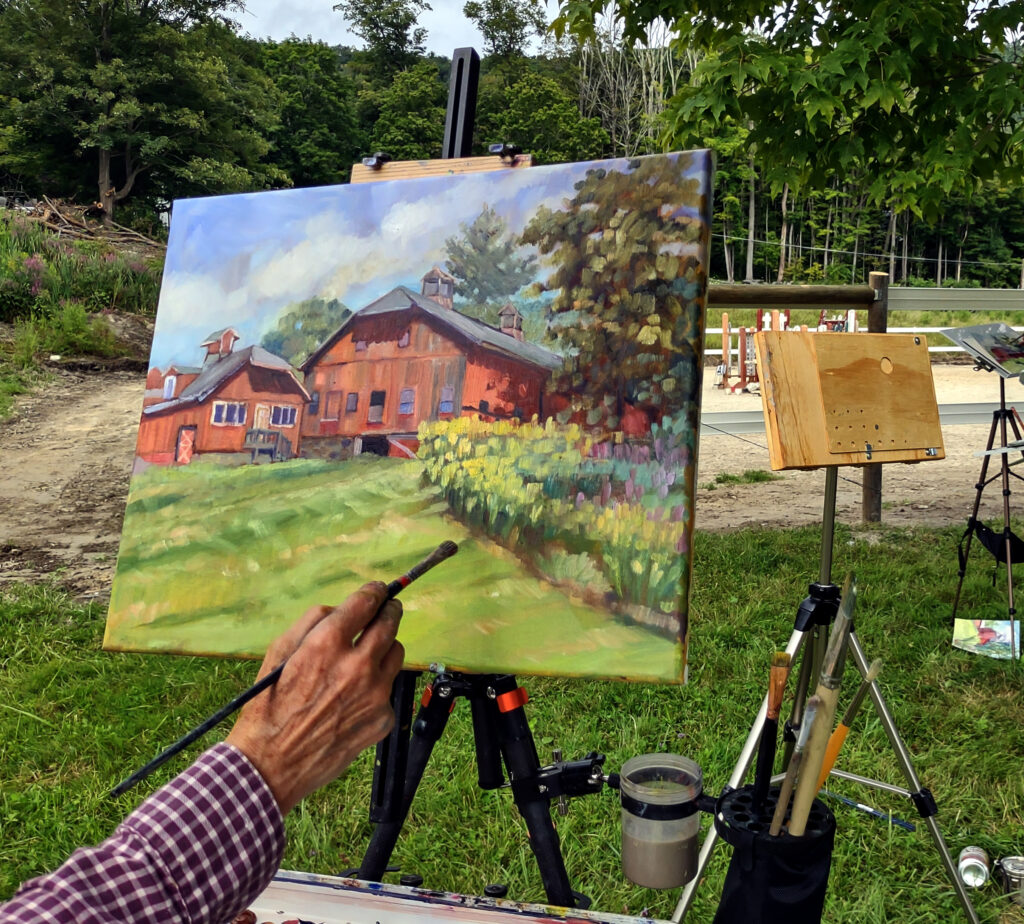
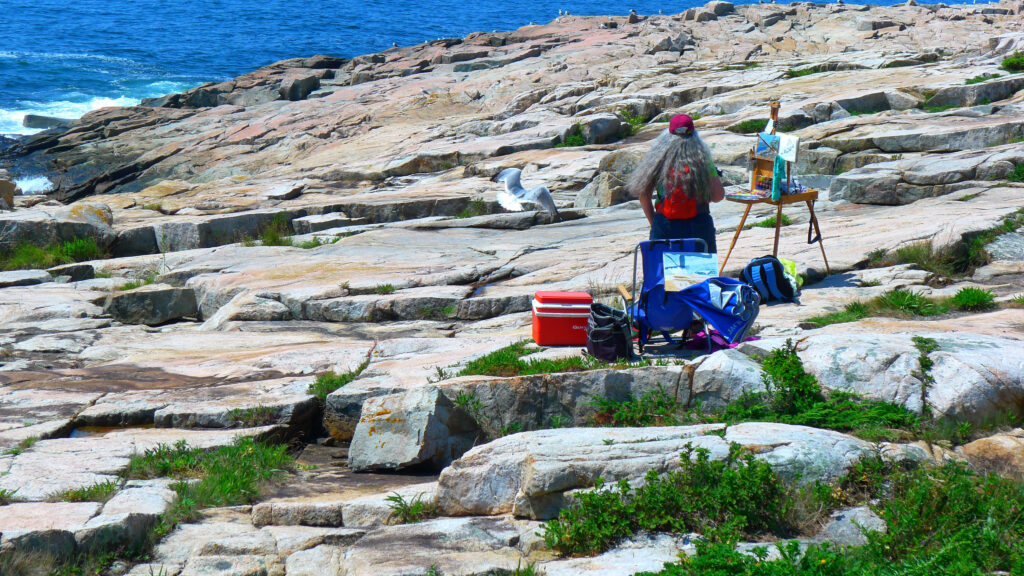
Carol L. Douglas painting at Acadia National Park
Cassie Sano’s painting of Home Farm at Undermountain’s Victorian barn from the Berkshire workshop.

St. Swithin’s Day was July 15. According to folklore, the weather conditions on this day—rain or sunshine—will hold for the next 40 days.

St. Swithin asked to be buried outside so that ‘the sweet rain of heaven’ might fall on his grave. When he was moved to an indoor shrine in 971 AD, he was so displeased that it rained continuously for the next 40 days.

His legend has a whiff of scientific truth. Around the middle of July, the polar jet stream settles into a pattern which mostly holds steady until the end of August. Here in the northeast, St. Swithin’s weather set fair, which bodes well for my next two workshops: Sea & Sky at Acadia National Park (8/2-7) and Find your Authentic Voice in Plein Air in the Berkshires (8/10-14).

My favorite photo of Becky Bense.

A quick note on weekly classes before we get into it

Claim your spot in Painting Nocturnes, Tuesday evenings or Painting Water, Monday evenings. Both are 6-9 PM, starting the week of August 17, 2026.

I upload videos of these online classes and you have access to them for as long as there’s YouTube. That means you can review them if you need a refresher or have to cut out early.

My own self-assessment

Someone recently told me I need to learn to ‘love myself.’ I cracked up; I spend more time on self-care than anyone but movie stars and influencers.

The activities that interest me most are painting, teaching painting, and writing about painting. Self-assessment is notoriously unreliable, but I think I’m good at these things.

These musings were prompted by Mark Gale texting, “I think, Carol, you can certainly teach people to paint.” That jogged me into asking a few of my Berkshires workshop students to tell you about their experiences. I decided to leave them unedited. Read through them, and imagine what a workshop can do for you.

The absolutely incredible view from HomeFarm at Undermountain, courtesy Berkshires Online

Cheryl Shanahan

Carol Douglas has made me a better painter—twice. I first studied with her in Acadia National Park (2024) and returned for her Berkshires workshop (2025) because I knew I’d be challenged in all the right ways.

We painted at several inspiring locations, including a historic horse farm, a Shaker village, an orchard, and a waterfall (bring your bug spray).

Carol has a remarkable ability to meet every student where they are, offering thoughtful, individualized instruction that sharpens observation, strengthens drawing, and builds confidence.

Under her guidance, I became more intentional about sketching from life, mixing color from direct observation, and exploring gouache as a new-to-me medium.

If you’re willing to arrive with an open mind, work hard, and embrace constructive feedback, you’ll leave painting at a higher level than when you arrived.

Becca Wilson

Taking Carol’s workshops has made me a much stronger painter because she emphasizes the fundamentals in a way that is approachable and immediately practical. I came away with a much better understanding of color theory, working with a limited palette, creating value studies, scaling up drawings, composition, and techniques for painting challenging subjects like multi-roofed barns, gnarly old tees, and clouds. Those are skills that continue to influence every painting I make.

The Berkshire workshop was especially memorable because it was relaxed, encouraging, and full of opportunities to explore. We painted in several beautiful locations, and Carol gently pushed me to choose subjects I probably wouldn’t have attempted on my own. That challenge expanded both my confidence and my way of seeing a landscape.

Carol doesn’t just demonstrate techniques. She teaches you how to really observe what you’re seeing, which completely changes the way you approach a painting, no matter the medium. 

My advice to future participants would be to stay open to painting subjects outside your comfort zone and to trust the process. Carol creates an environment where experimentation feels safe, and that’s where a lot of the learning happens. I particularly loved the final critique with my fellow students. Whether you’re looking to strengthen your technical skills or simply grow as an artist, you’ll leave with both new knowledge and renewed confidence.

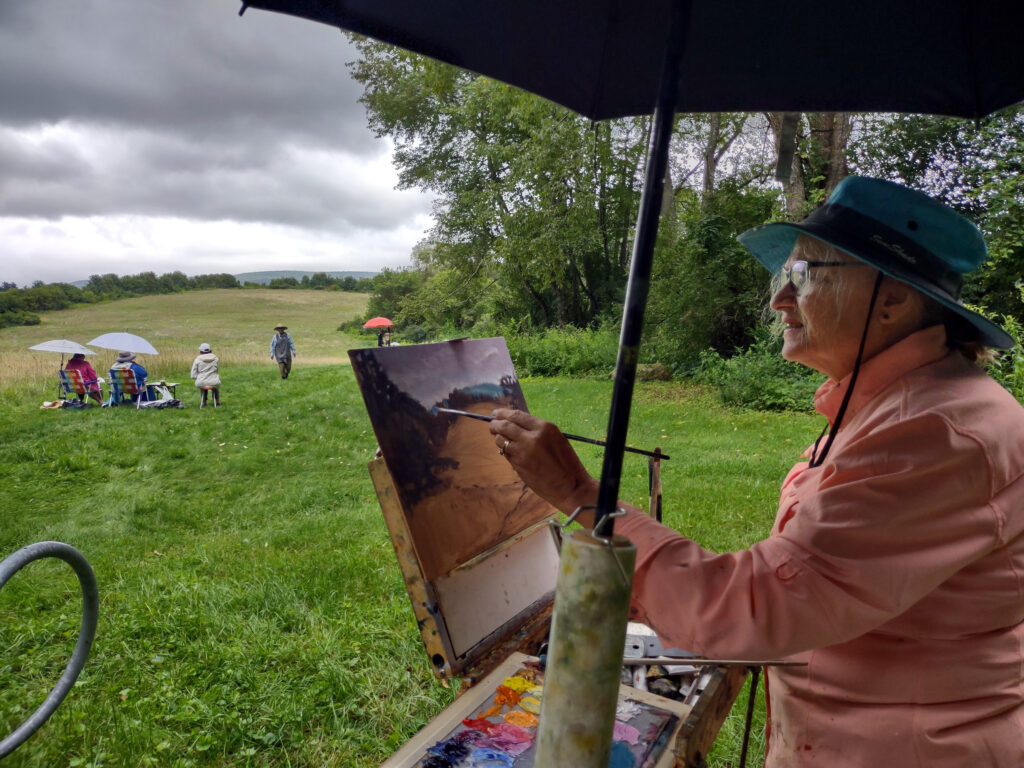
Lynda Mussen painting under a changeable sky in the Berkshires. She’s coming back to Schoodic this year.

Lauren Hammond

In 2024, I attended the Berkshire workshop. The moment I arrived, I realized it was the perfect setting to learn how to paint layered bands of green trees, open fields, and wooded landscapes. I dove right in, and with Carol’s generous guidance, I made significant progress in this area.

Amy Holderness

I had the pleasure of taking Carol Douglas’s five-day painting workshop in the beautiful Berkshires, and it was a truly memorable experience as it was my first time taking a workshop like this.  Each day brought us to a different location, offering fresh inspiration and new challenges as we painted our way through the stunning landscape.

Carol is a wonderful teacher who shares her knowledge and encouragement in a way that makes you want to keep painting and improving. One of the best compliments I received during the workshop was, “I wish I had painted that.” It was such an encouraging moment and a reminder of how much I had grown over the course of the workshop.

One of the best pieces of advice Carol gave me was to start each day with a small, 20-stroke painting. This simple exercise helped me loosen up, focus on the essentials, and let go of the pressure to make every painting perfect. The 20-stroke painting I did on-site was eye opening as I learned how to plan my work in advance and then just go for it. 

Kimberly Quinn-Jones’ underpainting on Blueberry Hill at Schoodic.

I came away from the workshop with new skills, renewed confidence, and wonderful memories of painting in the Berkshires. I highly recommend Carol’s workshop to anyone looking to grow as a painter while enjoying a truly inspiring and supportive experience.

I have just two workshops left in 2026! Reserve your spot:

Can’t commit to a full workshop? Work online at your own pace:
Seven Protocols for Successful Oil Painters

What is your authentic voice as a painter?

Autumn Farm, Evening Blues, oil on canvasboard. For more information, click on image.

Students often tell me they want to “find their style.” It’s one of the most common goals I hear, right up there with wanting to “loosen up” or “master color.” But it’s the wrong question.

A quick note on weekly classes before we get into it

Claim your spot in Painting Nocturnes, Tuesday evenings or Painting Water, Monday evenings. Both are 6-9 PM, starting the week of August 17, 2026.

I upload videos of these online classes and you have access to them for as long as there’s YouTube. That means you can review them if you need a refresher or have to cut out early.

Style and voice aren’t the same thing.

Style is what’s left when we fail to achieve perfection. Practically speaking, style is the sum of the visual tools we use to try to get there: brushwork, color palette, paint handling, edges, whether you’re painterly or linear, high-key or tonal. These are all important, but they’re also constantly evolving. The worst thing you can do is lock yourself into something believing it’s your style. Your style should change as your technical skills and interests change. After all, you’re not still wearing skinny jeans, are you? Are you?

Autumn farm, oil on canvasboard, for more information, click on image.

Voice is something else entirely.

Your voice is the why behind what you paint. It’s your way of seeing the world. It’s the thread that runs through your work even as your technique changes. It comes from your experiences, your curiosity, your temperament and the questions you ask every time you set up an easel.

Ironically, trying too hard to develop a recognizable style often delays finding your authentic voice. When you’re focused on looking like someone else—or even on looking consistently like yourself—you stop responding honestly to what’s in front of you.

Evening in the Garden, 9X12, oil on archival canvasboard, for more information, click on image.

Instead, ask better questions

  • What drew you to this scene?
  • What emotion does this place evoke?
  • What deserves emphasis, and what can be left out?

Those decisions shape your paintings far more than any particular brushstroke ever will.

This is one reason I love teaching in the Berkshires. Its landscape is rich enough to inspire any painter, yet varied enough that no two artists respond to it the same way. Some are captivated by the rolling farmland, others by tumbling waterfalls, dense forests or historic villages. One painter sees dramatic light. Another notices subtle atmosphere. All are responding to their own authentic voice.

In my Find Your Authentic Voice in Plein Air workshop, we spend plenty of time discussing composition, value, color harmony and paint handling. Good technique matters. It gives you the vocabulary to express your ideas clearly.

Great technique is the twin-turbocharged V-8 that drives your painting. But your destination is your authentic voice.

Brilliant autumn day, 9X12, oil on canvasboard, for more information, click on image.

Throughout the week, I’ll encourage you to make choices based on what genuinely interests you instead of what you think a successful painting is supposed to look like. We’ll talk about editing, simplifying, emphasis and trusting your own observations. We’ll talk about intent as much as execution, because the strongest paintings are built on clear ideas as well as sound craftsmanship.

If you’re ready to move beyond imitation, stop chasing someone else’s style, and develop paintings that reflect your own way of seeing, I’d love to paint alongside you this August in the Berkshires. Join me for my Find Your Authentic Voice in Plein Air workshop and discover how stronger observation, thoughtful technique and honest expression work together for stronger paintings.

I have just two workshops left in 2026! Reserve your spot:

Can’t commit to a full workshop? Work online at your own pace:

Seven Protocols for Successful Oil Painters

Monday Morning Art School: sketching is thinking

Maine Coast, 8X10, oil on archival canvasboard, for more information, click on image.

On Friday, a visitor to my gallery told me, “I’ve never learned to paint; I’ve only taken drawing classes.” If only everyone started that way! The ability to sketch out designs is integral to painting.

Paint has a way of making small mistakes expensive. Weak composition, confused values and awkward shapes are much harder to correct once you’ve mixed colors and committed brush to surface. Twenty minutes with a pencil lets you think through those issues.

Your sketch is both visual exploration and how you think through what your painting will be about.

A quick note on weekly classes before we get into it

Claim your spot in Painting Nocturnes, Tuesday evenings or Painting Water, Monday evenings. Both are 6-9 PM, starting the week of August 17, 2026.

I upload videos of these online classes and you have access to them forever (or for as long as there’s YouTube.) That means you can review them if you feel you need a refresher or have to cut out early for some reason.

Beach Roses, 10X10 on sealed Baltic birch, for more information, click on image.

Composition first

All subjects present you with an overwhelming amount of information. That’s especially true in landscape, where even the simplest scenes are visually cluttered.

Your impulse is to slavishly copy everything you see, especially when working from photos. Sketching helps you organize and prune.

You can test different arrangements quickly. Move the horizon. Shift the focal point. Crop out distractions. Combine shapes. This is where good paintings begin—not with paint, but with good decisions.

Off Pearl Street, 8X10, oil on archival canvasboard, for more information, click on image.

Value is easier to see in pencil

Dealing with hue and saturation at the beginning distracts us from what really makes a painting work—value. That’s what our eyes are programmed to see first, so it’s what we should focus on first. If the values don’t work, all the beautiful shades in the world can’t rescue your painting. And this is simplest to see in a pencil sketch (not an ink or marker drawing).

Sketching teaches you to see

Most beginners paint what they ‘know,’ rather than what they see. Experienced artists look for visual relationships rather than objects. What are the height and width relationships? Where do shadows start and end? Which plane is lighter or darker?

Regular sketching trains you to observe value relationships, proportion, perspective, angles and negative space.

Save time, paint and frustration

It’s much easier to erase a pencil line than repaint an entire canvas. Five or ten minutes spent sketching can save days of wrestling with a painting that’s built on a weak design. Professional painters aren’t necessarily faster because they paint quickly. They’re faster because they’ve already solved the important questions before starting to paint.

That’s so much more fun than flailing around.

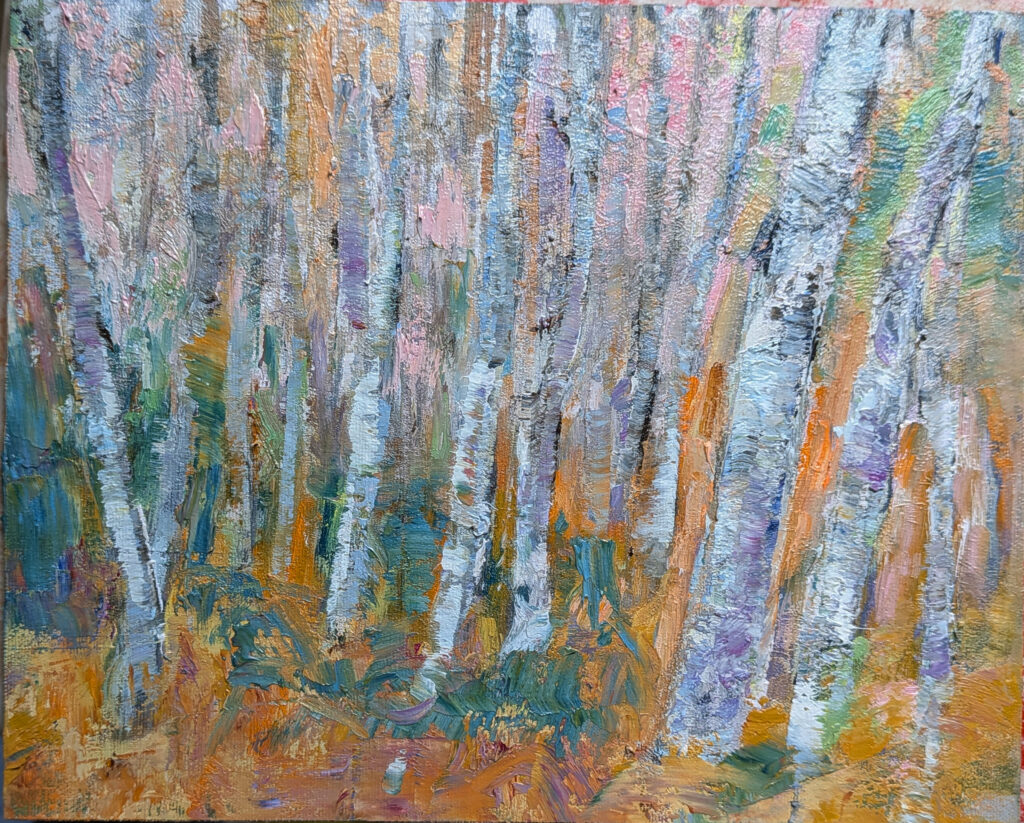
Grey Birches, 8X10, oil on archival canvasboard, for more information, click on image.

Build your visual library

Every sketch you draw adds another page to your internal reference book. Over time you accumulate knowledge about cloud formations, tree structures, human proportion, architecture, light and countless compositional solutions. This visual library becomes invaluable when you’re working from memory, developing studio paintings or radically revising the scene in front of you. The more you sketch, the richer your artistic vocabulary becomes.

Better drawing leads to better painting

Confident drawing leads to confident, looser brushwork. Your marks are more decisive because your eye has learned to judge distance, angle and proportion instinctively.

Your sketch is not a blueprint, it’s a guide

I encourage my students to transfer their sketches to canvas by gridding, and then leave their sketches nearby so they can refer back to the patterns of light and dark that first interested them. This is especially important when painting outdoors, where light levels constantly shift.

But the purpose of this sketch is to establish composition, value pattern and design, not to dictate every brushstroke. Once the fundamentals are secure, that leaves room for discovery.

If you’d like to develop stronger compositions, better value structure, and a more confident painting process, my workshops (below) emphasize these practical skills.

I have just two workshops left in 2026! Reserve your spot:

Can’t commit to a full workshop? Work online at your own pace:
Seven Protocols for Successful Oil Painters

New England isn’t one big landscape, it’s many painting questions

Sea Fog, 9X12, oil on canvasboard, available. For more information, click on image.

People from the rest of America sometimes talk about New England as if it’s one place. I get that, since I sometimes use “the west” or “the south” or “the Midwest” as verbal shorthand. But New England comprises many distinct regions, each with its own light, geology, atmosphere and visual language.

A quick note on weekly classes before we get into it

Claim your spot in Painting Nocturnes, Tuesday evenings or Painting Water, Monday evenings. Both are 6-9 PM, starting the week of August 17, 2026.

I upload videos of these online classes and you have access to them forever (or for as long as there’s YouTube.) That means you can review them if you feel you need a refresher or have to cut out early for some reason.

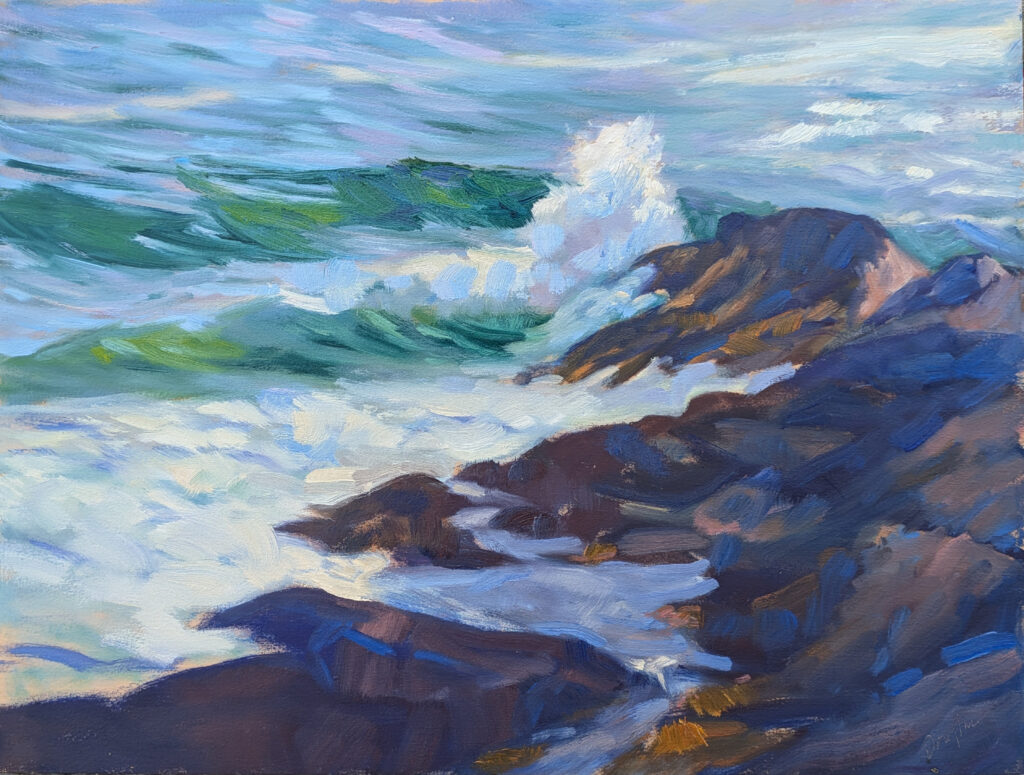
High Surf, 12X16, oil on prepared birch painting surface, for more information, click on image.

The rocky coast of Maine

This is a world of granite ledges, pine and spruce forests, tidal rivers, and a mercurial ocean. A lot of it is coastline, but even more is unspoiled mountains, lakes and rivers. The light is cool, clear and crystalline. It has attracted painters from Winslow Homer to Rockwell Kent because it strips away sentimentality. Maine rewards honest observation and strong design.

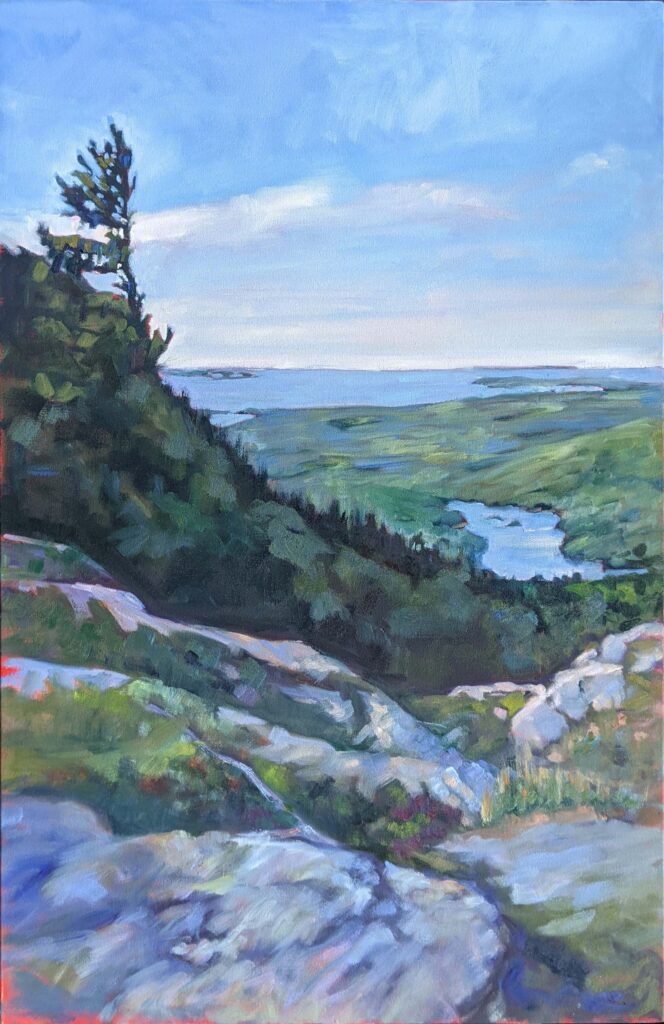
View from Bald Mountain, 24X36, oil on canvas, Carol L. Douglas, private collection.

The White Mountains of New Hampshire

Cross into New Hampshire’s White Mountains and suddenly the landscape becomes about mass and structure. The mountains rise abruptly, the forests are dense, and the weather changes with astonishing speed. The painters of the nineteenth-century White Mountain school weren’t simply documenting scenery—they were fascinated by geology, atmosphere and scale.

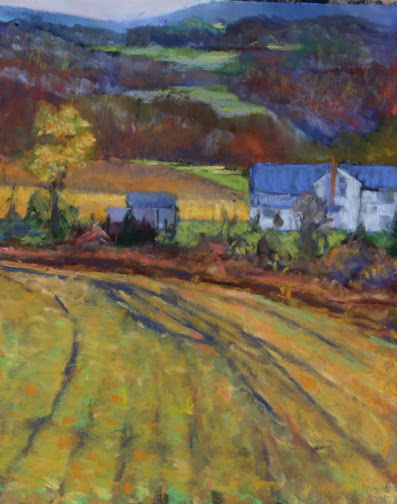
Farm in Autumn, 9X12, pastel. Private collection.

Rolling farmland

Vermont is much more polite. Rolling farmland, sugar maples, stone walls and villages nestle into broad valleys beneath the Green Mountains. Its beauty is orderly rather than dramatic. That attracted painters like Aldro Hibbard who loved rhythm, pattern and subtle color harmony. This landscape rewards patience and observation.

Beachy New England

From southern Maine through Connecticut, the New England coast is dotted with beaches—some extensive and some tucked into quiet pockets. Childe Hassam and Edward Hopper both explored this part of the coast.

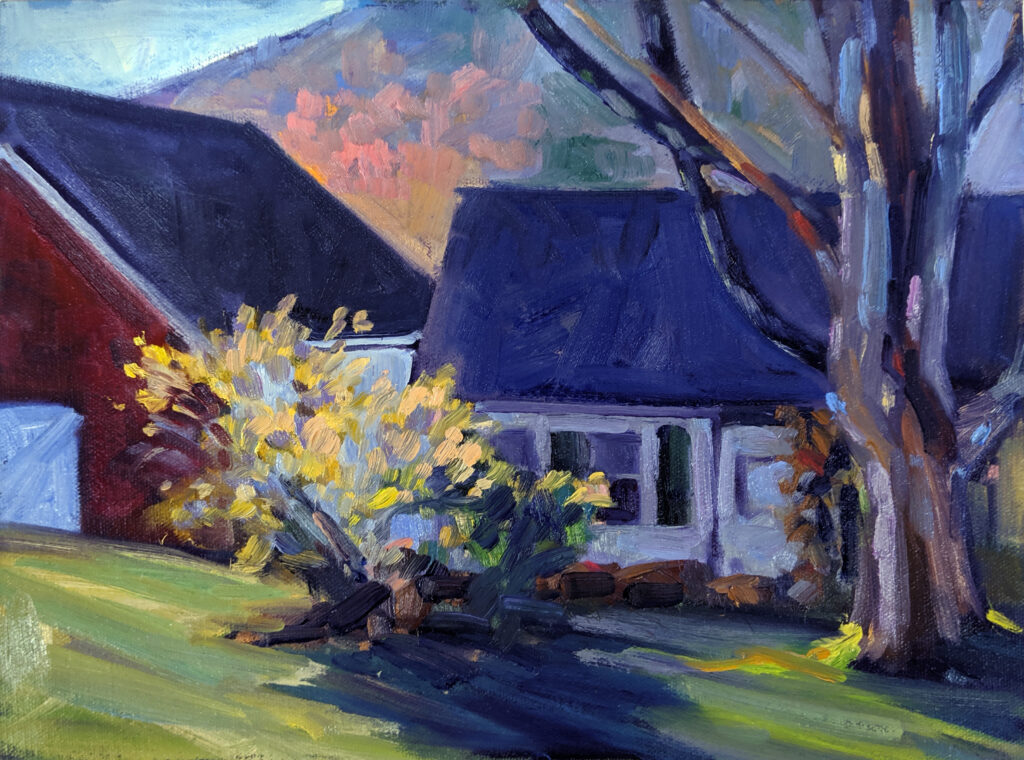
New England farmyard, 9X12, private collection.

Berkshires

The Berkshires of western Massachusetts are something else entirely. They’re softer than the White Mountains but grander than Vermont’s hills. The broad valleys, winding roads, old farms and dense woodlands have inspired generations of artists, writers and musicians. The Berkshires invite painters to look beyond mere representation and ask, “What is the emotional heart of this place?”

Southern New England

Connecticut’s river valleys and coastal marshes offered the American Impressionists an entirely different challenge. Childe Hassam and Willard Metcalf chased broken light across meadows, beaches and village streets. Rhode Island’s rocky shores and historic harbors attracted both marine painters and Impressionists like Mabel May Woodward.

Landscapes shape painters

Every region asks for different choices in composition, edges, color temperature and brushwork. That’s why I encourage students to travel and paint in many places. Every new landscape stretches your visual vocabulary. You begin to recognize that painting isn’t about memorizing formulas. It’s about learning to see.

Whether we’re working on the granite coast of Maine, beneath the immense skies of Acadia, among the lyrical hills of the Berkshires, or exploring color and composition in Rockport, every workshop is really about the same thing: learning to understand what makes a place unique, and discovering how to express that with confidence and authenticity.

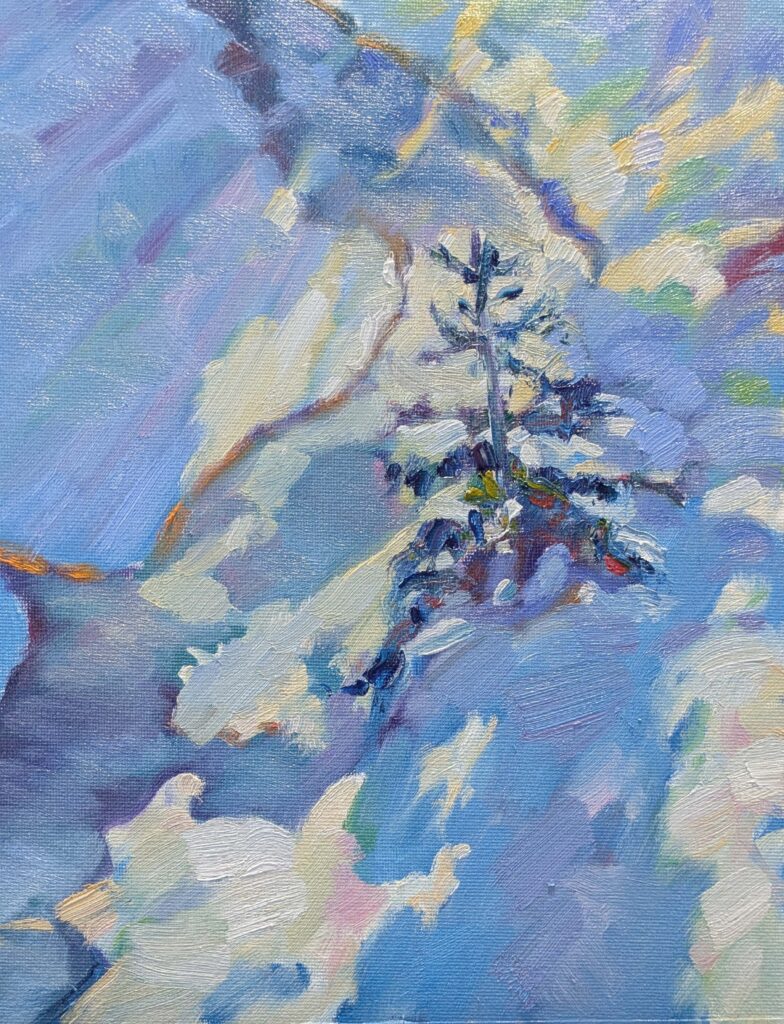
Baby pine tree, 6X8, private collection.

If you’re ready to deepen your understanding of landscape painting, I’d love to paint alongside you. My workshops include plenty of one-on-one time so you’ll leave with stronger paintings, sharper observational skills and a repeatable process you can take home. Painters of all levels are welcome!

I have just two workshops left in 2026! Reserve your spot:

Can’t commit to a full workshop? Work online at your own pace:
Seven Protocols for Successful Oil Painters

Why I fell in love with the Berkshires

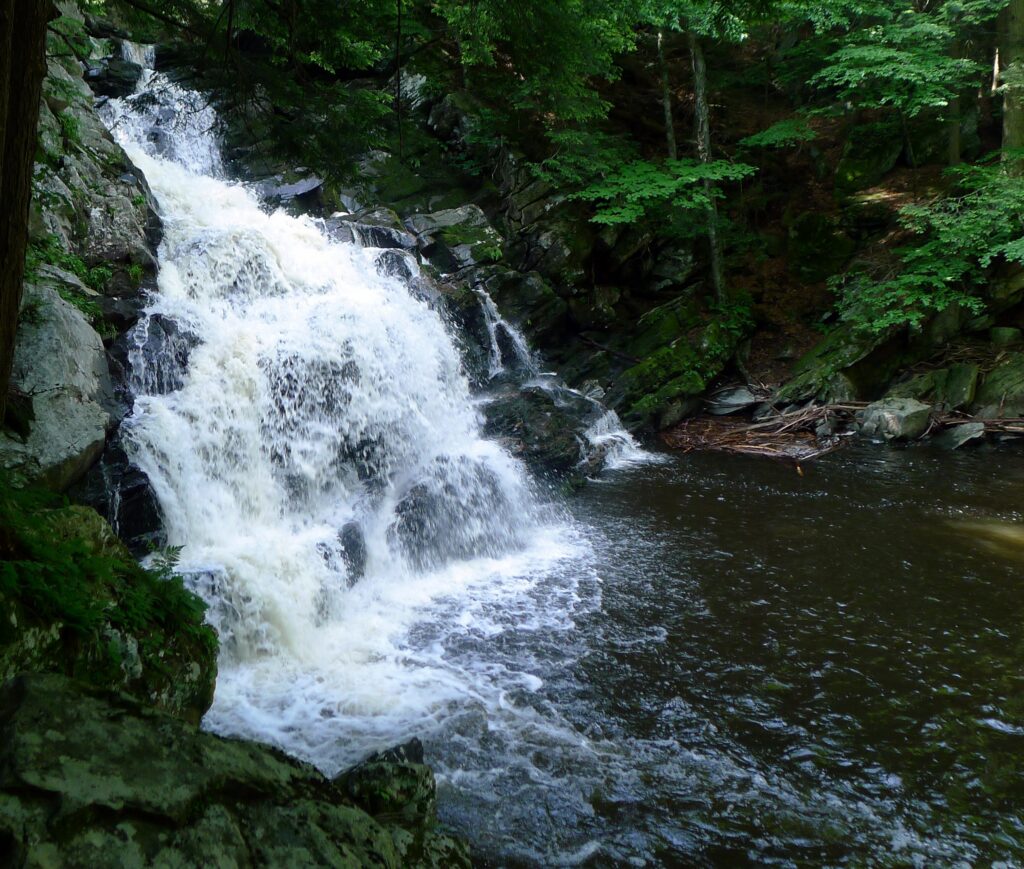
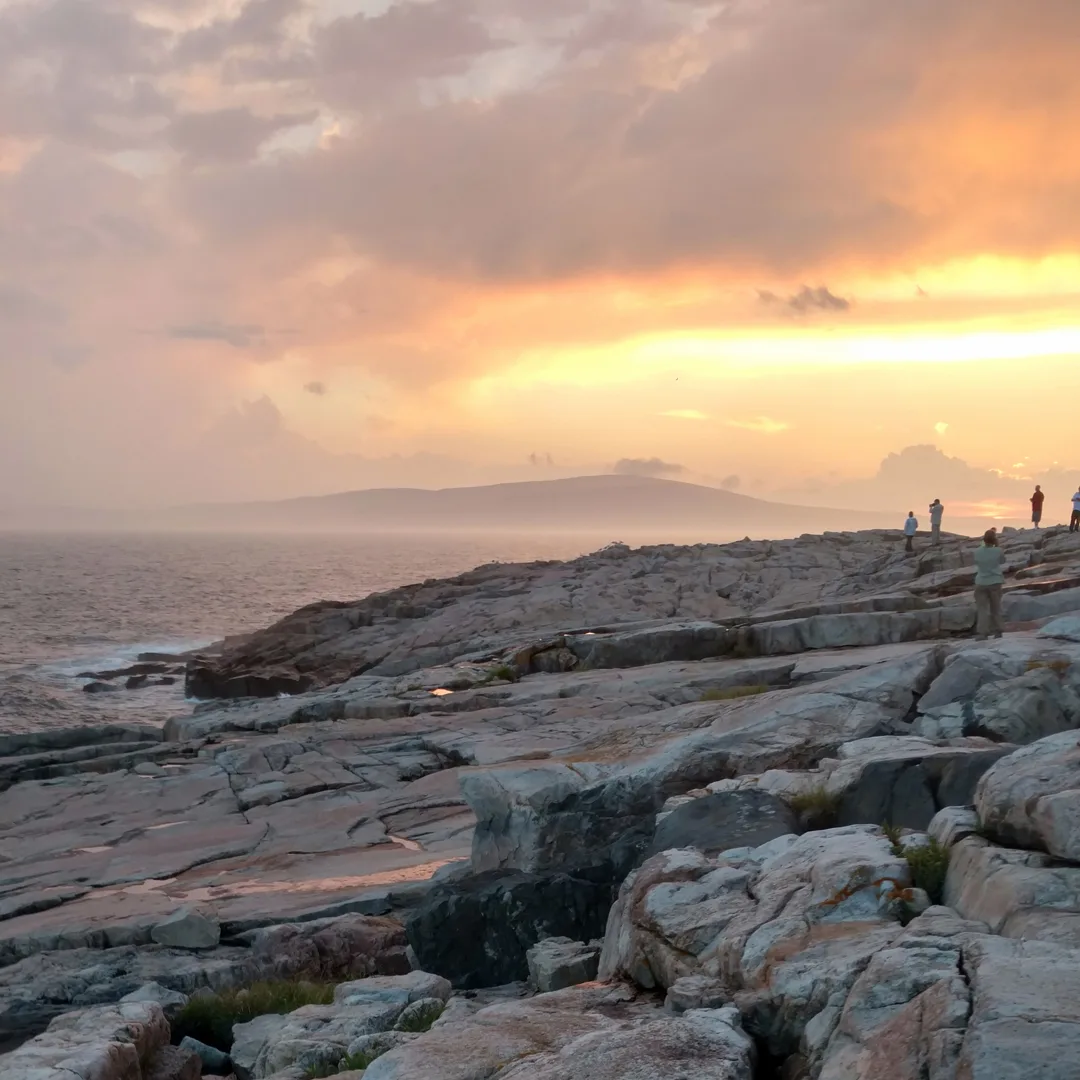
Wild spills of water aren’t just in Maine. This is in Dalton, MA, and I try to take my students here every year.

Fifteen years ago, my daughter and new son-in-law moved to Pittsfield, MA. It’s given me an opportunity to learn and love the Berkshires.

A quick note on weekly classes before we get into it

Claim your spot in Painting Nocturnes, Tuesday evenings or Painting Water, Monday evenings. Both are 6-9 PM, starting the week of August 17, 2026.

I upload videos of these online classes and you have access to them forever (or for as long as there’s YouTube.) That means you can review them if you feel you need a refresher or have to cut out early for some reason.

The Berkshires landscape ranges from the pastoral beauty of Shaker communities to wilderness.

Artists and writers, poets and performers

Among the great artists who’ve worked in the Berkshire were Thomas Cole, George Inness, Norman Rockwell (who lived there for the last 25 years of his life) and sculptor Daniel Chester French.

Writers included Herman Melville (who wrote much of Moby-Dick there), Edith Wharton, Nathaniel Hawthorne, Henry David Thoreau and William Cullen Bryant.

Musicians and performing artists have been drawn to Tanglewood, including Leonard Bernstein, Aaron Copeland, Yo-Yo Ma, James Taylor and Ted Shawn, whose Jacob’s Pillow in Becket is America’s oldest dance festival.

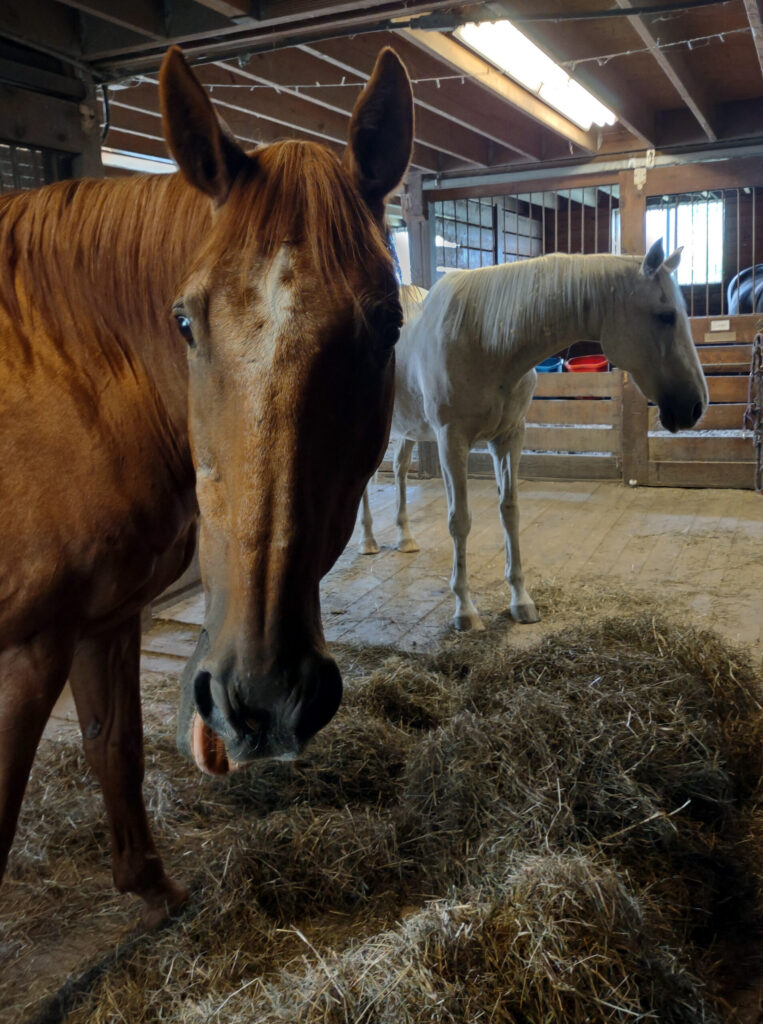
Horses at an historic farm in the Berkshires.

It’s close to both New York and Boston

One reason artists love the Berkshires is its proximity to the two centers of 19th century culture. Today you can get there from New York City in less than three hours by car and from Boston in two hours.

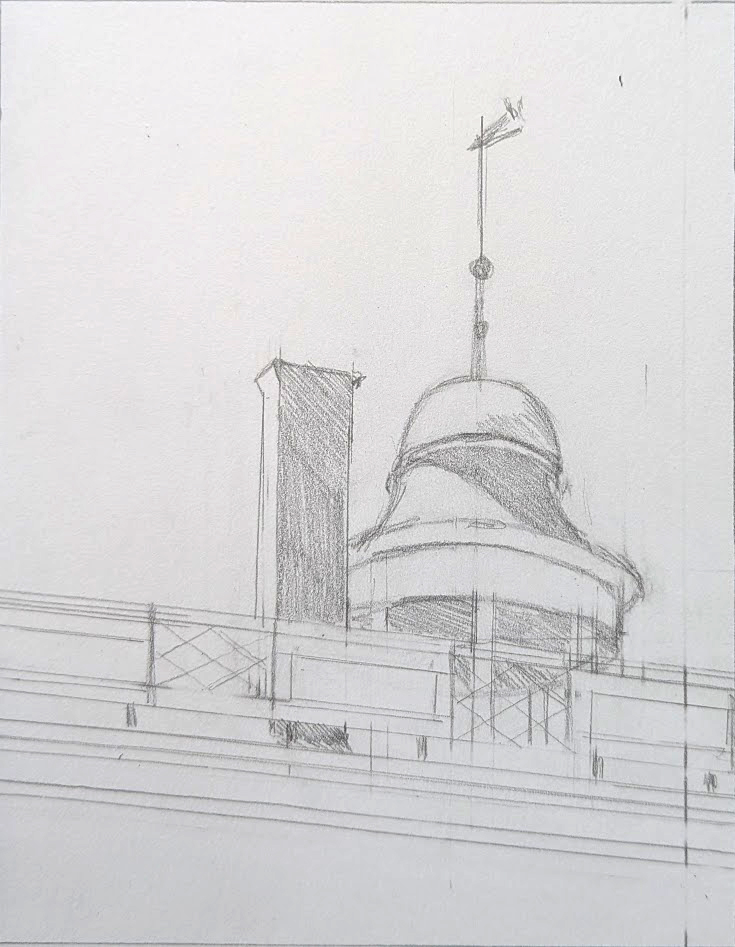
The villages and towns of the Berkshires are a great place to learn to draw architecture.

It’s beautiful

There are endless back roads, small mountain lakes and rolling green mountains. One can paint broad mountain vistas, a New England village green and a tumbling stream, all within a few miles of one another. The Berkshires are full of sweet surprises. Every bend in the road reveals another weathered barn, old stone wall, maple grove or hillside pasture.

The light is very different from coastal Maine or Arizona, but every bit as lovely. There can be luminous mornings, towering cumulus clouds in the afternoon and long, glowing evenings. The hills overlap in increasingly cool blues, giving wonderful opportunities to practice atmospheric perspective without it feeling contrived.

Shaker country

The American Shaker community was founded in nearby Watervliet, NY, but the whole of western Massachusetts is Shaker country. The most extensive renovated site is the Shaker village in Hancock, MA. I’ve brought groups there for several years and I always find things I’d never noticed before. Beyond the Shakers, there are white spires of churches, bustling old downtowns, apple orchards and horse farms. If you can’t find something that enraptures you, you’re not trying.

If the Berkshires have been calling your name, why not answer? Find Your Authentic Voice in Plein Air is a five-day workshop designed to help you move beyond simply recording what you see and toward painting with confidence, clarity, and your own authentic voice. It includes plenty of individual instruction, demonstrations and thoughtful critiques that will strengthen both your technical skills and your artistic vision. Painters in oils, watercolor, acrylic, gouache, and pastel at any level are welcome.

The Lenox library building was built in 1815–1816. It has a pocket park next door with deep shade, and restaurants nearby. What’s not to love?

The workshop runs from August 10–14, 2026 and enrollment is limited so everyone receives plenty of personal attention. Whether you’re looking to sharpen your plein air skills, reconnect with the joy of painting outdoors, or just learn to paint, I’d love to have you join us.

I have just two workshops left in 2026! Reserve your spot:

Can’t commit to a full workshop? Work online at your own pace:
Seven Protocols for Successful Oil Painters

Monday Morning Art School: nocturnes and water

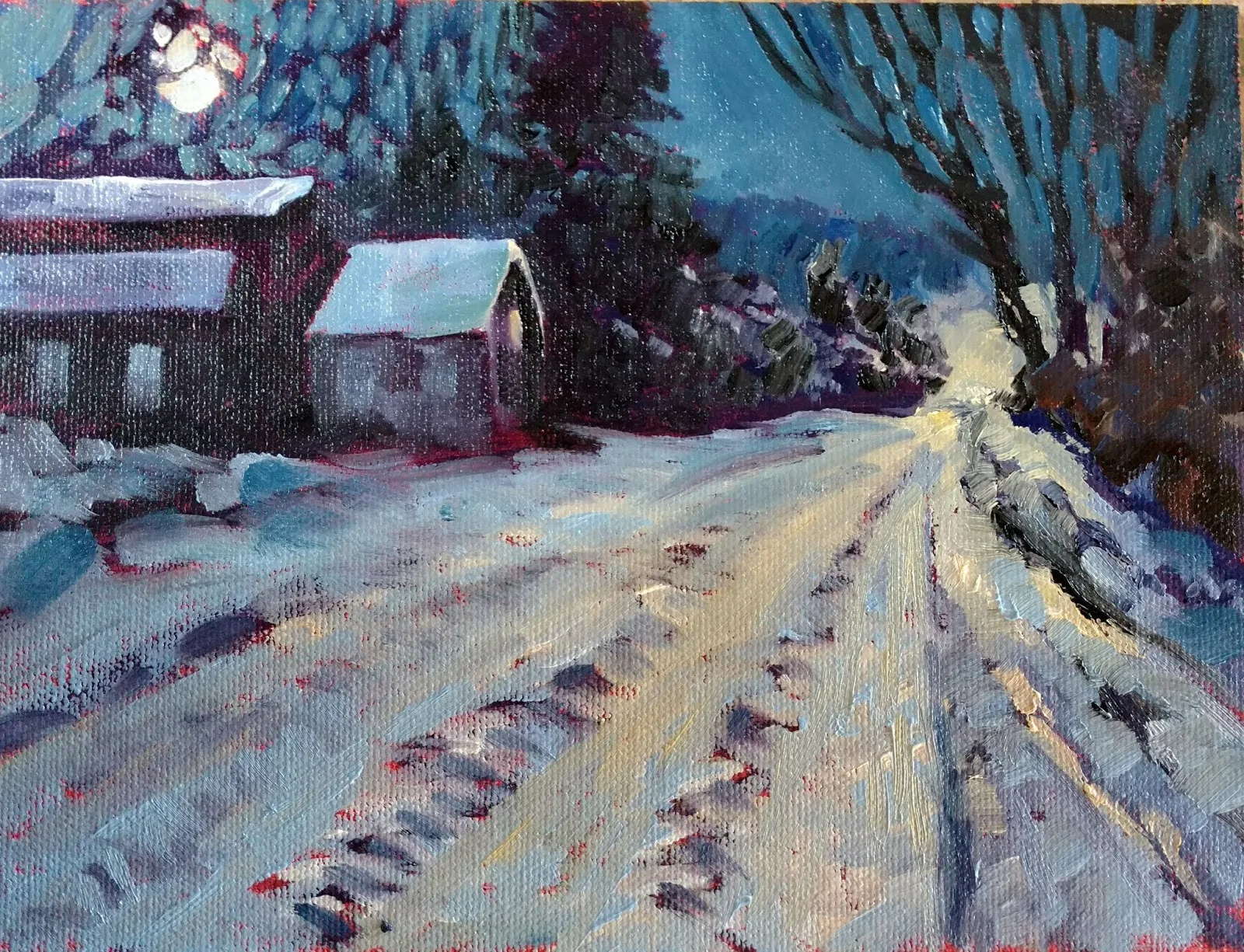
Christmas Eve 2, oil on canvasboard, private collection.

I’d like to pretend that I am very systematic about my painting classes, but the truth is that I sometimes go haring off after rabbits. This one was set off by a student who loves nocturnes. I’m focusing on them myself right now, so it seemed like a perfect fit.

Since my classes end up oversubscribed on the first go-round, it makes sense to repeat Painting Water so those people who were shut out last time get a chance.

The bald facts:

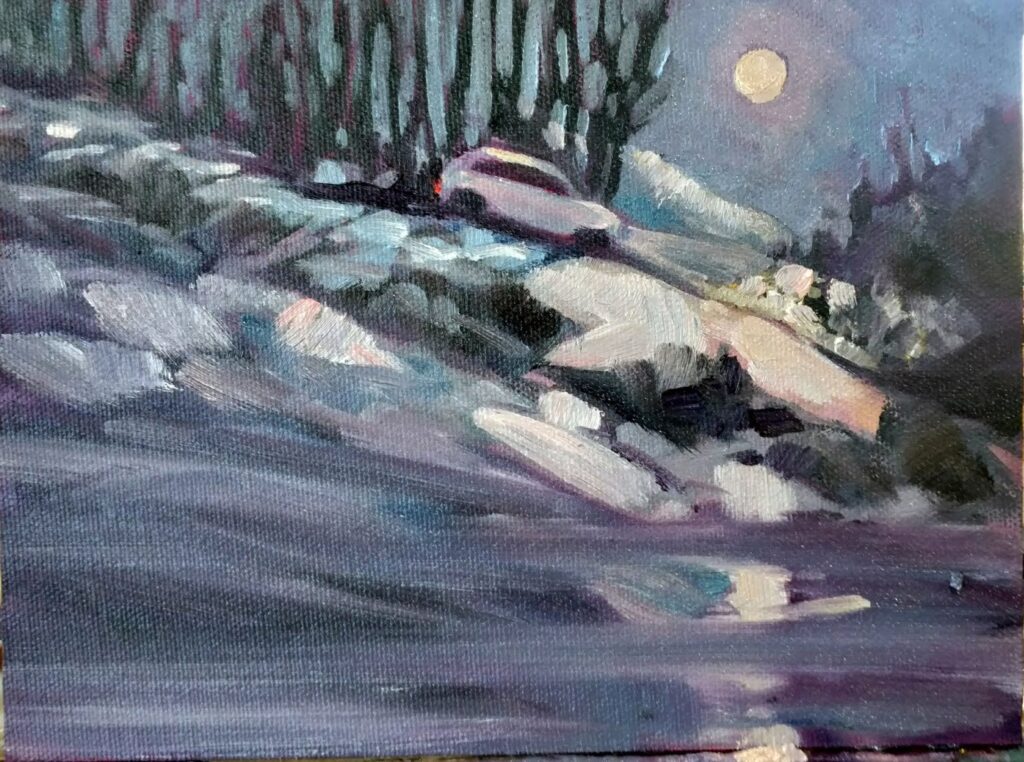
Amazing Grace, 12X16, oil on archival canvasboard, private collection

Painting Nocturnes
Tuesday evenings, 6-9 PM
August 18, 25, September 1

In this focused, three-week session, we’re going to demystify the night scene. If you’ve ever found yourself mesmerized by the night sky, this class is for you. Learn more.

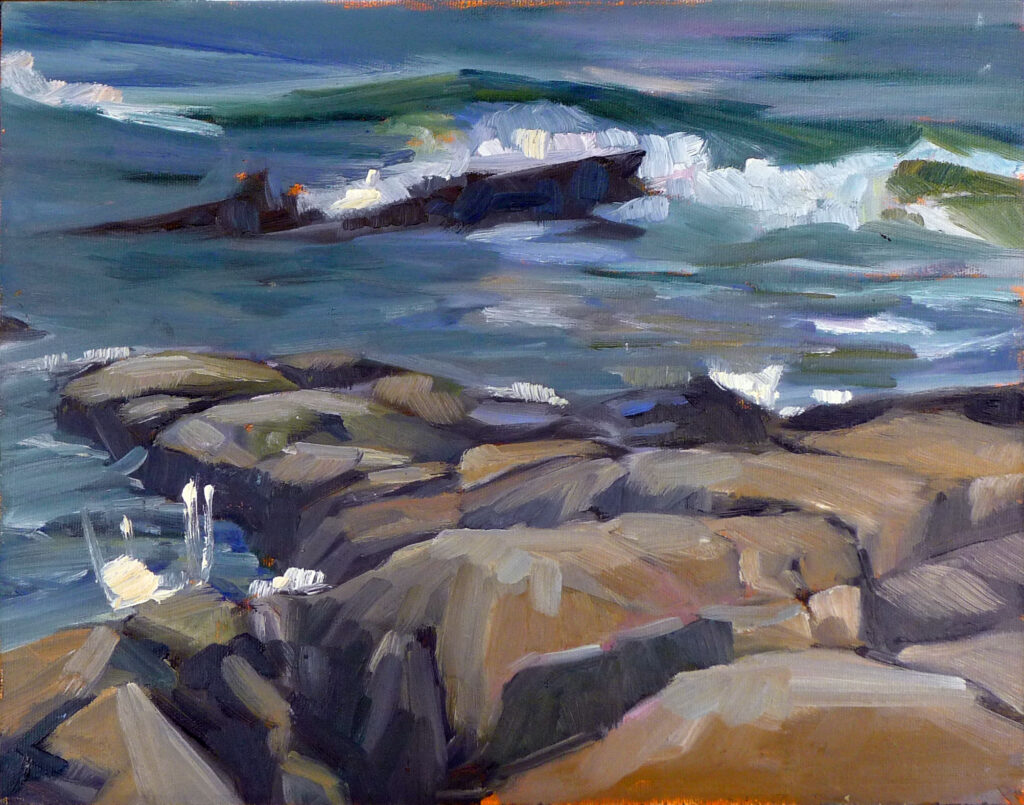
“Surf at Marshall Point,” oil on canvasboard, private collection.

Zoom Class: Painting Water

Monday evenings, 6-9 PM
August 17, 24, 31

Light, surface, and movement are the three important elements in painting water. Class size is limited, claim your spot now! Learn more.

I upload videos of these online classes and you have access to them forever (or for as long as there’s YouTube.) That means you can review them if you feel you need a refresher or have to cut out early for some reason.

Why these subjects matter

Water and nocturnes are both subjects that are just a little mysterious. They’re also two of the most rewarding subjects to learn to paint because they teach lessons that carry over into every landscape you create.

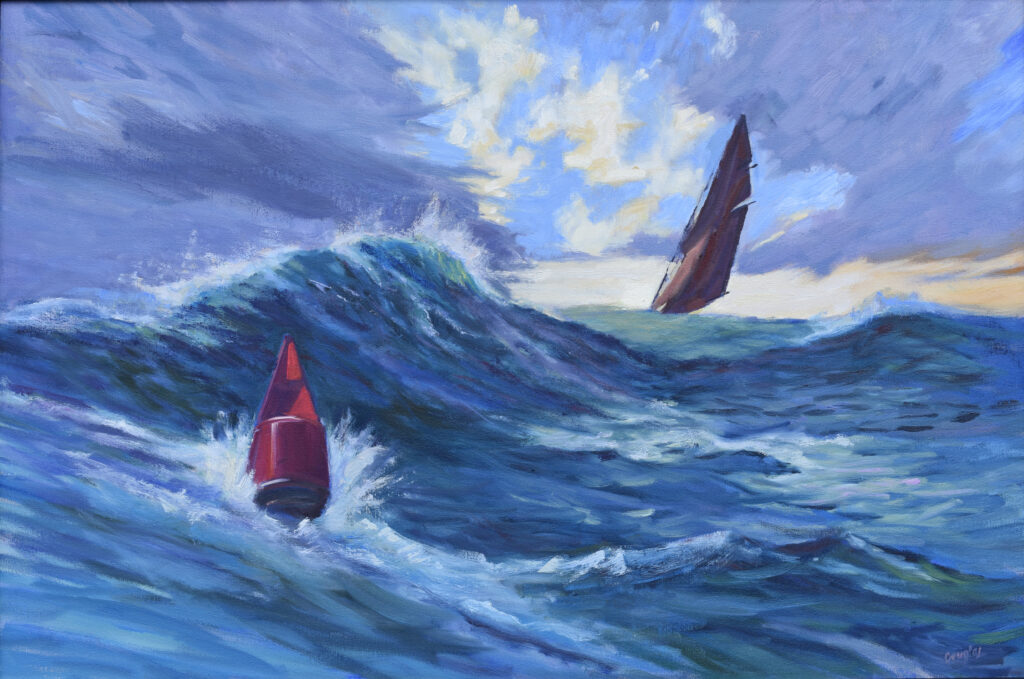
Heavy Weather (Ketch Angelique), 24X36, oil on canvas, for more details, click on image.

Water

Water is often the most mesmerizing part of a landscape, which is why I paint it so much. It catches the light, reflects the sky, and adds movement and atmosphere to what might be an otherwise static scene. Yet many painters struggle because they try to paint every ripple. Instead, there’s an underlying structure, based on the physics of light. Once you figure it out, you’ll struggle no more.

In this class, you’ll learn how light, surface, and movement work together to create believable water. That’s true whether you’re painting a quiet pond, a bustling harbor or surf breaking on a rocky Maine shore. Once you understand the principles, you’ll never look at water the same way again.

Nocturnes

There’s something magical about painting after dark. I’m better at it before dawn than after dusk, although most people see it otherwise. Either way, the world is quieter, colors are subtler and every light source suddenly matters.

In this focused three-week session, we’ll demystify the nocturne. You’ll learn how to organize values and use color to suggest darkness rather than relying on blackness. You’ll create paintings filled with atmosphere and mood. If you’ve ever been captivated by moonlight, glowing windows or the last light lingering in the western sky, this class will give you the tools to paint them with confidence.

Both classes are taught live on Zoom and include explanations, discussion, critique and plenty of time for questions. They’re designed for painters who want practical, repeatable techniques they can apply immediately to their own work. As always, class sizes are intentionally small so everyone has an opportunity to participate.

I hope you’ll join me for one—or both—of these classes. They’re two of my favorite subjects to teach, and I think you’ll come away seeing the world with fresh eyes.

I have just two workshops left in 2026! Reserve your spot:

Can’t commit to a full workshop? Work online at your own pace:
Seven Protocols for Successful Oil Painters

Even advanced artists take classes

A painting by Lynda Mussen (all paintings are from previous workshops and classes since this one hasn’t happened yet).

Advanced Painting Workshop Student Show

Friday, July 17
4:00–7:00 PM
Richards Hill Gallery
394 Commercial Street
Rockport, ME 04846

“…but I’m not a professional,” one of my students trailed off. I had to laugh—she shows in established venues, and I’ve watched her outsell me on more than one occasion. To paraphrase my friend Bobbi Heath, “A professional artist is one who sells paintings, collects sales tax and pays income tax on their earnings.”

One of the persistent myths about painting is that, once you’ve reached a certain level of competence, you don’t struggle anymore. In reality, every accomplished painter I know is still learning, still experimenting and still looking for ways to make the next painting stronger than the last.

Summer scene by Rachel Houlihan

That’s why I’m especially excited about our Advanced Painting Workshop Student Show, which will be open to the public for one evening only on Friday, July 17, from 4:00 to 7:00 PM at Richards Hill Gallery, 394 Commercial Street, Rockport, ME 04846.

None of these painters are beginners; they’re already highly skilled artists. They come to class not because they need to learn how to hold a brush, but because they understand something that every successful painter eventually discovers: there is no finish line.

This workshop will be their opportunity to step away from routine and examine higher-level issues: themes and narratives, edge control, drawing, composition, advanced color concepts, brushwork, broken color, dealing with difficult material and developing a consistent visual language.

I like teaching painters of all levels, but teaching really experienced painters is a joy. I get to facilitate a group of talented artists who are all pushing one another forward. The conversations are thoughtful, the critiques are honest and the willingness to take risks is inspiring.

The start of something fabulous by Kimberly Quinn-Jones.

The paintings you’ll see in this show will reflect that spirit. While the artists share a commitment to careful observation and strong design, no two paintings ever look alike. Each painter has already developed an individual voice before they even get to me. They’re already interpreting familiar subjects through personal choices of color, brushwork and composition. My job is to help them sharpen that while also introducing them to my favorite places to paint in midcoast Maine.

The most encouraging lesson this exhibition offers is that artistic growth never ends. Improvement isn’t reserved for beginners. In many ways, it becomes even more rewarding after you’ve mastered the basics, because every discovery builds on years of experience. That’s true whether you’ve painted for five years or fifty.

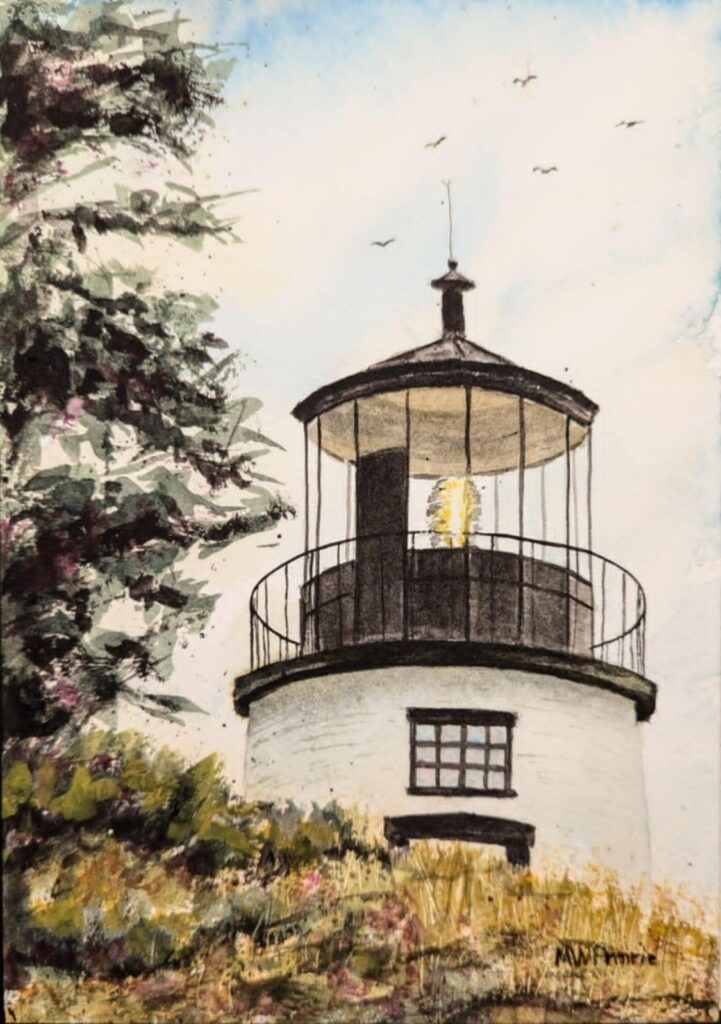
Owls Head Light by Michael Prairie.

If you’re an artist yourself, I hope this show reminds you that lifelong learning isn’t a sign of weakness, it’s one of the hallmarks of serious professionals. The best painters never stop being students.

And if you simply enjoy fine art, I hope you’ll stop by. It’s a wonderful opportunity to see a remarkable collection of fresh work created by some fine painters, all gathered under one roof for a single evening.

I have just two workshops left in 2026! Reserve your spot:

Can’t commit to a full workshop? Work online at your own pace:

Seven Protocols for Successful Oil Painters

National juried shows should ban (or cover) signatures

Carol L. Douglas painting workshops 2026
Larky Morning at Rockport Harbor, 11X14, on linen, for more information, click on image.

I got a note from a friend who just judged a national show. While last week’s heat may have made her a tad bit cranky, what she wrote was absolutely true.

“I will not judge another show where artists are allowed to submit signed work,” she said. Judges are human, and signatures are basically spoilers.

OPA, AIS, ASMA, ABC, XYZ, OBE, Order of the Garter, Old Etonian…

We get it; you worked hard and spent lots of money collecting enough post-nominal letters to rival an alternative medicine guru or British aristocrat. “I’m supposed to be judging the painting, not your résumé. If the work can’t impress me without the alphabet soup, we’ve got a problem.”

Downtown Rockport, 14X18, oil on archival canvasboard, framed, for more information, click on image.

You’ve entered almost this same exact painting since the Clinton administration.

Different boat, different barn, same old schtick. “I recognized your work before I saw the signature; I’m bored and suddenly I realize the problem isn’t me; it’s you. Seeing your signature reminds me of just how boring you’ve become.”

Wait, was this an off day?

“You’re usually excellent, so now I’m wondering: were you experimenting, rushing to meet a deadline, or should someone check your blood pressure? You usually do great work but this painting makes me wonder whether you’re phoning it in or if you had a stroke.”

Oh… it’s you (version one).

“You’ve been an a–hole for years and I don’t want you to succeed even if you can paint. Unfortunately, I remember that charming conversation where you explained, at length, why everyone else in the room was an idiot. I am trying very hard to judge only the painting. Very. Hard. It’s not working.”

Beautiful Dream, oil on archival canvasboard, for more information, click on image.

Oh… it’s you (version two).

“Oh… it’s you! You’re delightful. You’re always smiling and once bought everyone coffee. Suddenly I’m rooting for your painting just a little more than I should.

“I like you and I want you to see you succeed even if you can’t paint as good as the guy in version one.” That’s not fair either.

Why is your signature larger than the subject?

“Your signature is huge and it looks like a 6-year-old’s work on the refrigerator. Work on a signature that knows its place.” Unless you’re secretly signing the Declaration of Independence, dial it back.

Home Port, 18X24, for more information, click on image.

How to sign a painting

Signatures don’t just identify the artist—they activate memories, prejudices, friendships, rivalries, admiration, annoyance, expectations and occasionally mild PTSD.

Keep it small enough that viewers discover it rather than notice it immediately. Place it where it balances the composition without drawing the eye away from the focal point. Most artists sign in one of the lower corners.

Use a color that harmonizes with the surrounding passage. A signature that screams in bright white or jet black against a subtle passage can be more distracting than the painting itself.

Practice your signature until it becomes second nature. It should be legible enough to identify you, but it doesn’t need to read like a legal document. The best artist signatures are confident, understated, and consistent. After all, you want collectors to remember the painting first—and your name second.

As for show submissions, it’s easy enough to obscure a signature, and my pal is right; they should be covered for jurying. Blind judging isn’t about pretending judges don’t have biases. It’s about removing one of the easiest ways for those biases to creep into the room.

I have just two workshops left in 2026! Reserve your spot:

Can’t commit to a full workshop? Work online at your own pace:
Seven Protocols for Successful Oil Painters