

“I’m clueless about what different brushes do,” a student emailed. She’s not alone. Walk into any art supply store and you’re confronted by a bewildering wall of fine-art painting brushes. They differ in hair, length, spring and, most visibly, in shape. And still, with all that variety, I can manage to not find the brushes I’m looking for. Each brush speaks differently, and painters develop strong preferences that can, however, change over time as our styles evolve. Knowing what brush to grab is part of learning how to paint.
I’ve written in detail about what brushes do, here and here. But let’s talk more generally about brushes.

Brush history
Brush evolution began in antiquity; as paint varied in viscosity, it required different brushes. Western painting started off with fairly simple round brushes. Meanwhile, Chinese calligraphy had very different requirements: a pointed round end with a full belly that could make either precise or broad strokes. We look for similar brushes in watercolor painting today.
By the Middle Ages, manuscript illumination called for fine squirrel and sable hair brushes. But brushes were still less important than today. There is a famous legend about Giovanni Bellini‘s admiration for Albrecht Dürer‘s incredible technique in painting hair. Bellini asked Dürer for the brushes he used. Dürer showed him his ordinary collection of brushes and demonstrated his technique by painting a long, flowing strand of hair with remarkable precision.
Brushes weren’t standardized until the 19th century, when their manufacture was industrialized. This coincided with Impressionism, when visible brushwork became not a flaw but a feature. Stiffer bristles and brighter shapes supported looser, faster painting.
What do different brush shapes do?
Round brushes taper to a point, which means they can draw a line, place a dot, or broaden into a stroke with pressure. In watercolor painting, a good round brush can carry a surprising amount of pigment and still snap to a sharp point for detail. In oil painting and acrylic painting, rounds are excellent for drawing into wet paint, placing accents, and working smaller passages.
Flat brushes have a squared-off edge and long hairs that hold paint evenly. They excel at laying down broad, confident strokes. Flats are perfect for blocking in large shapes, cutting clean edges, and establishing planes. Turn one on its side and you get a thin line; press it flat and you cover ground quickly.
Brights are just short flats. The reduced hair length makes them stiffer and more controllable. That stiffness is ideal for pushing thicker paint in oil painting or for scrubbing color into the surface in acrylic painting. If you like visible brushwork and a sense of physical paint, brights give you that muscular quality.
Filberts combine the coverage of a flat with the gentleness of a round. They naturally create organic edges, perfect for modeling form. They’re especially useful when you want transitions without fussing.
Angle brushes have a slanted edge that makes them excellent for controlled strokes and awkward angles.
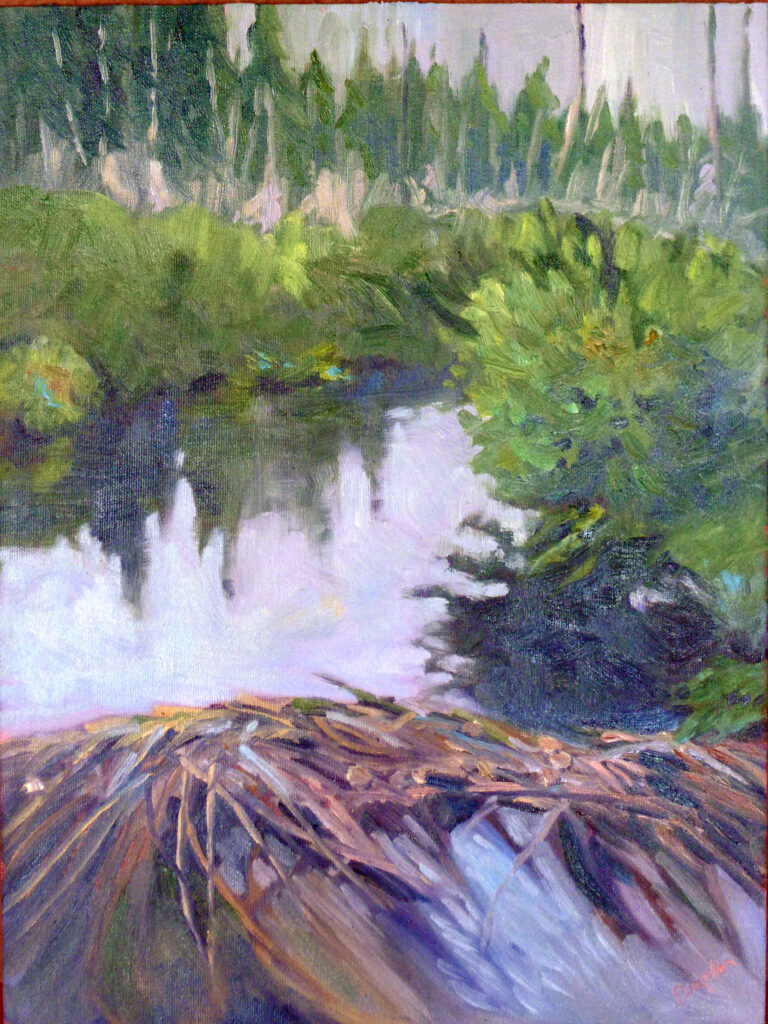
Fan brushes are not for painting happy little trees. Fan brushes can soften edges, blend transitions, or suggest texture like grasses, hair, or water reflections. The key is restraint.
Mop brushes are for watercolor painting. Their full, rounded shape holds a great deal of water, making them ideal for washes, soft skies, and seamless transitions.
Ultimately, brush shapes don’t make a painting good or bad. They shape how you think and how your hand moves. Experimenting with different fine-art painting brushes teaches you to see stroke, edge, and texture as choices rather than accidents. And that—more than owning the ‘right’ brush—is where real progress begins.
I have just two workshops left in 2026! Reserve your spot:
- New! Color Clinic 2026 | Rockport, ME, October 3-4, 2026
- New! Composition Week 2026 | Rockport, ME, October 5-9, 2026
- High-Desert Light & Monumental Form | Sedona, AZ, Apr 26, 2027 – Apr 30, 2027
Can’t commit to a full workshop? Work online at your own pace:
Famous question from me to Carol back in 2008, when I first started painting and saw my supply list (“filberts of differing sizes”) from the artist/instructor I’d signed up with for an oil-painting workshop: “Isn’t a filbert a nut?” I really was that clueless. Haha.
Well, you weren’t wrong.