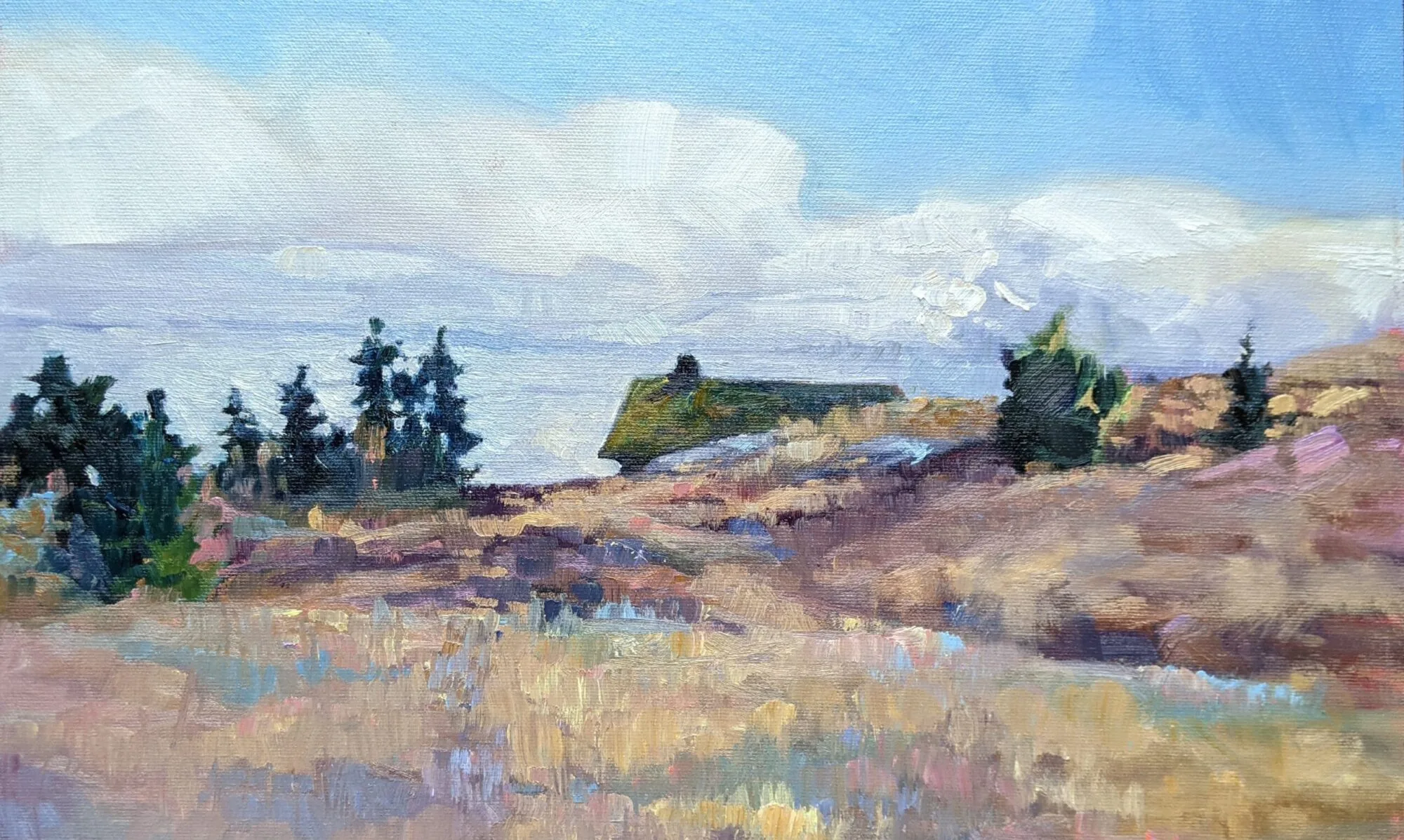


Arizona (especially Sedona’s red-rock country) looks simple from a distance. Big shapes. Big color. Big sky. That apparent simplicity is exactly what makes it hard to paint well.
Every landscape has its own rules, and the desert is particularly unforgiving to painters who arrive armed with assumptions instead of observation. I know this because a long time ago I did exactly that. What did the Arizona desert teach me about painting light and color? More things than I can list, but below are the main points.

Capturing desert light
Capturing desert light starts with understanding that Arizona’s atmosphere is clean, dry, and thin. There’s very little haze to soften transitions. As a result, value contrasts are stronger than you may be used to, and color temperature shifts are abrupt. Sunlit planes are warmer than expected, except at midday. The shadows snap cool, sometimes dramatically so. That’s from a distance. Up close, there’s a tremendous amount of color bouncing around the shadows. They are often higher in chroma than the sun-bleached parts of the picture.
If your painting feels flat, it’s often because you aren’t respecting color temperature enough.

Painting rock formations
Painting rocks is less about detail and more about structure. From individual rocks to gigantic massifs, rock formations are built from planes. Start by identifying the major directional faces of the rock and assign them clear value families. Vertical planes can read darker than sloped ones, and ledges catch light differently still. At the vast scale of the desert, texture and detail are almost an afterthought. If you paint every crack and striation, you’ll destroy your painting—and your mind.

Working fast in changing light
Working fast is not optional in the desert. The light moves quickly, and shadows can crawl across a canyon wall in minutes. This is where the preparatory sketch earns its keep. Adapt it for desert conditions by simplifying even more than usual. Four different value steps are sufficient. If you can’t organize the scene in ten minutes, you won’t fix it in two hours. And you’ll be mighty glad to have that sketch when the light shifts.
Color mixing for arid landscapes
Color mixing for arid landscapes is where many painters go off the rails. Yes, rocks are orange and bluffs are ochre. But Sedona and the wider Southwest are full of violets, cool reds, muted greens and dusty neutrals. Shadows are often infused with unexpected color. Adjust temperature rather than dialing up saturation. If everything is intense, nothing is.
The desert doesn’t reward fussing. It rewards decisiveness, clear value structure, and honest color. Arizona’s landscape will teach you quickly where your habits help you—and where they don’t. That’s why painters keep coming back. The desert is a tough teacher, but it never wastes your time.
Want to learn more?
This March, I’m leading a 5-day plein air workshop in Arizona, and I’d love for you to join me.
Canyon Color for the Painter: A Plein Air Workshop will be held through the Sedona Arts Center, March 9–13, 2026. This immersive week-long workshop is designed for painters in oil, acrylic, pastel, watercolor, gouache, and all experience levels.
You can register directly on Sedona Arts Center’s website, here. Or, contact me if you have questions. I’m happy to answer anything about the workshop, skill requirements, materials or what to expect painting in the desert.
I have just two workshops left in 2026! Reserve your spot:
- New! Color Clinic 2026 | Rockport, ME, October 3-4, 2026
- New! Composition Week 2026 | Rockport, ME, October 5-9, 2026
- High-Desert Light & Monumental Form | Sedona, AZ, Apr 26, 2027 – Apr 30, 2027
Can’t commit to a full workshop? Work online at your own pace:
I absolutely love your desert paintings Carol. You have really mastered the colors.
Disappointed that I can’t attend the workshop-have a conflict on those dates. Next time for sure.
Awww. That’s too bad!