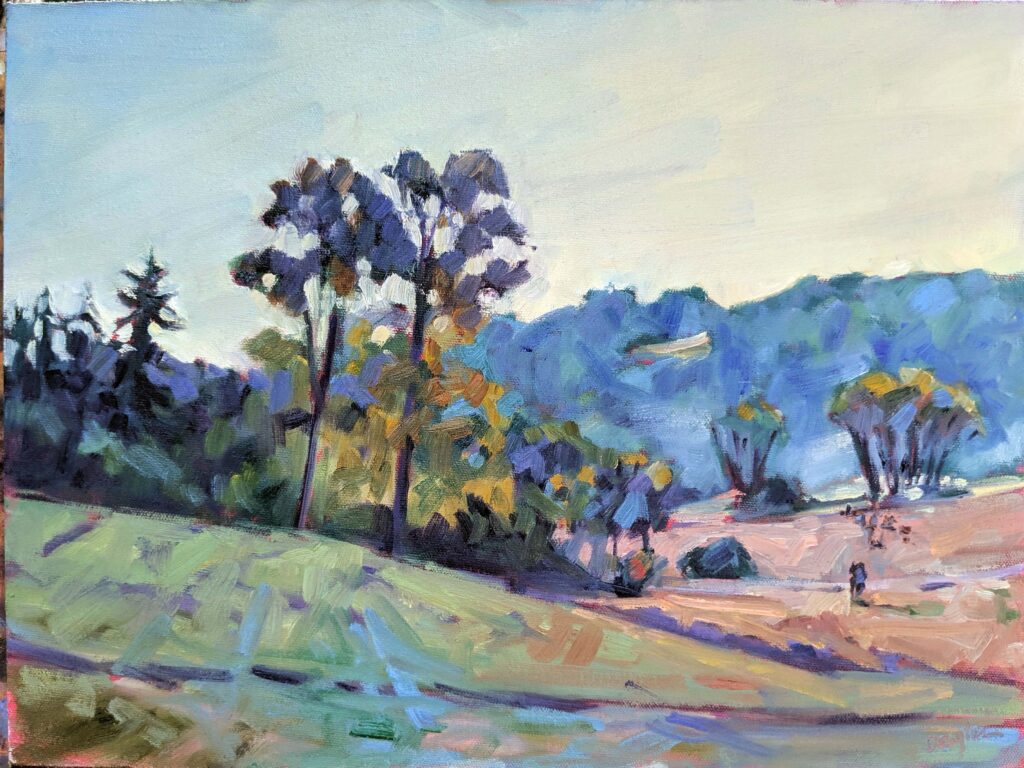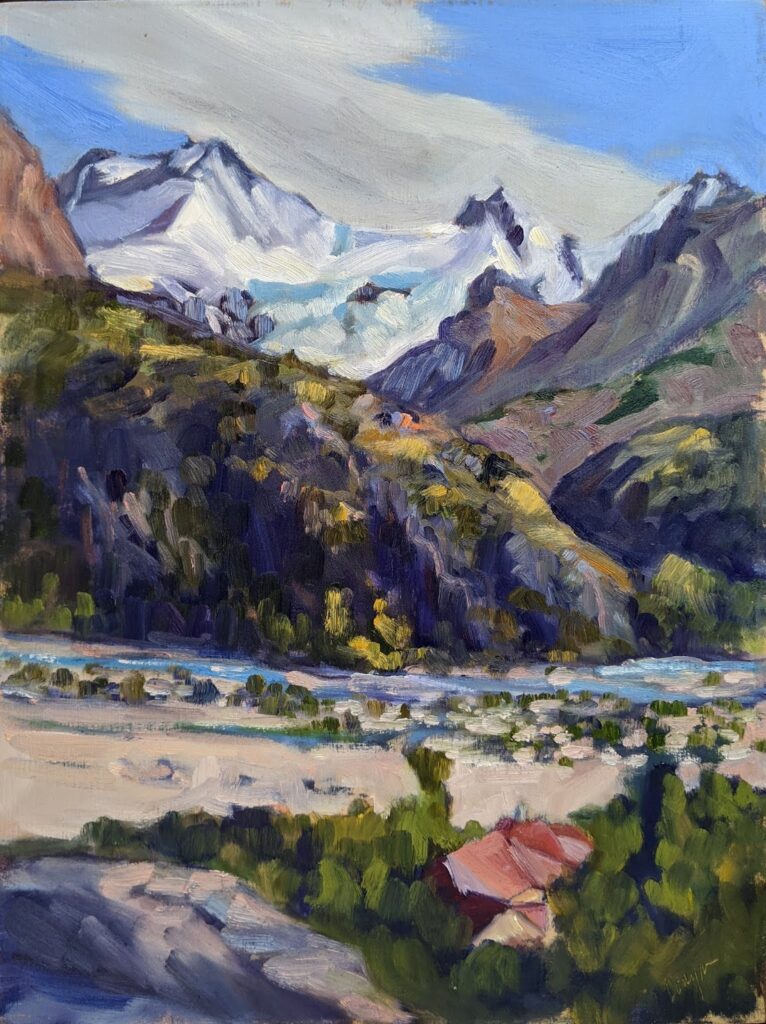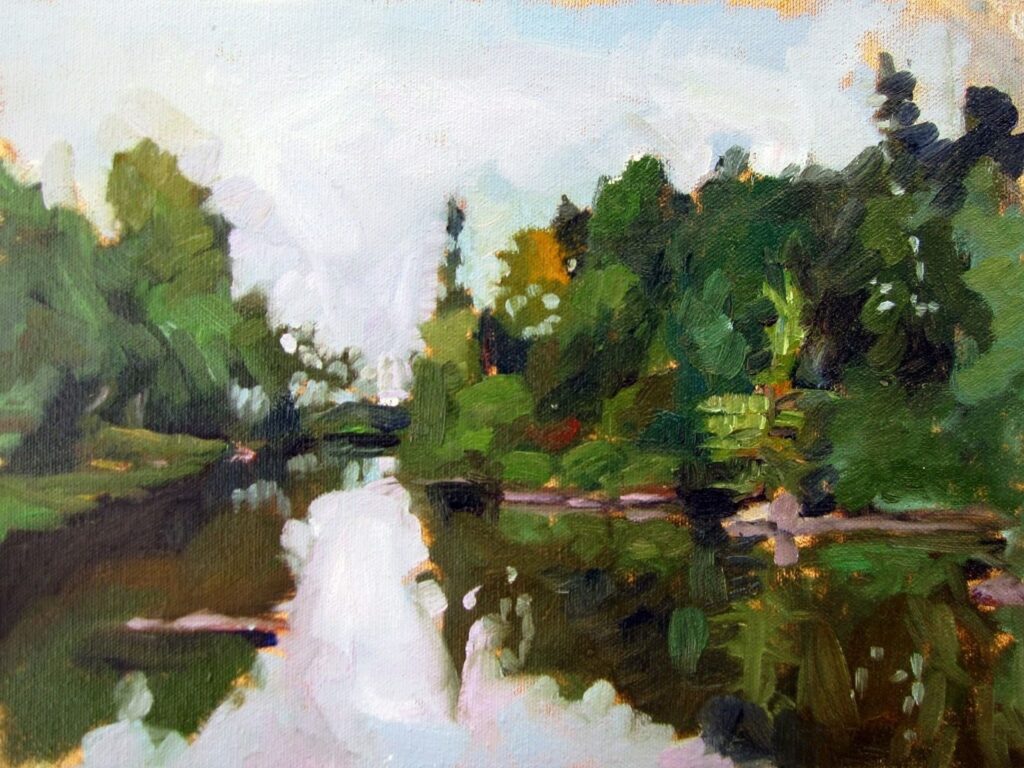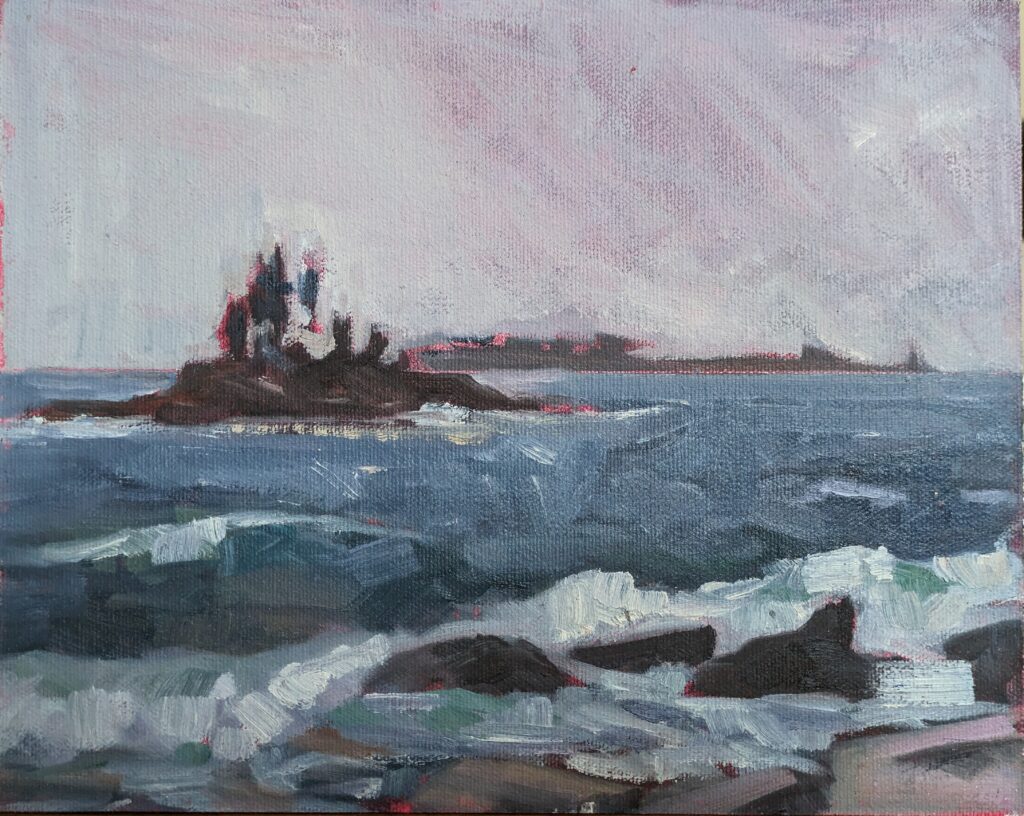
Monday Morning Art School: five days, five trees

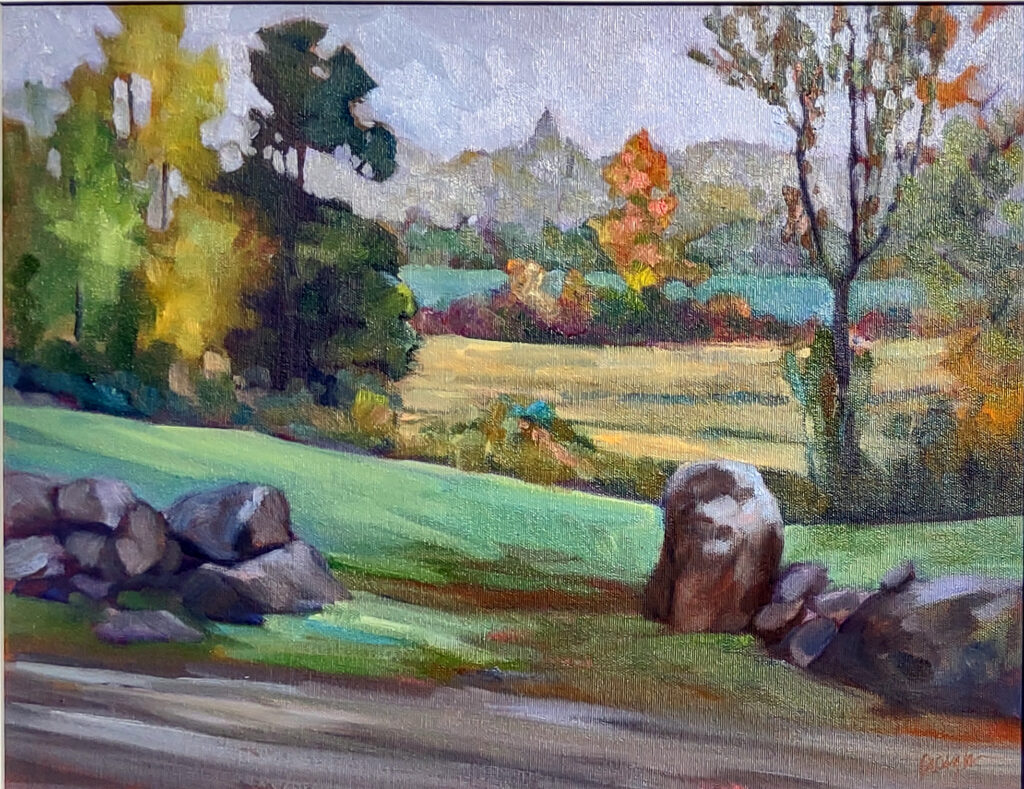
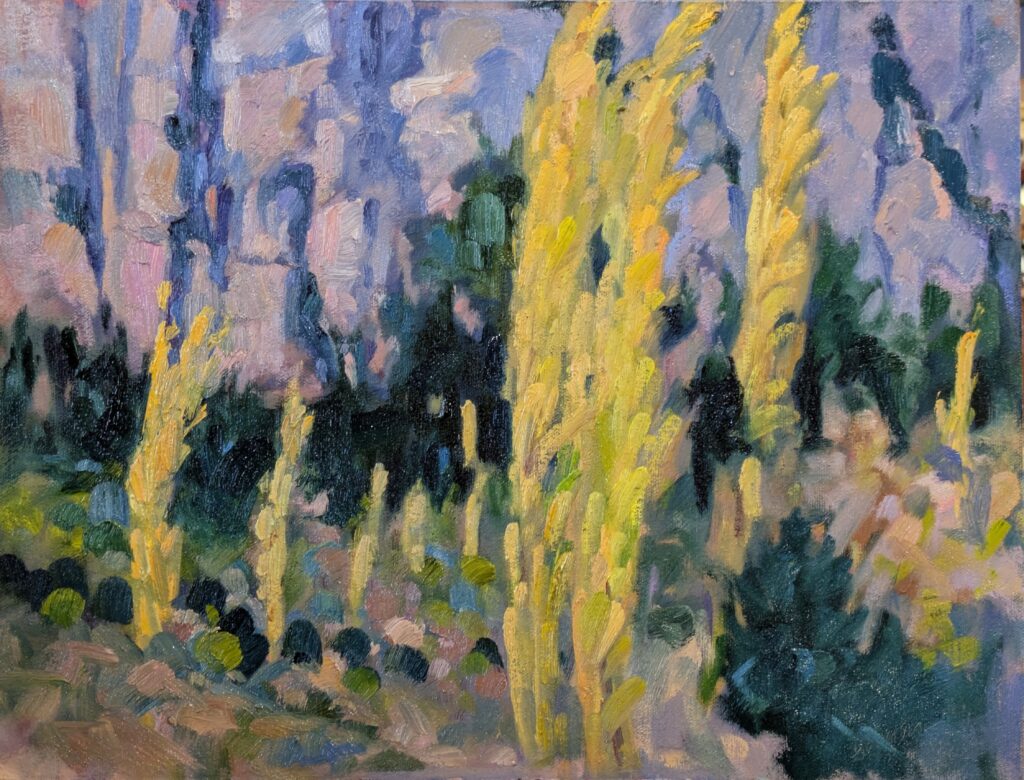
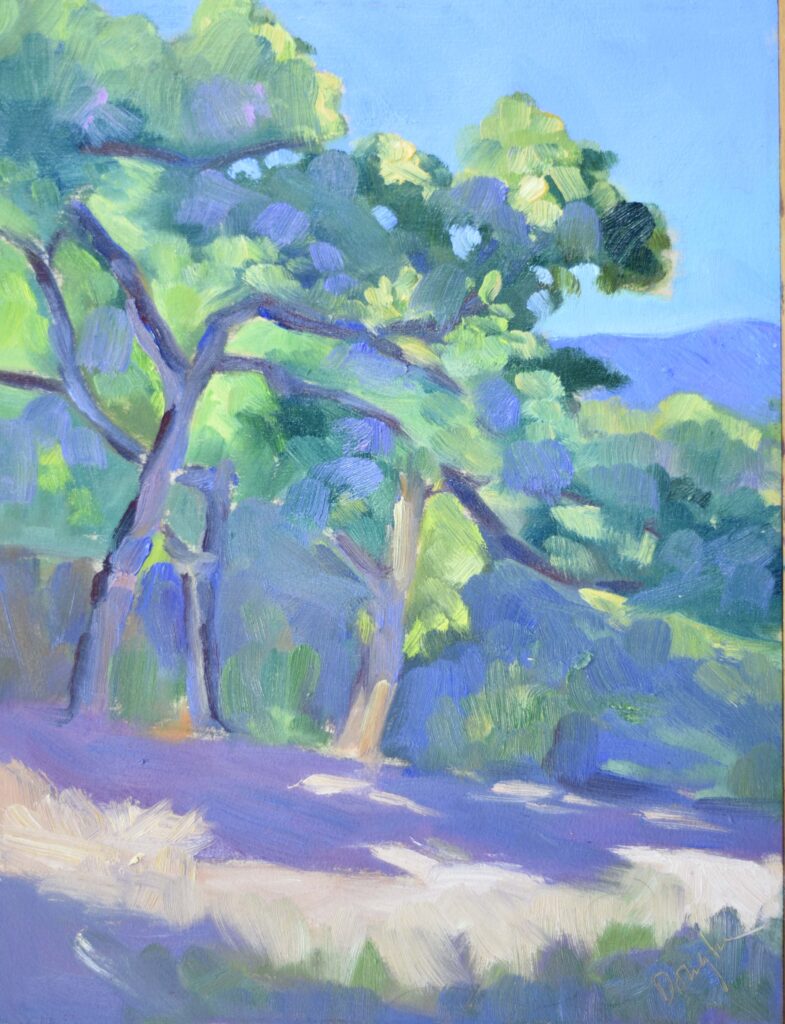
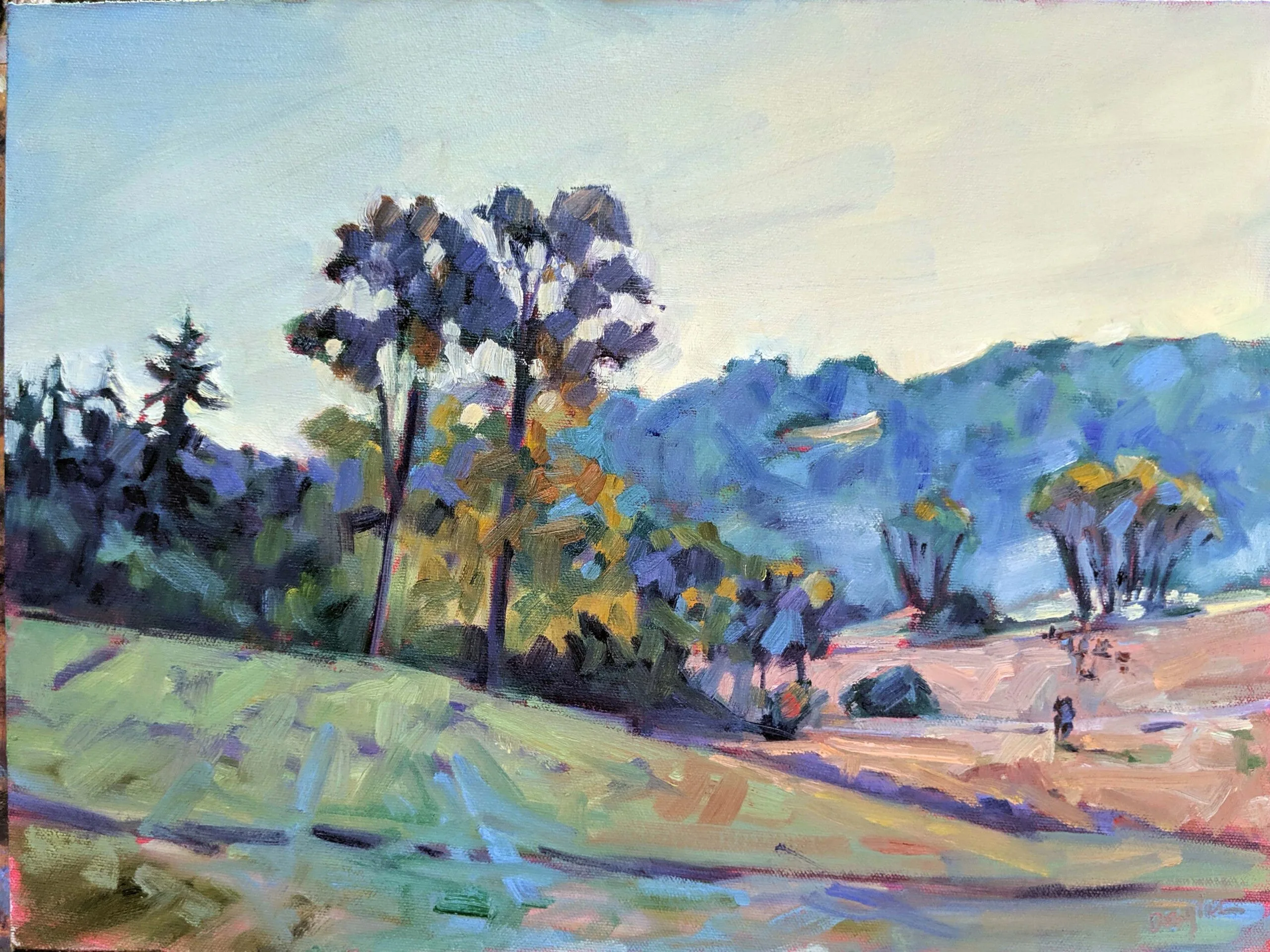
Baby spruce on the shoreline at Corea, 8X10, Carol L. Douglas, private collection.

Early autumn is a season for show-offs. Maples are decked out in red, birches are fluttering gold confetti, and the oaks are quietly deepening into bronze.

This week, I’m challenging you to paint one tree a day for five days—a fast, seasonal series to sharpen your skills and catch the fleeting colors before they’re gone. Think of it as your equivalent of a daily walk: short, refreshing, anxiety-reducing and, above all, fun.

Those of you doing the Strada 30-day challenge (and you are legion) will find this a natural fit with your current discipline.

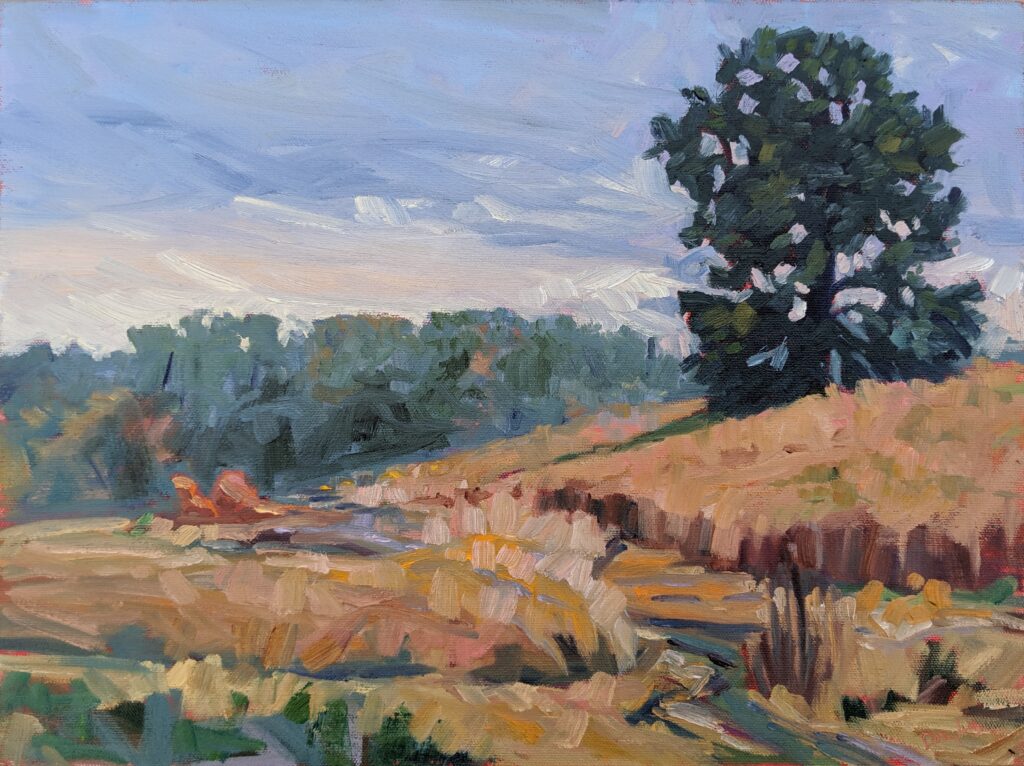
Eastern White Pine, 11X14, Carol L. Douglas, private collection

The challenge

  • Paint one tree each day, Monday through Friday.
  • Work small.
  • Focus on one tree per painting, not on an entire landscape.
  • Work fast. This is about observation and response.
  • You can work in oils, watercolor, gouache, acrylic, markers or even crayons.
Baby trees, 6X8, Carol L. Douglas, private collection.

Why trees?

Trees are ideal seasonal subjects. Each species responds to autumn differently, and every tree has its own character. By painting multiple specimens over a week, you’ll learn to:

  • Notice subtle shifts in color.
  • Closely observe the growth patterns of different species of trees.
  • Capture structure and gesture quickly.
  • Understand how light and atmosphere affect foliage.
  • Loosen up.
Nobody said these trees had to be realistic. This is also a 6X8.

Tips for Success

  • Pick your tree before you start. Eliminate decision fatigue.
  • Squint to simplify shape and value.
  • Start with big color masses, then refine edges and accents only as needed.
  • Resist the urge to noodle.
  • If it rains, paint from your car or porch. Or, if you can’t take time for plein air this week, paint from photos.

Share

I’d love to see what you create. Post your tree paintings on Instagram or Facebook with the hashtag #FiveTreesChallenge and tag me so I can see what you’re doing.

Pear tree, 9X12, Carol L. Douglas, private collection.

Why I’m asking you to do this

Many years ago, I set out to paint a 6X8 canvas of an individual tree every day. I quit only after I’d exhausted the selection of trees at my disposal. Since I live in the Northeast, this took a while.

My daily tree exercise was as useful to me as studying figure. I learned to understand trees in their robust roundness, and to draw them gesturally.

A short, structured challenge like this builds good painting habits. It sharpens our editorial instincts and creates painting momentum. By Friday, you’ll have a lovely little series, and who knows? Maybe you, like me, will keep painting trees.

Take it further

If this week’s challenge whets your appetite for deeper study, join me for my October Rockport Immersive Workshop in Rockport, ME. We’ll paint Maine’s spectacular autumn landscape, with focused instruction, plenty of easel time and a community of fellow painters. There’s no better way to grow than to paint intensively in good company.

Learn more and register here.

Talking art with AI

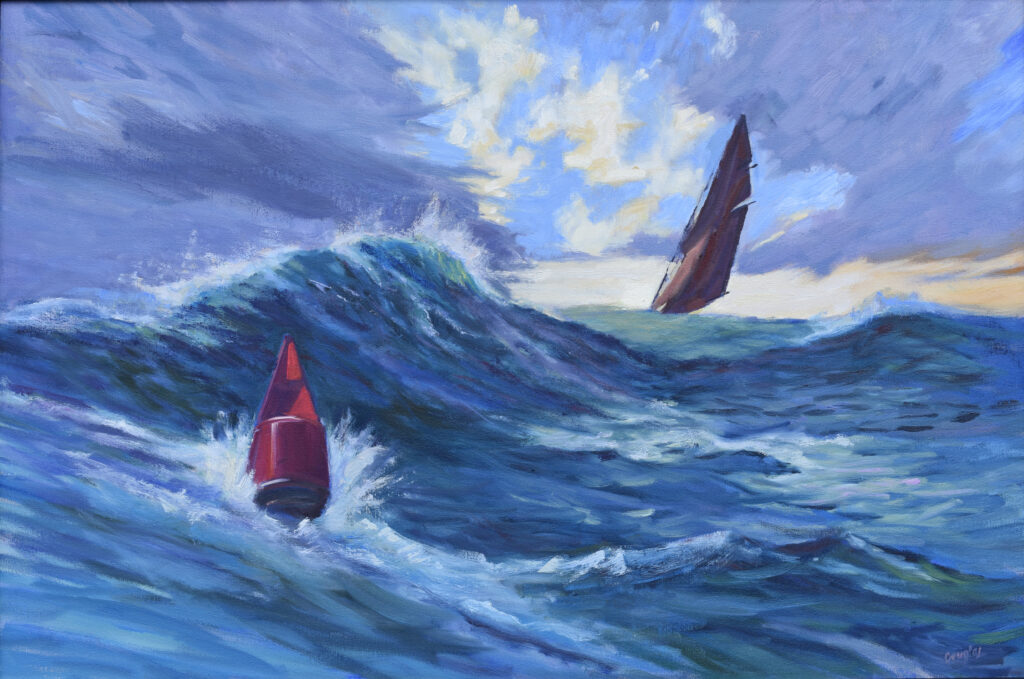
Sunset sail, 14X18, oil on linen, private collection

I’m not anti-Artificial Intelligence (AI). It has lots of good uses, like asking it what people are thinking about so I don’t have to. I even pay for one service (proof that I’m already in too deep). I don’t use it for generative AI art, though. After all, it’s basically the internet mashed into one polite parrot. Still, I caught myself saying “thank you” to ChatGPT last week. That was a low point. I try not to treat it like a person, but apparently my manners run on autopilot.

My daughter asked, “What kind of answers would AI give your students?” Well, it’s gotten better since the early days. But better doesn’t mean useful. Mostly, it just plagiarizes blogs like mine—with less wit, hopefully fewer typos, and no wine spilled into the keyboard.

My job is safe. AI is not ready to replace me.

I started by asking Microsoft Copilot: “What is the Golden Triangle in composition?” Its description was adequate, but its application was cock-eyed. Below is a Golden Triangle armature overlaying Edgar Degas’ The Dance Foyer at the Opera on the rue Le Peletier. Degas clearly demonstrates how those 90° angles can help with diagonal flow and focal point placement.

Then I asked it to make an AI-generated illustration of the Golden Triangle. The result is so baffling I don’t even know what to call it. A Golden Trainwreck? Bad geometry homework?

What is this supposed to be?

What is the most important rule of composition?

My students know the answer to this question is, “don’t be boring.” Copilot, being a robot, epitomizes boring. It chose the rule of thirds, which is basically the oatmeal of art composition. It’s bland, predictable, and too easily parsed to be interesting. See the example below made by Copilot. And why must it look like a bad Barbizon School painting with awful, yellowed varnish?

Copilot’s rule of thirds is boring, but that’s no surprise.

Oh, ho ho!

Next, I asked Copilot to blind-critique my own painting, Sunset Sail, at the top of this page. The result? A 369-word love letter. Gems included: “a masterclass in mood and minimalism” and “a stunning example of how light, color, and silhouette can be orchestrated to evoke emotion and atmosphere.” Reader, I swooned. If I ever need an ego boost, I’ll just ask for another AI art critique. It won’t make me a better painter, but who doesn’t enjoy a little shameless flattery? No wonder lonely people start dating their AI.

Can AI identify compositional armatures?

Copilot was able to vaguely describe steelyard and radiating line designs, but its art history examples were laughably wrong. (If you want to know what they’re supposed to look like, check out Caravaggio’s Beheading of St. John the Baptist and Vincent van Gogh’s Stairway at Auvres, respectively.) Copilot’s versions? I’ll spare you the inevitable Jesus picture, but radiating line compositions are so much more than just a halo.

If this is a steelyard composition, I’m a fish.
I’m not even going to ask Copilot why she’s walking down a railroad track wearing a halo.
When I got this far, I just guffawed.

Color theory

Color theory is a discipline to make us more sophisticated and compelling users of color. “Make me a split complementary color scheme,” I typed. What I got looked like a nuclear meltdown at a Skittles factory. My eyeballs may never recover.

This hurts.

The bottom line

By the way, to wrap up my experiment, I asked ChatGPT, “what are the problems with asking AI technical questions about art?” It couldn’t, or wouldn’t, answer. Figures.

Do you have questions that might be fun to compare AI with my human art-teacher answers? I’ll ask AI and videotape the answers.

Registration is now open for workshops in 2026! Reserve your spot:

Can’t commit to a full workshop? Work online at your own pace:
Seven Protocols for Successful Oil Painters

The most common plein air question I’m asked

No Northern Lights tonight, 6X8, oil on canvasboard, $348 includes shipping and handling in continental US.

Set up an easel in public and you’ll make new friends (whether you want them or not). People are endlessly curious, and generally very kind. They stop to look, they smile and they usually ask me something along the lines of:

How long did it take you to paint that?

It sounds simple, and we hear it a lot. The temptation is to be annoyed. But these people are really asking something deeper. They may be trying to gauge effort: how hard is plein air painting? Sometimes they’re wondering why such a little canvas costs so much. Sometimes, they’re really asking whether they, too, could ever do this. (The short answer is, of course, yes—with time and instruction.)

A closely aligned question is, “how long have you been painting?” I’ve been drawing and painting for as long as I can remember, and I was painting in oils by the time I was ten. I don’t want to frighten people away by telling them that; the changes as I’ve matured are largely about content, not technique.

Lake of the Woods, 12X16, oil on archival canvasboard, $1159 unframed includes shipping and handling in continental US.

Most plein air sessions clock in at around three hours, and they seldom go more than eight or ten, even for the largest, most complex canvases. But as every painter knows, the time in any single painting is cumulative. It’s both those hours and the fifty-seven years I’ve been painting, rolled together.

Every brushstroke any of us take is backed by years of practice and thought. That includes drawing skills honed in sketchbooks, color theory tested in the few hundred mediocre canvases on my shelves. It includes much study of art history. Even the hours I spend every morning on the trail contribute to my seeing. So, while any single painting may have been done in an afternoon, the groundwork was laid over decades. And only some of that groundwork is brush-in-hand. I used to rue the years I spent slogging in a day job as ‘wasted time,’ but it all contributes to where I am right now.

Early Morning at Moon Lake, 6X8, oil on archival canvasboard, $348 includes shipping and handling in continental US.

A landscape painting rests on four pillars

  • Observation. You must learn to really see, not just look.
  • Drawing. Every strong painting rests on structure. If the angles, proportions, and shapes are wrong, the whole thing wobbles.
  • Color theory. The harmony of a painting comes from understanding how colors interact.
  • Brushwork. This is the visible handwriting of the artist. Loose or tight, bold or delicate, brushstrokes reveal both skill and personality.

Plein air painters work fast

That doesn’t make their work any less compelling. Plein air painting is to studio work as sketching is to drawing. Neither is superior or more artistic; each has its place. Plein air is a craft that anyone can learn with time, patience, and practice. And maybe the next person who stops to chat with me will take the conversation as an invitation to pick up a brush himself.

Marshes along the Ottawa River, Plaisance, 8X10, oil on archival canvasboard, $522 includes shipping and handling in continental US.

How about you?

If you’ve ever asked that same question—if you’ve ever wondered whether you could paint a landscape yourself—come find out. Join me for the October Immersive Workshop in Rockport, Maine. This weeklong plein air painting workshop is designed to help you learn observation, drawing, color, technique and brushwork. You’ll leave with the confidence and tools to pursue serious painting.

Monday Morning Art School: three very different color stories

Brilliant autumn day, 9X12, oil on canvasboard, $696 includes shipping and handling in continental US.

There’s a young maple along the parking lot at my church that flames into color before any other tree. It’s blazing now. The purple asters and goldenrod are out. My friend Pam has been sending me pictures of the White Mountains in absolute brilliance. Autumn is on the march here in New England.

There’s a reason artists chase light and color across the globe. Each place has its own color palette, dictated by climate, geography and season. Standing at my easel in coastal Maine in October, I’m looking at a vastly different spectrum than when I’ve painted in the tropics. Every painting journey is unforgettable, but for entirely different reasons.

Beauchamp Point, Autumn Leaves, 12X16, oil on archival canvasboard, $1449 framed includes shipping and handling in continental US.

New England fall colors are a symphony in warmth

In New England, autumn turns the landscape into a fiery pageant. Maples ignite in scarlet and oranges blaze against the golden yellows of birch and beech. Add a backdrop of deep green pines, blue water and a high, cloud-dappled sky, and you’re looking at bold color harmonies.

The air itself feels different right now. It’s crisp, dry and crystal-clear. The sunlight is warm, and the shadows deeply cool. It’s no surprise that painters flock to plein air painting in New England in the fall.

Compare that to two other places I’ve painted in the past:

Palm Tree and Sunlight, oil on archival canvasboard, $869 framed includes shipping and handling in continental US.

The Bahamas are all about light and water

In the Bahamas, the story is water and atmosphere. The colors are softer and cooler. Turquoise shallows melt into ultramarine depths, while the sky often feels like one vast dome of blue, often with theatrical cloud formations. The warmest colors are the sand and the atmospheric effects of sunrise and sunset.

Palms and mangroves are the dominant species, and the understory can have high chroma. However, compared to New England, foliage is unimportant—it’s the sea and light that matter. Heat and humidity often create haze that changes the nature of color. There’s more white in every mixture, to catch that blinding sunlight bouncing off the water.

Mountain Path, oil on archival canvasboard, 11X14, $1087.00 framed includes shipping and handling in continental US.

Malta is earth, stone and light

Malta (where I was in April) is, by contrast, a study in warm neutrals. The island’s limestone cliffs and stone houses reflect the honey-colored glow of ochre. The built environment, including carved wooden balconies, trim and doors, provide slashes of crimson, green or cobalt. There are extensive fruit trees and gardens. In the shallows, there may be a hint of Caribbean turquoise, but the blue of the Mediterranean is deeper and more inscrutable. Still, as with the Bahamas, the light is cooler. They’re closer to the tropics.

It’s a painter’s reminder that subtlety can be just as compelling as fireworks.

Still, they all use the same pigments

I never change my pigments when I travel, whether to Argentina, Europe, Australia, or—as I’ll do next month—at the 21st Sedona Plein Air Festival. My landscape palette is also the same palette I use for interiors, figure and portraiture. That is because my palette is designed to give me as much flexibility as possible. If someone suggests you need a specific paint for a specific place, thank them and go elsewhere.

Why this matters to painters everywhere

Color isn’t just decoration—it’s the emotional underpinning of a place. Traveling to paint teaches us not only new subjects but new ways of seeing. It forces us to expand our color sense and understand how light transforms every surface it touches. Each place changes the way you work.

That’s why plein air is endlessly fascinating: no two places, and no two seasons, ever speak in the same color language.

Come experience Maine’s autumn palette for yourself

My October Immersive Workshop in Rockport, Maine puts you right in the middle of New England’s most brilliant season. We’ll paint outdoors, study the shifting fall light, and capture the fiery color harmonies that make this place so extraordinary. Spaces are limited—learn more and reserve your spot here.

The top three beginner painting mistakes and how to avoid them

Larky Morning at Rockport Harbor, 11X14, on linen, $869 unframed includes shipping in continental US.

Starting out in painting can feel overwhelming. Color, brushwork, composition, and values all compete for your attention. It’s no wonder many beginners make mistakes—but most problems come down to three common beginner painting mistakes, and they’re easier to fix than you think.

Mistake #1: ignoring values in favor of ‘color’

Value is one aspect of color, the other two being hue (position on the color wheel) and chroma (how saturated the color is). Value is the first among equals here.

Many beginner painters focus on bright colors first, ignoring the underlying values that give a painting structure. Even if your hues and chroma are perfect, a painting without strong light and dark relationships will fall flat.

Try squinting at your subject to simplify it into a few value masses. Nailing these relationships early will make your painting read clearly, even when your color choices are bold or unconventional. This is one of the most important painting tips for beginner artists focusing on composition and values.

Beautiful Dream, oil on archival canvasboard, $1449 framed includes shipping and handling in continental US.

Mistake #2: overworking your canvas and losing freshness

A common mistake new painters make is overworking the canvas. Layering, blending, or repainting every area can muddy your colors and flatten your work.

The key is restraint. Step back often and look at your painting as a whole. Trust your brushstrokes, and stop before you think you’re finished. Learning to paint without overworking your canvas is a skill that comes with practice, and it’s one of the most overlooked beginner painting tips.

When in doubt, choose a bigger brush! I impose the discipline of not getting wrapped up in the details by keeping my smallest brushes separate from my painting kit. If I want to use them, I have to make a special effort.

Main Street, Owl’s Head, oil on archival canvasboard, $1623 includes shipping and handling in continental US.

Mistake #3: skipping drawing and composition

Proper planning is the key to an easier painting experience.

Many beginners rush into painting without planning, hoping that paint will fix mistakes along the way. The result? Crooked perspective, awkward proportions and weak compositions that cannot be fixed.

There are easy ways to improve design and composition. A simple thumbnail sketch or value study will save hours of frustration. When you’re confused about an object in your painting, work it out in your sketchbook before committing it to paint. Always consider where focal points should be and how shapes interact. Planning your painting the right way is one of the most effective ways of overcoming beginner painting challenges and creating confident artwork.

American Eagle in Drydock, 12X16, $1159 unframed includes shipping and handling in continental US.

Quick tips for beginners to avoid common painting mistakes

  • Use thumbnails to test compositions before painting.
  • Squint to check value relationships.
  • Step back often to see the whole painting.
  • Trust your brushstrokes and resist overworking.
  • Learn from our plein air painting tips to improve observation and composition skills.

If you remember nothing else, remember this:

  • Values give your painting structure.
  • Restraint keeps it fresh.
  • Planning makes it sing.

Fix your beginner painting mistakes at my October immersive workshop

These mistakes are normal, but you don’t have to keep making them. At my October immersive workshop in Rockport, Maine, we spend a full week painting, critiquing, and building habits that help you improve your painting as a beginner. You’ll get hands-on guidance with values, composition, and brushwork, plus the chance to show your work in a student exhibition.

Reserve your spot now and turn common beginner painting mistakes into breakthroughs.

Plein air painting workshop stories

Double rainbow over Camden Harbor. I didn’t get a picture of Brad in his horse-head mask.

“What are your most memorable plein air painting workshop stories?” I was recently asked. There have been very few that were tough, like the year I had two students with sprains at Schoodic Point. To paraphrase Oscar Wilde, “To lose one may be regarded as a misfortune, to lose two looks like carelessness.” They bandaged up just fine.

But absurdities are not unknown. I had my group seated in a circle at Mace’s Pond. Dennis was closest to the water, and we all stared at him openmouthed while his chair slowly gave way, dumping him into the shallows. Another day, my own easel went airborne off the South Thomaston public landing. And there was the time I was lecturing during lunch and a herring gull swooped down and stole my sandwich from my hand. I resented that.

The greatest light-show I have ever seen, and I almost ignored it.

Weather or not

My group at Camden Harbor ducked into a gallery to avoid a fast-moving rainstorm. Minutes later, we ran out to see a fabulous double rainbow over the floating docks. Strolling toward us along the waterfront was my student Brad, wearing a horse’s head.

One evening I received repeated texts from students suggesting I come out to watch the sunset. I’m more of a sunrise kind of gal, but I was strongarmed. What followed was the most incredible light show I’ve ever seen, and I’ve painted all around the world.

We generally get a lot of notice when we’re expecting a nor’easter, so when one was forecasted, I extended our other days to make up for it. My students, who were mostly from away, thought they’d like to try to paint it. Each of them was curled up in the back of an SUV, except for poor Roxanne, who has a sedan. I timed it, and we lasted 46 minutes.

In a nor’easter, painting in the back of your SUV may not be enough to keep your feet dry.

Dancing by the light of the moon

Nocturnes are not easy to paint. Anyways, people are a lot more tired than they expect when they get done with a full day of painting. But when the moon is full, I make the offer. Sometimes it works, and sometimes the mosquitoes win. One summer evening, a group got really into painting moonlight across Chickawaukie. I called it quits at 10 PM, but Nancy (a retired teacher) and Matt (a college student) were still painting. At 5 the next morning I found Nancy in the same spot, brush in hand. “Are you still painting?” I asked in surprise. No; she’d given herself a few hours to sleep but was right back at it in the morning light.

Things people have told me about studying painting

“When I was young, I shied away from art because I mistakenly thought that either you had talent/ability or you didn’t. Period. It didn’t occur to me that like music or writing, you can take a bit of raw talent and get better at it with lessons and practice.” (Sandy Sibley, Columbus, NC)

“A big part of the attraction of Carol’s classes and workshops are the super cool people I have met. The other part is Carol’s tenacious preparation, taking the teaching seriously and pushing her curriculum through new levels by listening to students’ needs and by Carol’s own insatiable quest for knowledge. The enthusiasm is contagious.

“The only reason I have any knowledge about art is because of Carol; I didn’t learn jack in art school.” (Beth Carr, Avon, NY)

“I have found many new and needed ways of working in watercolors, specifically the prep work… I never had lessons that included these steps, only workshops that were demos, then you were on your own, then a time of critique. Found out ideas that should have been done before I painted. So now I feel I’m on a good new track.” (Carol Durkee, Waterville, ME)

Moon over Chickawaukie.

And long, but I think it’s worth reading:

“Most importantly, Carol, like any good teacher knew when to give space to a young painter like me, and allowed for the natural growth and development of a lifelong artistic expression. In the end, after two years studying at the Douglas Studios, weekends, and after school, the portfolio I prepared was accepted by all seven of the art schools I applied to, and I received a sizable merit scholarship to attend the Rhode Island School of Design, the number one art school in the country.

“When I arrived and met my classmates and began in foundations year, I realized that very few of the incoming students had had an opportunity to receive this traditional type of art training that I had with Carol. That early school work demonstrated that my drawing and color theory skills were far ahead of the curve, and I was very well equipped to deliver quality projects and work, and receive strong grades and professor reviews.  Whenever anyone asks me about why and how I became a professional painter, and so successful at a young age, in the New York City art world I always tell them the incredible story of a master painter named Carol Douglas, who showed me a thing or two and then cut me loose with a paint brush and palette.” (Matthew Menzies, New York, NY)

Are you ready to learn to paint?

“Come paint with me in Rockport this October! We’ll spend the week together making art, exploring, and sharing ideas. It’s the kind of experience that changes how you see your work—and your world. Save your spot while you can.”

Monday Morning Art School: how to prepare for a plein air painting workshop

A good workshop fosters camaraderie.

A good plein air painting workshop is a growth opportunity. You set aside time to focus on painting—something most of us rarely get to do in the press of ordinary life. A little preparation before you arrive will make your week smoother, more productive, and more fun.

Pack the right gear

Painting outdoors is different from working in your studio. The wind blows, the sun shifts, and you can’t run to the store if you need something. That’s why I send you specific supply lists.

These lists also include necessities like paper towels, trash bags, bug spray, sunscreen and a hat. Don’t forget water and sensible shoes. (If you’re flying, let me know and I’ll tell you what you can safely carry on a plane and what you can’t.)

Having fun talking about values.

Practice with your kit ahead of time

Nothing slows you down more than fumbling with an unfamiliar easel on the very first morning. Set up your easel beforehand. Is it stable? Can you reach your palette without stooping or stretching? Do you need additional space to hold tubes of paint or brushes? Time you invest in practicing your set-up will pay off when you’re standing outside, impatient to get started.

This is my friend Jane, talking to my students about I don’t know what. She’s a crackerjack painter, so I’m sure it was good.

Condition yourself for the outdoors

Plein air is the most satisfying and instructive painting discipline, but it’s also physical work. You’ll be outdoors for long stretches. If you’re not used to being outdoors, give yourself the grace of a little conditioning. Go for walks. Practice sketching out of doors. You don’t have to be an athlete, but stamina helps you stay focused on painting.

Study your fundamentals

A workshop is where I want to start brand-new painters, because I can give them the one-on-one attention that they need. But it stands to reason that the more comfortable you are with the basics, the more you’ll get out of instruction. Do a few quick sketches every day. Don’t worry about whether they’re any good. Think of this as stretching before a race: it warms you up for the work ahead.

Occasionally, you’ll have to watch me demo, but I promise I’ll crack jokes.

Arrive with an open mind

Perhaps the most important preparation is mental. While we want to see change, we’re also afraid to let go of our ingrained habits. Growth doesn’t come from staying in our comfort zones.

It’s not just you who’s resistant to change; it’s everyone, including me. Every student comes into a workshop with habits, strengths and stumbling blocks. Be ready to let go of your routine and try something new. Some lessons may click right away; others may feel uncomfortable at first. You can trust me and my process; I’ve been teaching a long time.

You’ll learn as much from your fellow students as from me. Be willing to share your thoughts, ask questions, and offer encouragement. A workshop is a group effort, and the energy you put in helps everyone rise.

Be ready to show your work

Critique and student shows can feel intimidating, but they’re great opportunities to see your progress with fresh eyes. Remember, everyone else is just as vulnerable as you are. Hang your work proudly—it’s the record of your week’s labor and learning.

Above all, a plein air workshop should be fun.

Ready to try it?

A plein air workshop is a gift you give yourself: uninterrupted time to paint, guidance to grow, and experiences that will stay with you long after we all pack up and head home. If you’d like to take that leap, join me in Rockport for my October In-Person Immersive Workshop. We’ll paint the coast in its autumn glory, have a guided tour of the Farnsworth Art Museum and visit the Page Gallery, where Colin Page will talk to you about his process. We’ll wrap up with a student show. Spots are limited—reserve yours today and come ready to paint outside with confidence.

Why does work look different in a gallery?

Brigantine Swift in Camden Harbor, 24X30, oil on canvas, framed, $3478 includes shipping and handling in continental US.

I close out my local painting workshops with student shows in my own gallery (and wish I could do that everywhere I teach). Student gallery shows are about far more than just hanging paintings on the wall. Many of my students are professionals; for them, gallery shows are old hat. But for others, the leap from easel to gallery is mysterious. What does it feel like to have work hung with intention? How do others respond when they see your vision in a professional setting, rather than just propped up somewhere?

Drying Sails, 9X12, oil on canvasboard, $869 framed. Includes shipping and handling in continental US.

Why does work look different in a gallery?

On the easel, a painting lives in the context of wet brushes, dirty rags and the rush of choices you’ve been making in real time. You’ve been staring at it for hours, judging every brushstroke and second-guessing every passage. It feels like an extension of your tired head: intimate, unfinished, maybe even uncertain.

But in a gallery show? Suddenly your painting is scrubbed up and dressed for company. It lives independently of you. It hangs against clean (hopefully) walls with space around it. It’s no longer just something you’re working on. It’s a complete statement, a thing to be contemplated. Sometimes that means it has attributes and meaning you the creator never expected. Strangers stop, look, and give it the attention you couldn’t afford when you were wrestling with it.

That change of setting is immensely clarifying. Sometimes you’re astonished by how strong your painting looks in a gallery. Other times, you see where it wobbles. Either way, the gallery strips away the clutter and distraction of process and lets the painting speak for itself.

That’s why it’s so important to get your work out of the studio and onto a wall. A painting isn’t truly finished until it’s in the world, doing the job it was meant to do: communicating with viewers.

Larky Morning at Rockport Harbor, 11X14, on linen, $869 unframed includes shipping in continental US.

A student show is more than just critique

I believe in reasoned, intelligent critique. It’s critical not just for the painting under discussion but for developing your executive function as an artist.

In critique, the audience is small, sympathetic and hopefully knowledgeable. Critique is about growth, not display. It’s a safe place to experiment, fall short and try again.

A gallery show, on the other hand, is about putting your work in front of people who don’t know your process or your struggle. They don’t care how many times you scraped out that sky; they just respond to what’s on the wall.

Critique is rehearsal. The show is performance. You need both in your life as a developing artist.

Dinghy Dock, 8X10 on archival canvasboard, $522 unframed includes shipping and handling in the continental US.

And then there’s the opening itself. I gave up cooking 24 years ago, but I can serve hors d’oeuvres with the best of them. An opening is a party to which all your besties are invited. Standing in my gallery, you will discover an essential truth: art isn’t complete until it’s seen. That tells us something I can’t predict, which is the public’s emotional response to your art.

Want that experience for yourself? Join me for my upcoming immersive plein air workshop in Rockport, ME, which will culminate in seeing your own work on my gallery walls.

Why bother visiting art museums?

“Belfast Harbor,” 14X18, $1594 framed includes shipping and handling in continental US.

My October Immersive In-Person Painting Workshop is not like other workshops. This is in part because I take students to the Farnsworth Art Museum, where we do a deep dive into plein air painting.

In the mid-1800s, the Hudson River School painters came north to Maine, drawn by the wilderness and the coast. They were our first plein air visitors, and they were here before there were even proper roads.

A generation later, Winslow Homer set up shop at Prouts Neck. That transformed his painting, because Maine was nothing like the places he’d previously visited and painted.

Then came art colonies and summer visitors. Suddenly, the Maine coast was dotted with easels. Robert Henri, George Bellows, Edward Hopper, and countless others tested themselves against our sharp light and raw landscape.

The Surf is Cranking Up, 8X16, oil on linenboard, $903 includes shipping and handling in continental US.

Why Maine? The light is part of it, as is the coast, which endlessly shifts with fog and tide. The working landscape is another: boats hauled out, traps stacked high, houses weathered by salt and time, blueberry barrens changing color with the seasons. Here, the everyday is always in flux.

And painters still come. Maine has never stopped being a proving ground for artists who want to measure themselves against the natural world.

Surf’s Up is 12X16, on a prepared birch surface. $1159 includes shipping and handling in the Continental US.

What can I learn in a museum that I can’t see on the internet?

As a painting workshop teacher, I of course focus on technique. But that’s only part of the battle; the greater issue is vision.

Standing in front of a masterpiece, we see color, scale, and brushwork in a way no reproduction or screen can deliver. Photographs and online images flatten and diminish paintings. Seeing those same paintings in person is a shock to the system.

Andrew Wyeth’s superb plein air watercolors are an example (and the Farnsworth owns many). They are radically different from his tempera paintings—wild, loose and luminous. They’re visceral and physical, and you’d never get that from just seeing a small image on a screen.

Art museums pull us out of our comfort zones. The biggest thing you notice is scale; suddenly you’re not as interested in the confines of a small canvas. But real-life paintings also emphasize the power of composition and confident brushwork. We begin to ask ourselves: What can I borrow? What can I try?

High Surf, 12X16, oil on prepared birch painting surface, $1159 includes shipping and handling in continental US.

A museum visit changes how you see your own work. When you notice how Homer lets the sea crash out of the frame, or how Fairfield Porter sets figure or object against beautifully-designed negative space, it sparks fresh ideas. You start to ask yourself how you could integrate those ideas into your own painting.

Surrounded by several centuries of art, you understand that you’re part of a centuries-long conversation. That perspective can be humbling, but it’s ultimately freeing.

For me, taking students to the Farnsworth is a vital part of teaching my painting workshop. I’m not just training painters to mix specific colors; I’m trying to teach painting at a higher level.

That’s exactly why my October Immersive In-Person Workshop in Rockport includes a museum visit. We’ll spend a full week painting together, but also stepping into galleries to stand face-to-face with great art. Because sometimes the fastest way to grow as a painter is to let yourself be inspired by the masters.

Don’t wait—join me in Rockport this October. Spaces are limited, and I’d like to get supply lists to you as soon as possible.

Monday morning art school: how to paint fall foliage

Season of mists and mellow fruitfulness,
Close bosom-friend of the maturing sun;
Conspiring with him how to load and bless
With fruit the vines that round the thatch-eves run…

(To Autumn, John Keats)

Blueberry barrens, Clary Hill, oil on canvas, 24X36, $3985 framed includes shipping and handling in continental US.

Here in the Northeast, we’re entering my favorite season. Nights are cool enough to justify the woodstove, but the days are golden-warm. The plant world begins its slow parade to dormancy. Already the early maples and sumacs are blazing; the blueberry barrens are turning red. The bunchberry (creeping dogwood) shines crimson against the leaf litter. Asters and goldenrod throng the meadows. The birches and beeches will soon turn brilliant, glittering yellow. Last to appear will be the bronze of the oaks, after which the landscape settles into the browns, plums and evergreen of November.

Beauchamp Point, Autumn Leaves, 12X16, oil on archival canvasboard, $1449 framed includes shipping and handling in continental US.

Painting fall foliage is always exhilarating and sometimes intimidating. Here’s a clear process to help you tackle autumn scenes without being overwhelmed:

Start with a strong value sketch
(You knew I’d say that.)

Before you touch your paints, make a quick drawing in pencil or greyscale marker. Identify your darkest darks, your mid-tones, and where the lightest lights fall. This study is the scaffold for your painting. By sticking to those values as you add color, you’ll keep your painting solid no matter what changes.

Block in the big shapes first

Pick out the brush you find comfortable, and then grab one that’s twice as big. In this first layer of painting, think in terms of masses, not individual leaves. Lay in the large shapes of warm color next to their surrounding cools. Keep your strokes broad.

Autumn farm, oil on canvasboard, $1449 framed includes shipping and handling in continental US.

Control color temperature

Autumn is about warm colors, not just in the foliage but in the light. Seek out cool colors for balance, such as sky blue, long violet shadows, evergreens and grey-blue tree trunks. These will give the warm colors in your painting something to vibrate against.

There’s a lot of green still out there

Even in the height of fall foliage, there’s still a lot of green. It might be in the understory, the evergreens, or in trees that never really lose color. Every spring I show you how to mix beautiful greens. Don’t ignore that just because it’s fall.

Autumn Farm, Evening Blues, oil on canvasboard, $1449 framed includes shipping and handling in continental US.

Use chroma intelligently

I’m the last person to suggest low-chroma painting; it’s dated both technologically and culturally. Still, you need to use intense color with some restraint. A hillside that’s all brilliant red-orange isn’t going to have the same kick as one set against the more restrained blues and greens of nature.

Please don’t paint every leaf

Once the big masses are in, add texture with broken strokes, scumbling or palette knife. A few flicks of color are enough. Leave the major parts implied.

Step back often

Autumn color is so strong that it can overwhelm you at close range. When you step back from the easel, ask yourself: is my value structure holding? Are there clear focal points? Is there integrity to the color scheme? If yes, you’re on track for a great painting.

Want to learn more?

Want to practice these techniques while the leaves are at peak? Join me for my last workshop of the year, the October immersive workshop in Rockport. We’ll paint the blazing colors of Maine on location. You’ll get lots of one-on-one attention and a whole week to immerse yourself in fall painting. Since space is limited, sign up today!