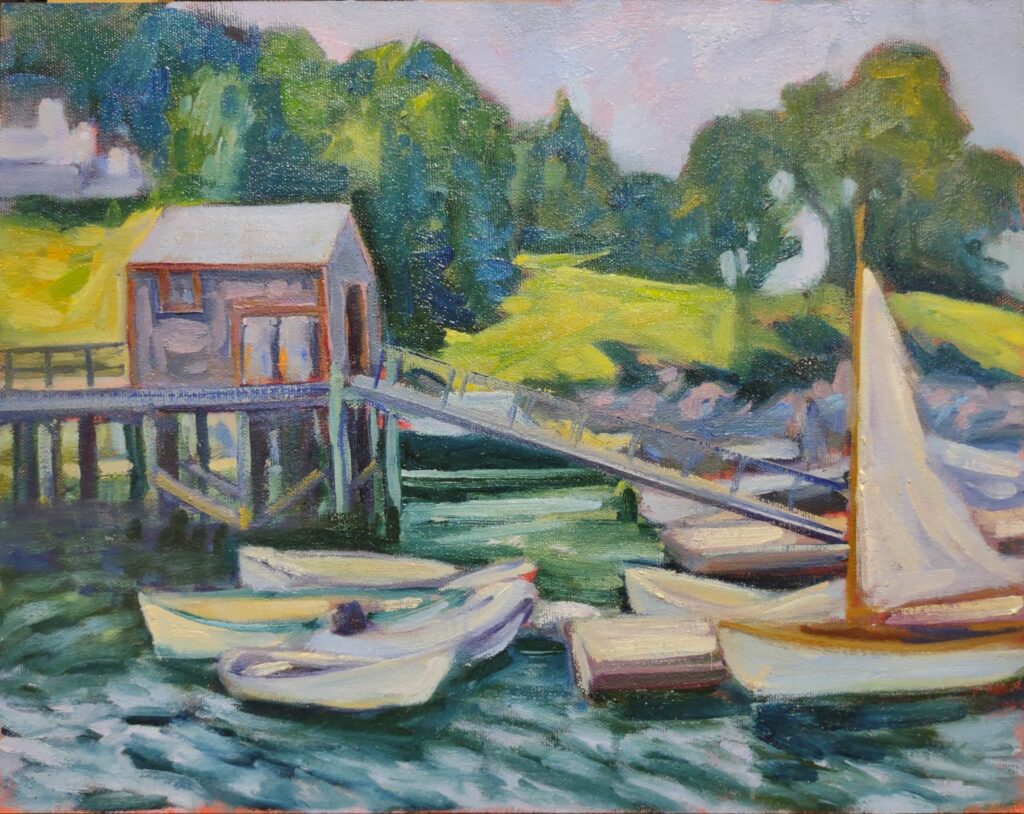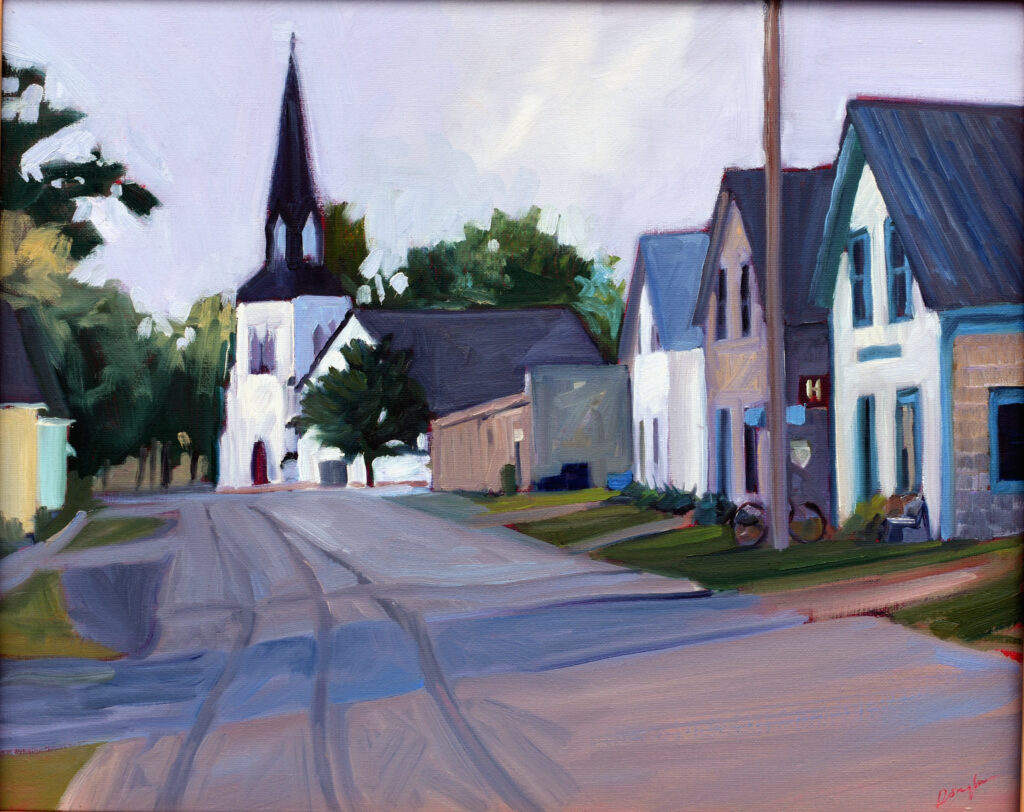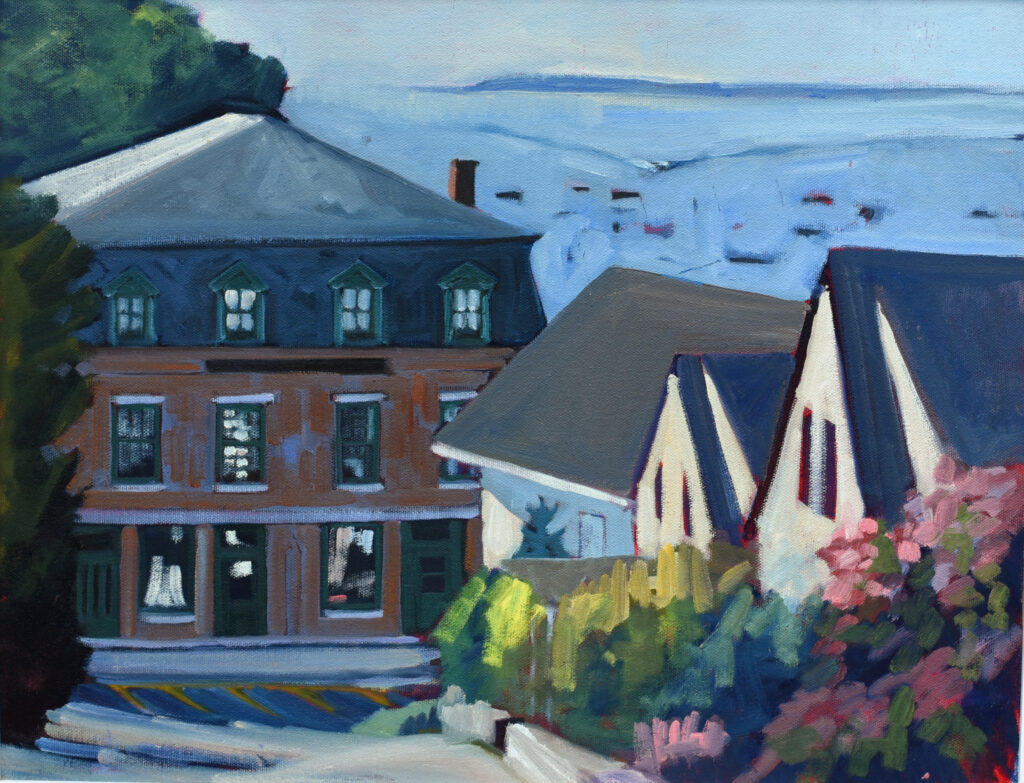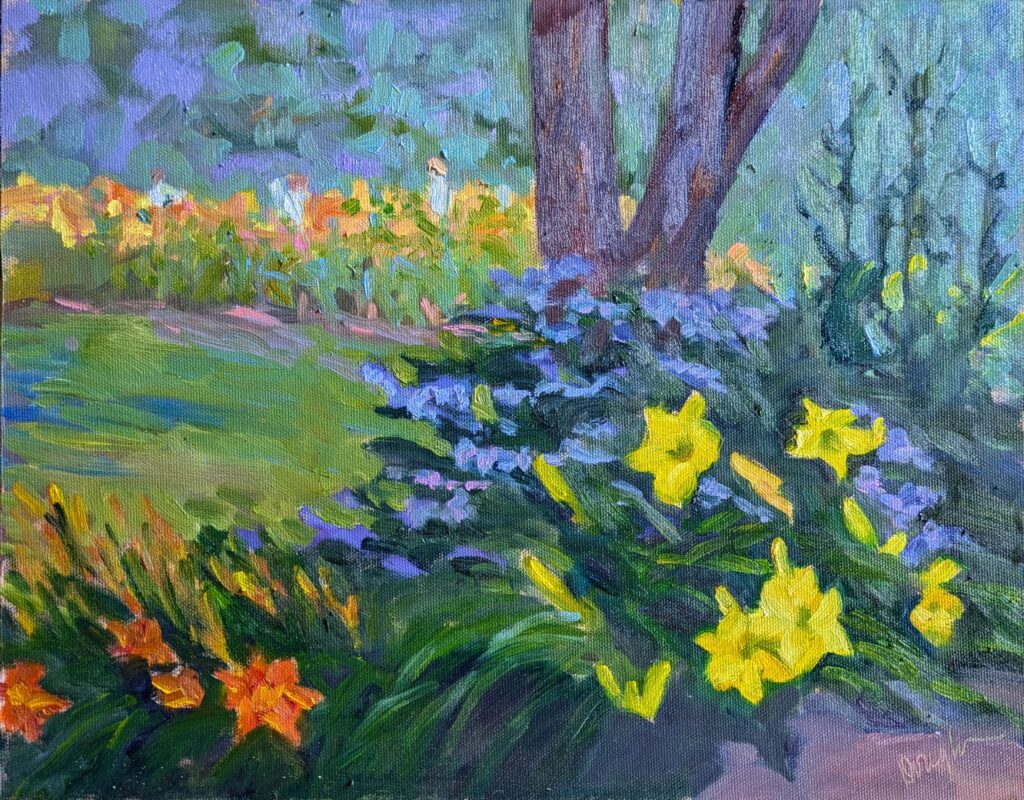
My one-of-a-kind gift guide, for people who deserve more than a tote bag

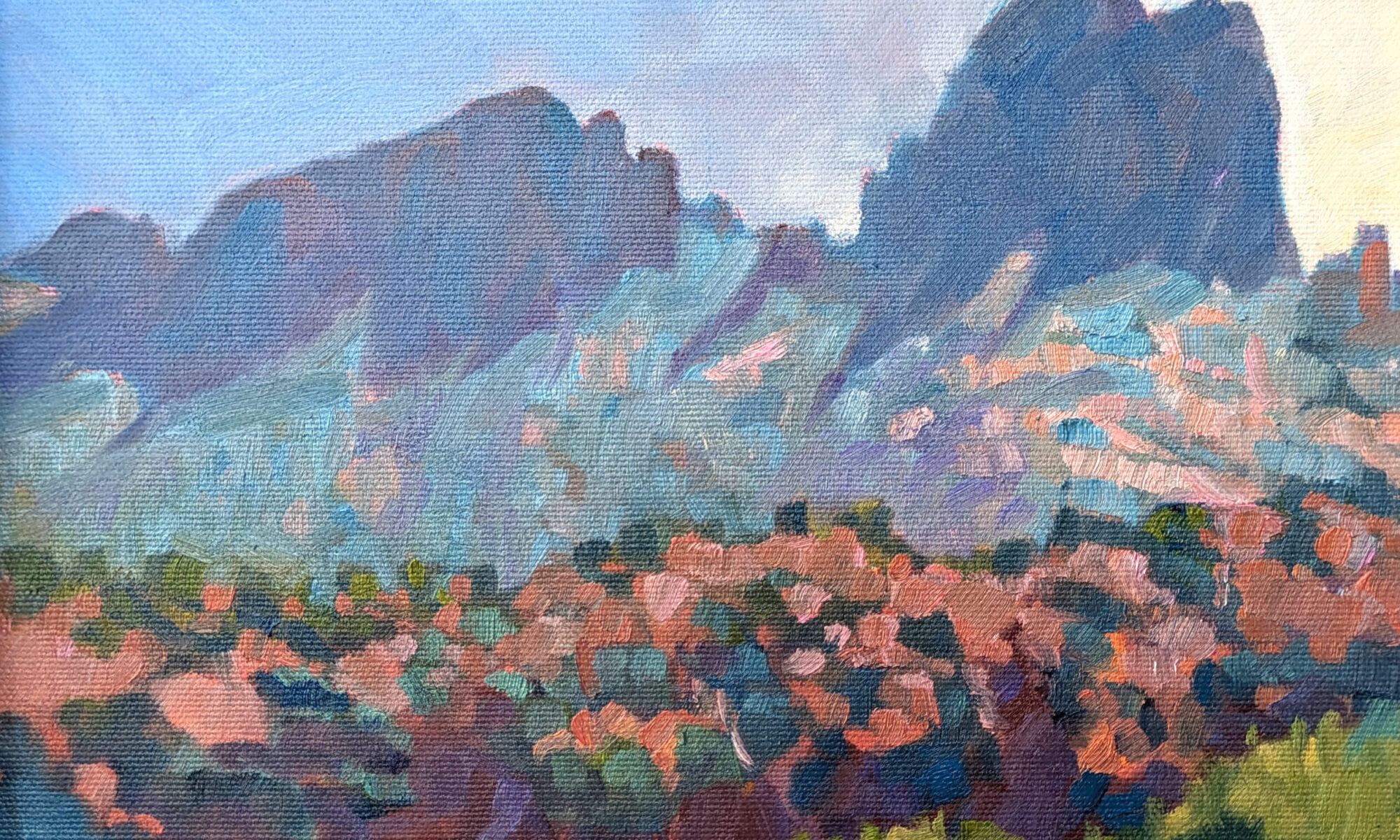
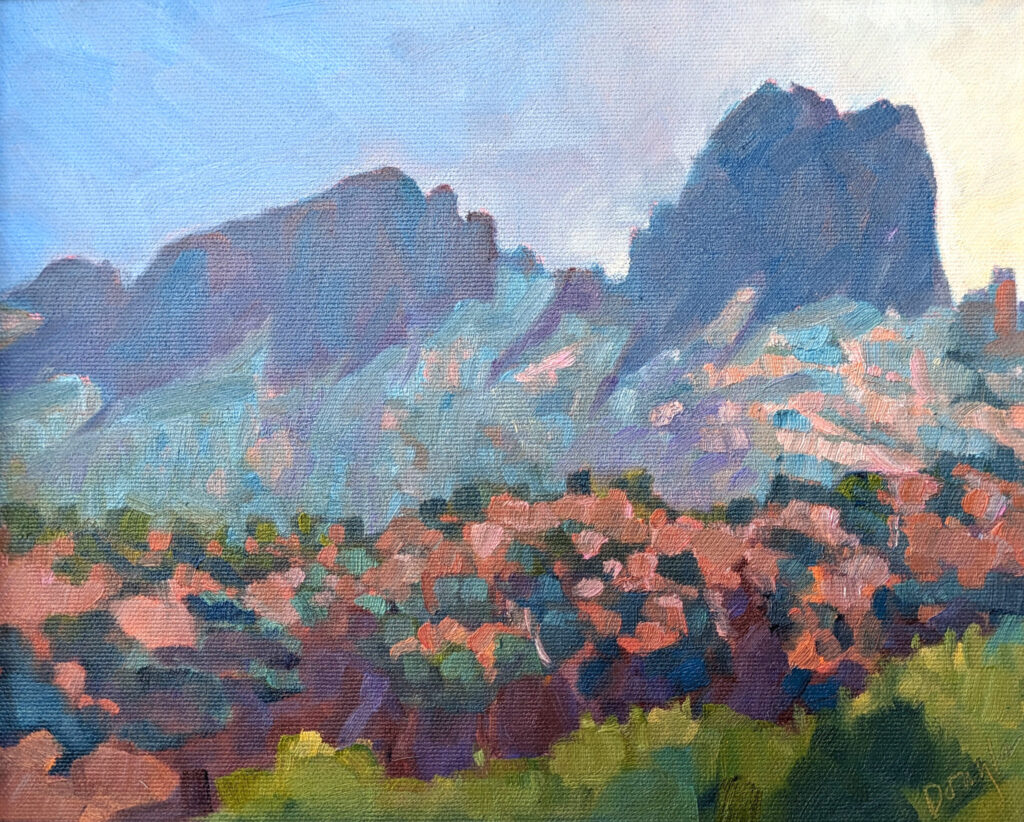
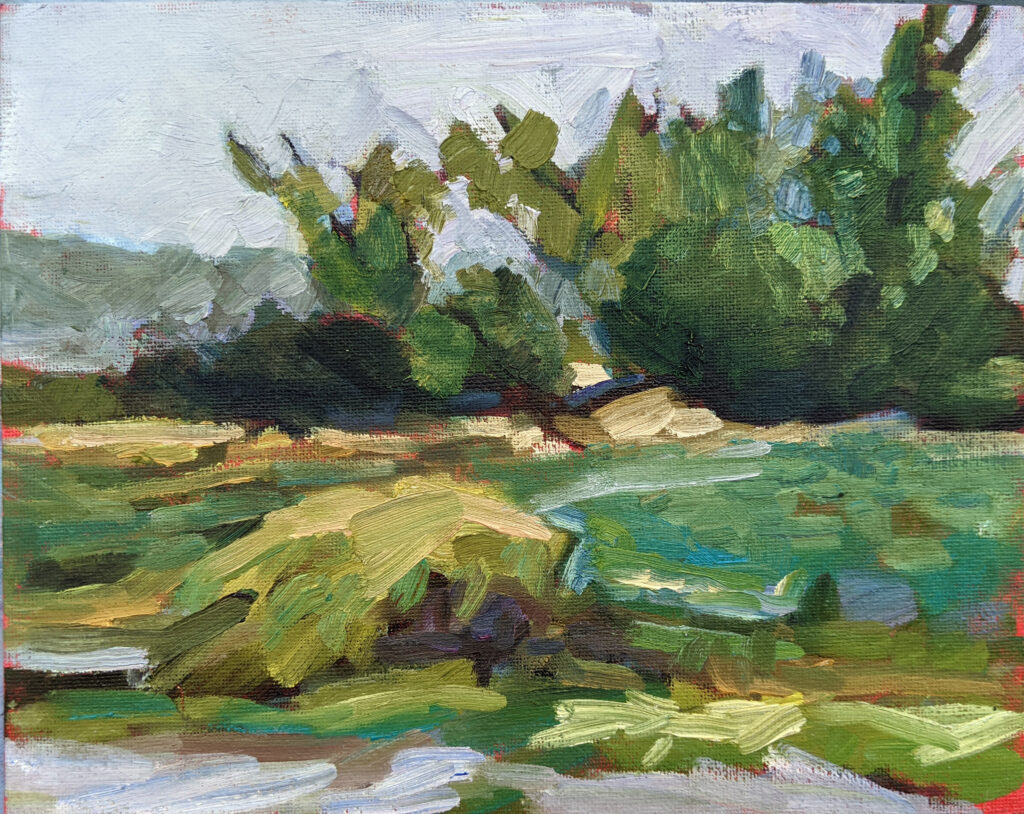
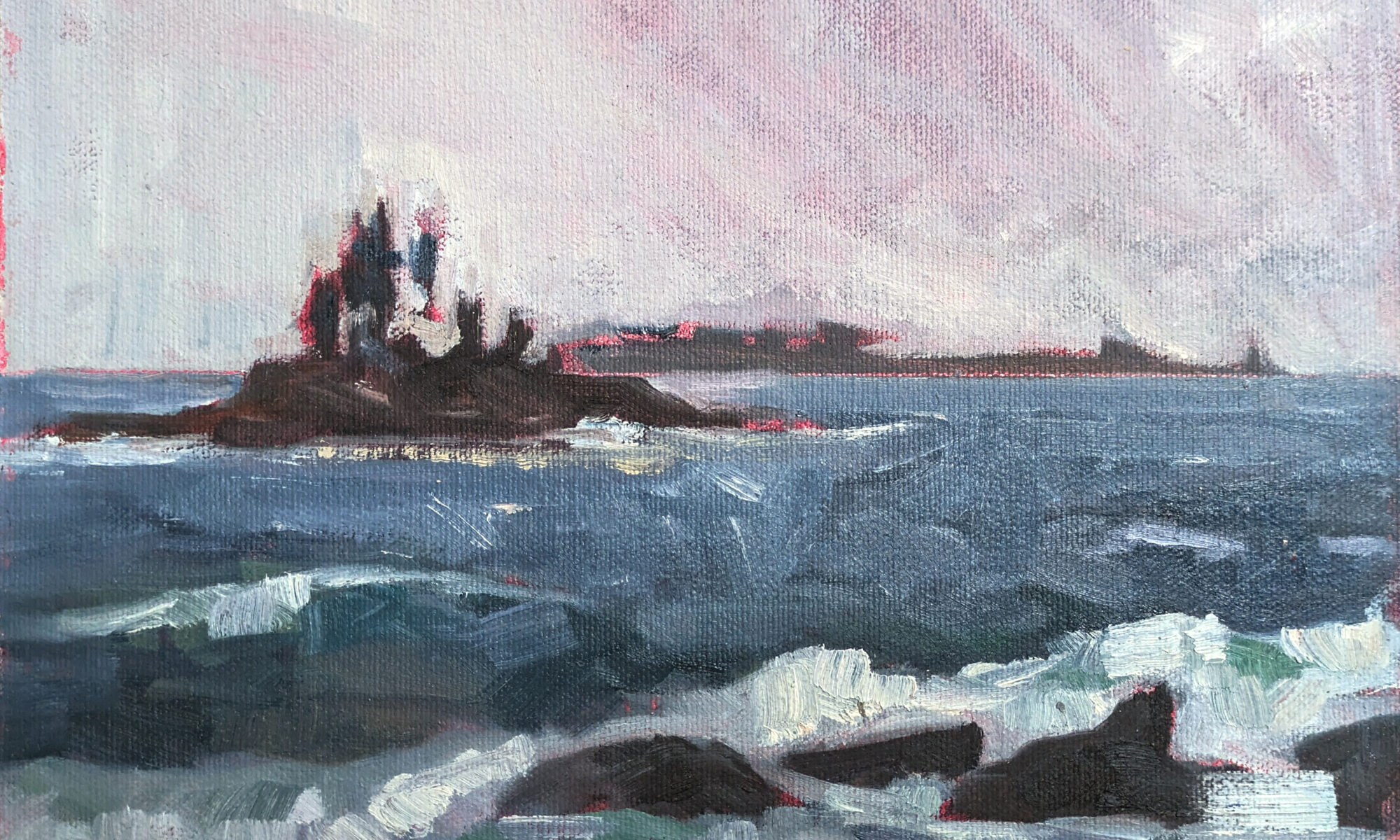
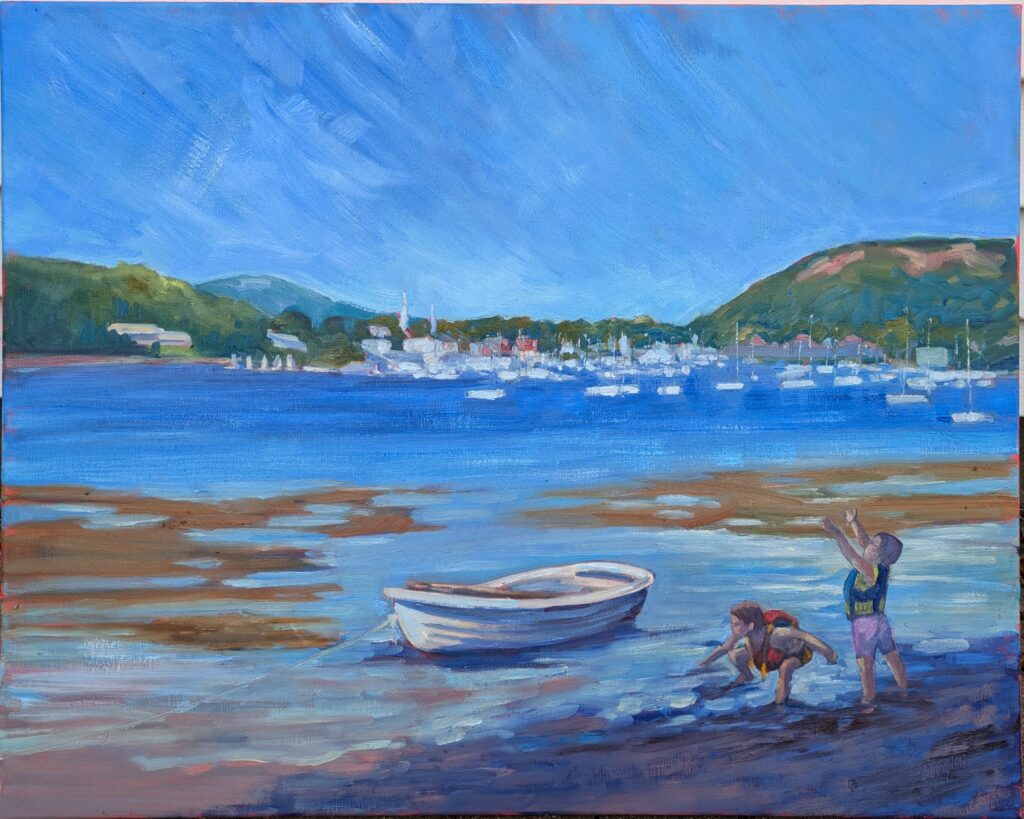
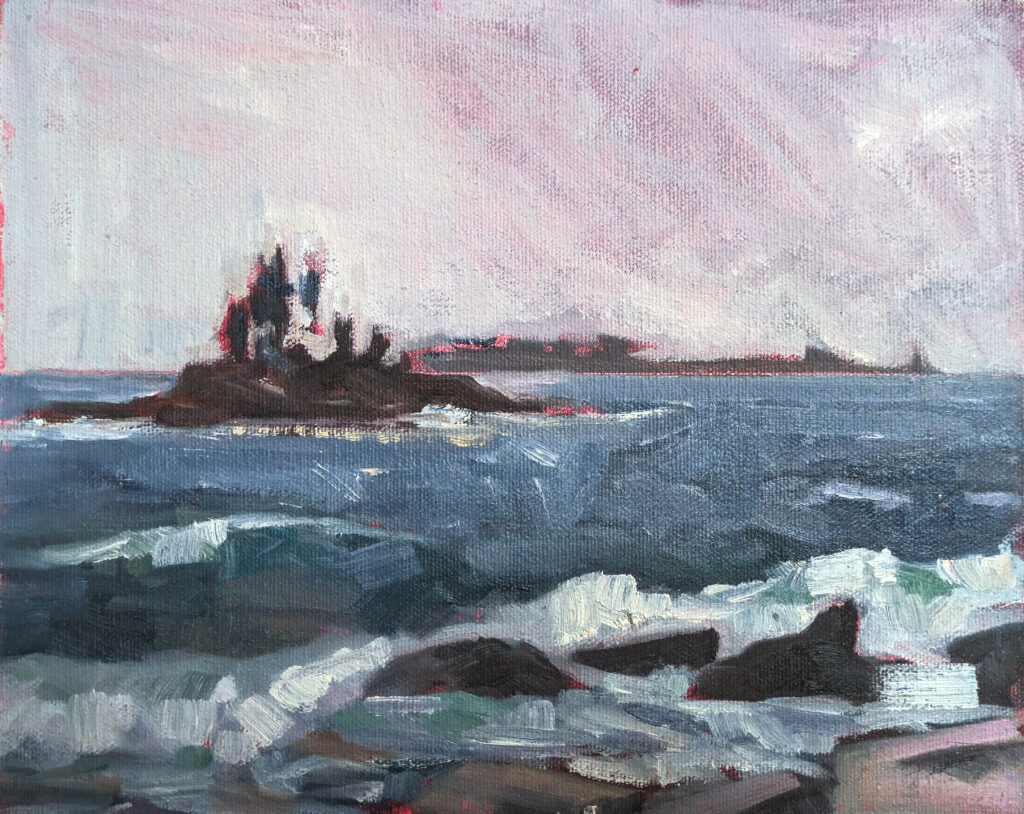
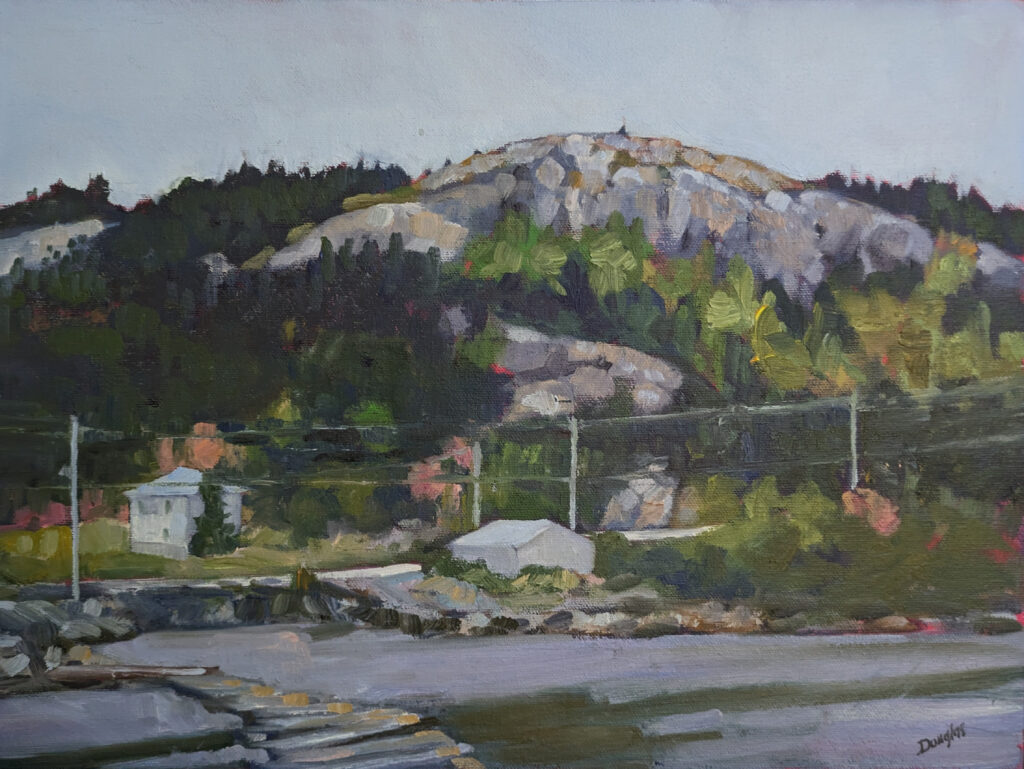
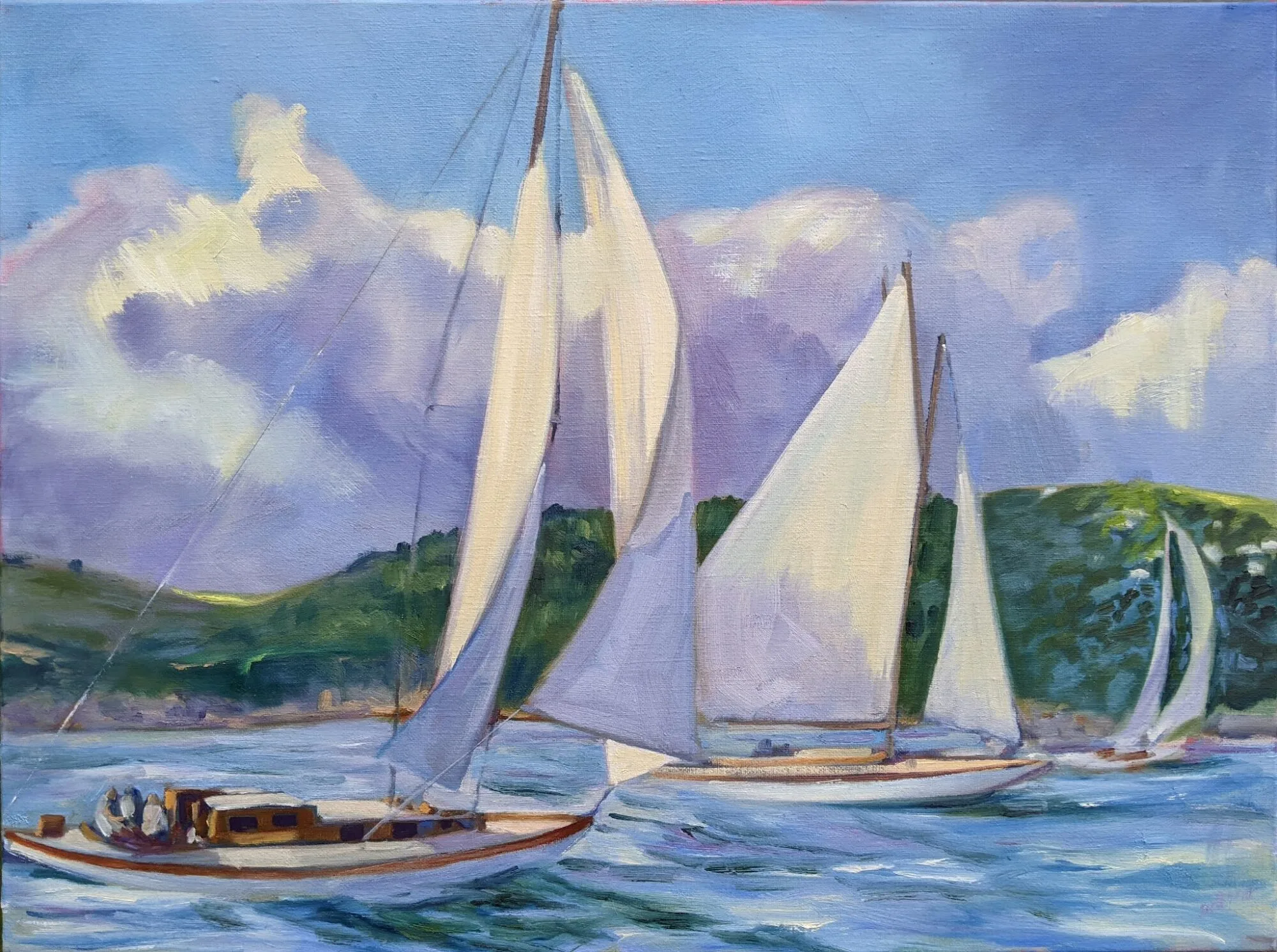
Cape Breton Highlands, 8X10, oil on archival canvasboard, $522 includes shipping and handling in continental US.

I woke up at 3 AM in a panic because I hadn’t started my Christmas shopping. Then I realized this was just a silly dream, but it shows what’s on my mind.

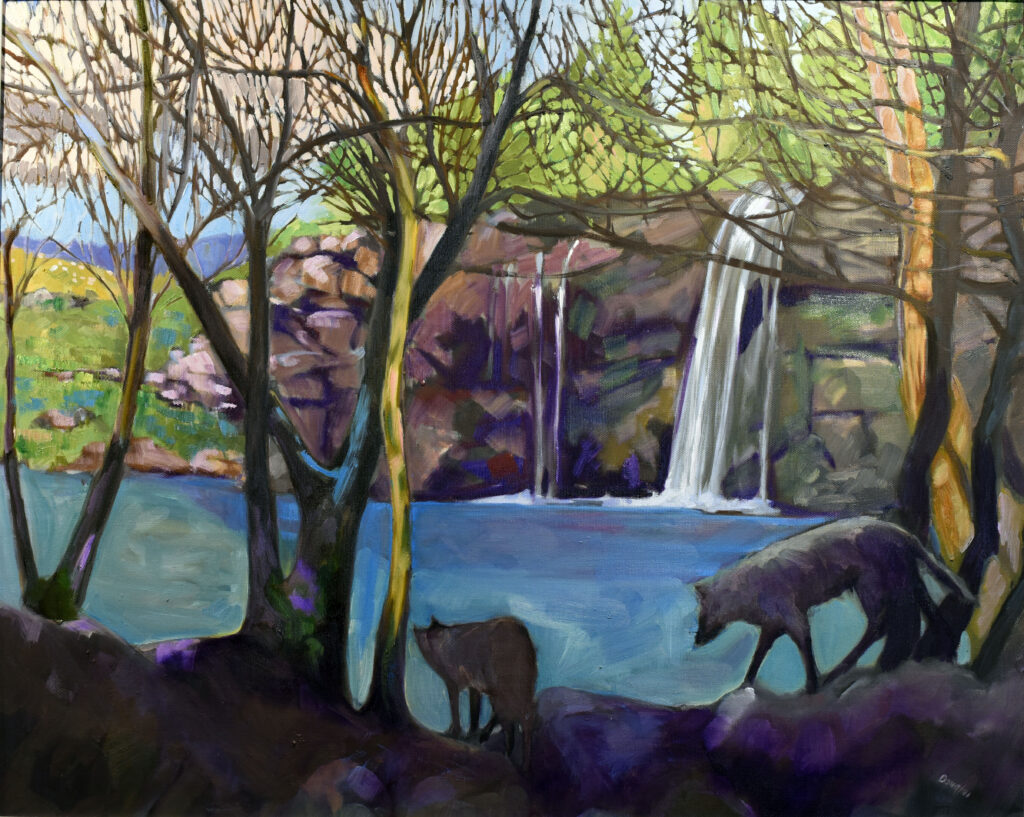
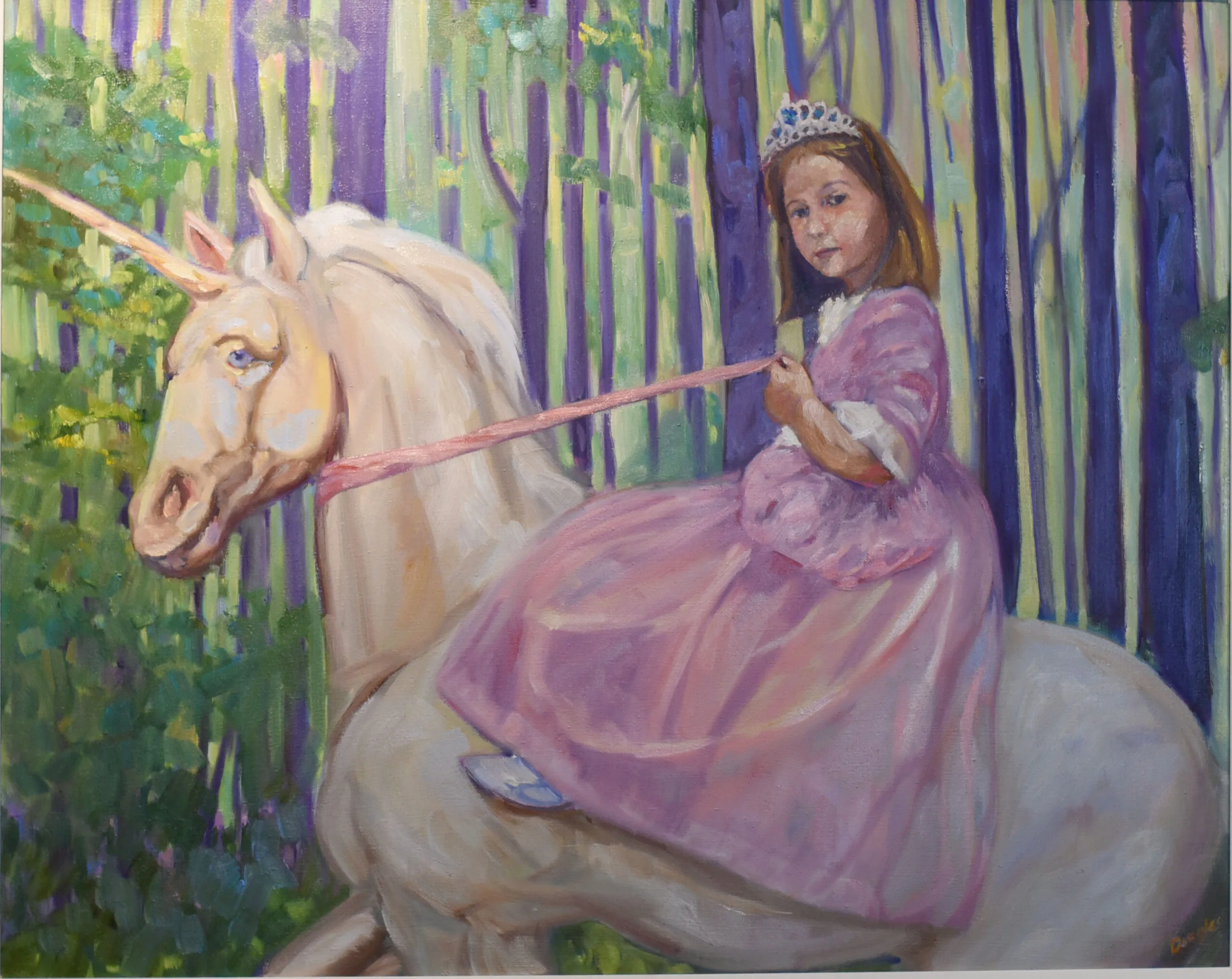
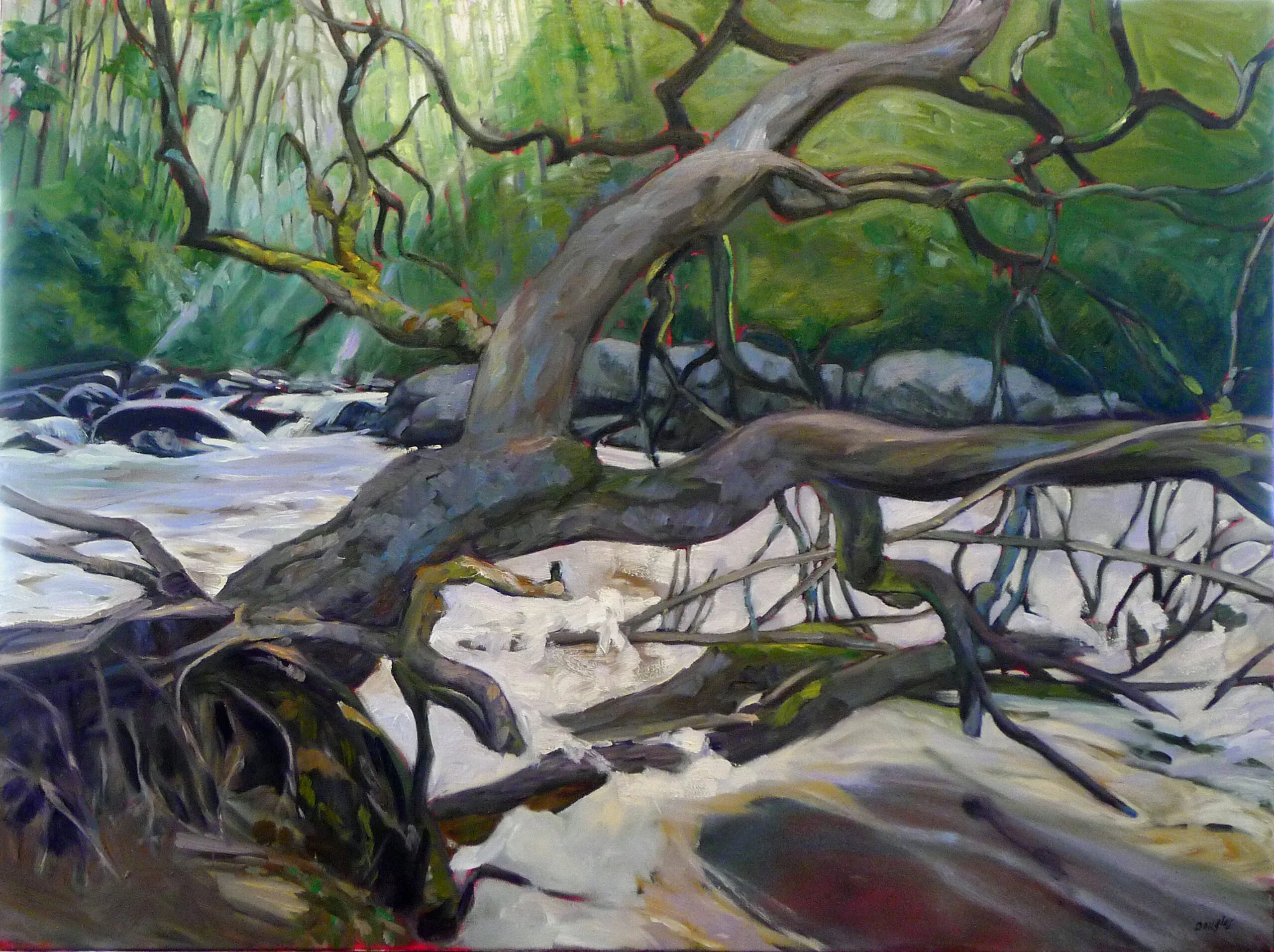
Nothing against a good tote. I love one myself, especially when it’s covered in paint. But when you want to give a forever gift—something that carries a story, a memory, or the feeling of a place—nothing quite compares to an original painting.

Original art isn’t mass-produced. It’s not something that shows up on a shipping tracker, or in Black Friday sales. It’s a true one-of-a-kind, a small piece of the world filtered through the artist’s hand and heart. That’s the kind of gift that lasts.

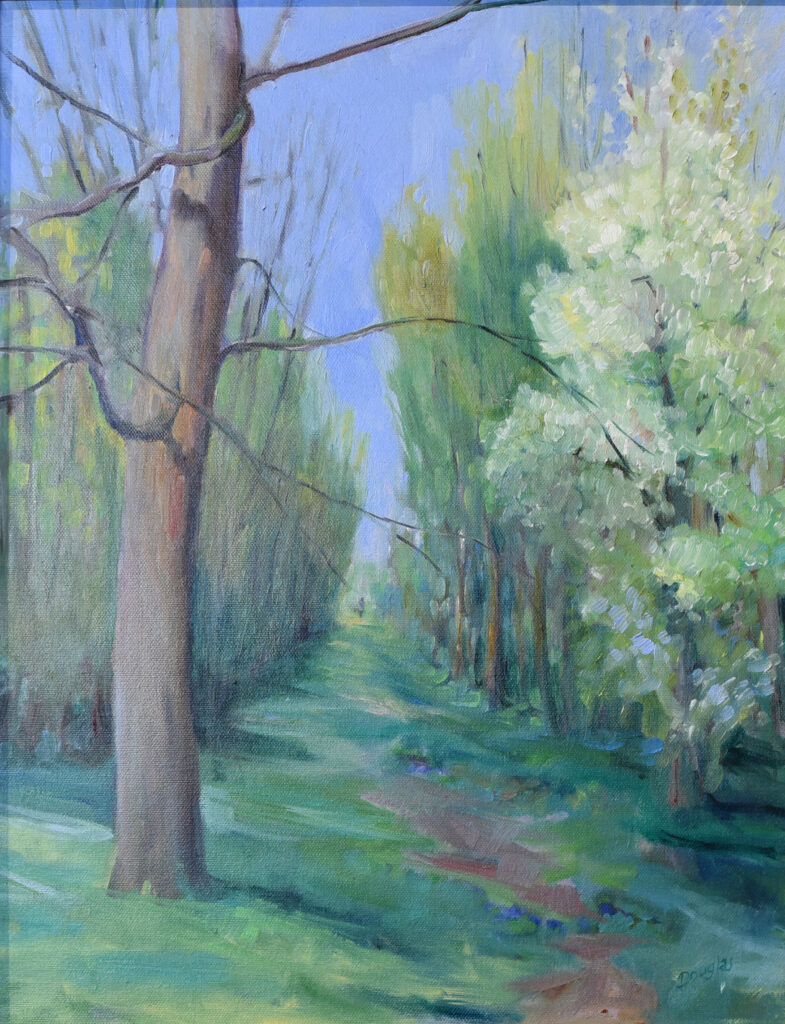
Autumn farm, oil on canvasboard, $1449 framed includes shipping and handling in continental US.

For the new homeowner, a statement painting

Assuming the closing goes well, my daughter will be a first-time homebuyer right before Christmas. That blank wall above the couch? It’s practically begging for something with life and light. Luckily, I know where to go.

A statement painting gives a home instant warmth and character. Think of it as important as good lighting; it changes everything. Whether it’s a landscape that reminds them of their favorite place or a bold scene that anchors the room, a painting makes a house feel like their house.

For the budding artist, Seven Protocols for Successful Oil Painters

Seven Protocols for Successful Oil Paintersis a perfect gift for someone starting in oil paints. Not only do I tell them how to do it, I tell them why they should do it that way. That starts with picking out the right paints (without wasting money) and goes right to the finishing touches of framing and varnishing. This is where every new painter should begin.

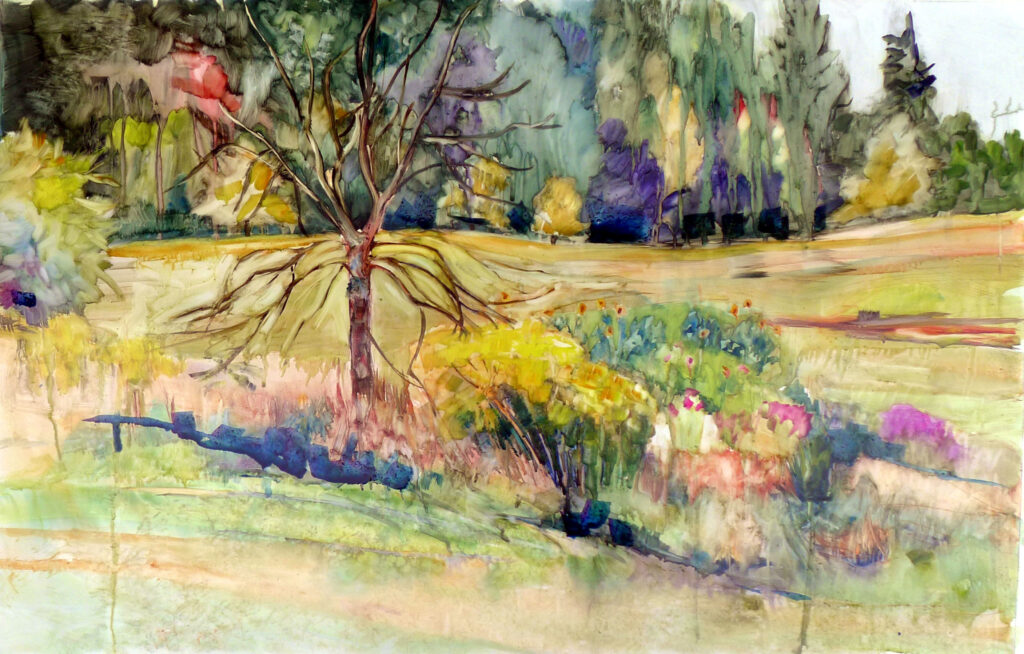
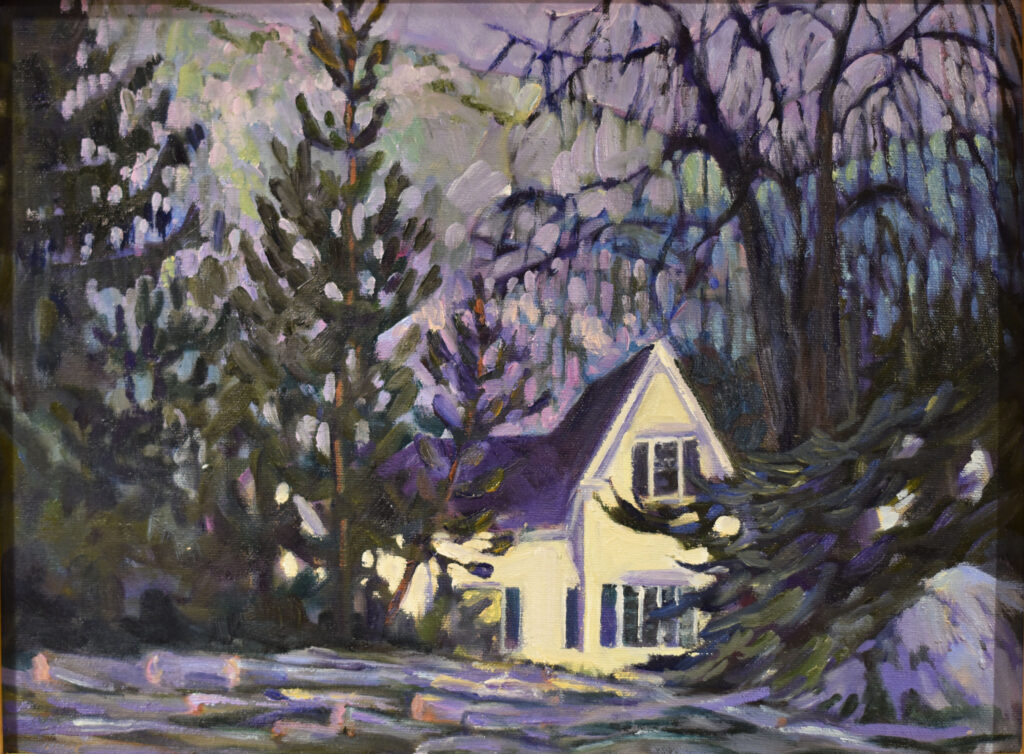
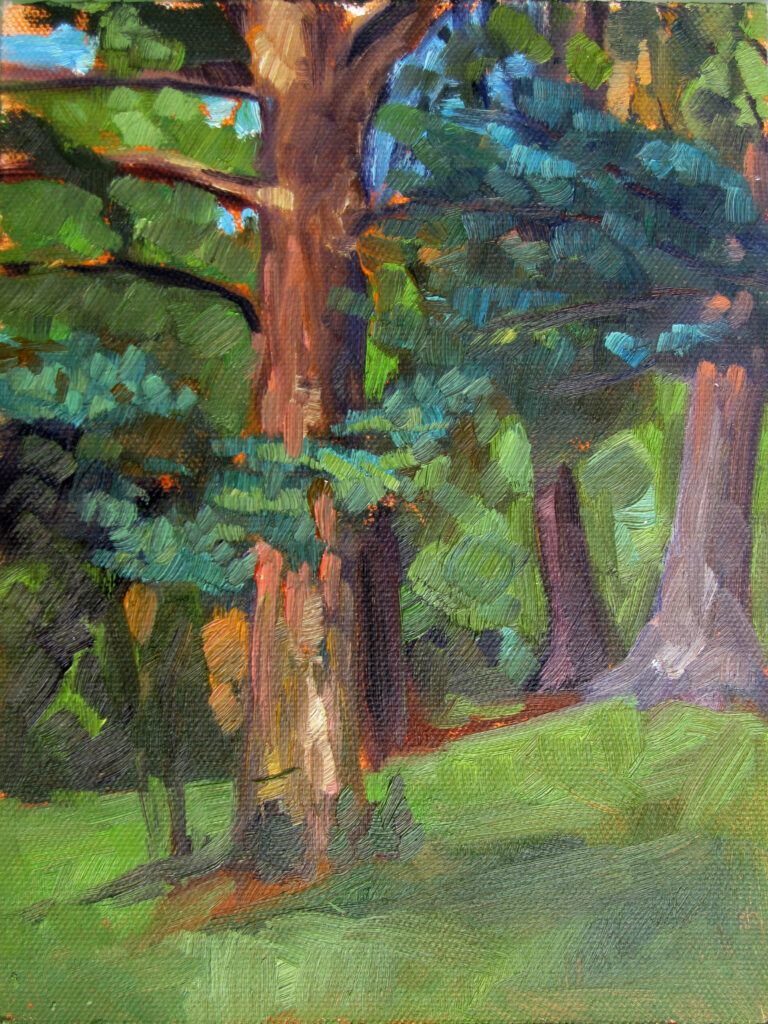
Evening in the Garden, 9X12, oil on archival canvasboard, $869 framed includes shipping and handling in continental US.

For the person who is impossible to shop for

You know that person; heck, I am that person. We buy what we want when we want it. But we’re also always hoping to be surprised by something super-thoughtful and personal. (What a pain in the neck we are!)

A small painting is intimate, something they can place on a bookshelf, a desk, or by a favorite chair. It’s not flashy, but it carries presence. It’s the kind of thing that draws the eye again and again. To search my collection from smallest to largest, just set the sort button to “price: low to high.”

For the traveler, especially one who misses the ocean

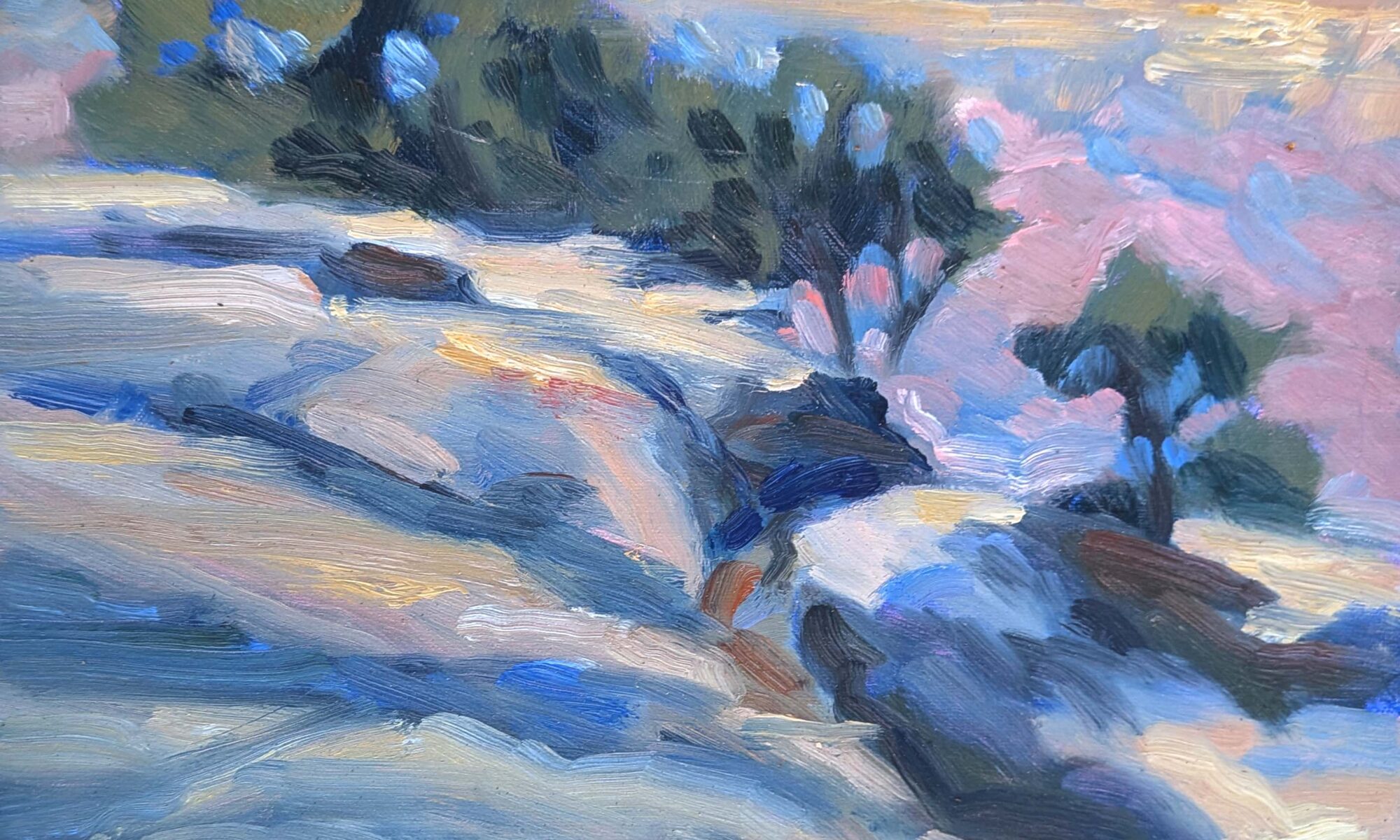
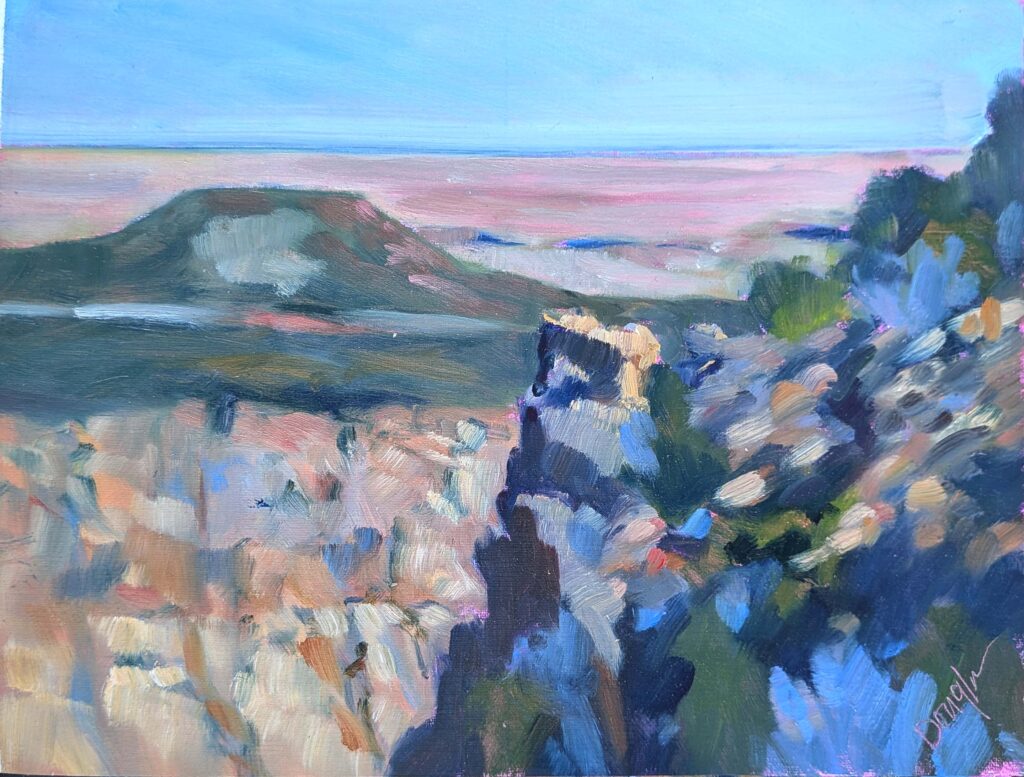
A plein air painting is a piece of a place. It’s wind and light, painted on-site, with sand still in the corners of the panel. For someone who loves the coast, the mountains, the Great White North, the desert or New England villages, an original plein air painting brings them right back. And this all reminds me that I never put my paintings of Argentina or the Grand Canyon on my website; silly me!

Île d’Orléans waterfront farm, 8X10, oil on archival canvasboard, $522 includes shipping and handling in continental US.

For the sentimental

Maybe it’s a garden or the view from a childhood porch. A commissioned painting of that place becomes a touchstone. (Note, if this is what you want by Christmas, I need to know ASAP. Just email me.)

In the end, give something that lasts

Totes have their place but real, original art has staying power. It carries stories, captures time, and makes ordinary moments feel meaningful. And that’s the magic of giving art — it continues to unfold long after the wrapping paper is gone.

Browse my paintings here.

Registration is now open for workshops in 2026! Reserve your spot:

Can’t commit to a full workshop? Work online at your own pace:
Seven Protocols for Successful Oil Painters

Decorating advice from a painter

Best Buds, 11X14, oil on canvasboard, $1087 framed includes shipping and handling in continental US.

One of my guilty pleasures is reading decorating advice on the internet. This is ridiculous since I never decorate with intention at all; we have second-hand furniture, musical instruments, many paintings and gifts from friends and family. They take up all the available space.

But I have strong opinions on the subject. Chief among my objections are ‘inspirational’ quotes hung on walls in lieu of pictures. That’s followed closely by any mass-produced wall decor from TJMaxx/Homegoods. That’s why I loved this passage from 5 Living Room Red Flags That Guests Immediately Notice, According to Designers, from The Spruce:

The type of art on display in your living room matters too, [Elissa] Hall says, and if done incorrectly, may set the wrong tone. “If I walk into a living room and only see generic, store-bought art on the walls, I disconnect from the space,” she says. The designer prefers to see pieces that reflect the homeowners’ personality. That doesn’t mean you have to spend a pretty penny in the process, though. “Vintage art is often as affordable as new pieces from big-box stores,” Hall says. You also don’t have to toss all of your stock art, either. Choose pieces that speak to you—that makes all the difference.

If that Live|Laugh|Love sign is meaningful, I guess you can keep it.

Home Farm, 20X24, oil on canvas, $2898 framed includes shipping and handling in continental US.

I have a painting in my kitchen of a kid roasting marshmallows at a campfire. A lithograph of a layered salad we once had for Christmas. Hasidim in a neighborhood like where we used to live. A hydra-headed Jack Russell Terrier. And so on, through every room in my house.

The excellent quality of this art isn’t the point. What matters most is the emotional connection to the subject, the work or the artist.

In my youth, people joked about buying paintings to match their sofas. That actually matters; a painting has to fit a room. If you have art that doesn’t pull its weight, try it in a different place. But good art is far more than just decor. It may be the brains of a room, or the room’s heart, but it should inspire thought or feeling.

This is especially true when we’re stuck inside during the colder months. It’s snowing as I write this and it will get much colder soon. I like winter, but for many of you, your homes are your cozy refuges from the weather.

Lobster pound, 14X18, oil on canvas, $1594 framed includes shipping and handling within the continental US.

But cozy doesn’t have to mean trite snowflakes and pine trees. It can be the soft tones of a winter landscape or the golden filtered light of a summer scene. These subjects are then transmuted into art by the minds and hands of real, living artists.

Does anyone really believe that the ‘art’ at TJMaxx/Homegoods didn’t come from an assembly line, the same way that sequins are applied to masks or feathers glued to lamps? We buy this imitation of art when we feel pressed by blank walls. But it is a complete waste of money. If it’s all you can afford, it’s far better to buy a print of a great painting than a bogus ‘original’.

A statement painting over the mantel can anchor a living room, drawing the eye and setting the tone for the entire space. However, a small painting on the right sliver of wall can deliver the same punch. Especially during the busy holiday season, more intimate works act as visual pauses.

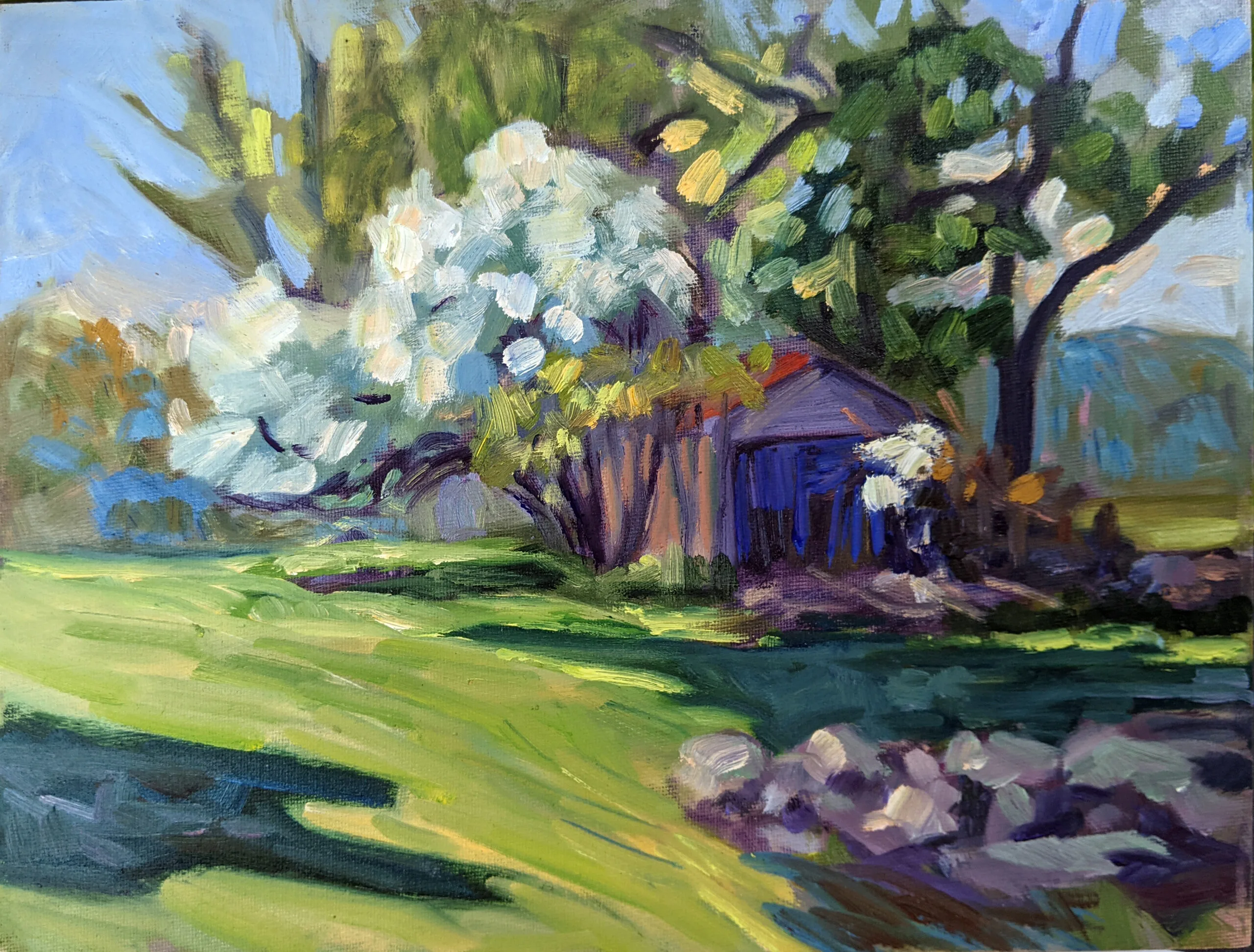
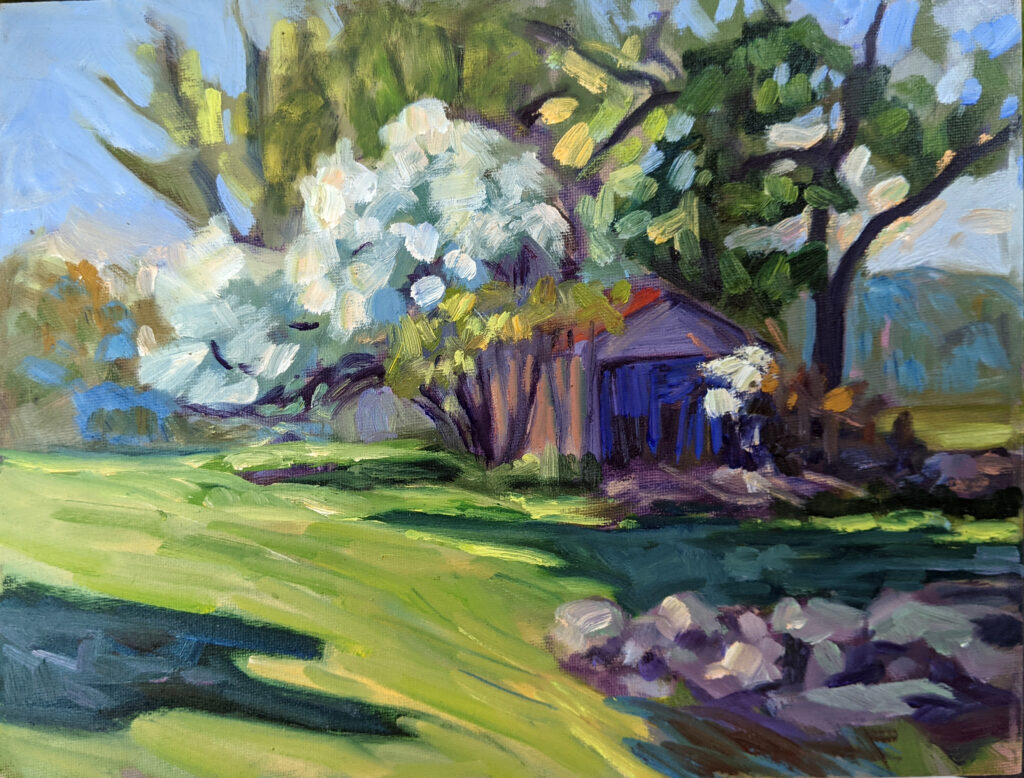
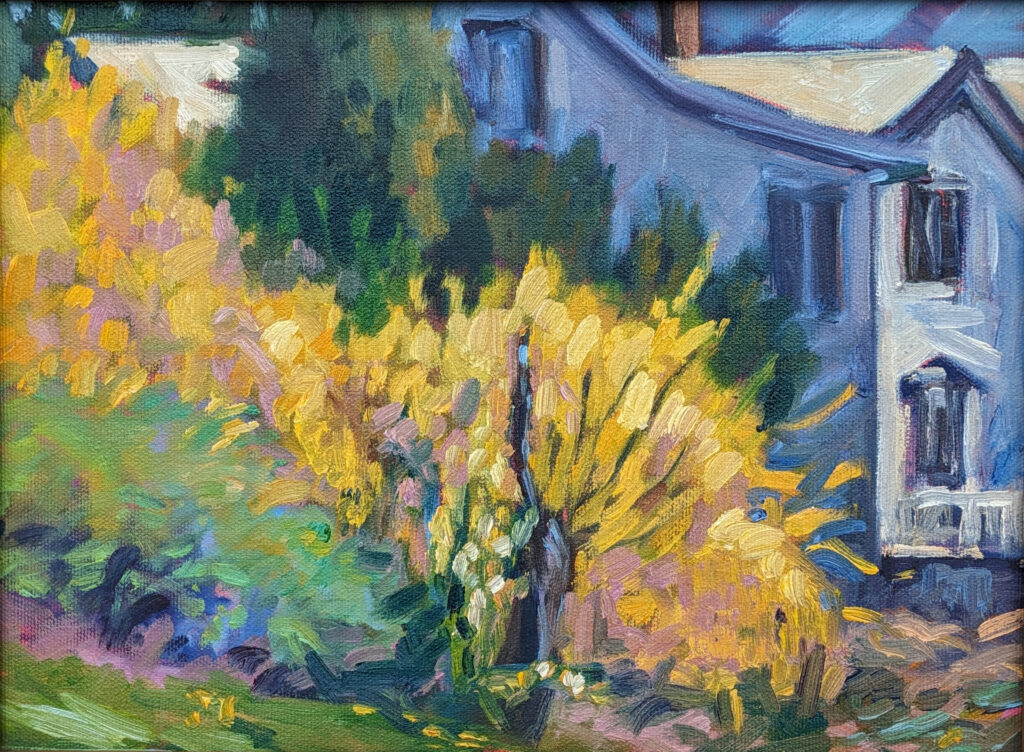
Apple Blossom Time, oil on archival canvasboard, $869 framed includes shipping and handling in continental US.

Coziness isn’t about perfection. It’s about meaning, memory and feeling; it’s almost an anti-decorator sentiment. Browse my collection of paintings to find the perfect piece to warm up your home this winter.

Registration is now open for workshops in 2026! Reserve your spot:

Can’t commit to a full workshop? Work online at your own pace:
Seven Protocols for Successful Oil Painters

Monday Morning Art School: simplifying shape and proportion

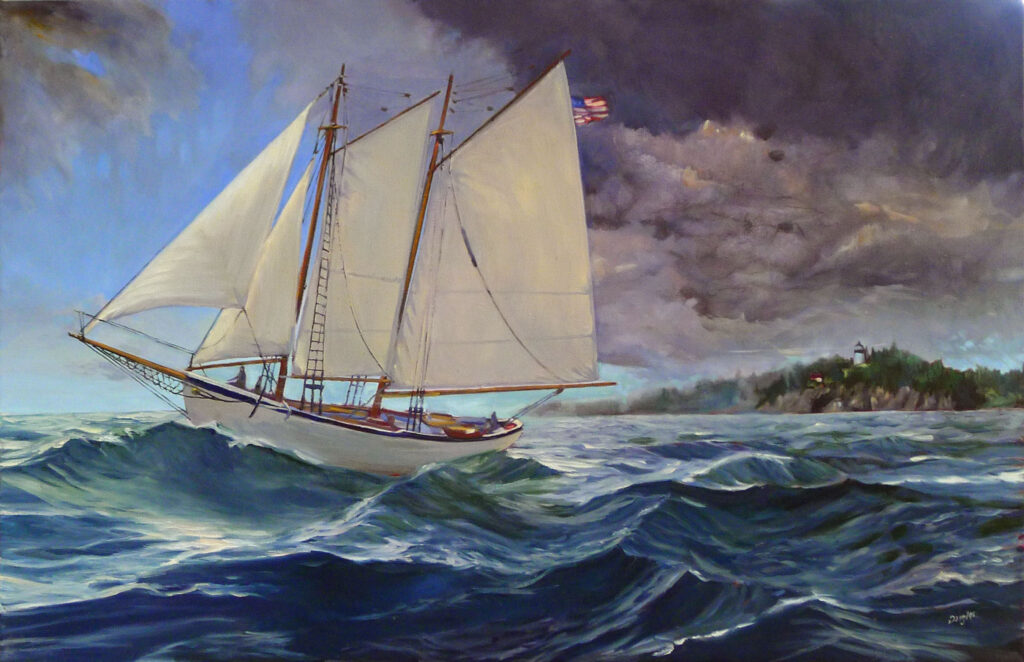
Heavy Weather (Ketch Angelique), 24X36, oil on canvas, framed, $3985 includes shipping and handling in continental US.

When you begin a painting, the natural instinct is to replicate every little wrinkle, cast shadow, and subtle nuance. But strong painting starts with drawing and structure. You must distill a composition down to its essential shapes and accurate proportions. That includes clear focal points and a compelling value structure. Once you have that you can worry about expressive brushwork.

A sketch of Trundy Point. It doesn’t need to be complicated; it’s a map, not a masterpiece.

Start with the underlying basic shapes

I’ve mentioned that I have the advantage of being slightly nearsighted, and I don’t paint with my glasses on. The rest of you can squint. What are the big masses? Forget identifying whether that’s a tree or a house; it’s a mass topped with another mass.

Every complex form or scene can be broken down into simplified geometric shapes. In addition to making better compositions, shape simplification helps you map proportion. Of course, you’ll occasionally need to check how tall vs. how wide the objects are and where they intersect.

Do this work in a sketchbook, where an ounce of prevention (drawing) is worth a pound of cure (overworking the painting).

How to block in a compelling composition

Once you understand the basic shapes, place them on your drawing. I never work inside a box; instead, I draw and then crop my drawing to match my canvas size. In fact, sometimes I do this several times, searching for the strongest composition.

My sketch for Heavy Weather. 5X8, graphite on Bristol-finish paper. This is a drawing that I spent a long time on, moving elements around until I was satisfied with the composition.

This allows me to explore all aspects of the idea before I commit to a composition. Sometimes I do a carefully-realized drawing. More typically, my drawing is not even identifiable as the subject; it’s merely a series of shapes.

How much of the canvas will the largest shape occupy? Is it part of a repeating motif or a one-off? Is it dark or light? Is it centered or offset? What quiet passages or negative space balance it? How does it support focal points?

This exploration is the most important part of painting (and to me, the most fun, since it’s fast and free). If line and value in a sketch are working, we know before we start whether the painting will end up feeling energetic, balanced, or completely static.

Refine edges before details

Working in big shapes does not mean those shapes remain unrefined; in fact, the best loose painters are the ones working from beautifully-drawn outlines. Drawing is the scaffolding of painting. Get the edges and proportions right while the shapes are still bold and simple.

Simplify and emphasize for impact

The beauty of this approach is that it can be pursued to whatever level of finish you like—either left wide open or with a high level of detail. With structure locked in, you can choose to paint the smaller elements as you wish, as long as you don’t overwrite your initial bold composition.

Napoleon I on his Imperial Throne, 1806, Jean-Auguste-Dominique Ingres, courtesy Musée de l’Armée

However, even the most meticulous realists edit some things out. For example, look at the above painting by Jean-Auguste-Dominique Ingres. At first glance, it’s highly detailed, but that’s selective. The robes are simplified, the carpet is simplified, and the background is simplified. (It’s huge, by the way.) Ingres knew what he wanted us to look at, and everything else is subservient to that. With a strong composition, his viewers instantly felt the power of Napoleon’s imperial pretensions, even before they noticed the details that Ingres did include.

Once the bones are in place, you can worry about style

Once shapes, proportion, value and placement are set, you can worry about brushwork. That includes lost-and-found edges, which can lead the eye through lesser forms and amplify major passages. You’ll find you’re a lot closer to looser brushwork if you lay a strong foundation first.

There are openings in my January-February Zoom classes

Trust the Process: making technique tell the story you want to tell
Monday evenings, 6-9, Jan. 5-Feb. 9, 2026

Where Do I Fit In?
Tuesday evenings, 6-9, Jan. 6-Feb. 10, 2026

Registration is now open for workshops in 2026! Reserve your spot:

Can’t commit to a full workshop? Work online at your own pace:
Seven Protocols for Successful Oil Painters

Two new Zoom classes for January

Possum, 6X8, oil on archival canvasboard, $435 includes shipping in continental US.

Careful readers of this blog know that I completely mangled Wednesday’s post about upcoming workshops. I was in Boston with my husband for a medical procedure, feeling oh, so smug about my efficiency in the face of stress, and then, bam, I created a mess that took Laura half a day to fix.

I rather like these reminders that none of us are endlessly elastic; we’re all subject to human limitation.

Here are my new classes for January. I am very excited about them both, since they’re a deeper dive into painting than simple “learn to paint.” The Monday class is about making room for the narrative, symbolic part of painting, by letting process guide the mechanical part. The Tuesday class is an exploration of the movements in art that have come before us, so that you, as a painter, can make informed choices about where you fit in the bigger world of painting.

If you have questions, feel free to email me.

Tin Foil Hat, 6X8, oil on archival canvasboard, $435 includes shipping in continental US.

Trust the Process: making technique tell the story you want to tell

Monday evenings, 6-9 PM
January 5, 12, 19, 26
February 2, 9

In Trust the Process, we focus on building a painting practice that supports your ideas instead of getting in their way. This class is about finding repeatable methods that make painting feel fluid, approachable, and reliable. You can stop wrestling with technique and start communicating clearly through your work.

Each session guides you through a structured but flexible approach: a way of working that you can return to again and again. You’ll learn to set up a process that’s both efficient and freeing. That starts with how you begin a painting, to how you develop layers, to when you know it’s time to stop. The goal isn’t to make every painting the same, but to create a foundation that lets your ideas move easily from imagination to finished painting.

We’ll experiment with systems that encourage consistency, including color palettes that simplify decisions, brush techniques that build confidence and layering methods that create depth without overworking. By repeating certain moves and sequences, you’ll find that the how of painting becomes second nature, freeing your attention for the why.

You’ll leave with a repeatable workflow you can adapt to any subject or idea, and the assurance that your practice can sustain momentum over time.

Trust the Process is designed for painters who want to stop flailing around and work smarter, not harder. By refining your process, you’ll discover that creativity doesn’t require chaos. It just needs a dependable path — one you can walk every day, confident that your technique will always rise to meet your ideas. To register, click here.

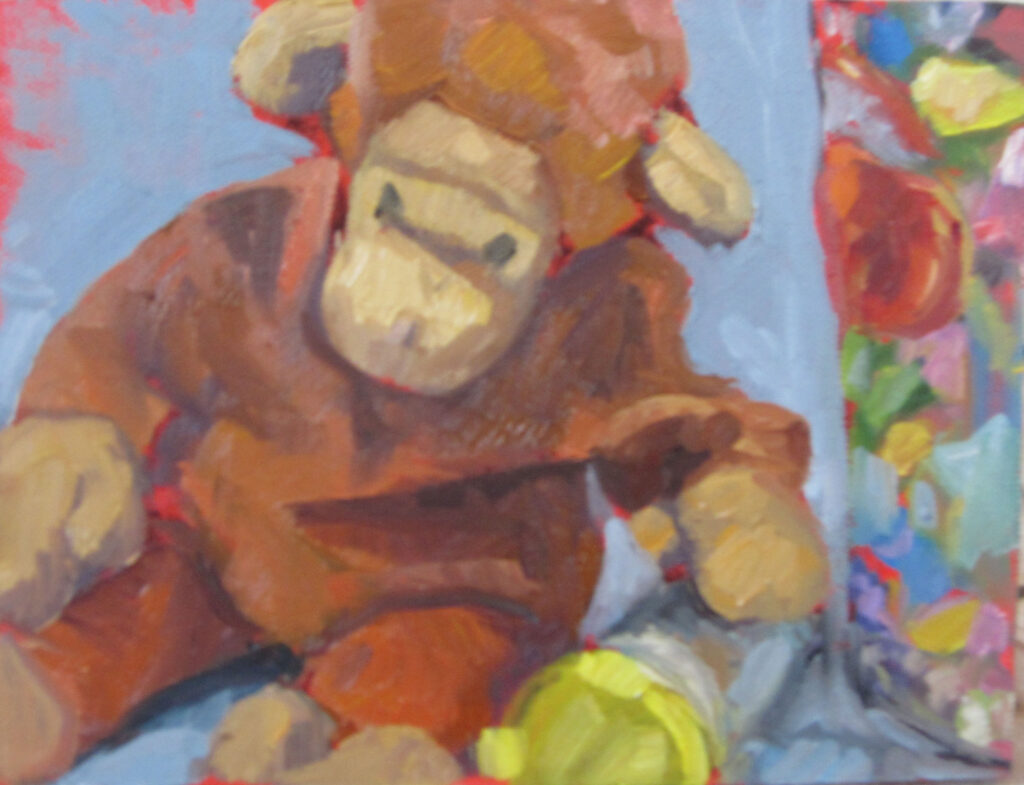
Toy Monkey and Candy, oil on archival canvasboard, $435 framed.

Where Do I Fit In?

Tuesday evenings, 6-9 PM
Jan 6, 13, 20, 27
February 3, 10

Ever wonder where your art belongs in the grand conversation of art history? This class invites you to explore your creative identity through the lens of the great movements that shaped the visual world.

Together, we’ll look at how artists have defined, challenged, and redefined what it means to make art. After a 30–45-minute guided discussion, we’ll move on to your paintings for the week, as you experiment with materials, methods and ideas inspired by each movement, discovering which resonate most deeply with your own artistic voice. You’ll begin to see how your work connects or pushes against historical traditions.

This isn’t about imitation; it’s about insight. By the end of the class, you’ll have a stronger understanding of your own style, an appreciation of the lineage you’re part of, and a body of work that reflects your evolving sense of place in the art world. Come ready to explore, question, and create — and find out where you fit in. To register, click here.

(Class requirement: some painting experience and a lot of intellectual curiosity.)

Stuffed animal in a bowl, with Saran Wrap. 6X8, oil on archival canvasboard, $435.

Registration is now open for workshops in 2026! Reserve your spot:

Can’t commit to a full workshop? Work online at your own pace:
Seven Protocols for Successful Oil Painters

Learn to Paint in 2026: Plein Air Painting Workshops with Carol L. Douglas

Carol L. Douglas painting at Acadia National Park
Carol L. Douglas teaching painting at Schoodic Point, Acadia National Park. Courtesy Sharron Prairie.

If you’ve ever dreamed of learning to paint outdoors — to capture light, color, and atmosphere right from life — 2026 is your year. Join me, Carol L. Douglas, for a new season of plein air painting workshops across some of America’s most inspiring landscapes: coastal Maine, the Berkshires, and the red rocks of Sedona, Arizona.

Whether you’re a beginner wanting to learn to paint from scratch, or an experienced artist ready to refine your technique, these workshops are designed to help you paint with confidence, structure, and joy.

Carol L. Douglas painting at Acadia National Park
Cassie Sano’s painting of Undermountain Farm’s Victorian barn from the Berkshire workshop.

What you’ll learn

Each workshop combines plein air painting, focused demos, and individual coaching. Together we’ll explore:

  • Composition and design — how to simplify complex scenes into strong, readable paintings.
  • Color theory — how to mix vibrant, believable color for light, shadow, and atmosphere.
  • Value control — understanding contrast to bring structure to your work.
  • Mark-making and brushwork — developing an expressive, personal style.
  • On-location problem-solving — painting outdoors in changing light and weather.

These workshops are about learning to see what’s in front of you and translating that into paint.

2026 Plein Air Workshop Schedule

Canyon Color for the Painter – Sedona, AZ, March 9–13, 2026
Explore the vivid palette of Sedona’s red rocks. This Arizona plein air painting workshop emphasizes bold color, composition, capturing the heat and glow of desert light. Click here to learn more.

Carol L. Douglas painting at Acadia National Park
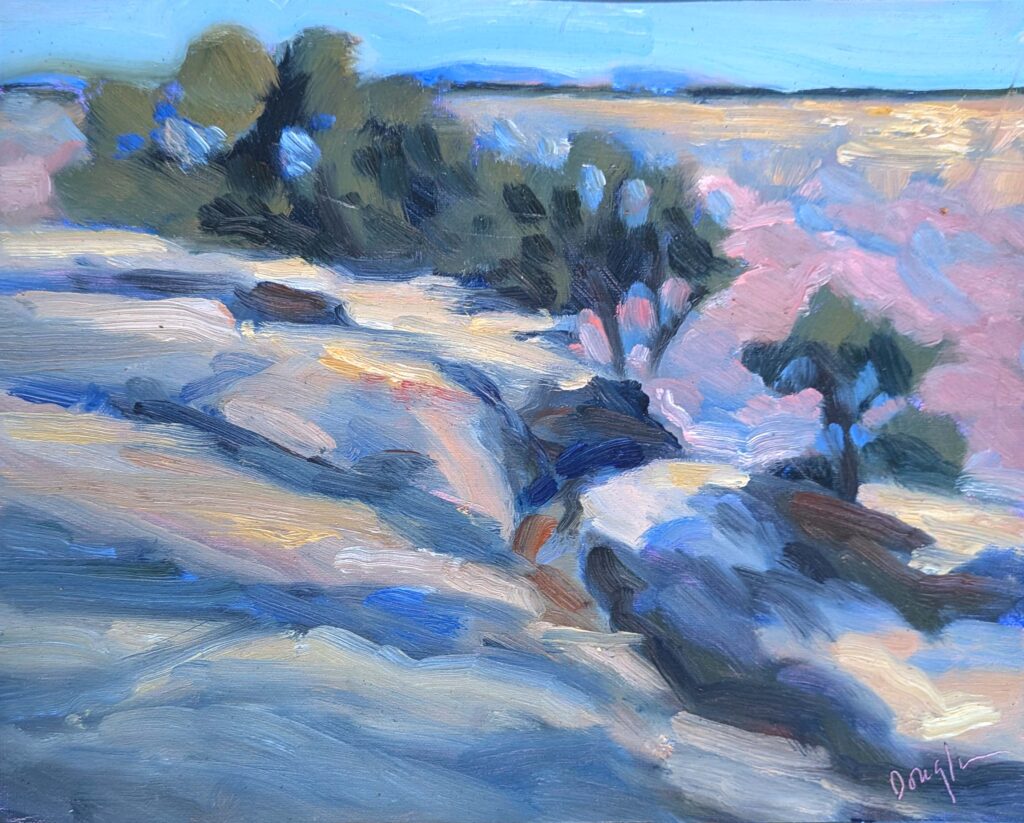
Sunlight and shadows (Sedona, AZ), Carol L. Douglas, oil on birch, 14X18, private collection.

Advanced Plein Air Painting – Rockport, ME, July 13-17, 2026
Back home on the coast of Maine, this session focuses on strengthening structure, value, and visual storytelling. Ideal for returning students ready to deepen their plein air practice. (If I don’t know you, I need to see a portfolio before you’re admitted. This is my only workshop that’s limited to advanced painters.) Click here to learn more.

Sea & Sky – Schoodic Institute at Acadia National Park, ME, August 2–7, 2026
A week painting the wild, wind-swept beauty of Acadia. Learn to handle shifting light and ocean atmosphere in oils, acrylics, or watercolor. Click here to learn more.

Find Your Authentic Voice in Plein Air – Berkshires (Lenox), MA, August 10–14, 2026
This Massachusetts painting workshop blends landscape study with artistic self-discovery. Perfect if you want to strengthen both your technical and expressive skills. Click here to learn more.

Carol L. Douglas painting workshops 2026
Larky Morning at Rockport Harbor, 11X14, on linen, $869 unframed includes shipping in continental US.

NEW! Color Clinic 2026 – NEW! Color Clinic 2026 – Rockport, ME, October 3-4, 2026
A focused color workshop exploring temperature, harmony, and color design. Learn to mix with purpose and paint with emotion. Click here to learn more.

NEW! Composition Week 2026 – Rockport, ME, October 5-9, 2026
Strong composition is the backbone of every great painting. This studio-based week dives deep into structure, rhythm, and creating balance on the canvas. Click here to learn more.

Who should attend

These plein air painting workshops are for artists of all levels (including beginners) who want to:

  • Build stronger foundations in drawing, value, and color.
  • Push past pretty to create meaningful, well-composed paintings.
  • Work outdoors with confidence — even when the light changes.
  • Join a supportive community of painters who love learning.

What you’ll take home

By the end of your workshop, you’ll leave with:

  • Finished plein air studies and field sketches.
  • A clear process for approaching any subject.
  • More confidence in color mixing and decision-making.
  • A refreshed, inspired outlook on your painting practice.

Why learn to paint outdoors

Plein air is simply the best training for artists. It teaches editing, observation and adaptability, which are skills that improve every kind of painting. When you paint from life, you stop copying and start interpreting. You learn to trust your eyes, your brush and your intuition.

Learning to paint isn’t about talent. It’s about curiosity, practice and guidance. My workshops give you all three.

Ready to join us?

Workshops fill quickly. View the full schedule and register here.

Monday Morning Art School: six things that matter in painting

Deadwood, oil on linen, 30X40, $5072.00 framed, includes shipping and handling in continental US.

Painting is not magic, it’s craft. No matter whether you’re working through studio oil painting techniques, watercolor experiments or exploring plein air painting, mastering these six essentials will improve your work.

See accurately

Before a brush ever touches canvas, train your eye. Accurate seeing underpins strong painting.

Downtown Rockport, 14X18, oil on archival canvasboard, framed, $1594 includes shipping and handling in continental US.

Learn to handle materials with confidence

  • Technical fluency frees you to focus on expression.
  • Know the proper ground for the medium you’ve chosen and the difference between good and mediocre papers, canvases and panels.
  • The only way to know your brushes is to experiment with them. That means use different types of brushes and strokes. It also means you should experiment with other ways to move paint, such as palette knifes, silicone chisels, credit cards or rag rollers.
  • Clean color mixing is a skill that takes a while to learn, but understanding how pigments and paints behave is the only way to avoid muddy results.
  • Understanding how solvents, oils, gels and retarders impact your paint is fundamental.

Compose with intention

Great paintings are designed, not accidental.

  • Draw, baby, draw: work it out in advance in your sketchbook before committing to paint. Those minutes you spend will save you hours down the road.
  • Establish clear focal points and build your painting around them.
  • Apply the design principles of balance, rhythm, unity, variety and movement.
  • Decide at the beginning what to include and what to leave out. Composition is about editing as much as drawing.

Work from life

Plein air painting teaches you to simplify, to respond to changing light, to see values and forms quickly, and to lay the image in without perseverating over the details.

Working from life teaches more than working from photos ever will. Even if you ultimately end up working from photo references, painting from life is invaluable for training your observation skills. The more practice you have painting from life, the less chained you are to photo references and the more you can draw from your internal vision.

Victoria Street, 16X20, oil on linen in a hard maple frame, $2029 includes shipping and handling in continental US.

Solve problems creatively

Every painting I’ve ever done started off brilliantly (in my head) and eventually reached an ‘oh, dang’ moment when its shortcomings became obvious. The difference between success and failure was in how I responded.

  • Step back and analyze objectively.
  • Make bold corrections rather than fussing endlessly over details.
  • Quit noodling.

Build a sustained practice

This is the least-glamorous part of life as an artist.

  • Paint regularly—even when uninspired—to build consistency and skill.
  • Learn to critique your own work on the fly.
  • Learn some art history; you’re part of a many-thousands-year-old tradition, after all.
Camden Harbor from Curtis Island, oil on canvas, $2782 unframed includes shipping and handling in continental United States.

Bonus for those pursuing painting as professionals

  • Good presentation supports your credibility. At a minimum, that means a website, business cards, and a resume.
  • Develop your personal voice through repetition and reflection.
  • Understand the art market: galleries, pricing, marketing are part of the professional painter’s toolkit.

Registration is now open for workshops in 2026! Reserve your spot:

Can’t commit to a full workshop? Work online at your own pace:
Seven Protocols for Successful Oil Painters

I’ve Been Everywhere: plein air painting in the Grand Canyon
(With apologies to Hank Snow—and everyone else who sang that song)

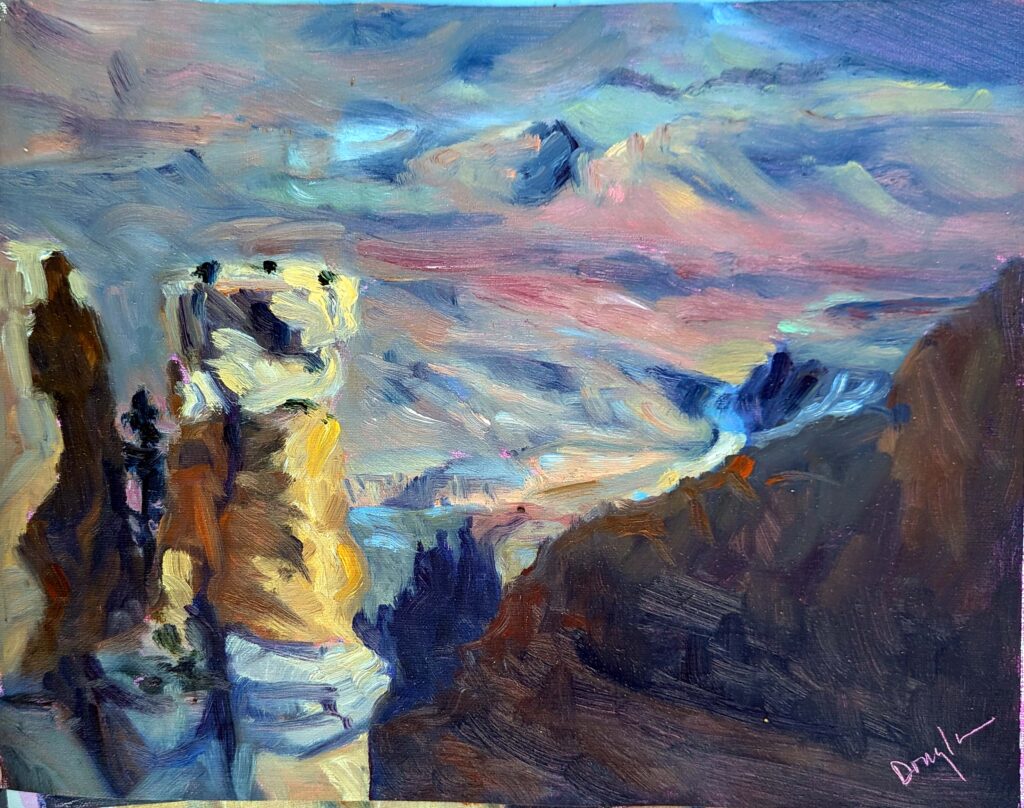
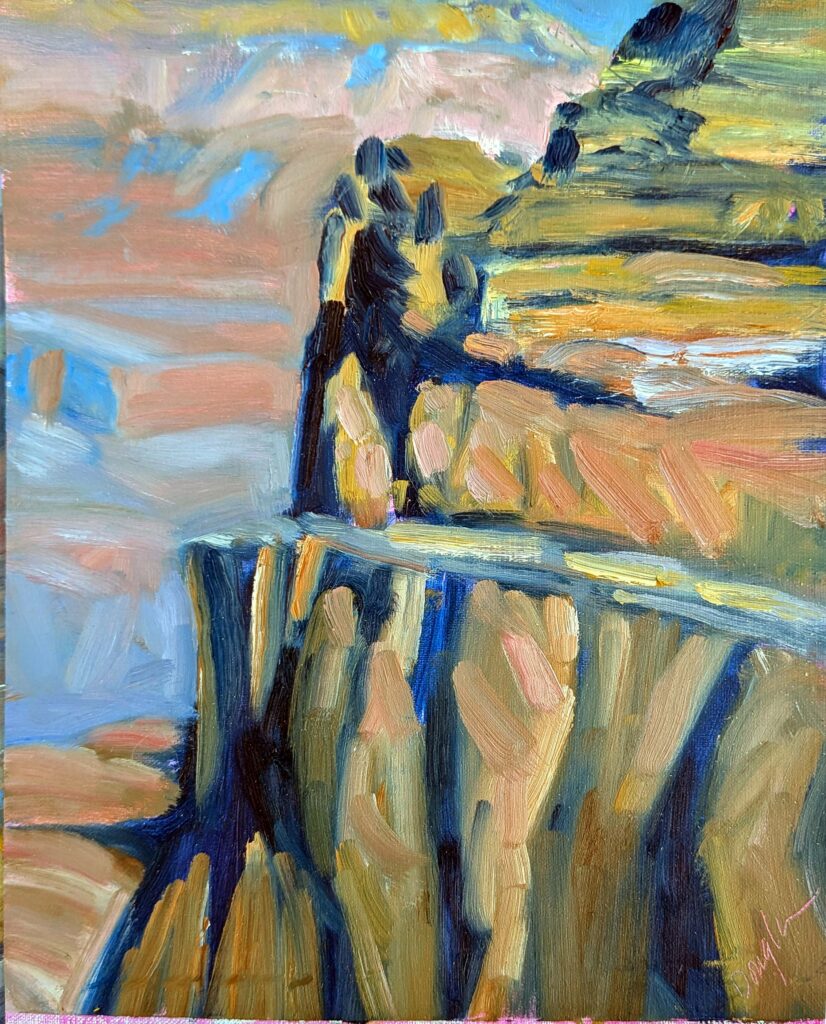
Mather Point at dawn, oil on canvasboard, 9X12.

I’ve been painting and traveling. I faithfully blogged every stop until Thursday, when I got home too late to photograph my latest Grand Canyon paintings. That’s why you’re getting this post a day late. (They’re still lousy pictures, but the weather wasn’t cooperating; see below.)

In the past few weeks, my travels have taken me from Albany, NY, to Phoenix, Sedona, the Grand Canyon, and Sun City, AZ. Then back to Albany and on to Rochester to meet my newest grandbaby. From there, it was one more stop in Albany before heading home to Maine.

Grand Canyon at sunset, oil on canvasboard, 9X12.

Plein air painting at the Grand Canyon

This was my third time painting at the Grand Canyon after leaving Sedona. The first time, I went with my Sedona workshop student, Kamillah Ramos. Ed Buonvecchio loaned me a cold-weather sleeping bag and I slept under the stars. That shimmering night sky was transcendentally beautiful.

Since then, I’ve repeated the experience with my friend Laura Martinez-Bianco. This year, Ed joined us, and Hadley Rampton stopped on her way home to Utah. Each trip brings breathtaking sunrise views and the utter chill of high-altitude October nights. Next time, I may bring gloves and long underwear, but I’ll keep going back as long as I can.

The first time one paints the Grand Canyon en plein air, it seems absurdly difficult. The scene is so vast that it can’t be easily sorted. But it grows on you; every year I find myself more capable of slicing and dicing it into manageable bits.

Grand Canyon, late morning, 8X16, oil on archival linenboard.

My Grand Canyon paintings survived the trip surprisingly well, despite a makeshift packing job using only cardboard corners and stretch film. (I hadn’t planned on transporting wet canvases.) In fact, the only thing I lost on this trip was my electric toothbrush, and I’m pretty sure I know where that ended up.

Next week I’ll be in Boston at Brigham and Women’s Hospital with my husband—not quite as fun as painting in Sedona, but important. Thankfully, my friend Bobbi Heath is watching my pup and hosting me, so I’ll get to catch up with her between hospital visits.

(If wealth was measured in friends, I’d be a billionaire.)

Ed Buonvecchio being summoned by the Mother Ship. We were only a few hundred miles from Area 51, after all.

From Arizona sun to Maine rain

I had a lovely time in Sedona, but checked the weather forecast every day to see if our drought had broken. The National Weather Service was reporting it as ‘severe’ or ‘extreme’ across Maine and New Hampshire. By the time I flew home, it had still not rained.

People don’t associate Maine with forest fire, but it happens. The Great Fires of 1947 destroyed 200,000 acres of forest across Maine and killed 16 people.

Very welcome rain, welcoming me home.

So, I was pleased to see drizzle as I set off on my last leg across Massachusetts. It wasn’t doing much by the time I went to bed on Thursday night, but I awoke to the steady thrumming of rain on the roof. By morning, both small creeks along my Beech Hill hike had water in them. They’ve been dry for many, many weeks. Plein air painters may not like rain, but we homeowners are relieved.

Sedona Plein Air Festival paintings

Carol L. Douglas painting at Acadia National Park

I finished the 2025 Sedona Plein Air Festival with eight paintings, two awards (and a group win in the artists’ games) and a whole lotta great memories. Those marked ‘available’ can be purchased through Sedona Arts Center by calling 866.282.3809 or emailing sac@sedonaartscenter.org. Without further ado, here they are:
Hammerhead cumulonimbus cloud over Posse Grounds Park, 9X12, oil on canvasboard, available through Sedona Arts Center.
Cliffs, 12X12, oil on birch, private collection.
Sunlight and shadows, oil on birch, 14X18, private collection. Winner, Best Abstract.
Sycamore and sunlight, 14X18, oil on canvasboard, available through Sedona Arts Center. Honorable Mention.
Along Boynton Canyon Road, 9X12, oil on birch, available through Sedona Arts Center.
Lone pines, 14X18, oil on birch, available through Sedona Arts Center.
Overlooking the Verde Valley, 14X18, oil on canvasboard, available through Sedona Arts Center.
Crepuscular rays along Forest Road 525, 8X16, oil on archival linenboard, available through Sedona Arts Center.

My partners for the Artists’ Games were Ellie Wilson, Barbara Mulleneaux and Olena Babak. We had one hour to work together to create a painting, our prompt was ‘pumpkins’ and we were told to be subtle. “Subtle” was, obviously, our métier.

Pumpkins, Ellie Wilson, Barbara Mulleneaux, Olena Babak and Carol Douglas. Artists’ games winner.

Needless to say, we won.

When I get back to Maine, I’ll unpack the three additional paintings I did in the Grand Canyon. If they survived the trip, I’ll show you on Friday.

Monday Morning Art School: solvent-free oil painting

Heavy Weather (Ketch Angelique), 24X36, oil on canvas, framed, $3985 includes shipping and handling in continental US.

Occasionally, I’ll hear from a painter who’s developed sensitivity to odorless mineral spirits (OMS), the solvent for oil painting. I think traditional oils, gouache and watercolors are the safest and least environmentally-damaging of mediums, but some people get headache from OMS. There are workarounds for solvent-free oil painting that can minimize or eliminate exposure.

A reminder: the binder in oil paints are drying oils: mostly linseed oil, but occasionally poppy seed, safflower or walnut oil. All are edible. The pigments used in paints are the same across all mediums. Avoid the heavy-metal pigments, and your risk from painting is low, no matter what medium you use.

American Eagle in Drydock, 12X16, $1159 unframed includes shipping and handling in continental US.

The toxicity of OMS (refined to remove aromatic hydrocarbons) is also low. It’s not likely to hurt you unless you drink it. You can fly with Gamsol, because its flash point is so high it’s not even considered combustible. If OMS gives you headache, I’d start by switching to it.

Consider a fan or an activated carbon filter for your studio. (HEPA filters will not remove volatile organic compounds from the air.) And empty the trash after every painting session. Not only can OMS- or oil-soaked rags lower air quality, they’re also flammable.

Oil painting requires both solvent and a medium. The solvent evaporates completely and is used to thin paint and clean brushes. Mediums become a permanent part of the paint film, altering gloss, body, and drying time. Mediums bind the pigment, while solvents dilute it. But many mediums contain solvents to speed dry time or control gloss.

Belfast Harbor, oil on archival canvasboard, 14X18, $1,275 unframed includes shipping and handling in continental United States.

There are many solvent-free mediums available on the market, including Gamblin’s solvent-free gel, but the oldest and most thoroughly-tested is plain old linseed oil. Just make sure you buy artist’s grade to avoid yellowing.

I’ve had many students who avoid the worst of OMS sensitivity with careful brush protocol. They wipe, rather than swish, their brushes during a painting session. (That is a good practice for preserving the fat-over-lean rule anyway.) At the end, they clean their brushes with coconut or other kitchen oils and then wash them with a good brush soap. The amount of OMS needed for the painting process itself can be what’s held in a small palette cup.

What about miscible oils?

I’ve never met a miscible (water-mixable) oil paint that behaves like traditional oils. They’re marketed for less-toxic brush clean-up and simpler waste disposal, but neither is really true. The environmental problem with paint is in the heavy-metal pigments. They shouldn’t be going down your drain any more than they should be in a landfill. OMS can be poured into a jar and the pigment particles allowed to settle. These can then be disposed of as solid waste, if you started without heavy-metal pigments.

My problem with miscible paints is that they’re stodgy. That’s no surprise, since they are made by the same process (saponification) that we use to make soap.

Home Port, 18X24,, $2318 includes shipping and handling in continental US.

The trade-offs of solvent-free oil painting

Solvent-free mediums tend to be oil-rich since they’re not cut with OMS or varnish. They must be used sparingly to maintain good film integrity. It’s also very difficult to underpaint in thin washes without OMS, so a very direct alla prima painting technique must be substituted for the layering typically used in oil painting. If you choose miscible oils, the drying times and handling characteristics are different from traditional solvent-thinned oils. Lastly, you won’t get away with wiping down your brushes and setting them aside to clean later. They must be cleaned with soap and water after each painting session.

(I’ll share my Sedona paintings with you on Wednesday.)

Paintings hold memories of places in a way photos can’t

“The End of a Perfect Day,” 16X20, oil on canvas, and I’m sorry about the terrible photo quality.

Yesterday I was painting alongside Dry Creek Road in Sedona with  Krystal Brown and Laura Martinez-Bianco. We’re here for the 21st Annual Sedona Plein Air Festival. Unfortunately, I forgot to photograph my painting during daylight, and I’m afraid of the javelinas who hang out outside at night, so you’ll have to wait for that.

A woman stopped by to see what we were doing. “Paintings tell a story that photos can’t,” she said. “A painting is a memory of a place, but you first have to experience the place.” That’s not always true; if it were, Frederic Church’s The Heart of the Andes would never have been a blockbuster hit. But there is a tangible difference between a snapshot and a painting in terms of capturing the essence of place.

I think of that a lot while painting here, at home in Maine, or indeed anywhere tourists visit. I’ve spent several mornings this week at a scenic overlook at Posse Grounds Park. Cars sometimes stop only long enough for the passenger to jump out and snap a picture. But whether the visitors are on foot or in a vehicle, they all seem to lead with their phones.

Hammerhead (anvil) cumulonimbus cloud, 9X12, oil on archival canvasboard. Again, it’s a terrible picture. I was so entranced watching this cloud I almost forgot to paint it!

That was an impossibility a generation ago, when we were constrained by 24- or 36-shot rolls of film. Then, we spent a lot more time looking before clicking. Now, we seem to fire off hundreds of shots, constrained by nothing. To me, the irony is that I never even look at the thousands of pictures I’ve taken along the road. Even when I’m lucky and get an excellent picture, it’s still stuck inside my little digital box. It has about the same half-life as an Instagram short (which is measured in hours, not weeks).

Conversely, good paintings engage intensively for a long time. That’s because they capture not only light and color, but a pared-down, essential distillation of experience.

Similarly, they’re a distillation of time. Paintings take hours, versus the fraction of a second that snapping a photo takes. The artist works through changes in weather and light. While we don’t ‘chase the light,’ the passage of time is part of the painting. Our paintings record not just a scene but the state of being that came with it.

This stinker was lying next to my steps when I got home on Wednesday night, with about a dozen or more of his buddies in close attendance. “They won’t hurt you if they don’t feel threatened,” my friend Debbie counseled. Then she added, “but don’t get out of your car.”

Painters are translators, not copyists. I see that in every person I teach. While I can help them develop technique, I can’t alter their essential worldview (nor do I want to). I look at paintings by others differently than my own work. In the front hall of my house, I have (among others) paintings by Poppy Balser of Advocate Harbor, NS; by Jane Chapin of Lower Colonias, NM; by Tom Conner of Cornville, AZ. These are all places I love, by painters I admire.

Even if you have a great printable photo on your cell phone, it will never command the same attention as a painting, which is a tactile, hand-wrought object from one human being to another. In today’s world, that’s a rare commodity.

I’ll be demoing at the Sedona Arts Center this afternoon at 1 PM, along with Laura Martinez-Bianco and Casey Cheuvront. That’s at 15 Art Barn Rd, Sedona. On Saturday, we’ll hang out final pieces for sale and judging, and they’ll be available through 2 PM on Sunday. There’s more information here.