

A brief history of nudes in art

Musicians and dancers on fresco at Tomb of Nebamun, c. 1420–1375 BC, British Museum

We live in curiously divided times. Pop media is suffused with sexuality, but nudes in art are aggressively quashed in social media. Ten years ago, I didn’t hesitate to illustrate a blog post with my own figure paintings; now I hope the algorithms are fooled by ancient Egyptian stylings into not seeing the painting above as figures.

The ancient world

One of the earliest known examples of nudes in art is the Venus of Willendorf, a small Paleolithic figurine. It has exaggerated breasts and hips and although it is said to be a fertility symbol, its purpose is, of course, unknown.

In ancient Egypt, nudes in art represented youth, fertility, and servitude. Nude subjects were children and servants, while gods and rulers were depicted clothed. In nearby Mesopotamia (modern Iraq, where some speculate the Garden of Eden was located), nudity was linked to religion and sex.
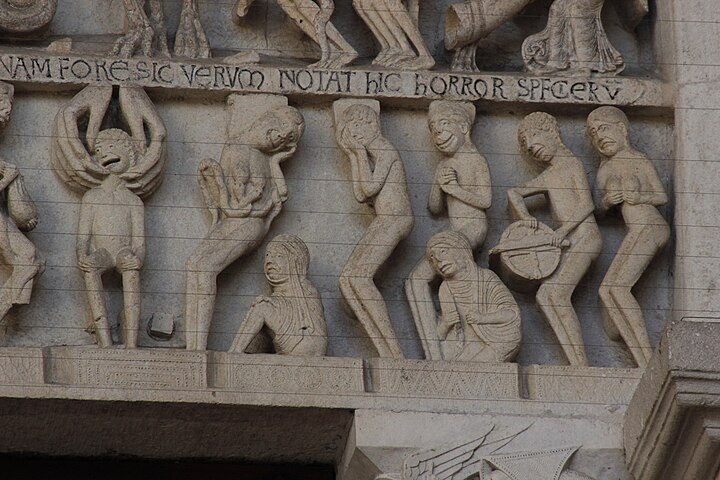
Detail from tympanum depicting the Last Judgment from the Saint-Lazare Cathedral, Autun, France. c. 1120-1145. Courtesy Alberti’s Window

What were our ancestors doing?

The Greeks adored the nude male body, which represented heroism, virtue, athleticism, and divine beauty. But nude images of women were far less common, and limited to goddesses, prostitutes, and scenes of violence or suffering. Respectable Greek matrons simply didn’t wander around naked.

Ancient Rome shamelessly aped Greek art and attitudes. However, nudity in Roman art also represented an artistic confrontation with the new religion of Christianity.

As Christianity made inroads into the old religions of Rome, the old forms of Greco-Roman art began to be seen as sinful. The only safe expression of nudes in art were the ancient myths of gods and goddesses.

By the Middle Ages, Christianity was the dominant factor in western art. While casual nudity was avoided, there were exceptions. In Judeo-Christian tradition, Adam and Eve were happily naked until they ate of the fruit of the knowledge of good and evil. Then, they were ashamed. They could be painted nude as a cautionary tale. The infant Jesus could be painted nude because he was innocent of sin.

There were also naked depictions of the Last Judgment and martyrdoms of the saints, and the occasional symbolic nudes in Byzantine art and illuminated manuscripts.

The Renaissance meant a revival of Greco-Roman artistic ideals, which in turn led to an interest in mastering the human form. Artists like Michelangelo, Leonardo da Vinci, Titian, and Sondro Botticelli sought to tie anatomical accuracy with spiritual or allegorical meaning. These artists struck a balance between the spiritual and temporal realms.
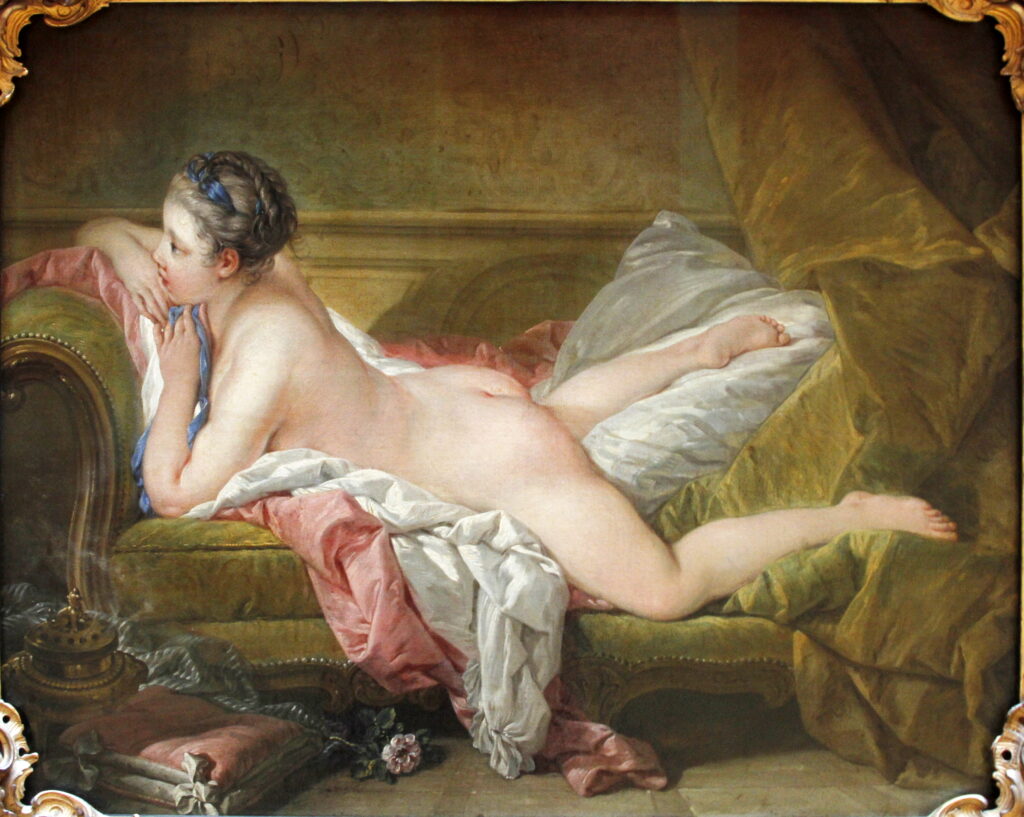
The Blonde Odalisque, François Boucher, 1753, courtesy Alte Pinakothek

By the 17th century, however, Baroque artists like Peter Paul Rubens and Caravaggio had tipped the scales to the fleshly, fleshy world. Rococo painters like Jean-Honoré Fragonard and François Boucher turned toward voluptuous eroticism and fantasy.

But all pendulums swing, and once again, in the late 18th and early 19th century, artists like Jacques-Louis David and Jean-Auguste-Dominique Ingres returned to heroic, idealized forms, often referencing mythology. Romantic artists like Jean-Louis André Théodore Géricault and Eugène Delacroix used nudity to express emotion, suffering, and passion.
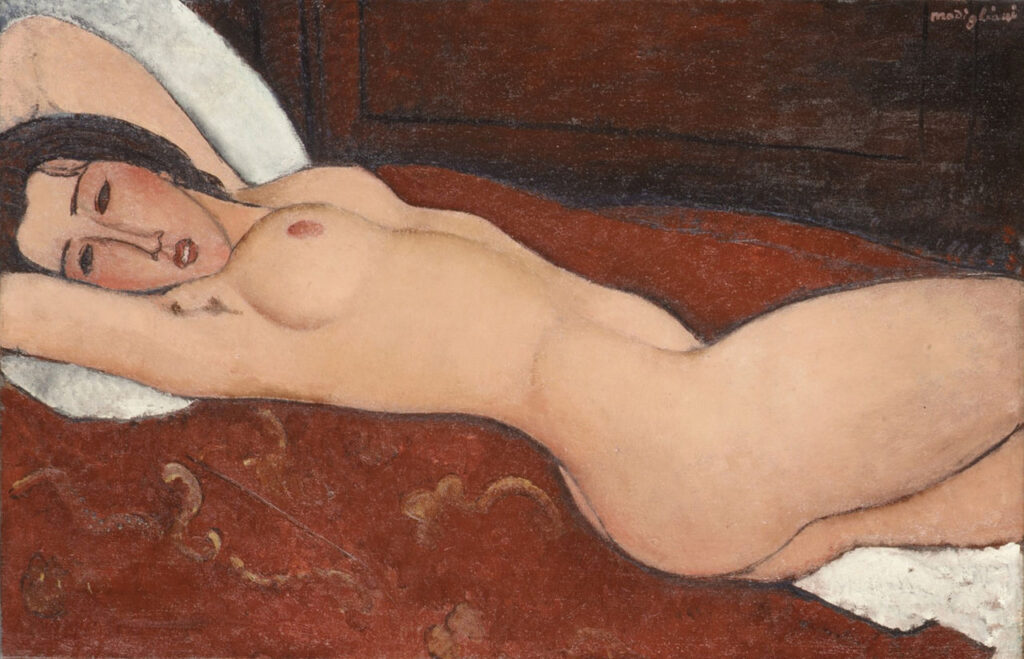
Reclining Nude, 1917, Amedeo Modigliani, courtesy Metropolitan Museum of Art

Our modern life

French Realists and Impressionists like Gustave Courbet, Édouard Manet, and Edgar Degas began to openly portray the nude provocatively. Courbet, in particular, was scandalous; in fact, he still shocks me.

Modernists like Pablo Picasso, Henri Matisse and Amedeo Modigliani deconstructed and dehumanized the nude. As the 20th century wore on, the nude became the battleground of both personal expression and sociopolitical challenge. That continues today, as the human form remains the locus for challenging gender norms, arguing politics, and discussing body image. That’s a lot of baggage for the poor old human body to carry.

Registration is now open for workshops in 2026! Reserve your spot:

Can’t commit to a full workshop? Work online at your own pace:
Seven Protocols for Successful Oil Painters

Monday Morning Art School: how does aerial perspective work?

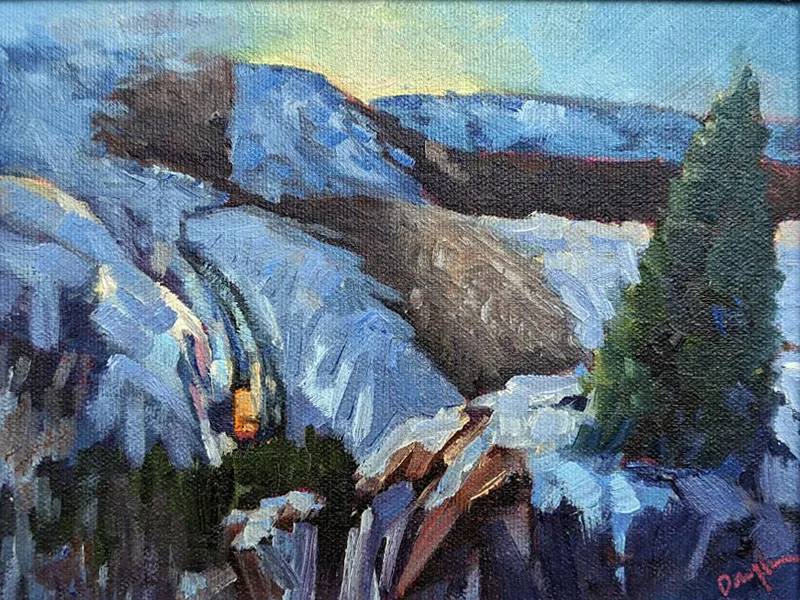
Sunset over Cadillac Mountain, oil on archival canvasboard, $869 includes shipping and handling.

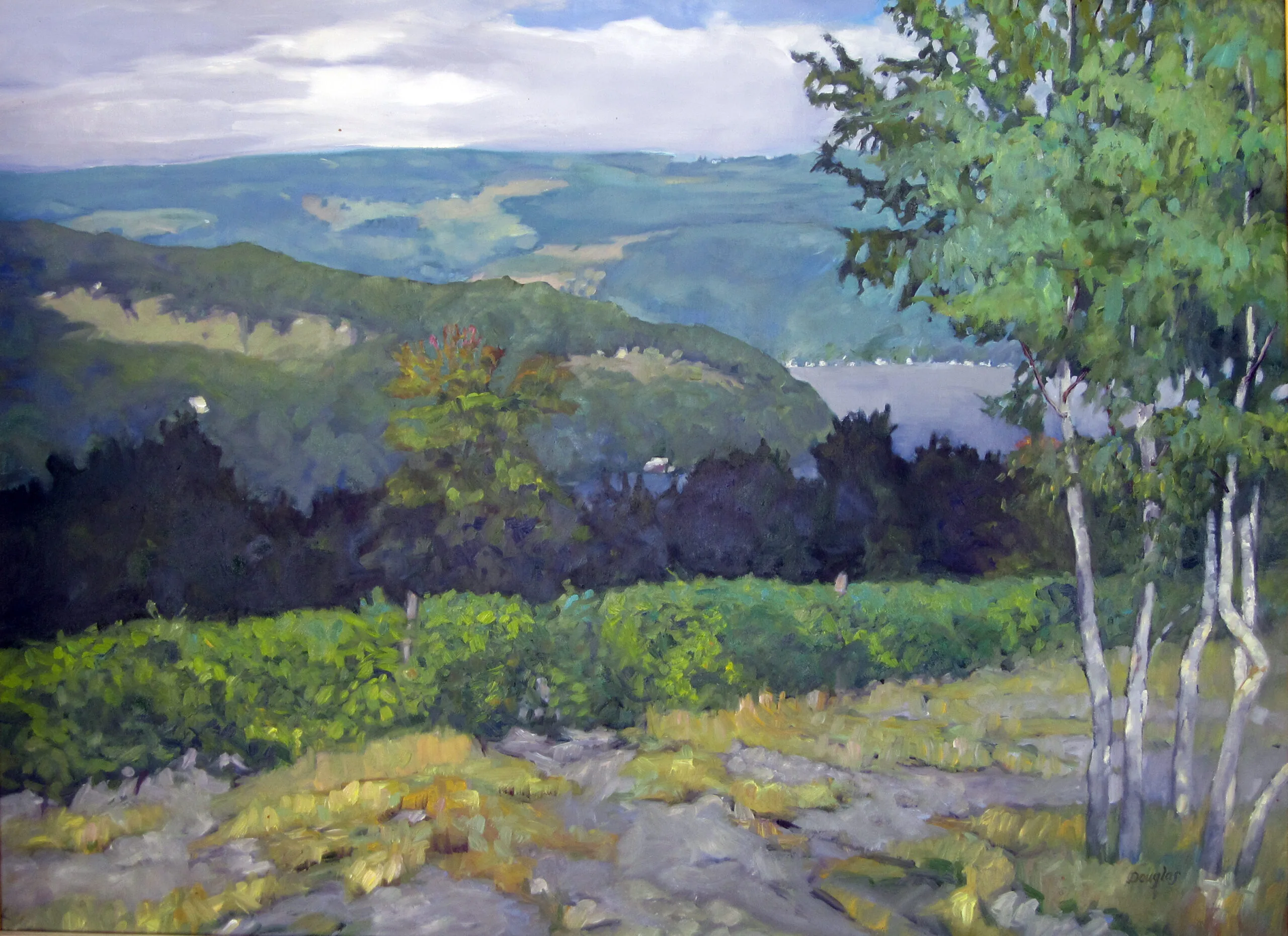
There are two kinds of perspective that artists use to create depth in paintings: aerial (or atmospheric) and linear. Linear perspective uses converging lines, accurate spatial relationships, size, and placement of objects to show things getting smaller as they recede into the distance. Aerial perspective creates the illusion of depth by simulating the effect of the atmosphere on objects seen at a distance.

The Vineyard, oil on linen, 30X40, $5072 framed, includes shipping and handling in continental US.

What creates aerial perspective?

Aerial perspective is caused by the scattering of light by particles in the atmosphere. As the distance between the viewer and an object increases, more air (and thus more particles like dust, water vapor, and pollution) lies between us and the subject.

Particle size affects how light is scattered. Fine particles, like oxygen and nitrogen molecules, cause the scattering that creates our blue skies and red sunsets. Mid-size particles, like dust, cause haziness, glare and that delicious golden light of afternoon. Big particles like water droplets, give us rainbows.

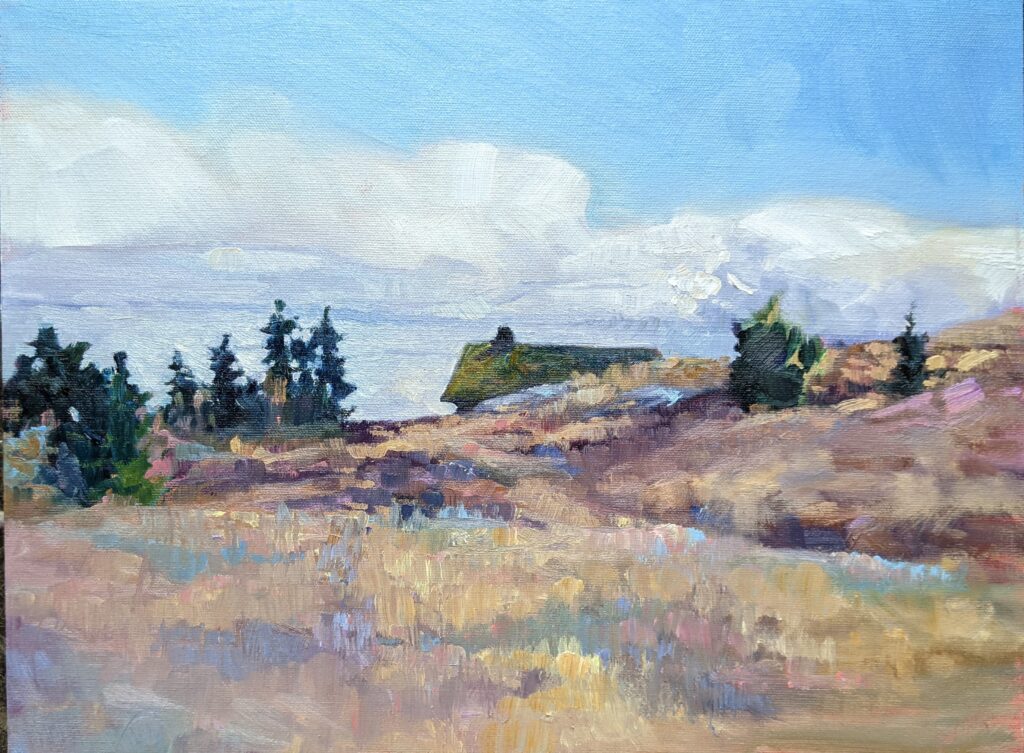
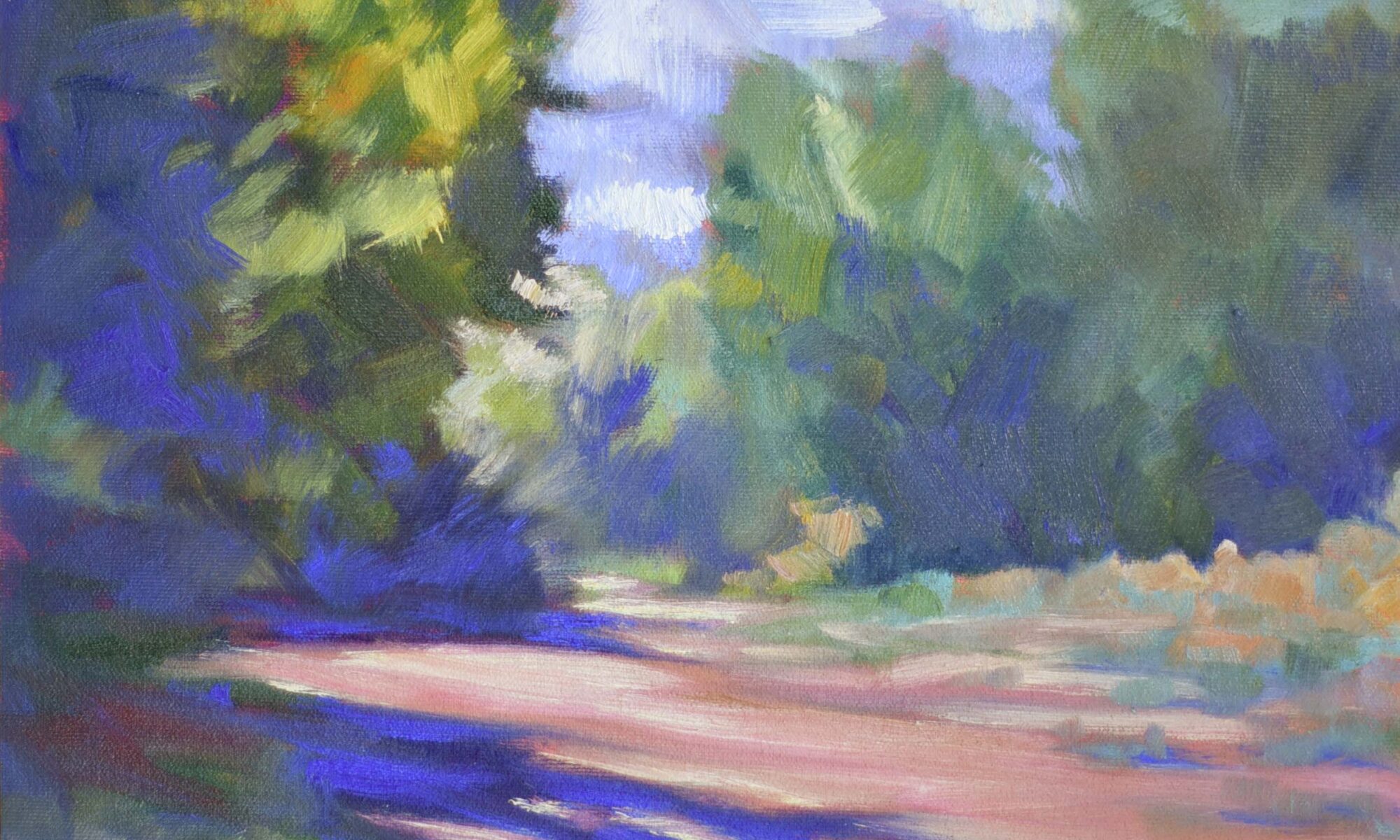
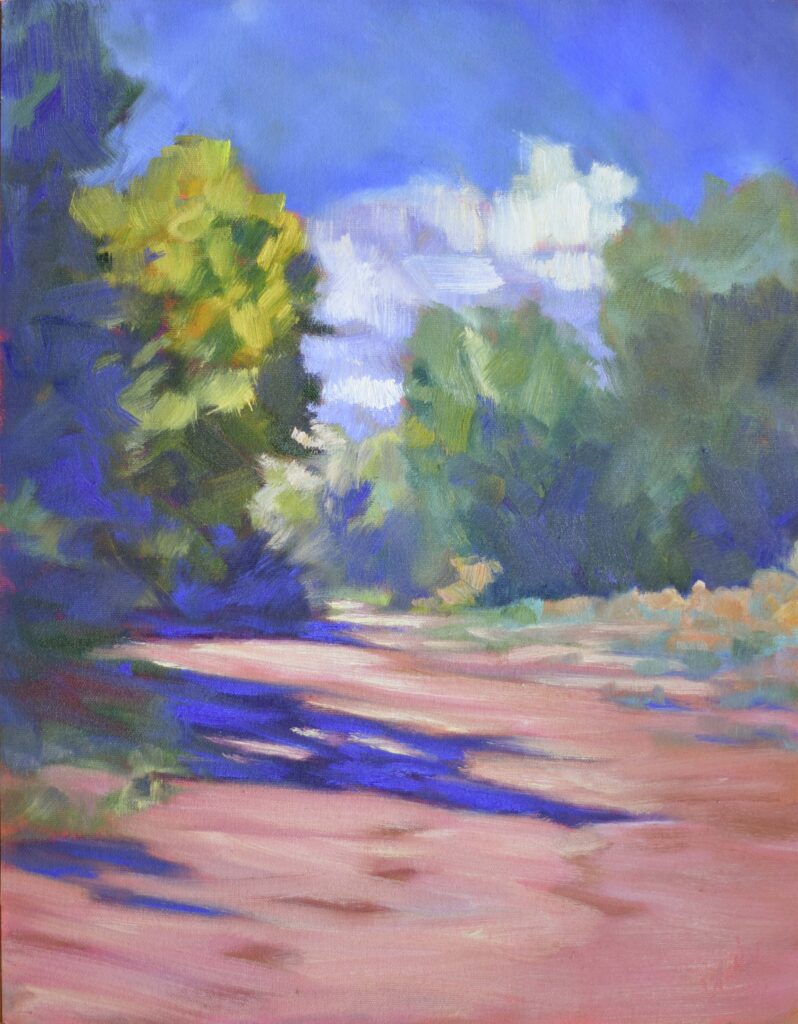
Country Path, 14X18, oil on archival canvasboard, $1,275 includes shipping and handling in continental US.

The unbreakable laws of aerial perspective

  1. Distant objects appear less contrasty because atmospheric scattering softens edges and reduces the difference between highlights and shadows. Conversely, nearby objects have sharper, crisper shadows and details.
  2. As we go back in space, the first color to fall out is red, followed by yellow, with finally blue or blue-violet remaining. (In some circumstances, the distant horizon might be grey rather than blue.) That’s because the shorter the wavelength, the more efficiently the light is scattered. That means that warm-colored objects must be desaturated the farther back they are in your picture. When in doubt, hold something neutral up to the far object and check just how ‘warm’ it really is.
  3. Overall, distant objects are generally less saturated than close objects, again, because of the scattering of light. However, there are times when distant mountains appear to thrum with an intense blue-violet light. Whether that’s rationally true or not, painting that feeling is more important than painting reality.
  4. We don’t see fine detail at long distances not because our eyes are weak, but because the scattering of light makes the image blurry. So much for my dream of someday having bionic eyes.
  5. Certain weather conditions increase aerial perspective. Fog, humidity, dust, and pollution increase the scattering of light, making distant objects look even hazier.
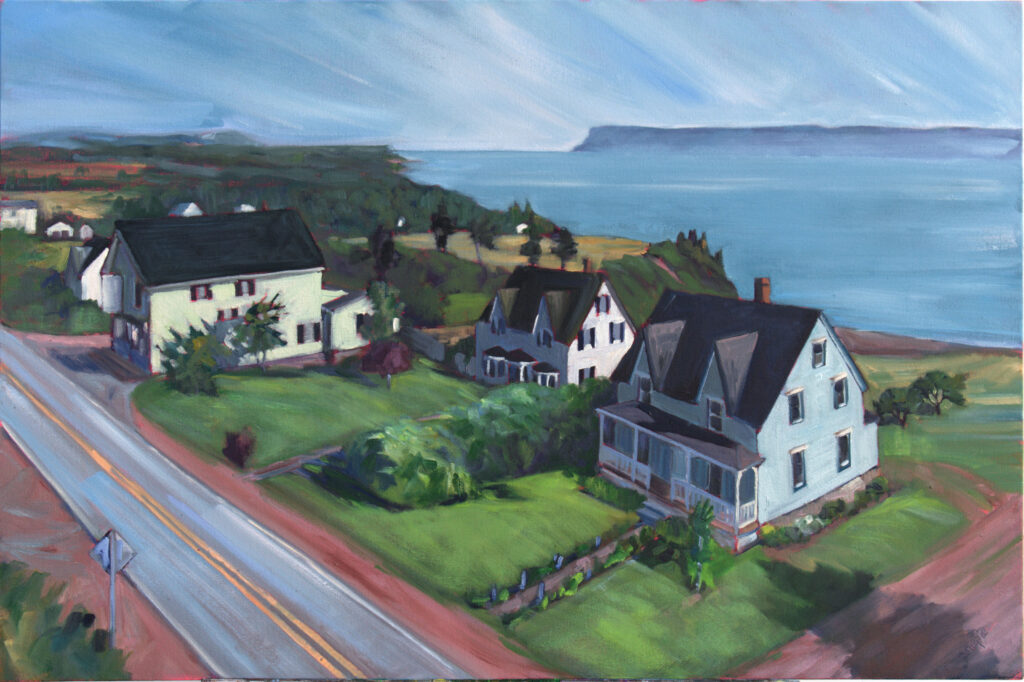
Midsummer along the Bay of Fundy, 24×36, available.

Things that aerial perspective can’t or won’t do

Aerial perspective does not mean that faraway objects are always lighter. The lightness or darkness of any passage depends on the local color and on where the sun is shining at that moment. There are many situations where the foreground is lighter than the background.

Aerial perspective isn’t just about dabbing blue hues on the mountains; it’s about carefully marking out a gradual falling off of reds and yellows, and observing shifts in detail and saturation.

You don’t get out of learning linear perspective just because you understand aerial perspective; the two work together to create a sense of depth. “But there’s no architecture in my painting, Carol,” you say. However, rocks, trees, fields, roads, clouds, and everything else in nature also obey the rules of linear perspective, so perhaps you should take one of my classes or workshops and really learn it.

Registration is now open for workshops in 2026! Reserve your spot:

Can’t commit to a full workshop? Work online at your own pace:
Seven Protocols for Successful Oil Painters

I should have named this art show ‘Sentimental Journey’

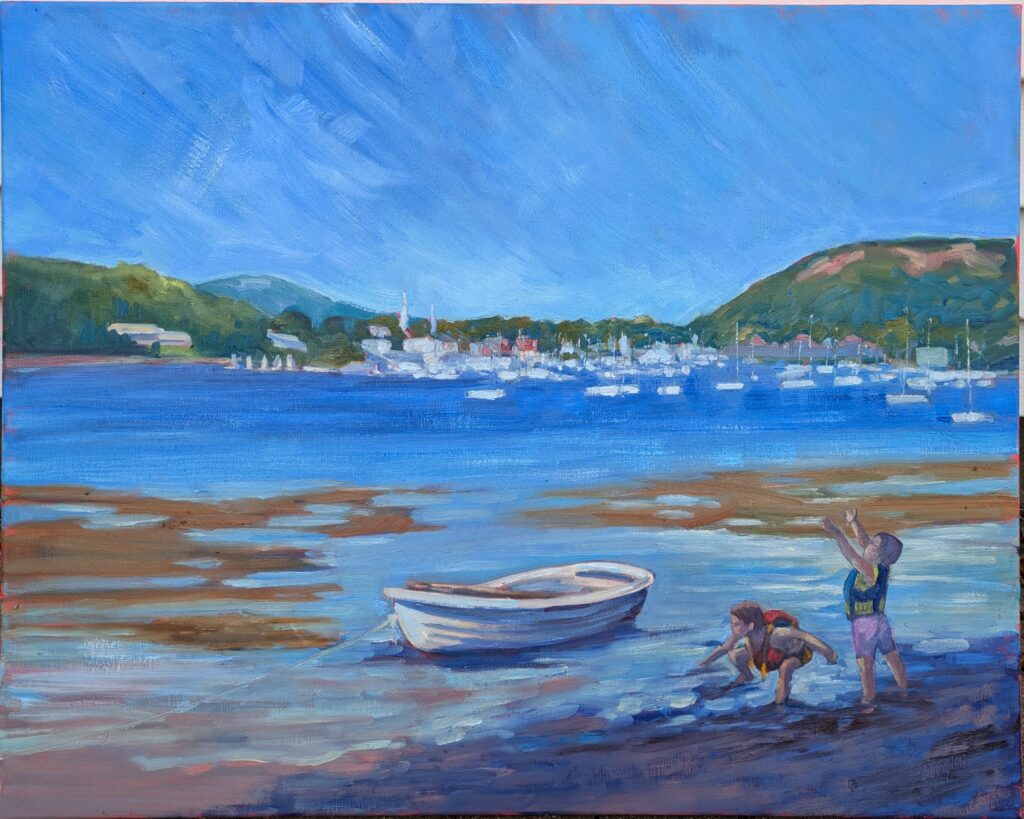
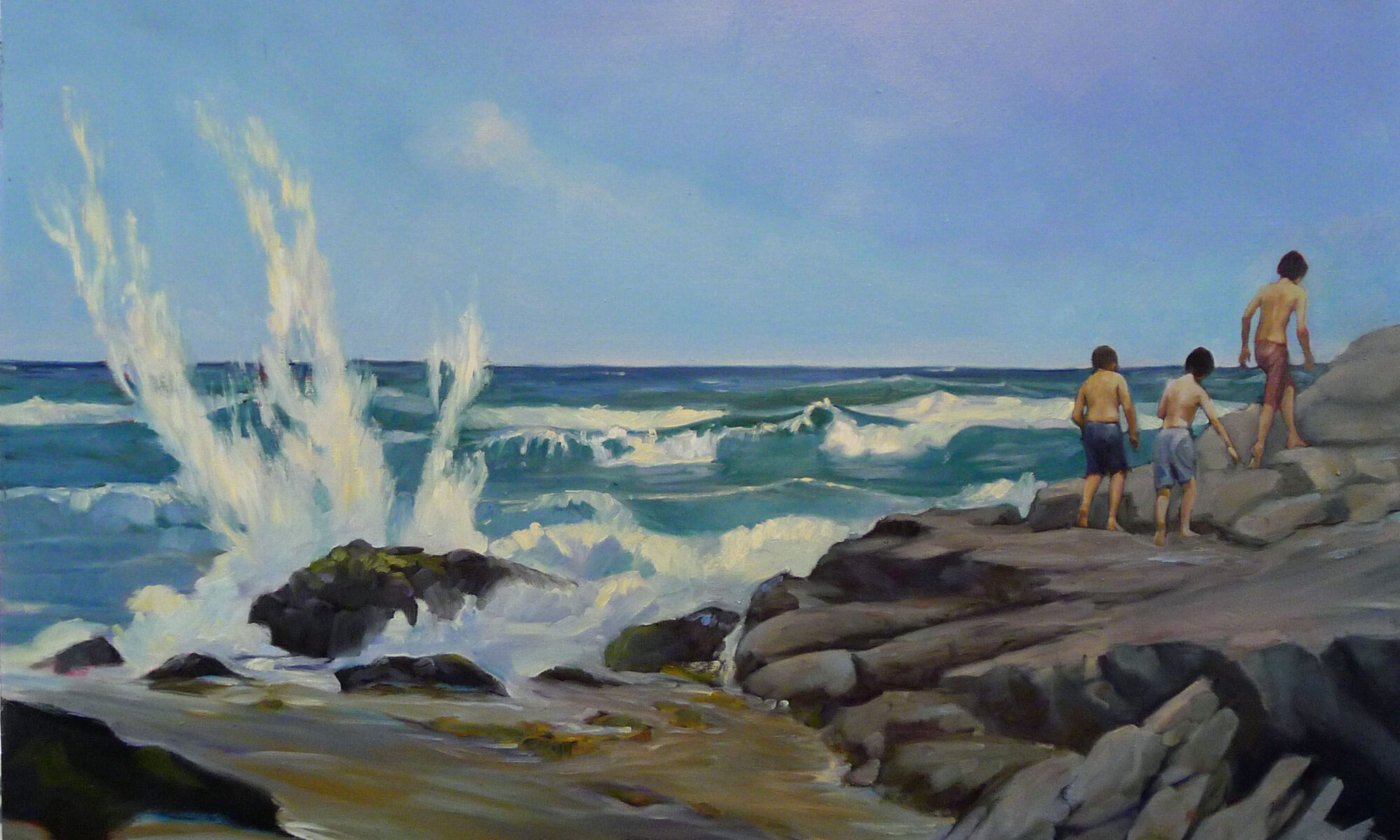
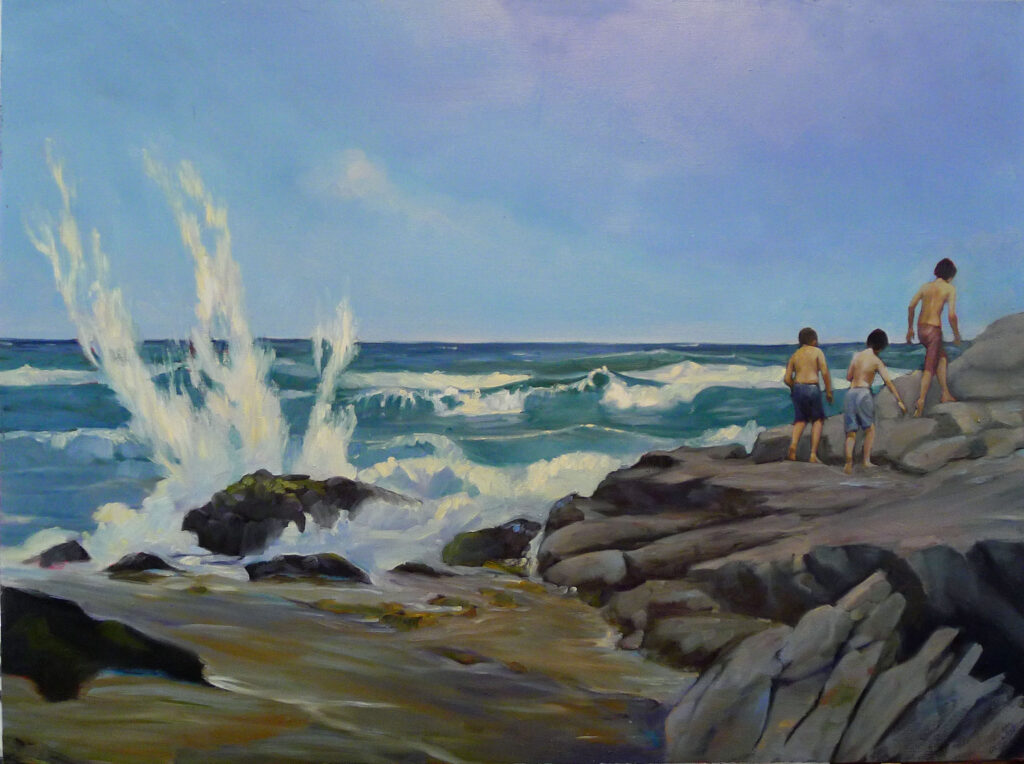
Waves of Mercy and Grace, 30X40, oil on linen, in a simple black wood frame, shipping and handling included in continental US, $6,231.00

My cousin Antony lives in Australia. The last time we saw each other was in 2008, when his boys were mere striplings. That’s a long flight, so you don’t just go for a week. I got to spend a lot of time with Oscar and Gus and their best bud Tim, including hours at the beach. They scampered up rocks like mountain goats and flopped into the water like seals. I painted a study of them, and then this larger painting from that study.  At the time, I was interested in the subject for aesthetic and symbolic purposes. Today, it reminds me of all the sweet days I’ve spent at the beach with kids. It’s the centerpiece of Letters from Home, which opens tomorrow at 4 PM.

Intimate storytelling

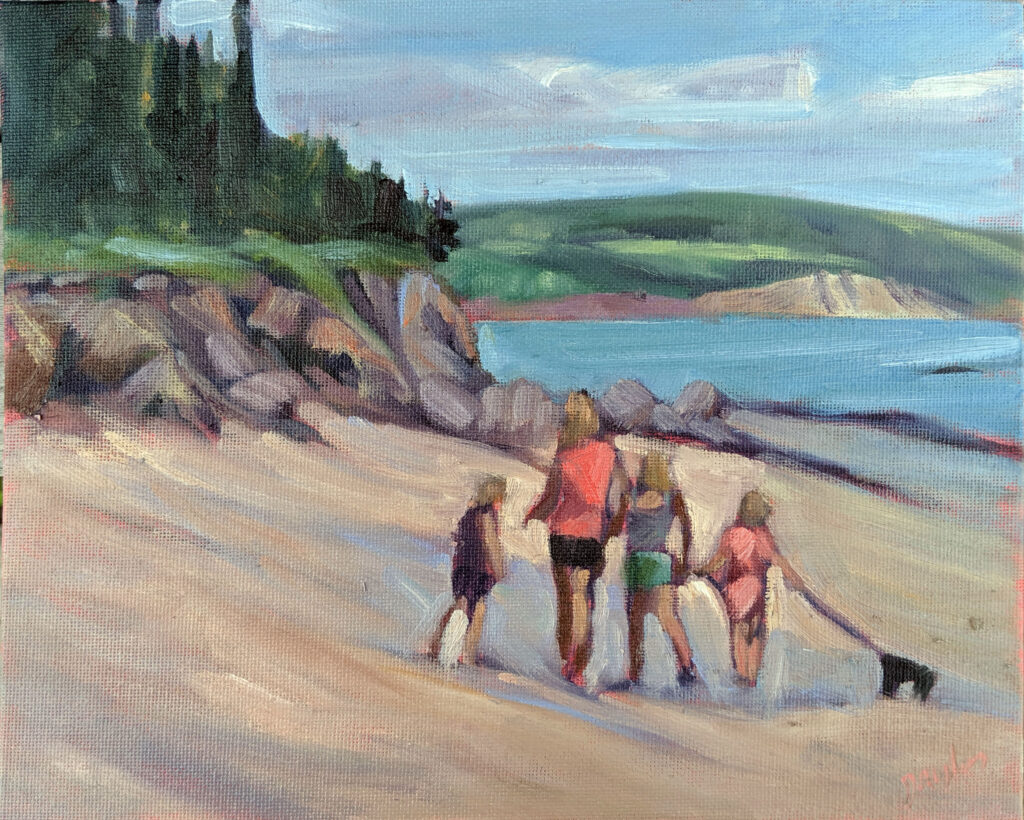
The new puppy, oil on archival canvasboard, 8X10, framed, $652 includes shipping and handling in continental United States.

I picked out paintings for this show based on their nostalgic appeal, as if they were letters from our universal ‘home’. When I put them all together, I realized there was some intimate storytelling involved. Take, for example, this little painting of a family walking their puppy on the beach. If you’ve ever had a puppy, you know you don’t walk it so much as coax it along. It’s a universal experience that every dog-lover knows, and the details don’t need to be spelled out.

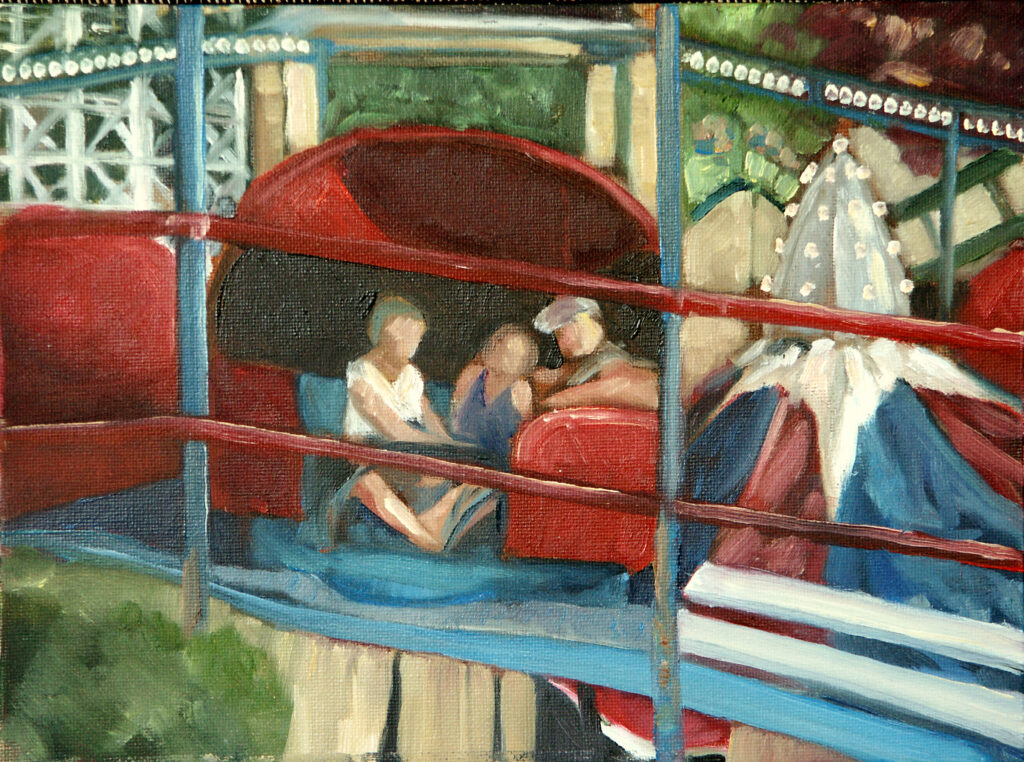
When my twins turned sixteen, their greatest ambition was to work at Seabreeze Amusement Park. Of course, only Laura got a job there; Julia got the consolation prize of working at a nearby big box store. What Laura quickly learned was that running the kiddie rides is hot, thirsty, dull work. As soon as she could, she too got a job at the same big box store.

Tilt-A-Whirl, oil on archival canvasboard, $869 framed includes shipping and handling in continental US.

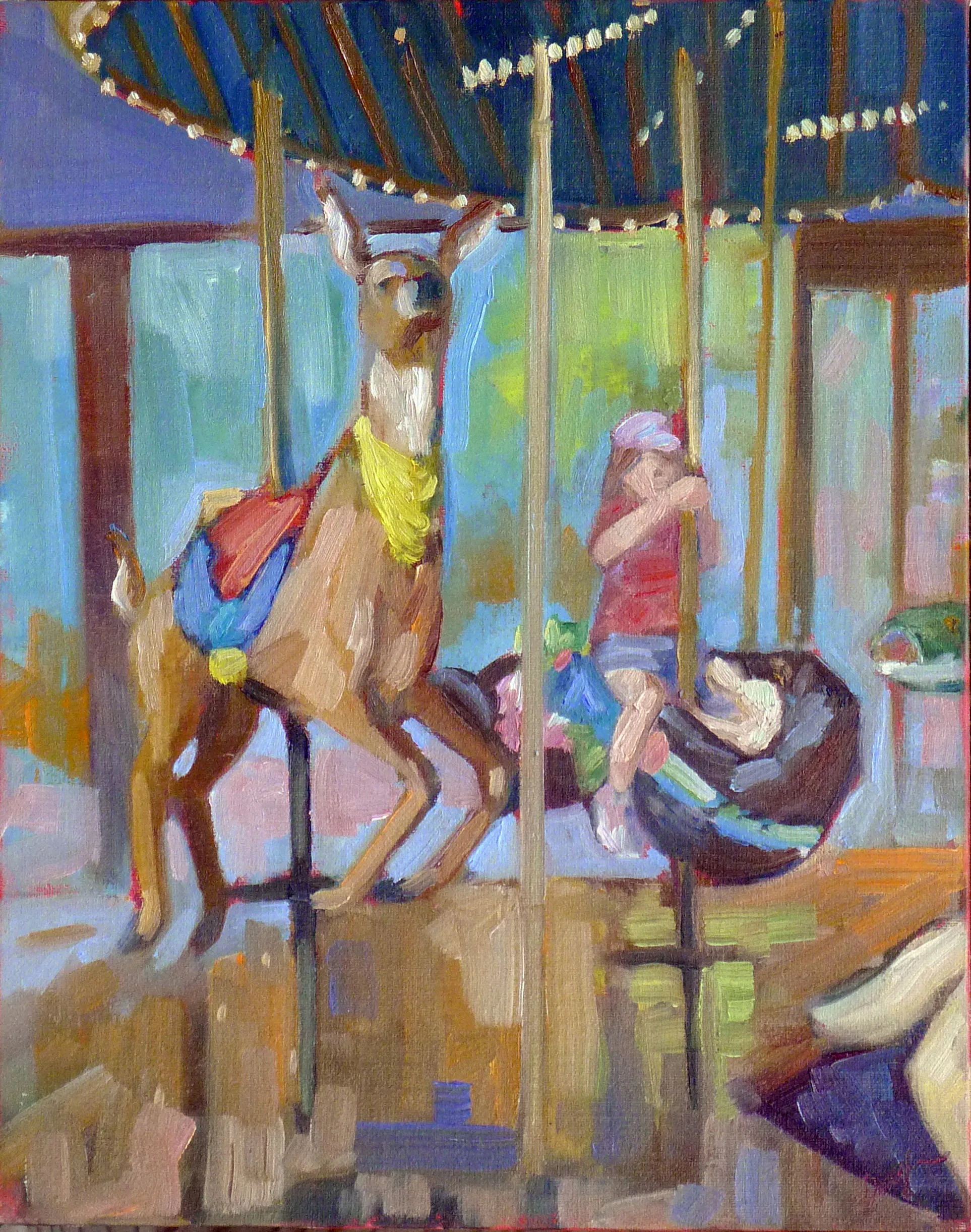
But none of us ever stopped loving the Tilt-a-Whirl. I painted it live, en plein air, just as I painted the carousel at Saranac Lake. It’s just a trick.

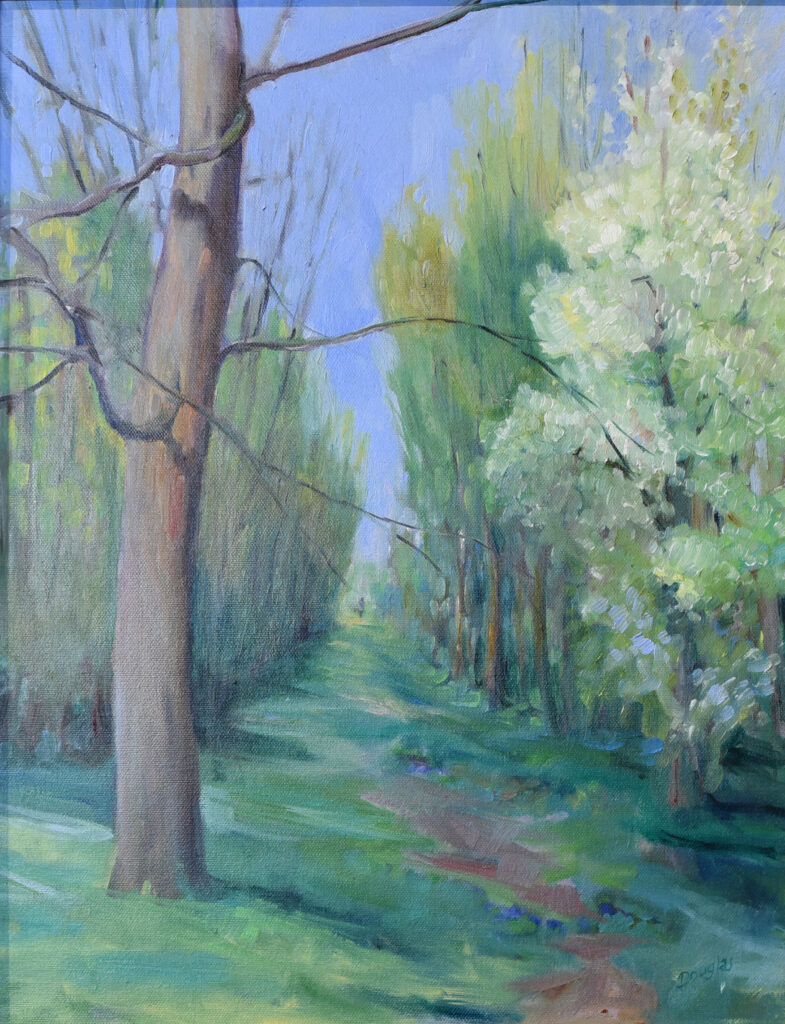
Spring Allee, oil on archival canvasboard, 14X18, $1594.00 framed includes shipping and handling in continental US.

Spring allee runs off the Erie Canal just east of Gasport, NY. It’s just a footpath running through scrub, but my friend Bill and I used it as a long cut when trail-riding some 50 years ago. Our horses are long gone, but I bet I can still pick out the trailhead.

Sometimes the story is less direct

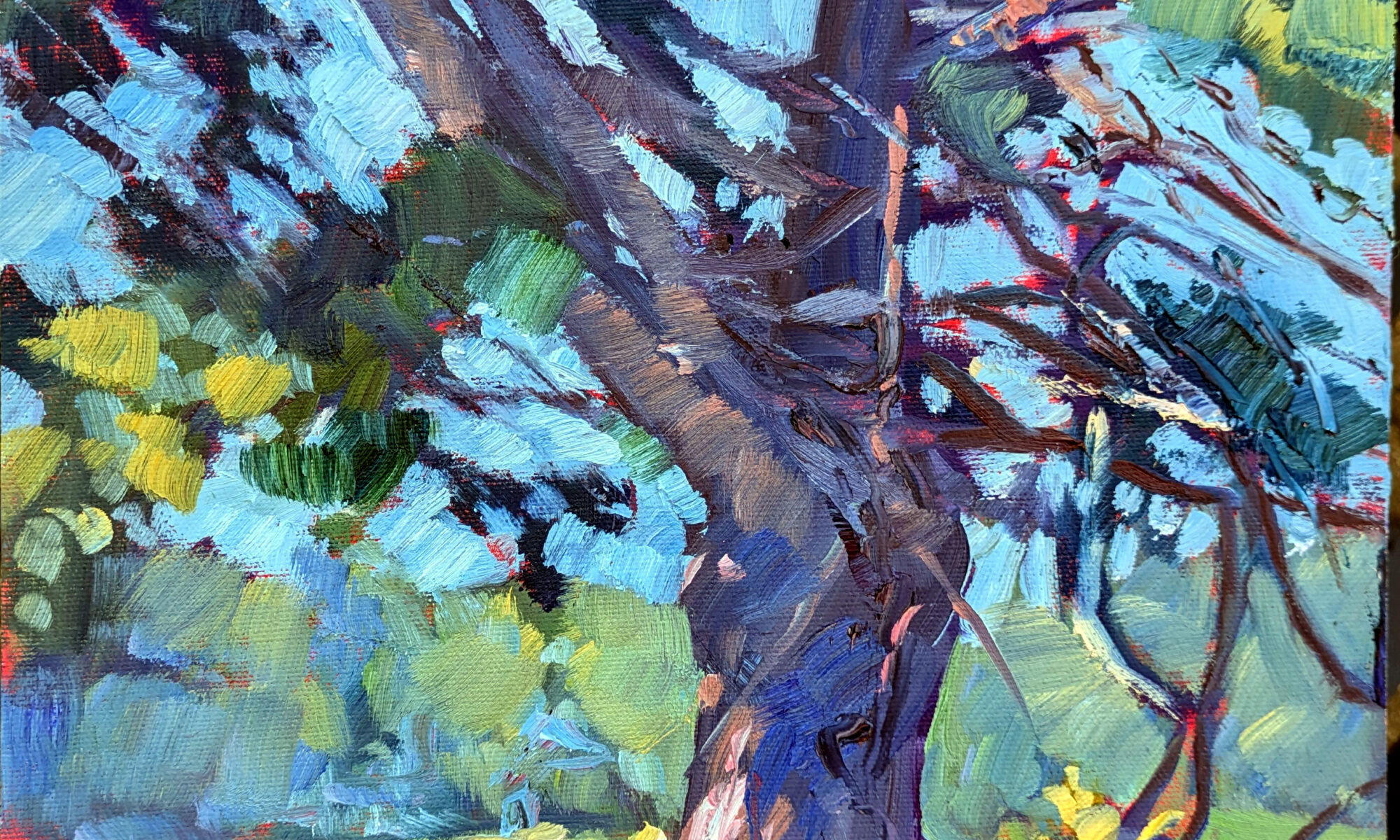
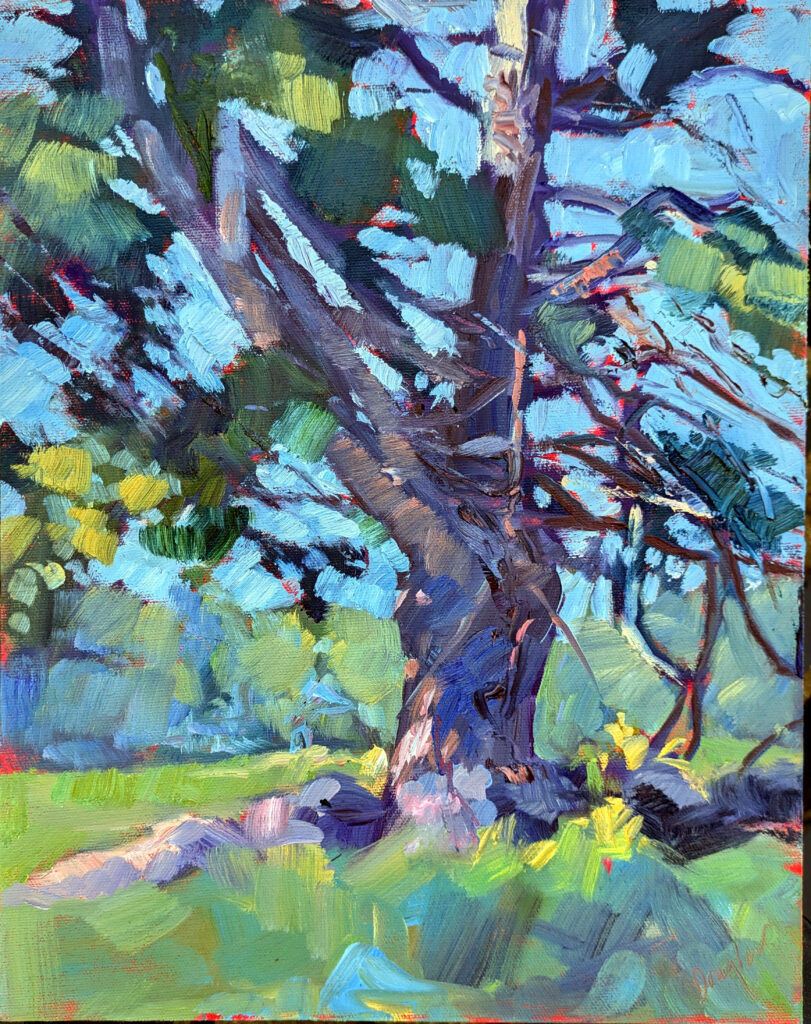
There’s a painting of a black walnut leaning against a stone wall in this show. It’s certainly representative of New England. For me, it’s also a memory of using Jonathan McPhillips as a windbreak in gale-force winds.

The Late Bus, oil on archival canvasboard, 6X8, $435.00 framed, includes shipping and handling in continental US.

Sometimes intimate storytelling isn’t based on a real place as much as an idea. The Late Bus is about going home after school from swim practice. My kids went to a suburban school and were walkers, so when my son had swim practice, I waited for him along a busy street. But I swam for a rural high school, and the chlorine, the frozen hair, and general feeling was just the same. This was just my way of capturing that feeling.

Opening Saturday, May 31, 4-7 PM
Carol L. Douglas Studio/Richards Hill Gallery,
394 Commercial Street, Rockport, ME, 04856
May 30-June 26, 2025
Tuesday-Sunday, Noon-5 PM

An important PS

Julie Hunt is my student from Alberta, Canada. She is in an online show called Crops Diversity Canada. The work is stunning, but only up until the end of this month, so take a few moments to browse it now!

Registration is now open for workshops in 2026! Reserve your spot:

Can’t commit to a full workshop? Work online at your own pace:
Seven Protocols for Successful Oil Painters

Getting ready for my art gallery opening

Opening Saturday, May 31, 4-7 PM
Carol L. Douglas Studio/Richards Hill Gallery,
394 Commercial Street, Rockport, ME, 04856
May 30-June 26, 2025
Tuesday-Sunday, Noon-5 PM

Early Spring on Beech Hill, oil on canvasboard, Carol L. Douglas, 12X16, $1449 framed includes shipping in continental US.

One of the sharpest women I’ve ever known is Lois Giess, former President of the Rochester (NY) City Council. She once told me, “All action is change, even inaction.” We were talking about an expansion project that ultimately failed. Indeed, that moment proved to be the organization’s high-water mark.

I think that’s true of both our everyday and artistic lives, which is why I’ve been harping about calling and meaning so much the past few weeks. I haven’t made any kind of fuss about it in my blog, but I’ve been ill since I got home from Malta on April 20—first with COVID and then with an asthma backlash. It’s taken until last week to get my medications straightened out so that I feel well enough to work a long day. I was overjoyed to realize I was right back into my usual optimism and energy as soon as they were fixed, and I’m deep in preparation for my art gallery opening.

Drying Sails, 9X12, oil on canvasboard, $869 framed.

What’s changing?

I just built the gallery last year, so there’s little that needs repair (although I did find a spot of rust on the door, darn it). However, we’ve changed the supports for the awnings, gotten new display cabinets and beefed up our security. The old security system was mainly my dog, who barks anytime a car pulls into the driveway. However, sometimes they’re just turning around, and he’s not great at telling me that. Now I can see them on my phone.

My husband worried that the old awning supports were so low someone might back over them. I thought they were hideously ugly. I’m completely full of myself about our solution, which involves a five-gallon bucket of concrete set inside a very pretty ceramic planter, with viney things set to climb up the poles.  

I started feeling better at the same time as the rainy season broke. That was great because you can’t really do that kind of work in cold rain. While I’ve had all the parts (and artwork) ready, I am just getting things installed this week. That’s rather pushing the limit for my art gallery opening this Saturday.

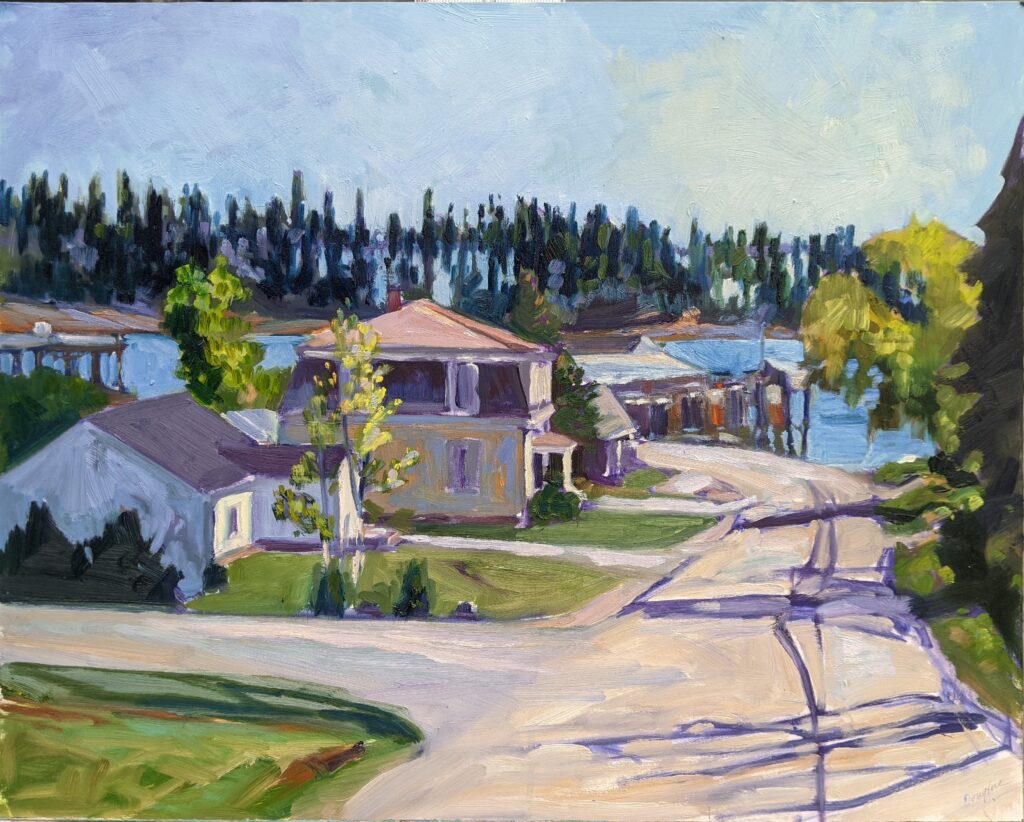
Main Street, Owl’s Head, oil on archival canvasboard, $1623 includes shipping and handling in continental US.

The things artists do instead of painting

My friend Björn Runquist has been counting the days of rain in May; at last report we were up to 47. As you can imagine, the overgrowth of weeds has been tremendous (as have the mosquitoes). That meant I had to divert some energies into weeding the foundation plantings. I have just enough hausfrau in me to believe that visitors would be so appalled by the weeds, they’d turn on their heels and walk out.

I was a dedicated gardener until plein air got in the way. I’d forgotten how much I enjoy the meditative quality of pulling weeds.

Best Buds, 11X14, oil on canvasboard, $1087 framed includes shipping and handling in continental US.

And a reminder about this art gallery opening

Letters from Home opens on Saturday, May 31 from 4-7 PM, at 394 Commercial Street, Rockport, ME. As my Uncle Frank says, be there or be square.

Registration is now open for workshops in 2026! Reserve your spot:

Can’t commit to a full workshop? Work online at your own pace:
Seven Protocols for Successful Oil Painters

Monday Morning Art School: why do you make art?

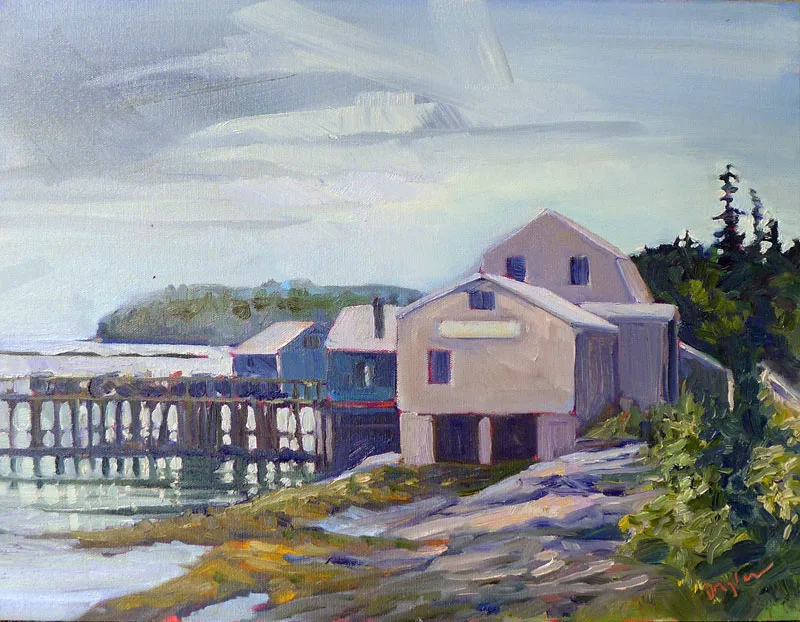
Camden Harbor from Curtis Island, oil on canvas, $2782 unframed includes shipping and handling in continental United States.

On Friday, I promised I’d write about calling in art, but it’s not an easy subject. Narrowing down your calling is a deeply personal process. Still, there are discrete steps you can take to bring clarity. Think of the process as a blend of introspection, experimentation, and alignment with your values and natural inclinations.

Why do you make art?

When I’m feeling glib, I say I’m an artist because I can’t do anything else. It would be more practical to ask:

  • What subjects or themes keep coming back in my work?
  • What emotions do I try to convey or experience through art?
  • What subjects energize me the most?

Tracking the answers to these questions will help you figure out why you make art, which in turn will help you understand your calling. It’s rare that I suggest doing this in writing, but for this exercise I think it is helpful.

Mature Eastern White Pine, oil on birch, $696 includes shipping and handling in continental United States.

What are your core interests in life and in art?

Looking at your past work:

  • What medium do you gravitate to? Is that shifting over time?
  • How is your style of painting shifting over time?
  • How are your painting topics shifting over time?
  • Do these topics/mediums/topics satisfy you, or do you feel like something is missing?

Take the long view here. You may not see much difference in six months, but if you’ve been painting for decades, you might be shocked at much has changed. I certainly am.

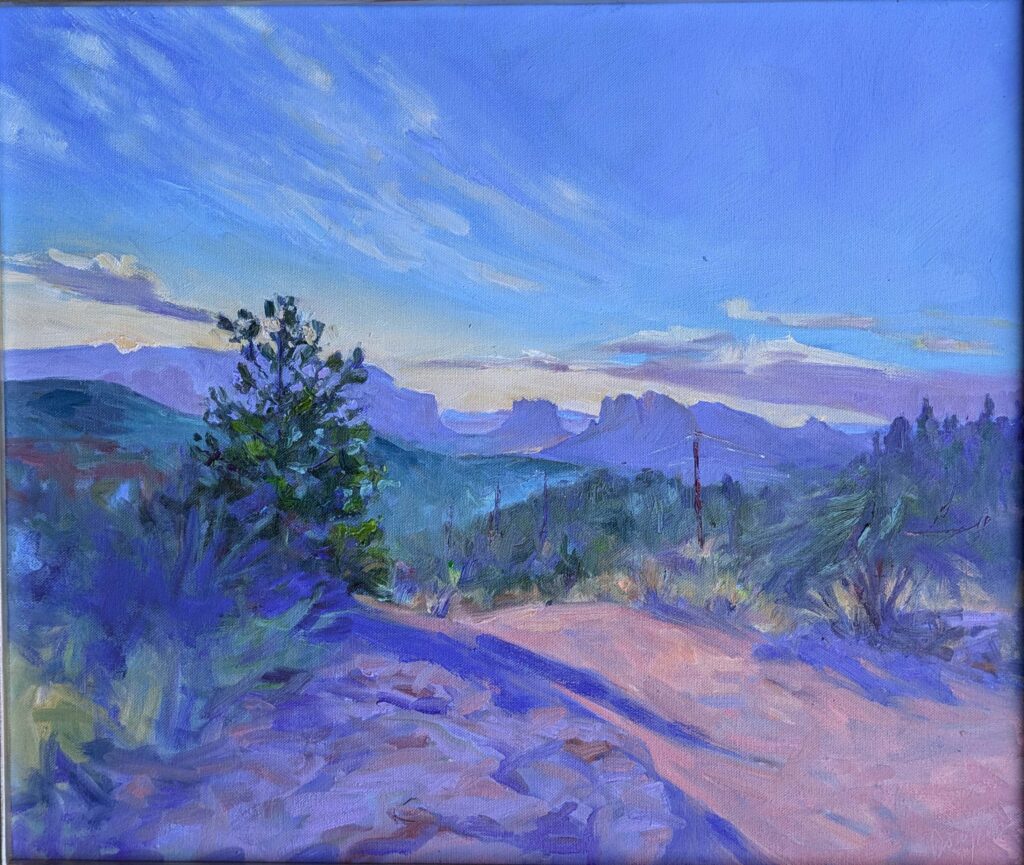
Dawn along Upper Red Rock Loop Road, Sedona, 20X24 oil on canvas, $2318 unframed includes shipping and handling in continental US.

Study your heroes

  • Who are the artists you admire deeply? I’ve listed mine here; who are yours?
  • What are the unifying characteristics of their work? That’s a harder question to answer. I’d say, for my list, there are three virtues: compositional genius, technical virtuosity and emotional truth.
  • What overlaps do you notice between their voice and your instincts? My work is just a pale imitation of these masters, but I’m definitely interested in technique, composition, and meaning.

Your calling should echo what you admire — not to copy, but to understand your own taste and values.

Experiment intentionally

If you’re still exploring, set short projects with specific constraints, like half-hour studies or daily short watercolors. Or, try working in a new medium or tackling a theme outside your comfort zone. Pay careful attention to what feels like a chore vs. what pulls you in and allows you to lose track of time.

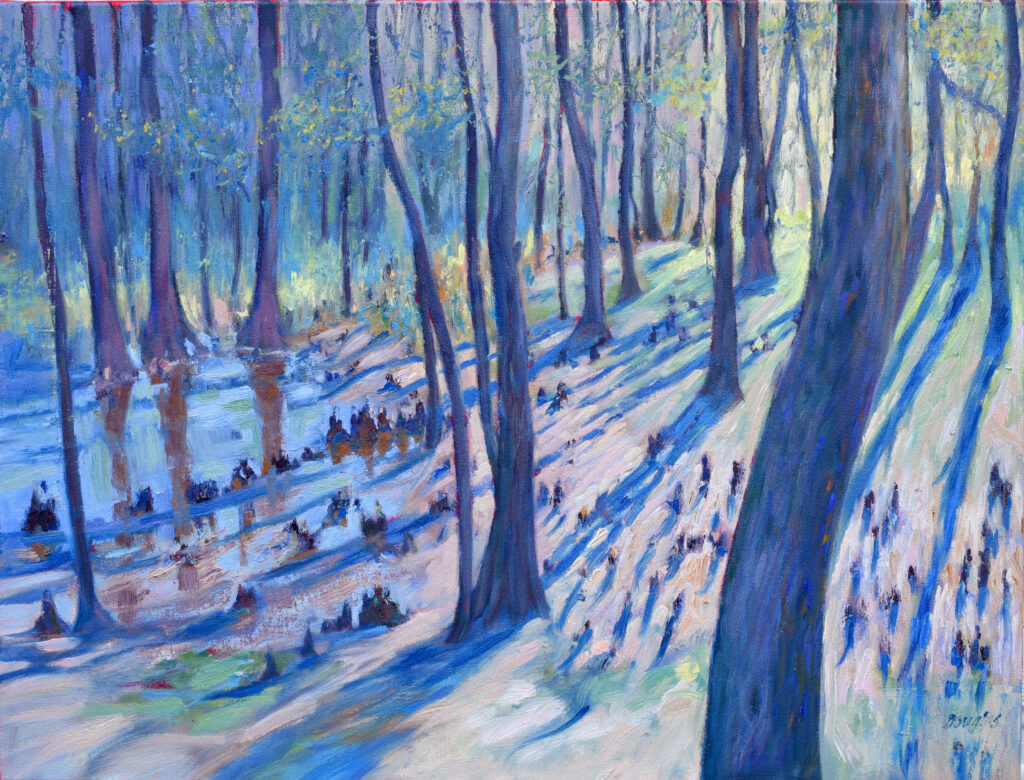
Cypress Swamp in Spring, oil on canvas, $2782 includes shipping and handling in continental US.

Pay attention to what resonates with others

This isn’t about chasing popularity, but rather what sparks strong reactions or conversations. Art is, after all, communication, and if your painting isn’t communicating something, what’s the point?

What do people say your art says to them? Often, others can put words to this more clearly than you can. (If nothing else, this can spark ideas for your artist’s statement.)

Where does skill meet meaning?

  • What kind of art would you make even if no one saw it? (For me, the answer is none; I think art is all about communication.)
  • What kind of art do you want to master technically?
  • What kind of art do you feel compelled to make because it matters?

Your calling lies at the intersection of joy, skill, and purpose.

For heaven’s sake, don’t rush

Your calling is not a niche; it’s a general direction.  We don’t find it like Where’s Waldo. We grow into it by staying curious and constantly resetting our compass.

Registration is now open for workshops in 2026! Reserve your spot:

Can’t commit to a full workshop? Work online at your own pace:
Seven Protocols for Successful Oil Painters

The death of an artist you’ve probably never heard of

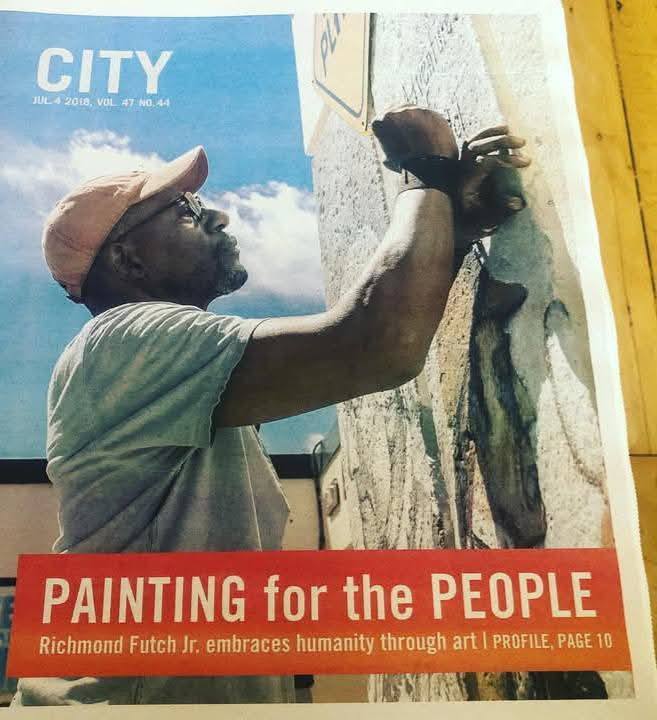
Courtesy Positively Southwest Rochester

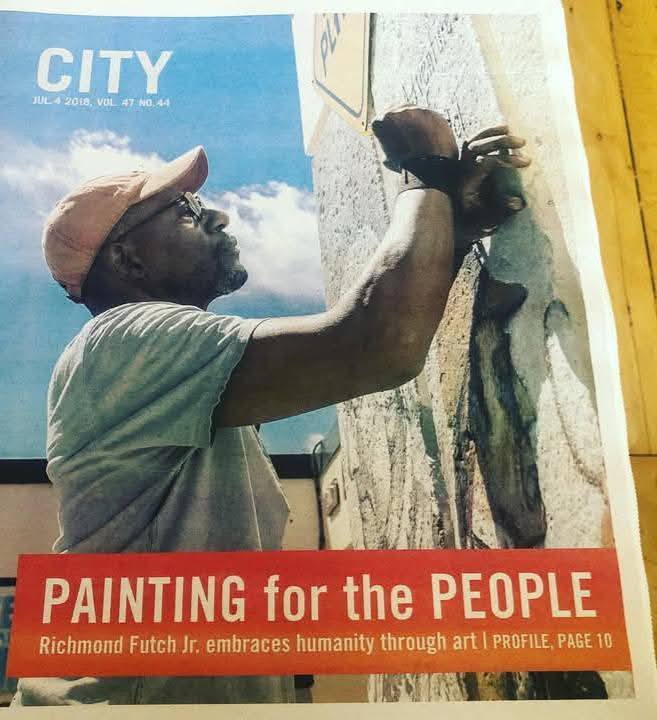
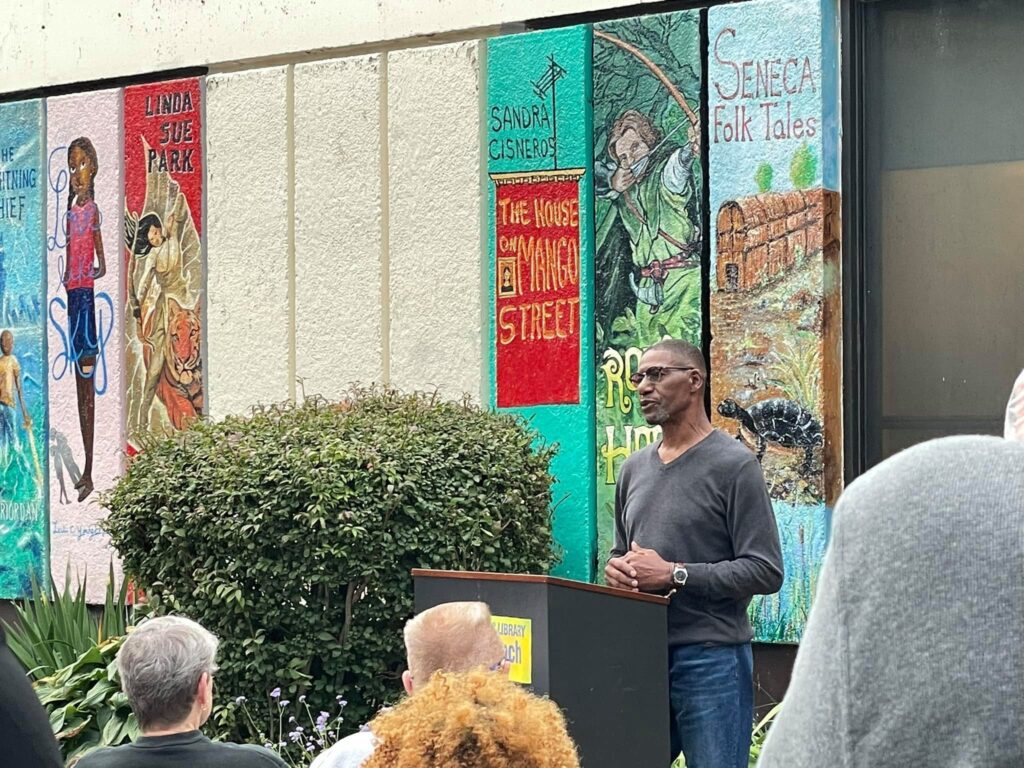
A fellow painter from Rochester passed away earlier this month. You aren’t going to read about him in an influential art journal, although his influence has been far greater than many of the windbags who are regularly profiled in the press. He was a modest man who used art for good in some of Rochester’s least-salubrious neighborhoods. When I die, if I can say I used art to do half the good work he has done, I will die content.

I met Richmond Futch, Jr. many years ago, when he curated a solo show for me at the art gallery at Bethel Christian Fellowship. As is often the way, I’ve been thinking about him recently. He was ‘painting in the spirit.’ This is a form of expression where the Holy Spirit works through the artist, often during a church service. “You can do it too,” he told me, but painting in front of a congregation was definitely not my jam.

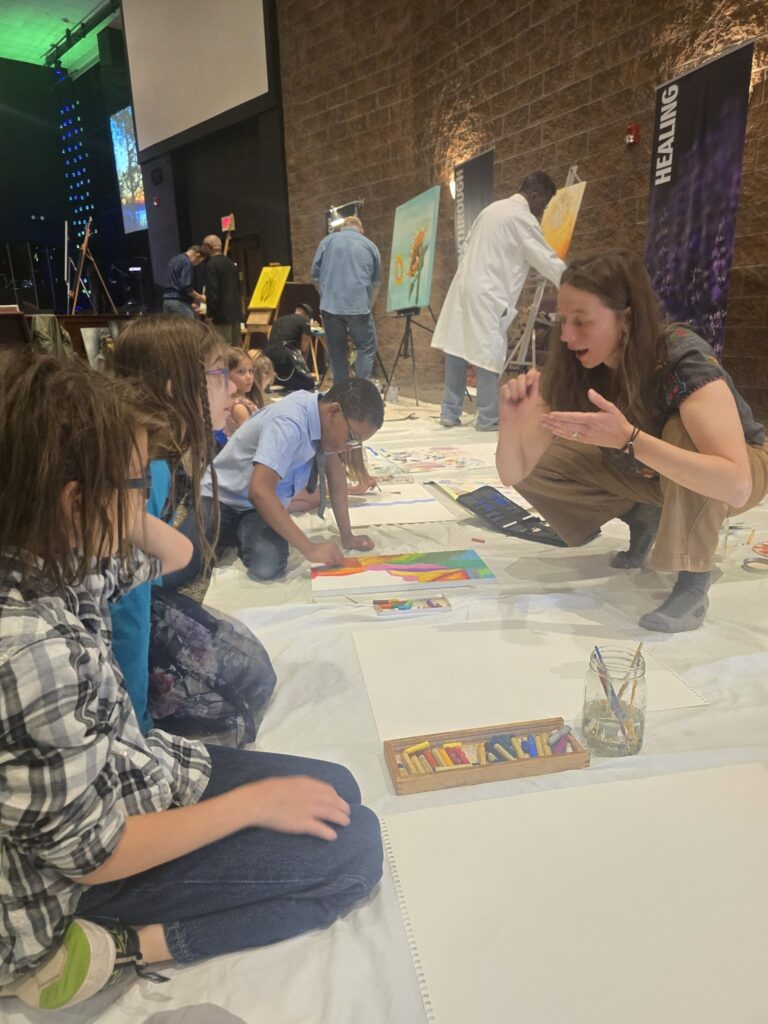
People painting together at Richmond’s memorial service at Bethel Christian Fellowship. Photo courtesy Christina Vail.

However, that got me started drawing in church, a habit I continue to this day. My church drawings are now the core of what I’m thinking about, artwise. Richmond would be the last person to say “I told you so,” but he might be shaking his head at how long it’s taken me to come around to his way of thinking.

Richmond told me about his conversion experience. Deep in the grip of addiction, completely on the skids, he was getting ready to kill himself. “If you don’t have any use for your life, I can use it,” Jesus told him in one of those rarer-than-hen’s-teeth, Saul-on-the-road-to-Damascus experiences. Richmond went on to faithfully serve his community for decades—art for the homeless, art for the community, art for kids in Haiti and, above all, patiently, kindly listening to people who needed hearing.

Richmond in Haiti, photo courtesy Sarah Brownell.

One of his friends, Sarah Brownell, wrote that he was “always thinking about how the people of Rochester could be touched and healed, especially the most vulnerable. You were a true champion of the poor, seeing and sharing their humanity, their goodness, their value and their talent.”

I’ve been talking to my class about the nature of calling in art, and I’ll write about that in practical terms on Monday. But I’ve wriggled around my own calling ever since my buddy Erla Guðrún Arnmundardóttir Beausang collared me last fall on the subject. I’ve had several kicks in the pants since then, and Richmond’s death is one more.

Courtesy Bethel Christian Fellowship

Richmond took his artistic talent to the streets of Rochester and used it not for self-aggrandizement, but to help others. Basically, it’s never a question of whether we can; it’s a question of whether we’re willing.

Registration is now open for workshops in 2026! Reserve your spot:

Can’t commit to a full workshop? Work online at your own pace:
Seven Protocols for Successful Oil Painters

Letters from home

Opening Saturday, May 31, 4-7 PM
Carol L. Douglas Studio/Richards Hill Gallery,
394 Commercial Street, Rockport, ME, 04856
May 30-June 26, 2025
Tuesday-Sunday, Noon-5 PM

Lobster pound, 14X18, oil on canvas, $1594 framed includes shipping and handling within the continental US. This is true nostalgia, since this lobster pound is no longer with us.

Certain places evoke collective nostalgia because they serve as shared universal touchstones. These are places where personal and collective memories intersect. Maine is one of them, which is why I’m calling my first show this season Letters from Home.

Letters from Home opens on Saturday, May 31 from 4-7 PM, at 394 Commercial Street, Rockport, ME. If you don’t stop by for a glass of wine and hors d’oeuvres, I’ll be terribly disappointed. For one thing, I hate leftovers.

Country Path, 14X18, oil on archival canvasboard, $1,275 includes shipping and handling in continental US. This isn’t in Maine, but it’s in the show because country roads and paths are places which inspire that feeling of nostalgia in us.

Collective nostalgia and the meaning of place

Maine is in New England, but it’s too north-woods to be in the top drawer of the social tea chest. (That’s true of much of northern New England, although the Yankee village-square and sugar maple aesthetic is universal.)

Still, Maine is a cultural touchstone of many virtues which we associate with New England. These include community, rugged individualism, self-sufficiency, respect for nature and hard work. I know we now like to adopt a cynical attitude about those things, but I submit that’s a pose. Even when we can’t succeed at them, we still, deep down, admire those traits. Our feelings about them are embedded in our collective nostalgia for Maine.

To most of America, Maine exists out of time. We’re all nostalgic for an America that once was, and the remnant of that exists here in Maine more than many other places. While most of my readers have never even visited my little town (but you should), we all have memories of a time when America had smaller communities, mom-and-pop motels, restaurants that weren’t chains and quieter roads. These memories may not even be from our own generation, but universal images that go back generations.

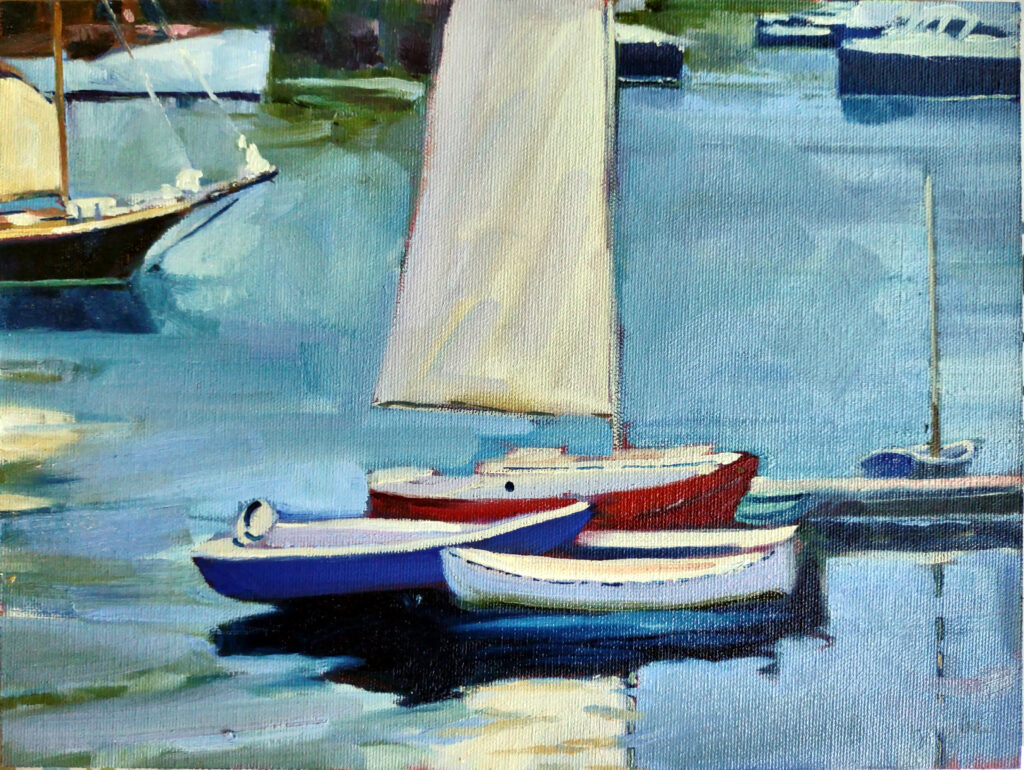
Larky Morning at Rockport Harbor, 11X14, on linen, $869 unframed includes shipping in continental US.

Places also carry an imprint of history. None of us are old enough to have hauled up cod onto the icy decks of schooners that plied the Grand Banks. However, we understand their importance, and are happy to see them, restored and resting in our harbors.

Not all these paintings are from Maine, because I don’t always paint here. But they’re all of things I think of as universal archetypes from the past. That’s our collective home.

Artists like me are, of course, terrible offenders at promoting collective nostalgia. We don’t do that cynically, or manipulatively. Like everyone else, we feel the pain of loss and change, so we paint what’s disappearing.

Please join me on May 31, from 4-7 PM for the opening of Letters from Home, at my gallery at 394 Commercial Street, Rockport, ME.

Evening in the Garden, 9X12, oil on archival canvasboard, $869 framed includes shipping and handling in continental US.

Registration is now open for workshops in 2026! Reserve your spot:

Can’t commit to a full workshop? Work online at your own pace:
Seven Protocols for Successful Oil Painters

Monday Morning Art School: how to prepare for your first art show

Île d’Orléans waterfront farm, 8X10, oil on archival canvasboard, $522 includes shipping and handling in continental US.

A student in one of my classes has been painting lovely small studies of birds. For the past two weeks, I’ve been musing on how she might display and sell them in her Brooklyn, NY, neighborhood. It turns out I’m not the only person who thinks she’s ready; she was just asked to mount her first show. We’ve had a lot of back-and-forth as she’s gotten things ready.

My first art show was in high school, when I could happily leave the prep to the grown-ups. For many years, I overprepared, with too much inventory and refreshments. I hope I’ve learned to be more balanced, but my Italian grandmother will peek out now and again.

How to prepare for your first art show

In honor of my student Amy, I’ve put together a list of questions I think are important. If you’re trying to figure out how to prepare for your first art show, I hope this helps.

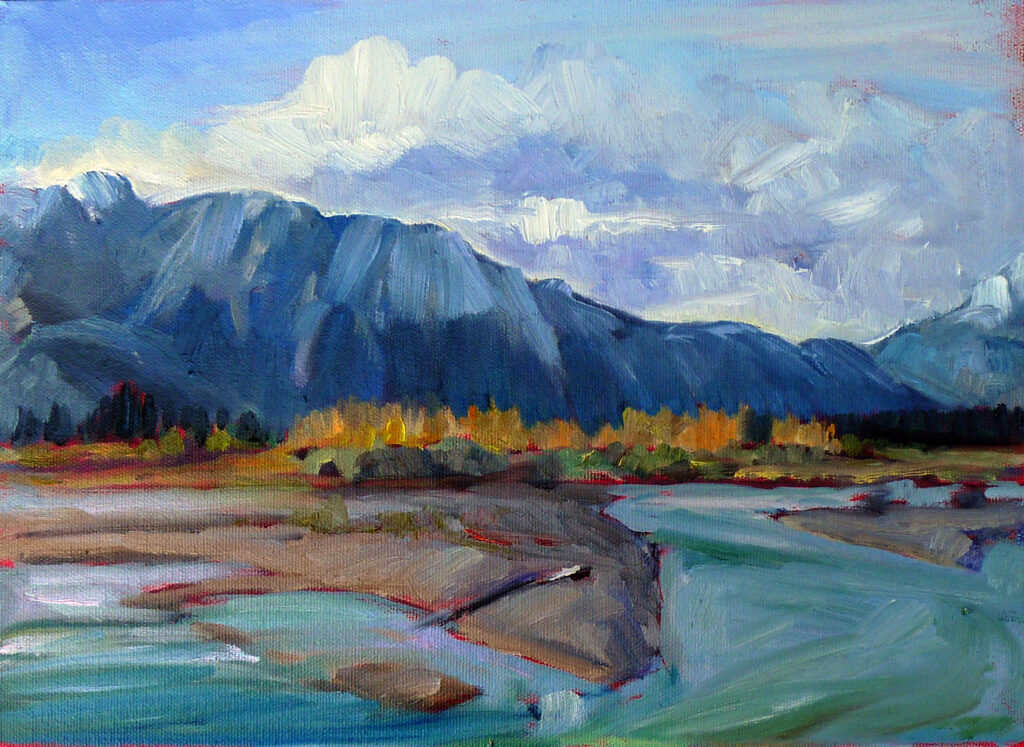
Athabasca River Confluence, 9X12, $696 includes shipping and handling in continental US.

Where should a beginning artist aim to show their work?

Approach coffee shops, professional offices and libraries to see if they would be interested in showing your work. Please don’t think of these places as down-market. I have had long, successful relationships with them, and they’ve resulted in better sales than some galleries.

How should you approach them? While galleries generally want you to apply online in 2025, that is too much to ask of a local business. The best way to approach them is in person. Follow that up by emailing them images of your work. Some kind of web presence is necessary, even if it’s a one-page free website. And you need a business card.

Assuming you’re not a hermit, you know people—at the Y, in your church, at the coffee shop you visit every day, at your local am-dram, your hometown library, at the dentist. Don’t hesitate to ask your connections.

Pensive 8X10, oil on archival canvasboard, $522 includes shipping and handling in continental US.

How many pieces do you need for an art show?

First off, don’t even go looking unless you have a solid body of work. I don’t mean work that you necessarily want to show, but a body of work with some depth that can be mined for content.

How much you need for a specific, thematically-related show depends on how large the space is and whether the work is to be hung salon-style or in a more open, contemporary way. When you visit the space, bring a tape measure and take photos. If they already have work up, count the pieces and compare the sizes to yours.

How should you choose a theme or title for your show?

That should derive naturally from your work, but if it isn’t, perhaps you could enlist a friend to help you narrow down the major themes of your work. “Historical landscapes” is a boring theme, but “Memories of Bad Old Butchertown” might be just roguish enough to draw people in.

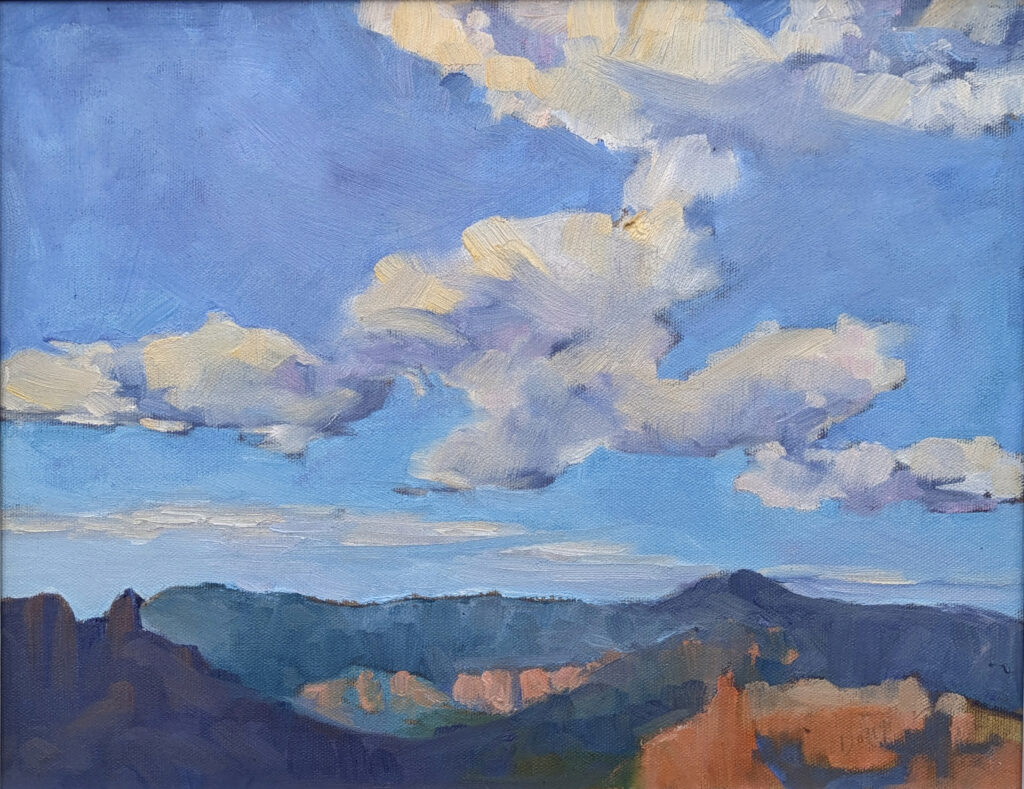
Maynard Dixon Clouds, 11X14, oil on archival canvas board, $869 includes shipping in continental US.

Should the work be framed?

In a perfect world, yes. Paintings generally look and sell better in frames. However, give people the option to buy them without frames at a slight discount.

I realize frames are expensive and annoying, but they really do sell paintings.

Should the work be signed?

Yes.

How do you label the work?

Label each painting with the title, dimensions, medium, price, and your name. These labels should be typed. I have created a blank you can download. If you know how to use Microsoft Office, you can merge these from a list; if not, you can just type in the information. Print them on card stock, trim them to be 2×3.5”, and Bob’s your uncle.

Who should you invite?

Absolutely everyone you know. You’ll be amazed at who’s interested.

Twenty minutes you won’t regret wasting

This is a fabulous short video by the National Gallery on 14th century Siena and the invention of painting.

Registration is now open for workshops in 2026! Reserve your spot:

Can’t commit to a full workshop? Work online at your own pace:
Seven Protocols for Successful Oil Painters

What is the purpose of art?

Old Wyoming Homestead, 9×12, oil on archival canvasboard, $696 unframed includes shipping and handling in continental US. In their spare time, Jane and her husband restored this place.

Yesterday I had a long drive and conversation with artist Jane Chapin about what we’re doing and why. You’d think at our ages we’d long ago figured out the purpose of art. However, that is a constantly-shifting question.

For a long time, painting is a question of mastery. Later, it becomes a question of meaning. For artist and collector alike, the purpose of art can be elusive.

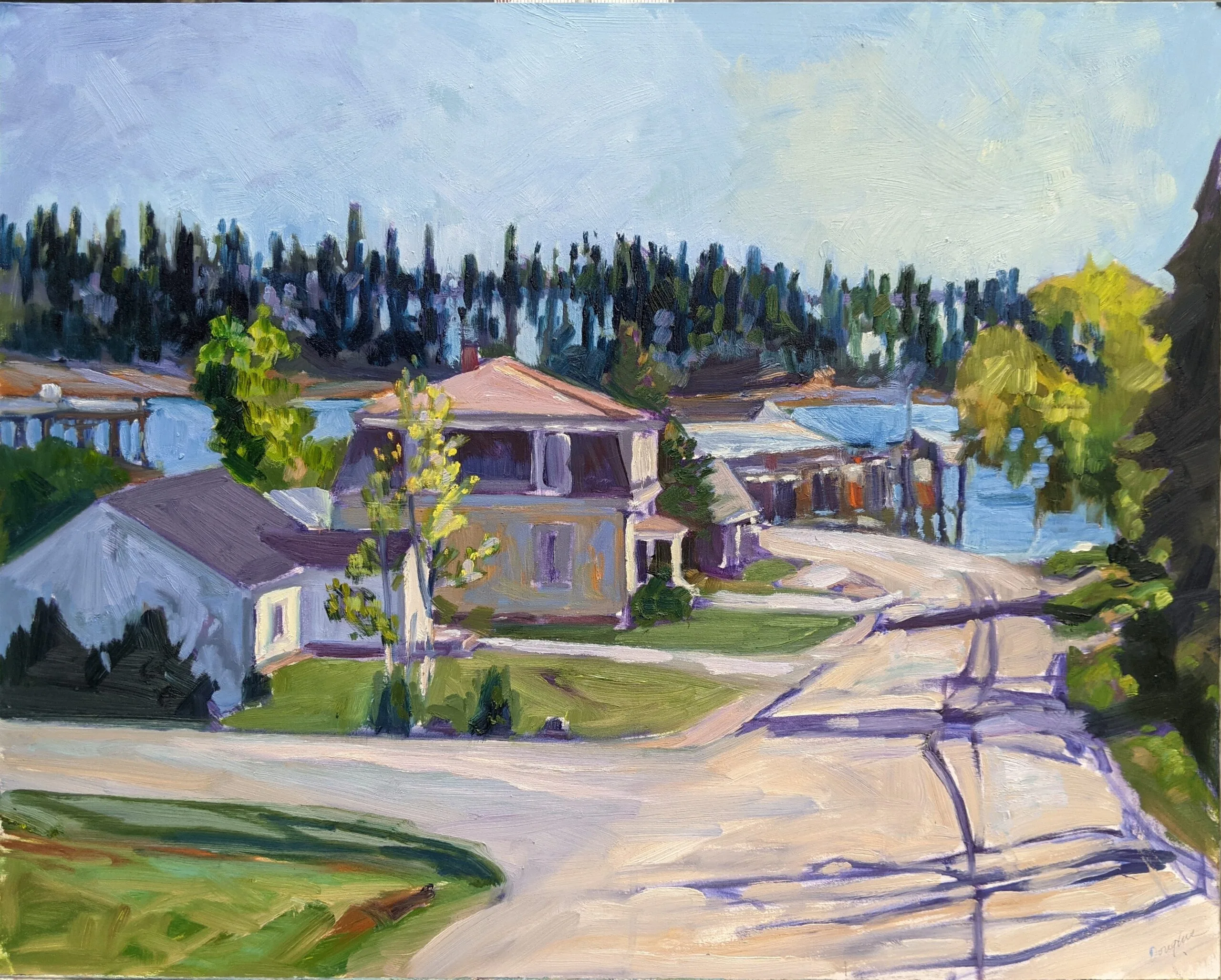
Main Street, Owl’s Head, oil on archival canvasboard, $1623 includes shipping and handling in continental US.

What is art, anyway?

I like to say that fine art is anything that’s made without any practical purpose whatsoever; a game with one active and many passive players. Art is, after all, just one expression of human creativity, imagination and skill.

Does that mean art doesn’t necessarily have a purpose?

Art doesn’t always have a practical purpose, but it almost always has a function. That might be emotional, intellectual, aesthetic or cultural. Its function may even be to defy or question the idea of purpose.

It’s more likely that art does have a broadly-defined purpose. That could be the expression of ideas, experiences, or even propaganda. Art plays a large part in our shared shaped identities, which is why we can so frequently identify the socioeconomic and ethnic background of people just by looking at pictures on their walls. And art influences people’s emotional states.

Lobster pound, 14X18, oil on canvas, $1594 framed includes shipping and handling within the continental US.

What is my art supposed to do, anyway?

This is the question I found myself batting around with Jane. It’s no longer enough to paint beautiful landscapes; I’ve got another itch in there to be satisfied.

Of course, art is not supposed to do anything in particular—its function varies across time, cultures, and personalities. But periodically I need to ask:

  • Am I trying to express inner feelings, thoughts or memories?
  • Am I trying to communicate ideas? If so, can I put them into words?
  • Or, am I trying to deliver messages that might be hard to express with words alone?
  • Am I trying to evoke an aesthetic or sensory response?
  • Am I trying to go where nobody has gone before? If so, how?
  • Am I trying to be disruptive or subversive?

Of course, artists can be trying to do more than one of those things at the same time. Right now, I’m debating how I rank those goals in importance to me. How would you rank their importance to you?

Owl’s Head, 11X14, oil on archival canvasboard, $1087 framed includes shipping and handling in continental US.

Why do people hang art on their walls?

Years ago, I painted a series on misogyny. I learned an important lesson: most people don’t want huge pictures of abused women on their walls. While there’s a place for intellectual paintings, some subjects are not going to attract buyers.

In my experience, the main reasons people buy paintings is that the work resonates with them aesthetically and they have an emotional connection with it. (That’s why landscape is so important to us.) Following that, art is a way to express one’s identity, tastes and values. It can be a cultural and social signifier (for those who think that way). Yes, art can be a décor item. For some of us, it’s aspirational; we hope to paint like that person someday.

I have a lot of original art in my house and most of it is, frankly, sentimental—paintings by people I know and admire, or places I love, or of my kids. None, I’m happy to say, is there to cover up marks in my walls.

Registration is now open for workshops in 2026! Reserve your spot:

Can’t commit to a full workshop? Work online at your own pace:
Seven Protocols for Successful Oil Painters

What’s wrong with the internet?

Back It Up, 6X8, oil on archival canvasboard, $435.

“Consulting a website on my phone recently, I was struck by how painful it has become to use the internet. All I wanted was to read some local news and check the spread of a power cut in my area. Instead, as I scrolled, I was assailed by interruptions from integrated adverts which – in the best case – wanted eagerly to tell me about the charm and usefulness of a new BMW. In the worst case, I was urged to consult some lawyers immediately because I had been mis-sold an insurance or financial product in the past and was due an enormous payout, if only I would contact the least credible-looking advocates in the country…” (James Snell, How the Internet Turned Ugly)

I was an early and enthusiastic convert to the internet, and this blog is ancient by modern communications standards. But my distrust mounts more and more. We build this website using WordPress, which is a pretty sophisticated publishing system. We should be able to control what you see when you look at this blog. But that’s becoming more and more difficult, and we’re debating killing advertising forever. (It offsets our hosting costs, nothing more.)

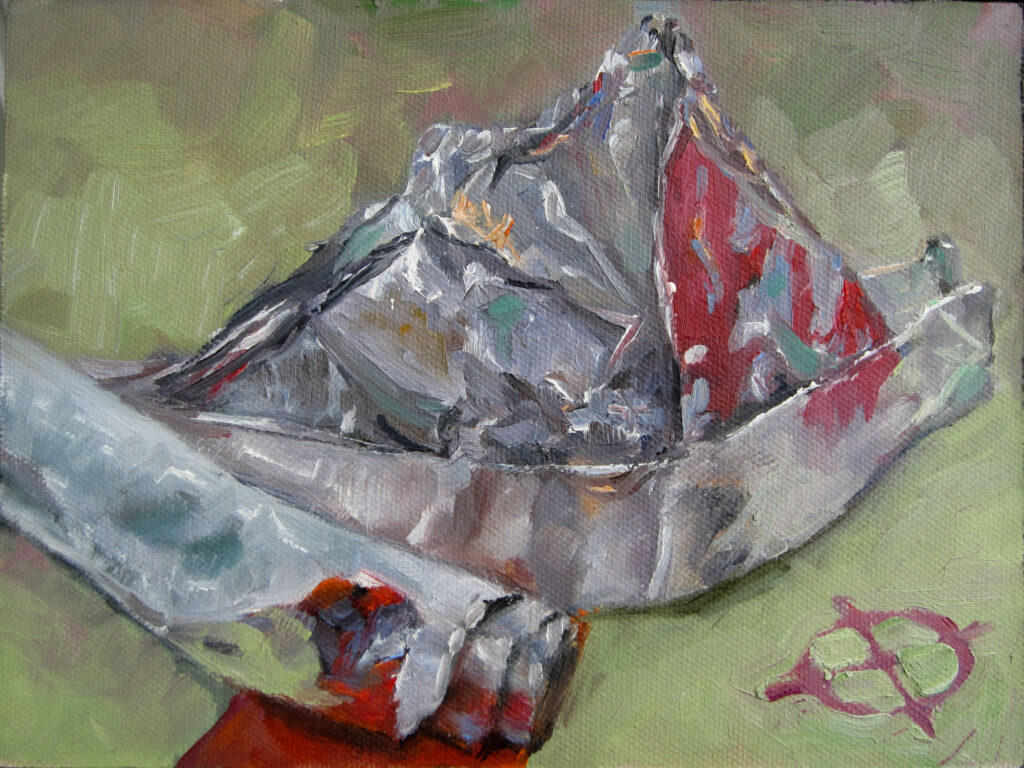
Tin Foil Hat, 6X8, oil on archival canvasboard, $435 includes shipping in continental US.

If you’re a regular commenter, you may have noticed your comments swallowed up in the ether recently. My host and software are good about repelling cyberattacks, which happen periodically. Recently, however, we’ve been getting flooded with bot-comments linking to spurious websites. While they couldn’t be published until I okayed them, they were burying real comments in a sea of goop. Protecting against this kind of stuff takes time and energy away from painting.

Then there are the bogus ‘offers’ to buy my work as either NFTs or with fake cashier’s checks. I used to get two or three a year. Now I get a dozen a day. I delete them, of course, but they clog up my communications channels.

The worst offender, platform-wise, is Facebook. We used to have intelligent conversations about art and culture there. Now any real discourse is buried in promoted posts and advertising.

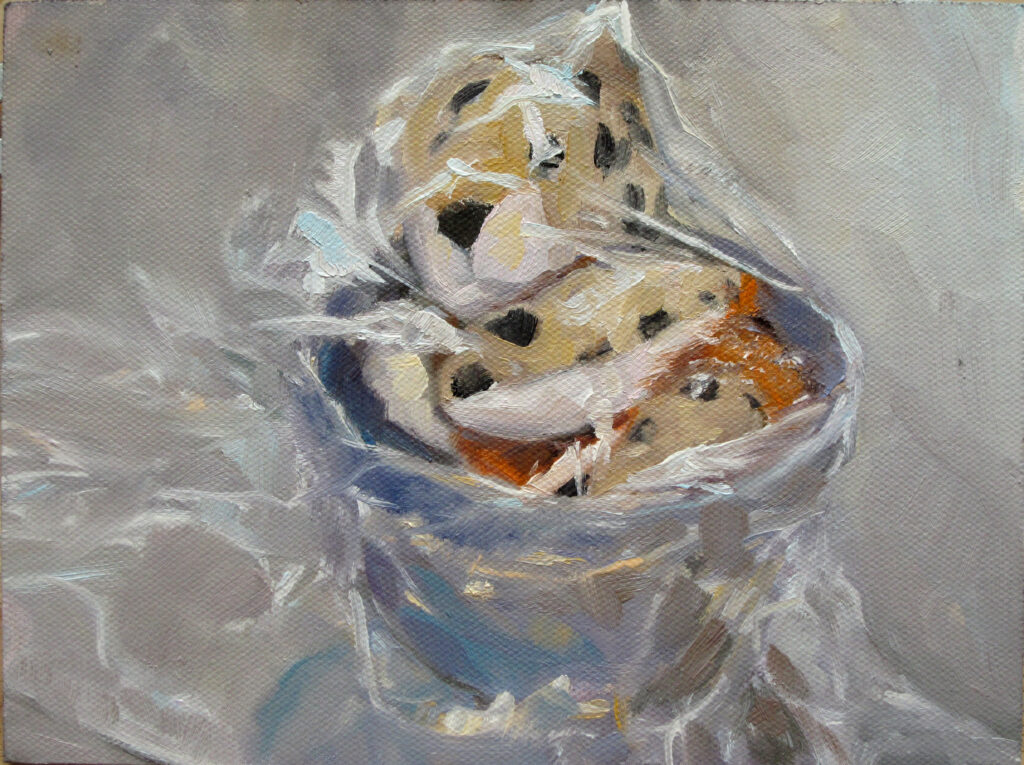
Stuffed animal in a bowl, with Saran Wrap. 6X8, oil on archival canvasboard, $435.

What’s wrong with the internet?

Much of the internet is now driven by ads, clickbait, and monetization schemes. All bloggers understand search-engine optimization (SEO) driven content; it’s how search engines work. But SEO also floods search engines with low-quality, repetitive results. And social media platforms prioritize engagement over accuracy and depth. That’s why all our writing tools have reading-level gauges; heaven forbid we use language that forces the reader to think.

You might imagine you’re surfing the web for stuff that interests you, but content discovery is at the mercy of computer algorithms. You see what those platforms want you to see, not what’s most valuable or relevant.

Niche blogs like this one are a dying breed. We just don’t pack enough punch to compete with centralized platforms. I have a big readership for a painting blog, but it’s a mere flyspeck compared to modern influencers. The answer for many creatives has been to go to Substack, which is a subscription-based newsletter model. That would be a departure from my original model, which, sadly, might be obsolete.

Baby Monkey Riding on a Pig, oil on archival canvasboard, $435.

Do you see this blog on a social media platform?

If so, you might want to take a moment to subscribe, at top left. I’ve spent twenty years not thinking overmuch about email as a means of dissemination, but in the current state of social media platforms, I don’t trust them to deliver fair, free content. Neither should you.

Registration is now open for workshops in 2026! Reserve your spot:

Can’t commit to a full workshop? Work online at your own pace:
Seven Protocols for Successful Oil Painters